Make your team AI literate, and show how you did it.
Sooner or later someone will ask which measures your organisation took for AI literacy. After this training your team works differently with AI, and you have it in black and white.
Still exploring? Start with why people don't use the AI they already have: the free guide 10 biases in AI adoption.

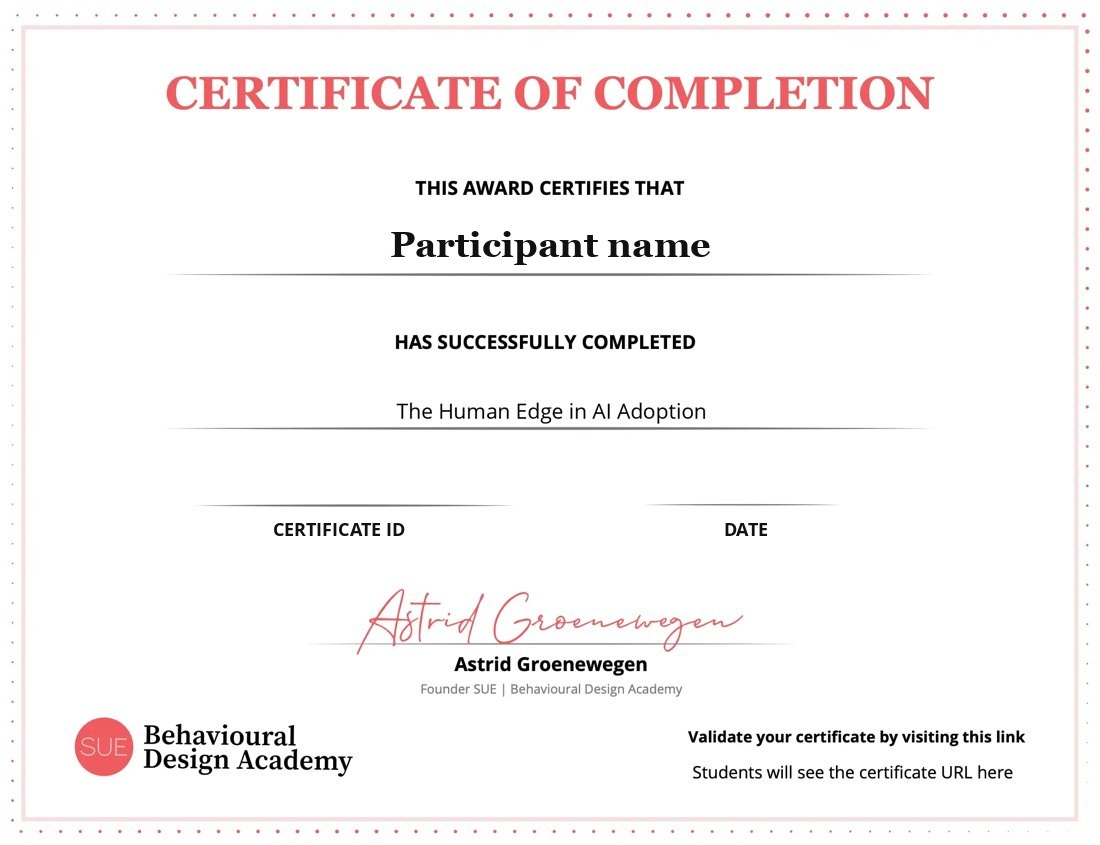
 Afterwards: a certificate for every participant and an overview for your AI policy
10,000+ professionals trained, including people from




Article 4 asks for measures. Make sure you can show which ones.
Since 27 July 2026, Article 4 of the EU AI Act has required providers and deployers of AI systems to "take measures to support the development of AI literacy of their staff and other persons dealing with the operation and use of AI systems on their behalf". In doing so they take into account technical knowledge, experience, education and training, the context of use, and the persons on whom the AI is used.
The law adds that this obligation "does not require providers or deployers to guarantee any specific level of AI literacy of any individual". It does not prescribe a set training, test or certificate either. What counts are the measures you take, and being able to show which ones they were.
Source: Regulation (EU) 2024/1689, Article 4, amended by Regulation (EU) 2026/1744 of 8 July 2026. In the Netherlands, the Dutch Data Protection Authority supervises algorithms and AI.
What you take away: the overview
After the training we give you an overview of who took which part, with the programme attached. This is what it looks like:
- What it isFor each participant, which parts they took and whether they earned the certificate.
- What forYou add it to your AI policy, so you can show which measures you took.
Everyone knows, and still someone pastes client data into a chatbot on a Friday afternoon.
Whoever has to finish a report by half past four takes the first answer. Not because they don't know better, but because the situation doesn't lead them there. That is why your team practises with tasks from their own work.

They check what comes out.
They notice when an answer sounds too good and check it, instead of passing it on.
They direct the AI.
They give context and ask follow-up questions, and get something back that fits their own field and client.
They see where AI goes wrong.
Invented sources, average answers, bias: they recognise it and know when AI is not the right tool.
They handle data safely.
They know what doesn't belong in a chatbot, and what to do instead.
One day together, then everyone in their own work.

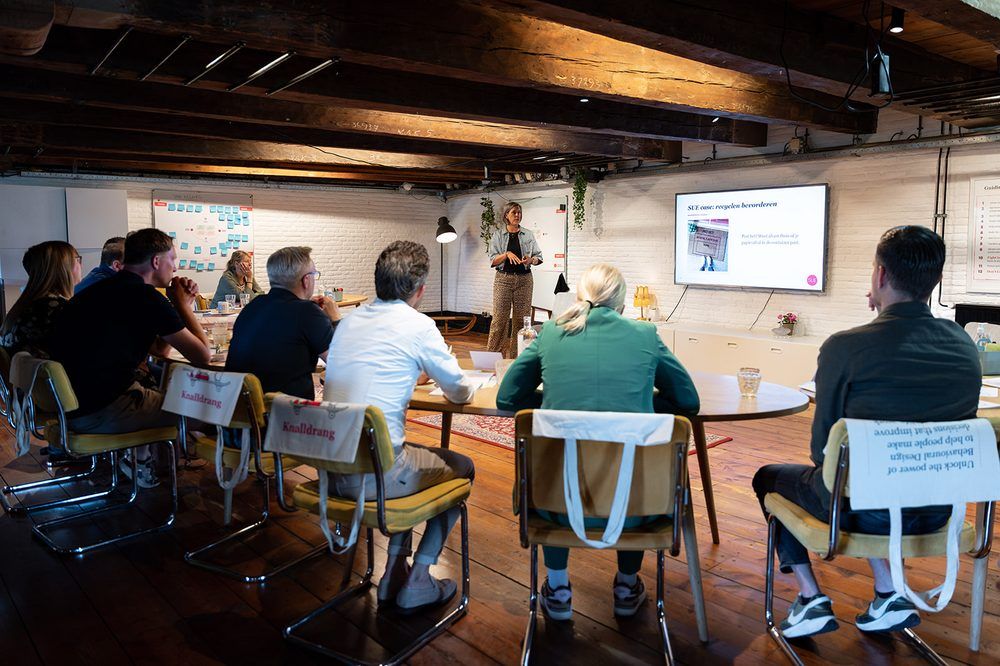
The day
One live day, at your place or ours in Amsterdam. Your team works on real tasks from their own work.

The online course
Everyone takes the 12 lessons of The Human Edge in AI Adoption at their own pace, and receives a certificate on completion.

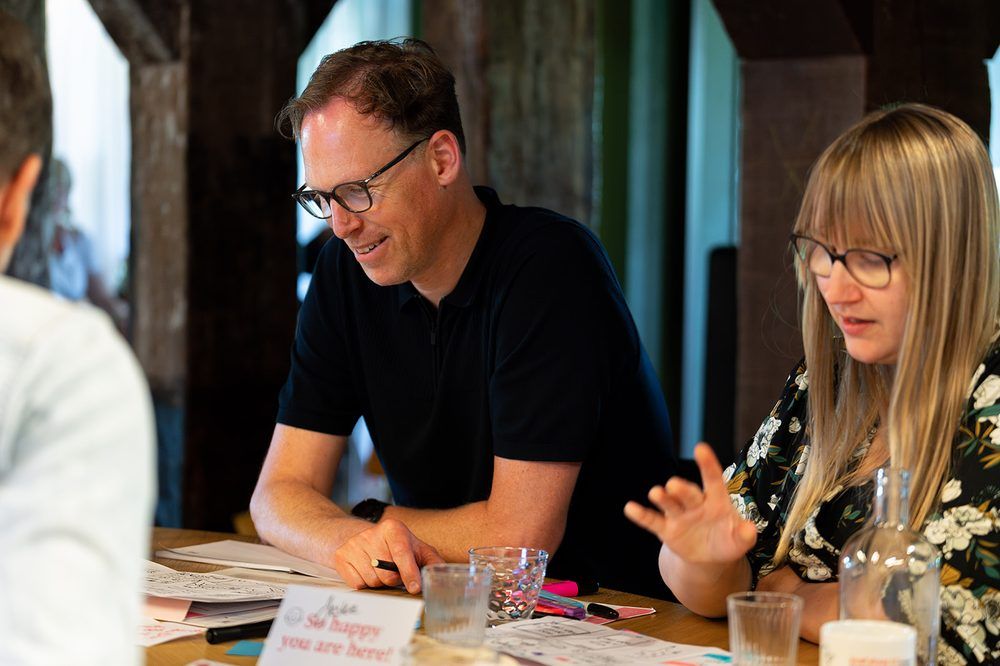
The follow-up
Two hours, virtual, a few weeks later. What works, where it gets stuck, and what you still change.
The Mentor
Everyone keeps the SUE Behavioural Design Mentor, which works in ChatGPT, Claude and Copilot.
For teams of up to 16 people. With more people we put together a proposal for several groups. No technical knowledge needed.
What people ask before they request a proposal.
Is AI literacy training mandatory?
The training itself is not, but measures for AI literacy are. Article 4 of the AI Act asks organisations that use AI to take measures that support the AI literacy of their people. Which measure you choose is up to you. Training is the most common one, because afterwards you can show what you did.
There are free e-learning courses. Why this one?
For basic knowledge they are fine. What they don't do is let your people practise with their own work and come back to it a few weeks later. That is the difference between knowing what can go wrong and doing it differently.
What does the training cost?
For a team we put together a proposal that fits the group size and the location. If you are looking for yourself only, the online course The Human Edge in AI Adoption costs €690 ex VAT.
Do participants get a certificate?
Yes. Everyone who completes the online course The Human Edge in AI Adoption receives a personal certificate. You also receive an overview of who took which part, with the programme attached.
Who in my organisation needs to be AI literate?
The law names staff and other people who use AI systems on behalf of your organisation, including standard tools such as ChatGPT or Copilot. You take their knowledge, experience and the context in which they use AI into account.
My team isn't technical. Can they take part?
Yes. No prior knowledge is needed. Working with AI is a matter of language and judgement, not code. Anyone who has ever opened ChatGPT or Copilot can join.
Can the training take place at our offices, and with more than 16 people?
The live day can be at your place or ours in Amsterdam, and the follow-up session is virtual. A group has up to 16 people. If there are more of you, we put together a proposal for several groups.