Over the past few years we have guided dozens of organisations through major change challenges. And the pattern is almost always the same. The change management plan is solid. The communication is clear. The leadership commitment is there - at least on paper. Three months later, almost nothing has changed. But nobody says so. Because everyone has done their best.
I say this including myself. I have lived through this pattern from the inside. And I think almost everyone who takes change management seriously recognises it. It is not down to the people. It is not a lack of will. It is down to how we think about behaviour change.
This article is not an attack on classical change management. Kotter, ADKAR, Lewin - these are valuable frameworks that provide good structure. But they miss the behavioural layer. And that behavioural layer is precisely where effective change management comes unstuck.
Why change management as a method is incomplete
Kotter's 8-step model focuses on creating a sense of urgency, building coalition and institutionalising change. ADKAR calls for awareness, desire, knowledge, ability and reinforcement. Lewin's freeze-change-refreeze model brings structure to the phases of change. All valuable - and all focused on process and communication.
But here lies the blind spot: all these models assume that people resist because they do not understand the change or do not believe in it. Communicate clearly enough, involve people early enough, demonstrate credible leadership - and it will work.
Behavioural science shows something different. People often understand the change perfectly well. They even believe in it. And yet they do not change. Because change does not fail at the level of conviction - it fails at the level of behaviour. And behaviour is largely driven by forces we rarely consciously notice.2
Change does not fail because people do not want it. It fails because the new behaviour is harder than the old.
Want to explore the fundamental tension between these two worlds more deeply? Read Behavioural Design vs Change Management: the core - a comparative article that places the two approaches side by side.
The behavioural science diagnosis of change
Imagine: a large healthcare organisation wants its managers to adopt a more coaching style of leadership rather than a directive one. The policy has been set. The training has been planned. The communication has been taken care of. Six months later, HR reports that there is "little visible behaviour change."
The classic response: more communication, tighter steering. The behavioural science question is different: What forces are keeping managers anchored in their current directive leadership style?
For this we use the SUE Influence Framework - a diagnostic model that maps the four forces that determine whether people will move or not.4
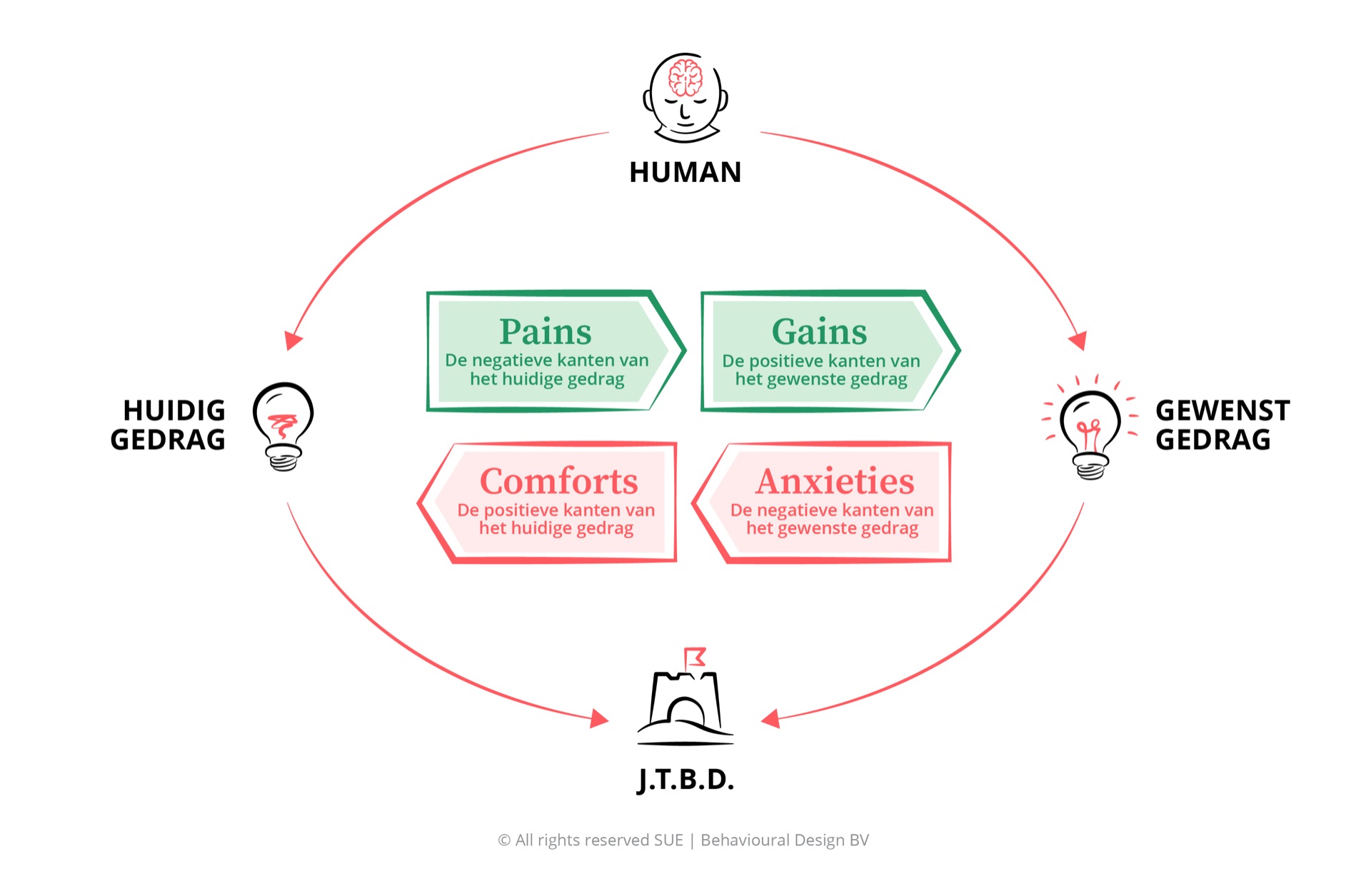
Applied to our coaching leadership case:
- Pains: Managers notice that their team shows little ownership, that problems keep landing with them, that they are overloaded by operational questions that really belong with team members.
- Gains: If it works, team members will become more independent, the manager will feel less like the go-to desk for all problems, and the team will perform better.
- Comforts: The directive style works. It gives control. It gives certainty. It is what made them successful. It fits how colleagues and superiors see them. In short: why would they stop doing what works?
- Anxieties: What if team members cannot handle the autonomy they are given? What if my manager sees this as a loss of grip? What if I am not good enough at this new style? What will my fellow managers think?
You can immediately see where classical change management falls short: it addresses the Pains (by creating urgency) and the Gains (by communicating benefits). But it barely touches the Comforts and Anxieties. And that is exactly where the resistance lives.
You do not change behaviour by working on behaviour. You change behaviour by designing the forces that drive it.
The most underestimated force: comforts
In virtually every change programme I have seen, removing Anxieties is central. Fear of the unknown, fear of incompetence - change managers recognise these as barriers to overcome. And they are right.
But Comforts are systematically underestimated. And that is understandable, because Comforts do not feel like resistance. They feel like normality. They are the invisible forces that make current behaviour pleasant, self-evident and effortless.
What are those Comforts in concrete terms within organisations?
- Habits: The way meetings are run, how decisions are made, how information is shared - all of that is automated behaviour that costs little energy.
- Expertise identity: People are good at what they do. The change asks them to become something new. That is not just a learning challenge - it is an identity question. "Am I still the expert if I display this new behaviour?"
- Social norms: How do my colleagues do this? What is normal here? If everyone is still working the old way, it costs a great deal of social energy to be the only one displaying the new behaviour.
- Reward systems: If people are assessed and rewarded on behaviour that runs counter to the desired change, then Comforts are systemically embedded.
Kurt Lewin - on whose work the Influence Framework is partly based - already demonstrated that the most effective strategy for change is not strengthening the driving forces (more communication, more pressure), but weakening the restraining forces.3 And Comforts are by far the strongest restraining force.
This means: people do not choose the status quo because they are lazy or change-fatigued. They choose comfort over effort because that is rational. If you want effective change management, you need to make the new behaviour just as comfortable as the old.
What actually works: change management as behavioural design
Once you have completed the Influence Framework analysis - and only then - it is time to design interventions. For this we use the SWAC model: four levers for behaviour change that together form a complete design.
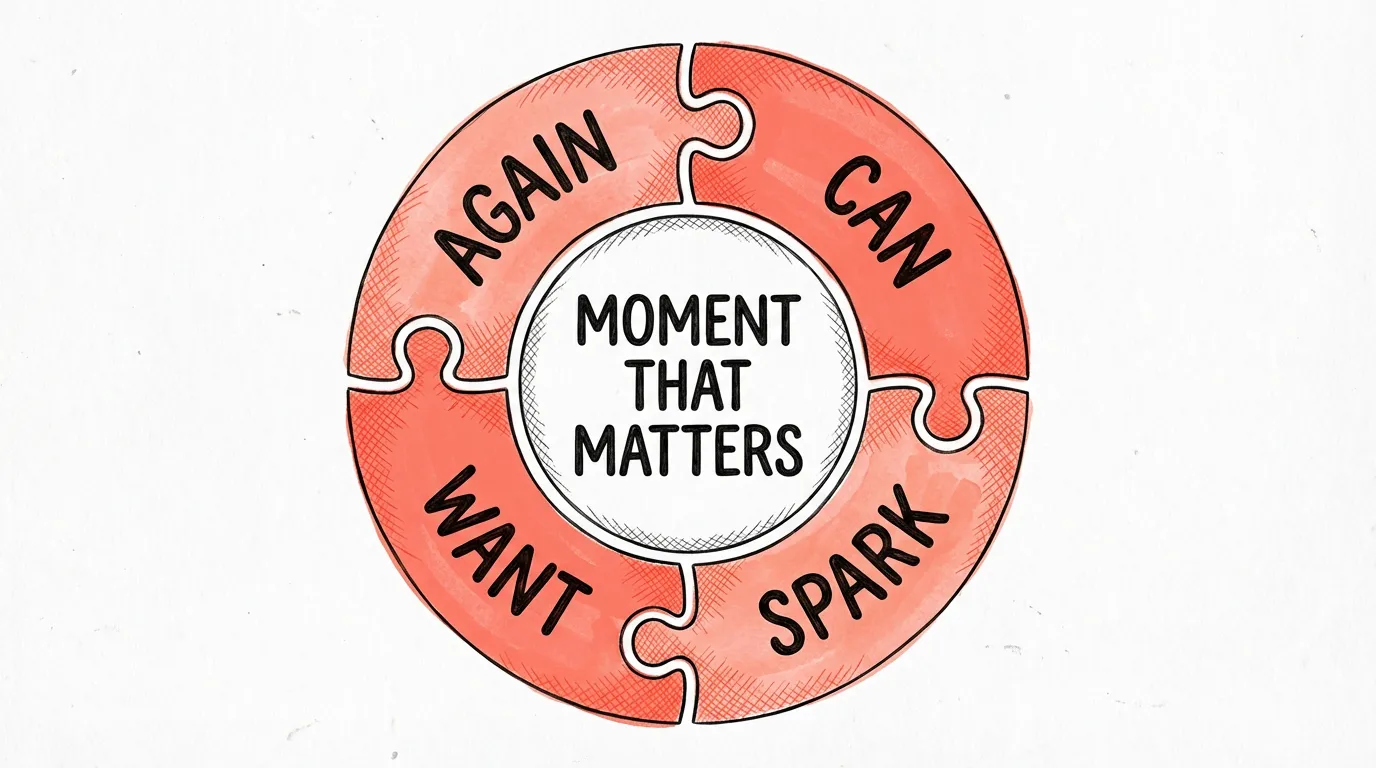
CAN: make the new behaviour easier
The best approach is not to push someone into the new behaviour, but to guide them into it. That starts with drastically reducing the friction of the new behaviour.
Concretely: if you want managers to hold coaching conversations, give them a conversation structure of three questions they can literally follow. Make it so simple that it costs less energy than their current pattern. Design defaults: ensure the new behaviour is the path of least resistance, not an extra step on top of everyday work.
Another example: if you want employees to use a new system, remove the old system. Not as a punishment, but as behavioural design. As long as the old one is available, it costs mental energy to choose the new one.
WANT: capitalise on moments of readiness
Willingness to change is not constant. There are moments when people are more open to new behaviour: a new role, a team change, a peak of frustration, the start of a quarter. These are the "fresh start" moments that behavioural science identifies as ideal entry points for behaviour change.
Effective change management is alert to these moments and attaches interventions to them. Not a generic communication moment, but a specific conversation or action at the moment when someone is ready for it.
Also use the social proof of early adopters who are respected in the organisation. People do not follow abstract communication - they follow people they trust and admire.2
SPARK: design trigger moments
Behaviour is not changed by training days alone. New behaviour needs triggers: contextual cues that activate the new behaviour at the right moment.
Think about redesigning the weekly team meeting so that it structurally opens with a coaching check-in. Or adjusting the physical workspace so that informal conversation spaces invite the kinds of conversations you want to encourage. Or a simple digital reminder that asks at the right moment: "What did you do today to help a team member grow?"
Triggers are the hinges of habit. Anyone who wants change to stick designs those hinges deliberately.
AGAIN: build repetition into the system
New behaviour needs repetition to become a habit. But most change programmes invest in a kick-off and forget the follow-through. One-off training sessions, grand launch events, inspiring speakers - they create short-lived motivation without lasting behaviour change.
Effective change management designs spaced learning into the system: weekly reflection moments, monthly peer sessions, quarterly check-ins where the new behaviour is made visible and celebrated. Not as control, but as ritual - because rituals are the architecture of habits.
The role of change managers in behavioural design
What changes for the change manager when you adopt this perspective? Everything, really.
The classical change manager thinks in terms of communication planning: who needs to know what and when, how do we build buy-in, how do we manage resistance. These are all above-the-waterline questions. The behavioural designer thinks in different terms: what makes the new behaviour difficult? What keeps people anchored in the old behaviour? How do we design the context so that the new behaviour becomes easier than the old?
The shift is from "how do we explain this?" to "how do we make this easy?"
That requires different questions in the diagnostic phase:
- What is the current behaviour we want to change, and what is the desired behaviour? (As concrete as possible - no abstractions like "more ownership", but: which three behaviours do we see when ownership is present?)
- What are the Comforts keeping people anchored in the current behaviour?
- What are the Anxieties about the new behaviour - including the unspoken fears?
- What makes the new behaviour harder than the old right now? What friction can we remove?
- Who are the early adopters that others will follow?
These are the questions that elevate a change programme from good to transformative.
Want to read more about how to genuinely engage employees in change? Read Engaging employees in change.
Five behavioural principles for effective change management
If I were to summarise the insights from this article in five principles, they would be these:
1. Start with behavioural diagnosis, not communication planning
Before you communicate, map the forces at play. Use the Influence Framework to systematically uncover Pains, Gains, Comforts and Anxieties for each key audience in your change. This prevents you from communicating about things that are not the core problem for that audience.
2. Strengthen driving forces and weaken restraining forces
Most change programmes push via Pains and Gains. But Lewin's insight is that weakening Comforts and Anxieties is at least as effective - and often more powerful. Both movements are needed. Pushing on driving forces alone leads to resistance; removing restraining forces alone creates space without direction.3
3. Design defaults: make the new behaviour the easiest path
Simplicity eats willpower for breakfast. If the new behaviour costs more effort than the old, people - even those who genuinely want it - will fall back on the familiar. Design the context so that the new behaviour is the default, the pre-filled option, the automatic choice.
4. Use the social proof of respected early adopters
People follow people they trust and admire, more than they follow policy or communication. Identify the informal leaders at every level of the organisation - the people others look to - and invest in them first. Their behaviour carries more social proof than ten internal newsletters.
5. Build repetition into the system, not into campaigns
One-off interventions create one-off moments. Lasting behaviour change requires rituals: fixed moments at which the new behaviour is made visible, reflected upon and reinforced. These need not be large, time-consuming sessions. A recurring ten-minute check-in can produce more behaviour change than a biannual inspiration day.1
Conclusion: from change manager to behavioural architect
McKinsey has been reporting for years that 70% of all change programmes fail to achieve their intended results.1 As a change manager, you can feel demoralised by that - or you can ask the question that has rarely been asked until now: Are we missing the behavioural layer?
Classical change management is indispensable for structure, planning and stakeholder management. But without a behavioural science foundation it gets stuck at communication. And communication changes intentions, not always behaviour.
The organisations that truly make change stick are the organisations that design change as behavioural design: they start by understanding the forces that keep people anchored in the old, they make the new behaviour easier than the old, they capitalise on windows of readiness, they build repetition into the system.
That is not a revolutionary theory. It is simply looking carefully at how people really work - and then designing smartly.
Curious about what makes effective change management fail before it even gets started? Read Why change programmes fail and Reducing resistance to change.
Frequently asked questions
According to McKinsey, 70% of all change programmes fail. The most commonly cited reason is "resistance from people", but that is a misdiagnosis. The real cause is a context design error: the new behaviour is harder than the old, and the Comforts (habits, expertise identity, social norms) and Anxieties (fear of incompetence, loss of status, uncertainty) have never been actively removed. People often want to change - the situation makes it too difficult.
Traditional change management (Kotter, ADKAR, Lewin) focuses on process and communication: people do not understand the change, so communicate more and better. Behavioural design goes further: people often understand the change perfectly well, but the new behaviour is harder than the old. Behavioural design reduces the friction of the new behaviour and strengthens motivation by addressing the unconscious forces that drive behaviour. The two approaches do not exclude each other - they reinforce each other.
Use the SUE Influence Framework to map the four forces: Pains (what is not working in the current situation?), Gains (what are the real benefits of the new behaviour?), Comforts (what keeps people anchored in the old behaviour?) and Anxieties (what do people fear about the change?). Only then apply the SWAC model: make the new behaviour easier (CAN), capitalise on moments of readiness (WANT), design trigger moments (SPARK) and build repetition into the system (AGAIN). Always start with diagnosis - never with intervention.