Burnout rates in Europe are at a record high. Organisations know this. There are wellbeing budgets, online portals, mindfulness workshops, cycle-to-work schemes, and resilience coaches. And yet absenteeism keeps rising. The share of employees who feel chronically exhausted keeps growing.
Most sustainable employability programmes rest on a flawed assumption: that it is a question of awareness and motivation. If employees only understood how important their health is, they would act on it.
They don’t. Behavioural science explains precisely why, and offers an approach that works. The lever is not the individual. It is the context.
Sustainable employability is the capacity of employees to work in a healthy, motivated, and productive way now and in the future. Most programmes try to achieve this through awareness and motivation. Behavioural science shows this is fundamentally the wrong lever: 96% of behaviour runs automatically, driven by the surrounding context. You don’t design sustainable employability through policy. You design it by building an environment where healthy work becomes the path of least resistance.
What is sustainable employability?
Sustainable employability means different things to different people. For some, it is about physical and mental health. For others, career development. For others still, engagement, adaptability, or job satisfaction.
A useful working definition covers three dimensions. First, health: physically and mentally fit enough to do the work. Second, motivation and engagement: the willingness and capacity to contribute. Third, adaptability: the ability to move with changes in work, role, and organisation.
What connects all three is that they are not about the absence of problems. Sustainable employability is not a zero point. It is active, positive functioning - now and over time. Work that generates energy rather than depleting it.
That distinction matters for how you design it. Most HR programmes target the bottom: reduce absenteeism, prevent burnout, minimise turnover. That is necessary but not sufficient. Sustainable employability means building the conditions under which people can function well over the long term - not just avoiding the worst.
Why sustainable employability programmes so often fail
The pattern is familiar. An organisation identifies a problem with vitality or absenteeism. A working group forms. A programme is designed. Trainings are offered, a portal is launched, a campaign rolls out. Six months later, the numbers have barely moved.
This is not an exception. Research consistently shows that the large majority of workplace wellbeing programmes produce no significant improvement in sustainable employability in the short term. The intentions are good. The approach is not.
Three widespread misconceptions explain why most programmes underperform.
The first is the willpower myth: the belief that employees can change behaviour through discipline. They can, but only briefly. Willpower is finite. When it runs out, people revert to the automatic routines their environment supports.
The second is the individual focus fallacy: the assumption that sustainable employability is a personal project. But behaviour is more than half determined by social and contextual factors. The workload an employee experiences, the culture that normalises overwork, the meeting schedule that destroys focus time: these are organisational problems, not personality problems.
The third is the quick-fix fantasy: the expectation that a training or campaign produces lasting behaviour change. On average, it takes 66 days for a new behaviour to become a habit. No one-off intervention comes close.[1]
Simplicity eats willpower for breakfast.
The fundamental problem is that most programmes focus on WANT: motivating people and raising awareness. The real lever is CAN: designing the environment so that the desired behaviour is easier than avoiding it.
The behavioural science behind sustainable employability
Applying the SUE Influence Framework to sustainable employability immediately reveals what is actually happening for employees.
The Influence Framework maps four forces that determine whether people change behaviour or stay where they are. Two forces push toward change: pains (what hurts about the current situation) and gains (what the desired situation offers). Two forces hold people back: comforts (the benefits of current behaviour) and anxieties (concerns about new behaviour).
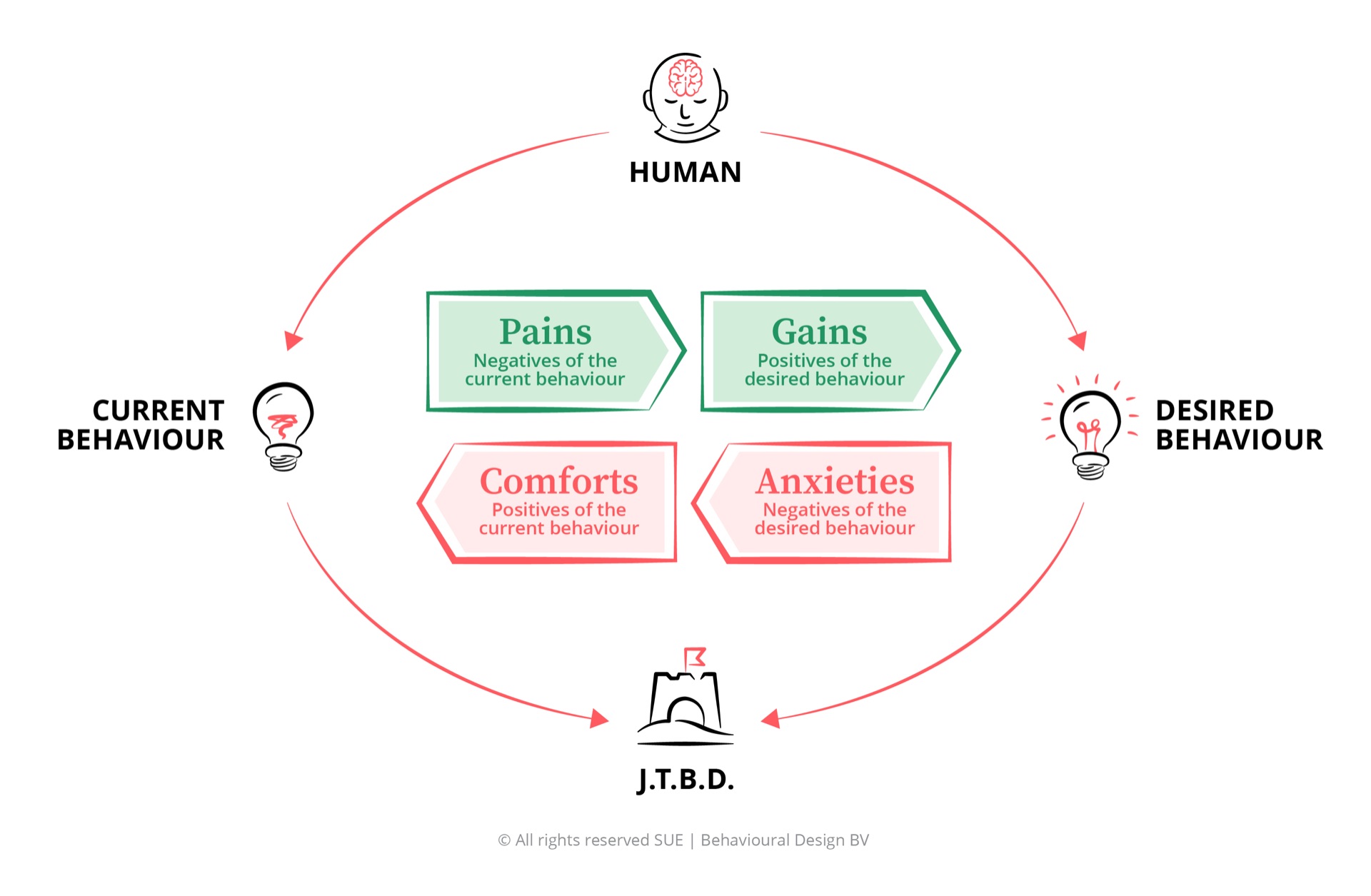
For a typical employee in a busy organisation, it looks like this:
The pains are real: fatigue, loss of control over their own schedule, fear of longer-term breakdown. The gains are clear: more energy, more satisfaction, a longer and healthier career.
But then the restraining forces. The comforts of current behaviour are tenacious: the habit of working until everything is done, the unwritten rule that availability outside office hours is valued, the presence logic that leaving early looks lazy. These are not irrational choices. They are entirely logical given the context.
The anxieties are just as powerful: “If I start setting limits, I’ll stand out.” “That training costs time I simply don’t have.” “I don’t know if it will actually help me.” Even employees with the best intentions find their behaviour blocked by these concerns.
Most sustainable employability programmes address pains and gains: they try to convince employees that change is necessary and good. But the comforts and anxieties remain untouched. As long as they are intact, nothing changes structurally, however good the motivation campaign.
This is what Kurt Lewin, the originator of the Influence Framework, described in the 1940s: the most effective strategy for behaviour change is not strengthening driving forces but reducing restraining ones. Don’t push harder. Lower the resistance.
How to design sustainable employability in practice
Designing sustainable employability means shaping the context so that healthy behaviour becomes the path of least resistance. Not changing the person. Changing the environment.
The four happiness contexts from The Art of Designing Behaviour provide a concrete structure. They are simultaneously the building blocks of workplace happiness and the conditions for sustainable employability. Each requires specific context interventions, not communication campaigns.
1. Curiosity - a learning culture
Employees who are allowed to experiment, ask questions without knowing the answers, and make mistakes without being penalised stay motivated longer. They grow. They don’t disengage. Organisations build this by structuring learning time into the working week, defining what “experimenting” is allowed to cost, and designing team retrospectives around learning rather than accountability.
2. Flow - protected focus time
Constant availability is one of the biggest happiness leaks at work. Open-plan offices, Slack notifications, email pressure, meetings without agendas: they fragment the working day so completely that deep work becomes impossible. The solution is a forcing function - fixed quiet hours as a team agreement, not a personal choice. What applies as a team rule requires no individual willpower.
3. Skill - growth opportunities just outside the comfort zone
People who grow in their work are less likely to burn out. But growth requires challenge, and challenge requires safety to fail. Learning budgets are most effective when they are automatically available in January rather than accessible on application. An automatic default removes the threshold. Stretch assignments work when managers actively offer them and name the growth norm, not when employees have to take the initiative themselves.
4. Connection - psychological safety
Amy Edmondson’s research shows that psychological safety is the single most important factor in team performance, and in the wellbeing of individual team members.[2] Psychological safety does not emerge by itself. It requires explicit ground rules: what is allowed to be said, how do we respond to each other’s mistakes, how do we handle disagreement. Teams that deliberately design these rules consistently score higher on both performance and wellbeing than teams that hope things will “naturally work out.”
The pattern across all four contexts is the same: design structures that make the desired behaviour automatic. You do not need to persuade employees. You make it easy.
From policy to behavioural design
The difference between a sustainable employability policy and sustainable employability design comes down to one question: who carries the responsibility for behaviour change?
Policy places that responsibility on the individual. Design places it on the context. And context always wins over individual intention - that is what decades of behavioural science has established.
That does not mean employees have no personal responsibility. It means organisations stop expecting good intentions to be sufficient when the environment actively works against healthy behaviour.
You design sustainable employability by addressing the comforts and anxieties that block people, introducing CAN interventions that make healthy behaviour the easiest option, and building the four happiness contexts that allow people to function well over time.
The first step is not writing a new programme. It is understanding what is currently stopping employees. And that starts with asking the right questions - directly to the people involved, not to a survey platform.
Frequently asked questions about sustainable employability
What is sustainable employability?
Sustainable employability is the capacity of employees to work in a healthy, motivated, and productive way now and in the future, including through organisational change or career transitions. It goes beyond the absence of illness to encompass work that consistently generates energy and meaning.
Why do sustainable employability programmes often fail?
Most programmes focus on awareness and motivation: persuading people that healthy work is important. But 96% of behaviour runs on System 1, automatic and habit-driven. Information and training do not change automatic behaviour. Only a well-designed context does.
How do you design sustainable employability using behavioural science?
By applying the Influence Framework: map the comforts and anxieties that prevent employees from healthy behaviour, then design interventions that remove those barriers. Protected focus time as a team agreement, learning budgets available by default, and explicit ground rules for psychological safety are all context interventions, not communication efforts.
What are the building blocks of sustainable employability?
Four contexts determine sustainable employability: curiosity (a learning culture), flow (protected focus time), skill (growth opportunities), and connection (psychological safety). Each requires deliberate design choices, not good intentions.