Last year I spoke with an HR director who told me how proud she was of her organisation’s new work happiness programme. A beautiful dashboard. Monthly pulse surveys. A mental health app. Fruit on every floor. And she was right: on paper it was impressive. But when I asked what had changed in the way work itself was organised - how much autonomy people had, how well their tasks matched their strengths, how connected they felt to the direction of the organisation - there was a silence.
That is the problem with most work happiness programmes in organisations. They are beautifully packaged, but they do not address the causes. They measure work happiness. They communicate about work happiness. They train people to be more resilient. But they do not design the context that makes work happiness structurally possible.
Behavioural science gives us a completely different starting point. And in this article I want to show you why that starting point leads to fundamentally better outcomes.
What work happiness is not: the three pitfalls
Before I explain what behavioural design means for work happiness, I want to name three popular approaches that, despite good intentions, are structurally insufficient.
Pitfall 1: The wellness-washing trap
Fruit, yoga, ping-pong tables, gym memberships. Many organisations invest heavily in what I call “wellness cosmetics”: visible, enjoyable additions that project a sense of care but do not address the underlying causes of low work happiness. It is symptom management.
An employee who is micro-managed day in, day out, whose strengths are structurally left untapped, or who does not understand how their own work contributes to a larger purpose - that employee is not made happier by a nice fruit bowl. The cause of their low work happiness is organisational, not physiological.
Pitfall 2: The survey trap
Pulse surveys are useful as a diagnostic tool. But in practice I see them used too often as an intervention in themselves. As if measuring work happiness equals improving it. That is obviously not the case. All a survey does is measure. Only when you act on the outcomes - and adjust the context - does something change.
What concerns me most is that many organisations use the results of their wellbeing survey to improve communication about wellbeing. More explanation of the EAP programme, a newsletter about mental health. But employees who are exhausted do not need more communication about exhaustion. They need a different context.
Pitfall 3: The individual-responsibility trap
This is the most persistent pitfall. The implicit message of many work happiness programmes is: if you do not feel good at work, you have something to learn about resilience, mindfulness or self-care.
That is behavioural science turned on its head. There is an overwhelming scientific consensus that work happiness is primarily determined by the quality of the work context, not by the mindset of the employee. The phrase “good person, bad circumstances” applies fully here: even the most resilient people buckle under structurally poor working conditions. And conversely: even people who are naturally less resilient flourish in a well-designed work environment.
We design the context. People bring their behaviour. And work happiness is the result of that encounter.
What actually determines work happiness: the behavioural science view
The most robust explanation for work happiness and intrinsic motivation comes from the Self-Determination Theory by Deci and Ryan.[1] They show that people have three basic psychological needs which, when structurally met, lead to intrinsic motivation, engagement and work happiness:
- Autonomy: the feeling that you have agency over your work - how, when and with whom you do it.
- Competence: the feeling that you are capable, growing, and that your strengths are being used and challenged.
- Relatedness: the feeling of meaningful connection with colleagues, the team and the purpose of the organisation.
When one or more of these needs are structurally unmet, what I call “happiness leaks” arise - hidden leaks that slowly but surely drain work happiness, regardless of how many courses and surveys you throw at the problem.
The three happiness leaks
The autonomy leak occurs when employees have little control over their work. Micro-management is the most visible cause, but the autonomy leak also seeps in through overloaded calendars that leave no room for personal choice, through rigid procedures that cut away professional autonomy, or through a culture in which people are not trusted with decisions.
The competence leak is about the feeling of capability and growth. This leak arises when people structurally do work that is below their level, when their strengths go untapped, or when they are exposed to work that is far above their current level without adequate support. Flow research by Csikszentmihalyi shows that people become absorbed in their work when challenge and competence are in balance.[3] When that balance is absent, boredom or anxiety is the result.
The relatedness leak is perhaps the most underestimated leak. Gallup reports that globally around 20% of employees are actively disengaged from their work.[2] A large part of that disengagement is related to a feeling of isolation - from the team, from the mission, from the bigger picture. This leak grows as organisations scale and personal contact dilutes into dashboards and digital updates.
For a deeper exploration of what work happiness fundamentally is, I refer you to the blog post Work happiness: what it is and how to design it. In this article I focus on the organisational design challenge: how do you address those leaks with behavioural design?
Work happiness through the lens of the Influence Framework
The SUE Influence Framework is a diagnostic model for making visible the unconscious forces that determine whether people exhibit or avoid certain behaviour. When I apply it to employees experiencing low work happiness, it looks like this:
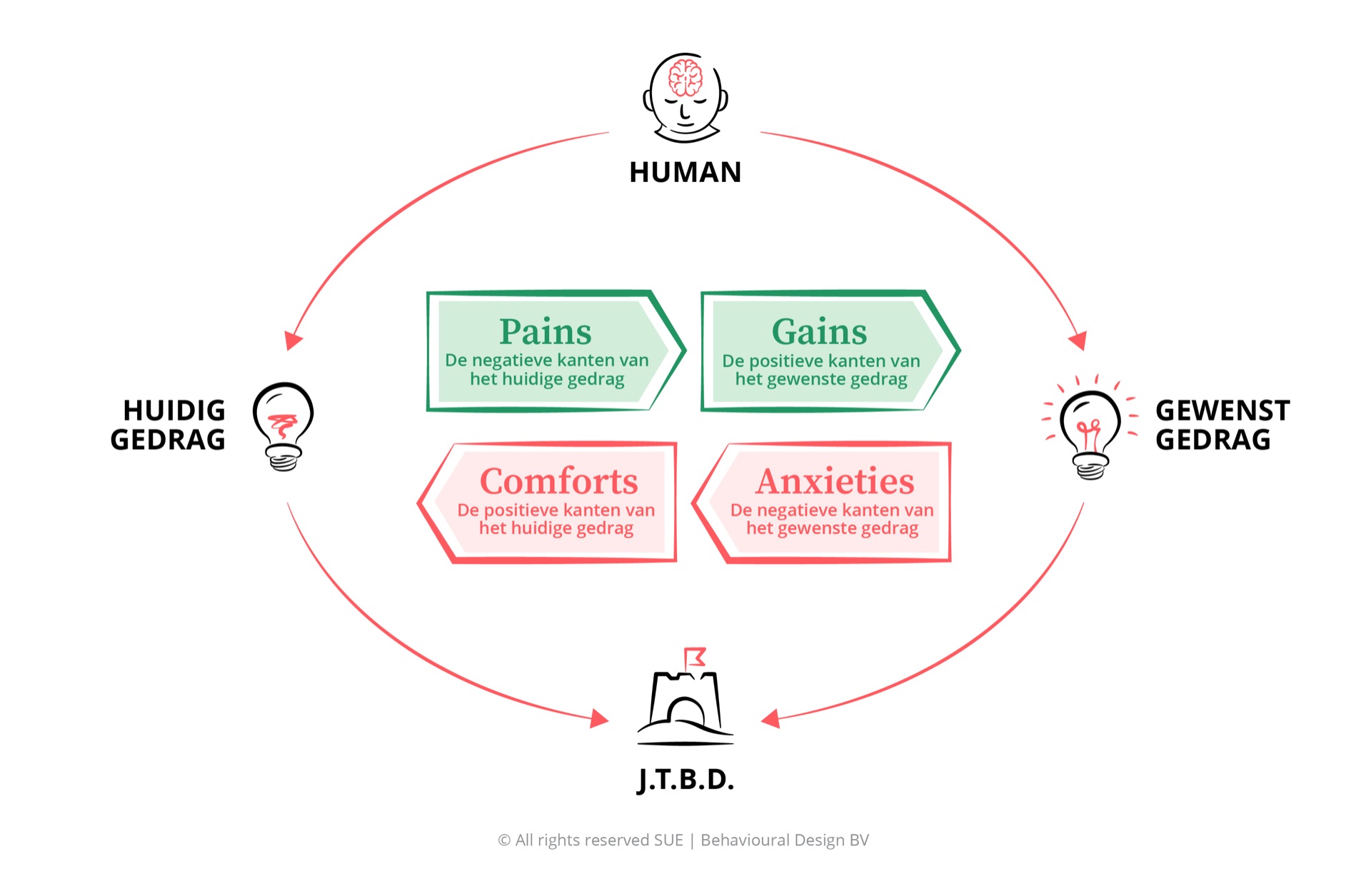
Pains: the daily frustrations
What makes working difficult or exhausting right now? The real pains of employees rarely concern the things organisations measure. They concern meeting pressure that leaves no room for deep work, unclear expectations that lead to endless corrections, the feeling that your effort goes unseen, and micro-management that makes you feel you are never truly responsible for anything.
Gains: what people truly want to experience at work
What would work happiness look like for this employee? Here we are talking about meaning, growth, recognition, autonomy and impact. Not “a better work-life balance” as an abstract wish, but concrete, daily experiences of capability and connection.
Comforts: the pull of the status quo
This is the most surprising element for many organisations. Even people who are exhausted by their current work environment cling to its familiar routines. The meeting structure that is draining is at least predictable. The way of working together that costs energy is familiar. The fixed working day that is too full still provides structure.
Comforts explain why employees take no initiative to change anything even when work happiness scores are low. Change is uncertain. The current context - however unsatisfying - offers certainty.
Anxieties: the barriers that block speaking up and change
The most underestimated force in work happiness programmes is the fear of naming work happiness problems. Employees worry that expressing exhaustion will be seen as weakness. They doubt whether their manager will do anything with it. They are uncertain about what “good” actually looks like in this organisation. And they wonder whether it is worth trying to change anything, if it probably will not work anyway.
As long as these anxieties are not removed, wellbeing programmes only reach the employees who already want to talk about it. The group that would benefit most from support is precisely the group that drops out.
How to design work happiness with SWAC
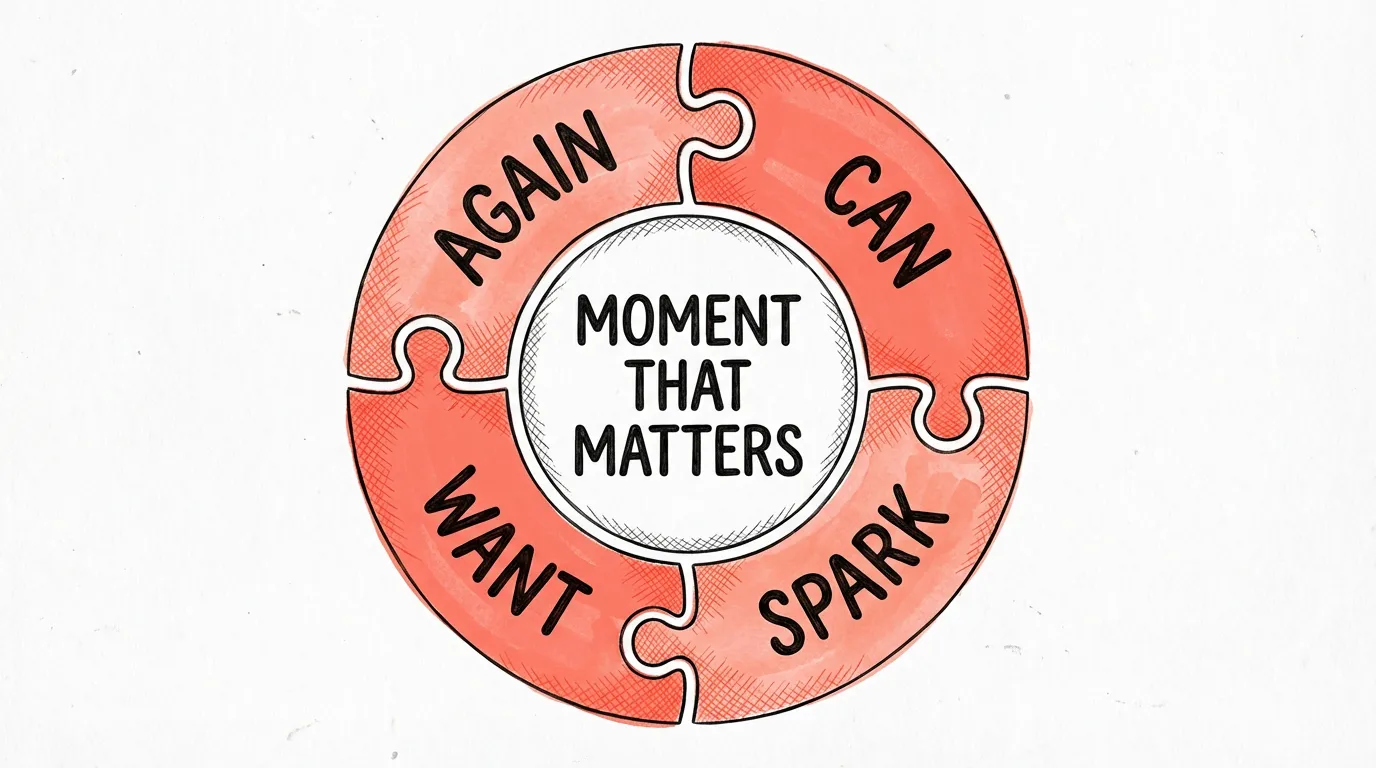
The SWAC model gives us four design questions that together lead to structural behaviour change around work happiness. Not as a temporary intervention, but as a lasting reform of how work is organised.
CAN: remove friction from wellbeing behaviour
The first question is: what makes the behaviour that supports work happiness difficult? And how can we remove that friction?
Concrete examples: make it easier for employees to schedule recovery time - not by encouraging them, but by structurally building meeting-free time blocks into the calendar. Make it easier to discuss workload problems - not by opening a helpline, but by ensuring managers ask the right questions in regular one-to-ones. Make it easier to decline work that does not fit priorities - not by training people in boundary-setting, but by simplifying escalation procedures and clarifying expectations.
WANT: connect work happiness to meaning and performance
Wellbeing is quickly seen as a “nice to have” - something the HR department handles and that the rest of the organisation approaches with a friendly detachment. The design question is: how do you make work happiness relevant to what people truly want to achieve?
This means connecting work happiness to team performance, to customer outcomes, to innovation capacity. Not as a rhetorical trick, but as a genuine intervention: show that teams with high work happiness scores achieve better results. Make work happiness a leadership indicator, not just an HR dashboard.
SPARK: rituals that trigger reflection and recovery
Behaviour does not change without triggers. The SPARK question is: what moments do you create that help people initiate work happiness-related behaviour?
Think of weekly team check-ins that explicitly attend to energy and workload. Quarterly conversations that begin with the question “What gives you energy in this work?” rather than just performance discussion. Team rituals that strengthen connectedness - not as a team-building outing, but as part of the normal rhythm of work.
AGAIN: make wellbeing behaviour automatic
Structural behaviour change requires that desired behaviour eventually becomes automatic - not dependent on individual motivation or reminders. The AGAIN question is: what structural adjustments ensure that work happiness-supporting behaviour becomes the default?
Examples: meeting-free mornings as an organisation-wide policy, not an individual choice. Protected deep work time built into the working week as standard. Performance reviews that routinely include work happiness as an indicator. Onboarding processes that actively build autonomy and connectedness in the first weeks, rather than assuming they will emerge on their own.
The three levels of work happiness design
Effective work happiness design operates on three levels simultaneously. Intervening on only one level means missing the leverage.
Level 1: the individual level
At the individual level, the focus is on task distribution and role design. Do the tasks someone performs match their strengths? Does the employee have sufficient autonomy in how they approach their work? Are expectations clear enough to be able to work independently?
This is not a conversation that happens once at the time of hire. It is a continuous design process that requires regular reflection between employee and manager.
Level 2: the team level
At the team level, it is about psychological safety, collaboration norms and team rituals. Can people in this team say what they think? Are mistakes shared or concealed? Is there space for vulnerability about workload?
Amy Edmondson’s research on psychological safety shows that teams with a high degree of safety perform better, learn more and report fewer instances of burnout. Psychological safety is not a personality trait of team members - it is a consequence of the norms and rituals the team maintains.
Level 3: the organisational level
At the organisational level, it is about leadership behaviour, structural design and measurement indicators. How do leaders themselves model work happiness? Which structures promote or undermine autonomy, competence use and connectedness? And what does the organisation measure as success - only productivity and output, or also wellbeing and sustainable engagement?
An organisation that takes work happiness seriously as a strategic priority translates that into its measurement instruments, its leadership development and its structural choices about how work is organised.
Measuring and designing simultaneously
I am not opposed to measuring work happiness. I am opposed to measuring work happiness as a substitute for designing it. Used well, wellbeing measurements are valuable diagnostic tools - provided you ask the right questions.
The difference lies in the questions. A traditional pulse survey asks: “How satisfied are you with your work on a scale of 1 to 10?” A behaviourally informed diagnosis asks: “What made work harder than necessary this week?” and “When did you feel most in your element this week?”
That second category of questions yields actionable information. It points to specific friction in the work context that you can remove, to specific moments of flow that you can strengthen. It does not lead to a dashboard on average wellbeing, but to concrete adjustments in the way work is organised.
The combination of behavioural diagnosis - aimed at uncovering happiness leaks and the context that causes them - with behavioural design gives organisations a powerful alternative to the traditional approach. Not measuring and communicating. Diagnosing and designing.
Conclusion
Work happiness in organisations is not a matter of better communication, more benefits or more resilient employees. It is a design challenge. The question is not: how do we make employees feel better? The question is: how do we design the context that makes work happiness structurally possible?
That begins with diagnosing the happiness leaks - the autonomy, competence and relatedness deficits that undermine work happiness. It continues with applying the Influence Framework to understand what truly moves employees and what holds them back. And it translates into SWAC interventions that remove friction, connect work happiness to meaning, create triggers for desired behaviour and implement structural changes that make good behaviour automatic.
Organisations that want to improve work happiness do not need to invest more in programmes. They need to invest in a different way of thinking: from measuring to designing, from individual to context, from symptom to cause.
That is precisely what behavioural science teaches us. And it is precisely what most work happiness programmes have yet to do.
Frequently asked questions
Most programmes focus on measuring work happiness (through surveys) or on improving the mindset of employees (through resilience training). But behavioural science shows that work happiness is primarily determined by the work context - the degree of autonomy, competence use and connectedness - and not by people’s mental attitude. As long as the context does not change, work happiness does not change structurally.
According to the Self-Determination Theory by Deci and Ryan, people are intrinsically motivated by three basic needs: autonomy (control over their own work), competence (the feeling of being capable and growing) and relatedness (a sense of connection with colleagues, team and organisational purpose). When one or more of these needs are structurally unmet, ‘happiness leaks’ arise that undermine work happiness - regardless of how many courses are offered.
SWAC stands for four design questions: CAN (remove the friction that makes wellbeing behaviour difficult), WANT (connect work happiness to meaning and performance), SPARK (create regular rituals that trigger reflection and recovery) and AGAIN (make wellbeing-supporting behaviour automatic through structural adjustments such as meeting-free days or protected focus time). The combination of these four questions leads to behaviour change that sticks.