Our learning method: SUE | Own It Learning Loop©

How influence becomes a skill that lasts.

For teams, managers and senior professionals who need to get people on board, build support or change behaviour. With the SUE | Own It Learning Loop©, they keep applying what they learn in the training to their own challenges, until it comes naturally. That is how training pays off in the work itself.
SUE illustration of a head with a glowing light bulb rising from it: an insight that sticks
10,000+
trained
9.3/10
rating
4.8/5
Google rating
EQAC
certified
Heineken KPN Eneco ANWB Randstad Amnesty International Roche Adyen European Commission Centraal Beheer Achmea DPG Media Gemeente Amsterdam Rijkswaterstaat Sony eBay CZ
What is the SUE | Own It Learning Loop©

Four steps that take you from knowledge to skill

The SUE | Own It Learning Loop© is the learning method of SUE | Behavioural Design Academy. Each step asks something different of your brain. For every step we have designed what you need, and how SUE supports you in it, long after the training too.

The SUE | Own It Learning Loop© as a circle of four steps. Get it: you see why people do what they do. Do it: you get a method, tools and templates to put it into practice straight away. Sharpen it: you recall, come back and get challenged until it holds. Own it: you do it with confidence, and it works. With your next challenge, the loop starts again.
Step 1

Get it: you see why people do what they do

You learn why a team says yes in the meeting and then nothing changes, and why a client chooses something other than what you advise. From day one you work with the SUE | Influence Framework©, the model that maps what pulls people towards new behaviour and what holds them back.

How SUE helps you here
  • The trainingsIn The Art of Influence© we lay the foundation in two days: you learn the Behavioural Design Method© and get the tools to keep working with. For managers there is Leading with Influence©, a programme with a two-day kick-off and monthly follow-up sessions.
  • WebinarsWe translate new behavioural research into applications for organisations.
  • Behavioural Design FestHere we bring speakers from practice and research together with people who look at behaviour the way you do.
Step 2

Do it: you learn to apply it in your own work

You practise the method on recognisable challenges, so you can then use it in your own work, for example with a leadership team that won't move or a change that never gets beyond the slide deck. With the SUE | Influence Framework© and the SUE | SWAC Tool© you design what you are going to do.

How SUE helps you here
  • HackathonsWe put you to work on a real challenge with other alumni, so you apply the method in a short space of time.
  • Alumni daysA day for members of the Behavioural Design Club, with a masterclass by Tom and Astrid and success stories from fellow alumni who show how they apply it.
  • Q&AsIf you get stuck on something in your work, we answer your question so you can move on.
  • Coaching callsA trainer looks at your own project with you and helps you take the next step.
Step 3

Sharpen it: you come back until it sticks

This is the step where knowledge becomes skill. Every time you apply the method again, it takes deeper root. That is why the live training comes with two things that help you come back: the SUE AI Mentor and lifetime membership of the Behavioural Design Club.

How SUE helps you here
  • SUE AI MentorIt keeps you recalling and practising: it tests you, plays a client, colleague or sceptic and challenges your work with an ethics check. It gives hints, not answers.
  • Behavioural Design ClubThe Club gives you a nudge at the right moment to apply Behavioural Design, with experiences from other members and questions for us and for each other.
  • Deep Dives (one-day trainings)A day of going deeper, in which you apply the method to your own field, from marketing to AI.
  • 1:1 coachingIf you want it, we guide you personally through your challenge.
Step 4

Own it: you do it without thinking about it

Behavioural Design moves from your notes into your intuition. You are in a meeting where everyone is already proposing solutions, and you hear yourself asking what is actually holding the target group back. Then the loop starts again, with your next challenge.

How SUE helps you here

Through the Behavioural Design Club, you stay connected to people who see things the way you do. You become the person in your organisation who gets people moving, and with every new challenge you get better at it.

Why is it a Learning Loop? Because we keep it turning. You get regular updates to the materials, we keep you up to date with the latest insights in Behavioural Design, and we keep inspiring you and prompting you to act.

Getting better at influence is not a talent. It is a skill you can add to your expertise for good.

Why it sticks

Every brain lets go of what it doesn't retrieve

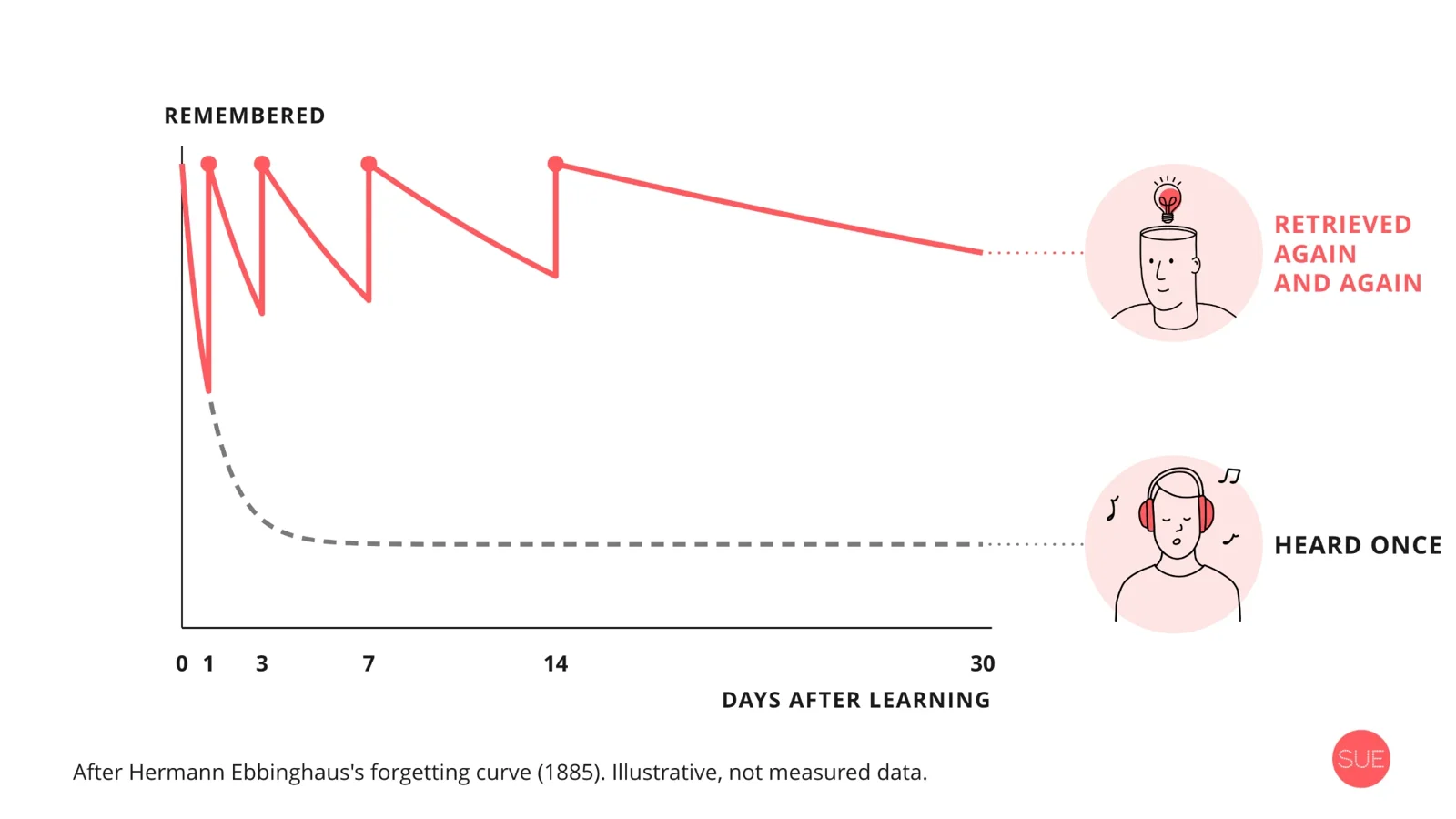
In 1885, the German psychologist Hermann Ebbinghaus became the first to measure forgetting. Most of what you learn is gone within a few days.

He also saw that the curve dropped less steeply every time he retrieved the material again. With that, he laid the groundwork for what we now call spaced repetition: practising at intervals. What that means for how you design a training is in our article on the forgetting curve.

Chart of the forgetting curve: what you only hear once drops sharply within a day and stays low. What you retrieve again on day 1, 3, 7 and 14 drops less each time and is still high after 30 days.
After Hermann Ebbinghaus's forgetting curve (1885). If you keep retrieving, you remember more than if you only heard it once.
Cepeda et al.

Spacing beats cramming

Psychologist Nicholas Cepeda and his colleagues analysed more than three hundred experiments. Spaced practice beats cramming, across hundreds of experiments and a wide range of time intervals.

Roediger & Karpicke

Recall beats rereading

Students either reread a text or tested themselves on it. Rereading felt more effective, but a week later the students who had tested themselves knew far more.

Robert Bjork, UCLA

Effort makes it last

Bjork calls these desirable difficulties: the learning that takes effort is usually the learning that stays. What feels easy often disappears fastest.

Oakley & Sejnowski

Practice turns loose knowledge into one chunk

In Learning How to Learn they show how knowledge moves from slow to fast thinking, from System 2 to System 1, to borrow Daniel Kahneman's terms. That takes repetition in the weeks after a training.

We practise what we preach

We designed the way we teach with our own craft

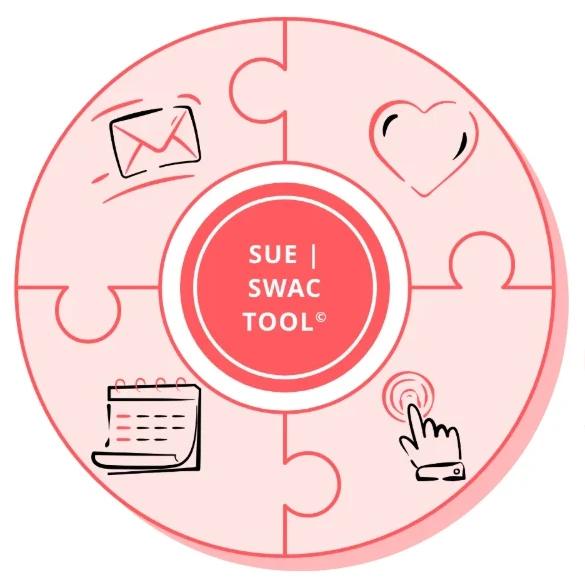
Using the SUE | SWAC Tool©, we built the four conditions for behaviour into our learning method, so that applying it after the training becomes a habit.

The SUE | SWAC Tool© as a puzzle circle of four pieces: an envelope (Spark), a heart (Want), a calendar (Again) and a finger pressing a button (Can)
WANT

You learn a method you can apply in your own work, to something you want to influence or improve.

CAN

We make it as easy as possible: no abstract theory, but behavioural science translated into practice, with handy tools and templates. So you can apply it straight away.

For L&D, team leaders and management

Want your team or leadership team to learn like this?

We bring the SUE | Own It Learning Loop© in-company, built around the challenges of your own organisation.

On your own case

We start with an intake, so the examples and exercises come from your organisation: the plan nobody is backing, or the department that won't move with you.

Application is built into the programme

In a training with follow-up days, the team shows what it has done with it in practice. We look at what worked and adjust, so what was learned takes root in the team.

The team keeps going afterwards

Participants keep access to the Behavioural Design Club, SUE's AI Mentor and the SUE | Influence Framework© as tools for the next challenge.

A format that fits

From a one-day training to a nine-month leadership programme for management teams, in groups of up to 16. After half an hour with a SUE learning expert, you have a proposal with a fixed price within a week.

Or would you rather learn this yourself?

The foundation training

The Art of Influence©

In two days you learn how to get people on board, build support and change behaviour, so you can apply it in your own work. After that, the SUE | Own It Learning Loop© keeps you sharp.

Live in Amsterdam · 2 days · max. 16 participants · €1,490 excl. VAT · SUE AI Mentor and lifetime membership of the Behavioural Design Club included

Frequently asked questions

About the learning method

The learning method of SUE | Behavioural Design Academy. It has four steps, Get it, Do it, Sharpen it and Own it, and it is designed with Behavioural Design so that you actually keep applying what you learn.

Because the brain quickly lets go of knowledge it does not retrieve again. Back in 1885, Hermann Ebbinghaus showed that most of it is gone within a few days. Spaced repetition and active recall slow that down.

Spaced repetition means practising at intervals. Every time you retrieve knowledge again, you forget it more slowly afterwards. It is one of the best-supported principles in learning research.

The SUE AI Mentor is an AI coach that helps you apply Behavioural Design after your training. It tests you, makes you think for yourself first, plays a client, colleague or sceptic and challenges your work, including an ethics check. It gives hints instead of ready-made answers, so you build the skill yourself. Research by Hamsa Bastani and colleagues (Wharton) found that secondary school students who practised with ordinary ChatGPT scored worse on the exam afterwards.

The live training The Art of Influence© comes with the SUE AI Mentor and lifetime membership of the Behavioural Design Club. You can also join webinars, hackathons, alumni days and Q&As, so you keep applying the method to your own challenges.

By training the team on its own challenge and building application into the programme. In a training with follow-up days, the team shows what it has done in practice and we look together at what worked. Afterwards, participants keep working with the Behavioural Design Club, SUE's AI Mentor and the SUE | Influence Framework©.

Yes, always. We start with an intake, so the examples and exercises come from your own organisation. The method stays the same, the case is yours. Book a conversation to discuss which format fits.

The SUE | Own It Learning Loop© as a staircase of four steps. Get it (training, webinars and the Behavioural Design Fest): you see why people do what they do. Do it (tools, hackathons, alumni days, Q&As and coaching calls): you get a method, tools and templates to put it into practice straight away. Sharpen it (your SUE Mentor, deep dives and 1:1 coaching): you recall, come back and get challenged until it holds. Own it, the final destination: you do it with confidence, and it works. A dotted line leads back to the first step.

Because this is what it is ultimately about: not knowing how it is done, but no longer being able to see it any other way.