The forgetting curve: why you forget a training and how to design learning that sticks
Think of the best training you ever attended. The energy in the room, the moment it clicked, a notebook full of ideas. Then think of the Monday after: your inbox, your meetings, your deadlines. How much of what you learned were you still using a month later?
For most people the honest answer is: not much. That rarely has to do with motivation or with the trainer. It has to do with the forgetting curve, and with training courses that stop at exactly the moment forgetting begins.
If you want to learn how to get people on board, build support or change behaviour, it is of little use if it has gone again within a week. So the question that really matters for L&D, managers and anyone choosing a course for themselves is this: what happens after the last day?
The forgetting curve shows how quickly you lose new knowledge if you do not retrieve it again. Hermann Ebbinghaus was the first to measure it, in 1885: most of what you learn is gone within a few days. Every time you retrieve the material again, the curve drops less steeply. Training that sticks is therefore designed around the weeks that follow. How we do that at SUE →
What is the Ebbinghaus forgetting curve?
The forgetting curve is a graph of how fast you forget. The German psychologist Hermann Ebbinghaus taught himself lists of meaningless syllables and kept testing how many he still knew after an hour, a day or a week.[1] Plotted on a graph, it shows a steep drop first and then a long, low tail.
Ebbinghaus also found the way out. Every time he retrieved the material again, the curve dropped less steeply and it took longer before he lost anything. With that, he laid the groundwork for what we now call spaced repetition: practising at intervals.
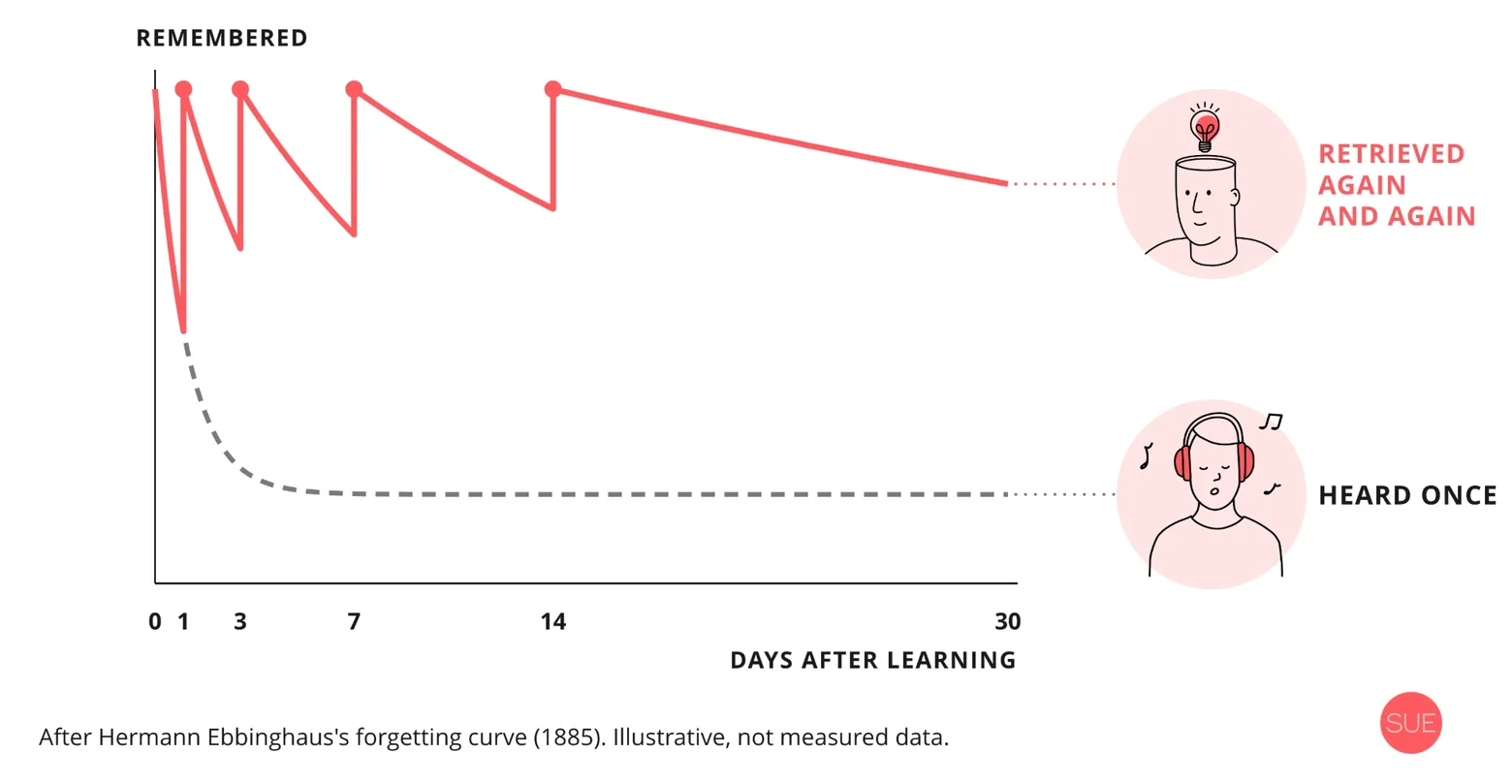
Put that curve next to an average training day and the problem is plain. All the effort goes into the days in the room. The weeks after, when the curve drops, are left to the participant's diary. Yet those are exactly the weeks that decide whether a training pays off.
What does research say about learning that sticks?
Since Ebbinghaus, there has been more than a century of research into learning that lasts. Four findings matter most for anyone who designs or chooses a training.
Spacing beats cramming. Psychologist Nicholas Cepeda and his colleagues analysed more than three hundred experiments in 2006.[2] Their conclusion: spaced practice beats learning everything in one go, across hundreds of experiments and a wide range of time intervals. Two intensive days lay a solid foundation. What happens afterwards decides whether that foundation holds.
Recall beats rereading. Henry Roediger and Jeffrey Karpicke of Washington University in St. Louis had students either reread a text or test themselves on it.[3] Rereading felt more effective. A week later, the students who had tested themselves knew far more. Knowledge you pull out of your own head stays better than knowledge you read again.
Effort makes it last. Robert Bjork of UCLA calls these desirable difficulties: the learning that takes effort is usually the learning that stays.[4] What feels easy often disappears fastest. A training everyone leaves feeling relaxed and satisfied is not necessarily a training that works.
Practice turns loose knowledge into one whole. In Learning How to Learn (2018), Barbara Oakley and Terrence Sejnowski describe how repeated practice fuses loose bits of knowledge into one pattern your brain can call up in one go, a chunk.[5] You know it from driving. In your first lesson, mirrors, indicating, clutch and accelerator all demanded your full attention. A few years later you drive home while holding a conversation.
The aim of a training is that knowledge moves from slow to fast thinking. That does not happen in the room.
To borrow Daniel Kahneman's terms, the knowledge moves from System 2 to System 1. That move happens in the weeks and months after a training, through repeated, spaced and effortful application to real situations. Exactly the period most trainings leave to chance.
How do you design training that sticks?
You design training that sticks around the forgetting curve. That means taking the weeks after the training as seriously as the days themselves. Five design choices make the difference, whether you work in L&D, lead a team or manage an organisation.
1. Let people work on their own challenge. Knowledge that immediately solves something a person cares about gets used again more often. A made-up case feels safe, but gives nobody a reason to come back afterwards. A real challenge does: it is still on your desk on Monday.
2. Spread the programme. Plan follow-up moments after a week, a month and a quarter, instead of putting everything in one block. Those moments are the retrieval Ebbinghaus and Cepeda are talking about.
3. Ask for recall, not repetition. Sending round a summary feels useful, but it is rereading. Ask participants instead to explain what they applied, what worked and what did not. It takes more effort, and that is why it stays.
4. Make it hard in the right way. Let people think for themselves before they get the answer. A role play with a critical colleague is more uncomfortable than watching a video, and teaches more.
5. Design the weeks after as behaviour. Applying what you learned is behaviour, and behaviour only happens when the circumstances make it easy. Who provides the reason to come back? What helps when the diary fills up? For teams, this works best when application is built into the programme itself; you can read how we do that on our in-company training page.
Taking a course yourself? The same rules apply. Choose one challenge in advance to apply what you learn to, put three moments in your diary to come back to it, and explain what you learned to a colleague in your own words. How to judge an in-company programme is covered in our guide to in-company training that works.
How SUE designs the weeks after the training
At SUE we design behaviour. So we asked ourselves the question we ask our clients: what stops people from applying what they have learned, and what makes them do it? To answer it, we used our own SUE | SWAC Tool©. Behaviour happens when four conditions come together, and we built all four into the way we teach.
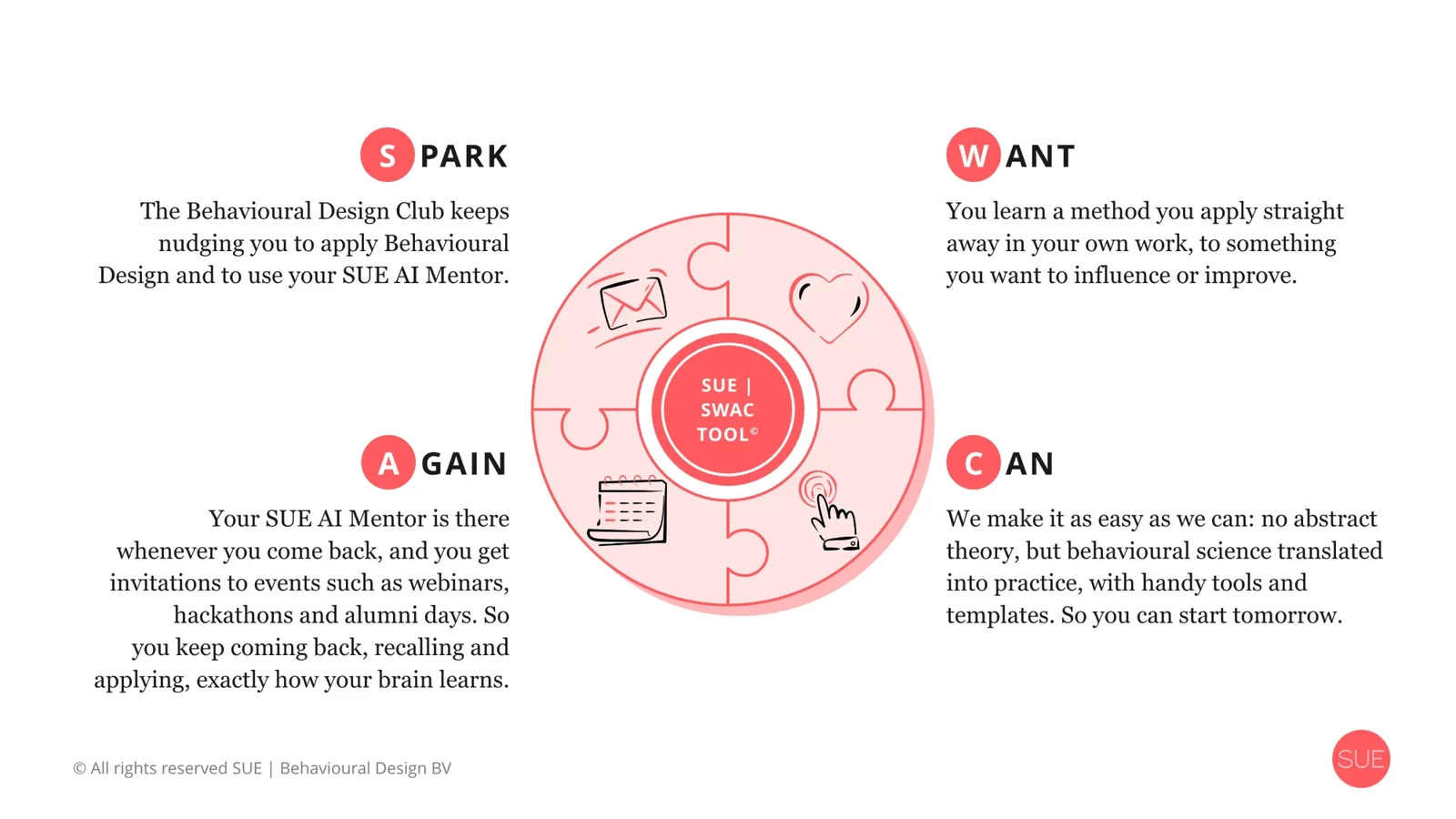
Spark: in our live programmes, the Behavioural Design Club keeps nudging you to apply Behavioural Design. Want: you learn a method you apply in your own work, to something you want to influence or improve. Again: your SUE AI Mentor is there whenever you come back, and our live programmes add webinars, hackathons and alumni days. Can: no abstract theory, but behavioural science translated into practice, with tools and templates.
The result is the SUE | Own It Learning Loop©, the learning method of SUE | Behavioural Design Academy. It has four steps you go through again and again. In Get it you see why people do what they do. In Do it you apply the method to your own challenge. In Sharpen it you come back until it sticks, and this is where most training stops. In Own it you do it without thinking about it, and the loop starts again with your next challenge.

Sharpen it is where the SUE AI Mentor comes in. It tests you, plays a client, colleague or sceptic, and challenges your work with an ethics check. It gives hints, not answers. That is a deliberate choice: research by Hamsa Bastani and colleagues at Wharton found in 2025 that secondary school students who practised with ordinary ChatGPT scored worse on the exam afterwards.[6] The AI did the thinking, their brains did not.
Frequently asked questions about the forgetting curve and training
What is the Ebbinghaus forgetting curve?
The forgetting curve shows how quickly you lose new knowledge if you do not retrieve it again. The German psychologist Hermann Ebbinghaus was the first to measure forgetting, in 1885. Most of what you learn is gone within a few days. Every time you retrieve the material again, the curve drops less steeply.
Why do people forget what they learn in a training so quickly?
Because the brain quickly lets go of knowledge it does not retrieve again. Most training stops at exactly the moment forgetting begins: after the last day. Spaced repetition and active recall slow that down.
What is spaced repetition?
Spaced repetition means practising at intervals. Every time you retrieve knowledge again, you forget it more slowly afterwards. A meta-analysis by Nicholas Cepeda and colleagues of more than three hundred experiments showed that spaced practice beats cramming.
How do you make training stick?
Let participants work on their own challenge, spread practice over weeks, have them retrieve knowledge rather than reread it, and plan in advance what happens after the training: a reason to come back, and someone or something that helps when the diary fills up.
What is the SUE | Own It Learning Loop©?
The learning method of SUE | Behavioural Design Academy. It has four steps, Get it, Do it, Sharpen it and Own it, and it is designed with Behavioural Design so that you actually keep applying what you learn. Read more about the learning method →
What happens after the last day
When people compare training courses, they usually compare the days in the room: the programme, the trainers, the venue. The forgetting curve shows you would do better to ask what happens in the weeks after. Will I work on my own challenge? When do I come back? And who helps me when my diary fills up?
Because this is what it is ultimately about: not knowing how it is done, but no longer being able to see it any other way.