In-company training: how to actually change behaviour
I have seen it dozens of times. A team comes back from an inspiring training day, full of new models and good intentions. Two weeks later everyone works exactly as before. The slides sit in a folder no one opens again.
That is the problem with most in-company training. It transfers knowledge. And knowledge does not change behaviour. A route map does not make you fit.
In this guide I explain what actually makes in-company training work: what it is, why most tracks stall, what it costs, and how to choose a provider that does not just deliver a pleasant day, but genuinely changes the behaviour of your team.
In-company training is a training that a provider designs on demand and delivers on site, for a whole team or department rather than individual participants. The difference with an ordinary course lies in the ambition: not to transfer knowledge that fades within a week, but to redesign the work so the new behaviour becomes the easiest option. More on behaviour change in organisations →
What is in-company training?
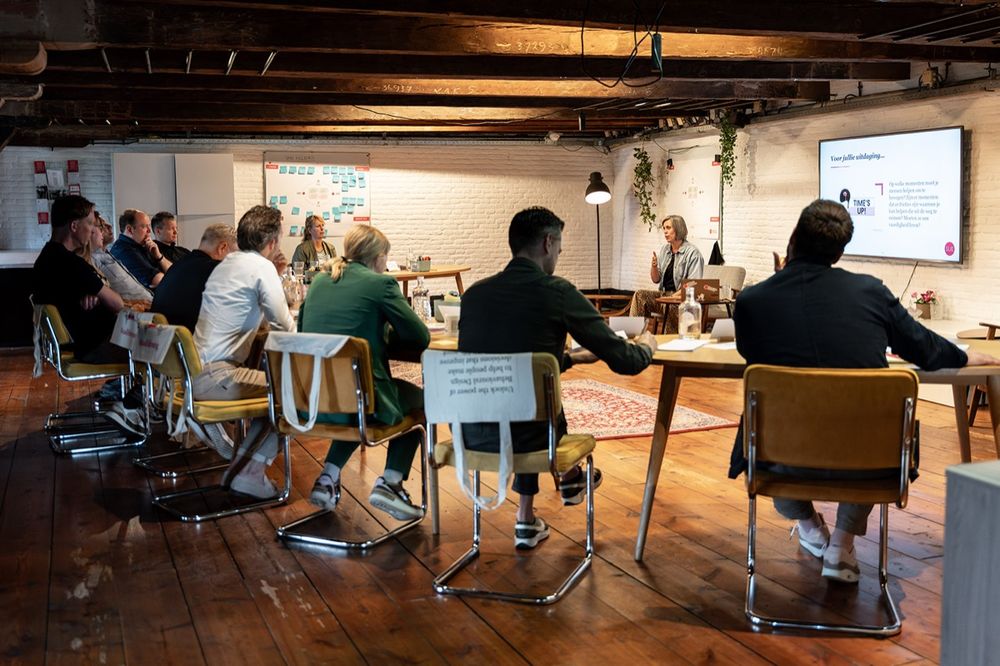
In-company training is a training you buy as an organisation for your own people, at your own location, around your own challenges. The trainer comes to you. There are no strangers from other companies in the room. So everything can be about your situation: your customers, your processes, your culture.
That is the big distinction from open enrolment, where you send individual participants to a course with people from all kinds of organisations. Both have their place. But they solve something different.
| Feature | In-company training | Open enrolment |
|---|---|---|
| Participants | One team or department | Individuals from different companies |
| Content | Tailored, around own cases | Fixed programme |
| Location | At your office or off-site | At the provider |
| Strongest for | A team that wants to work differently together | Individual development |
| Price | Per track, for the whole group | Per participant |
If you want your whole team to look at customers, change or collaboration in a new way, in-company is almost always the better choice. You do not train five people who then have to carry it alone, you change the norm of the whole group at once.
Why most in-company training does not change behaviour
Most training is built on an assumption that is wrong: that people will act differently if only they understand enough. More explanation, more models, more insight. As if behaviour were an information problem.
It is not. Look at the numbers. According to the forgetting curve of Hermann Ebbinghaus, people forget most of what they heard on a training day within a few days.[1] And that is about knowledge sticking, let alone behaviour changing.
At the organisational level you see the same thing. According to McKinsey, an estimated seventy percent of change efforts fail to reach their stated goals.[2] Not because the plans are bad. Because the behaviour of people on the floor does not move with the management deck.
A training that only transfers knowledge changes behaviour about as much as a diet book changes your weight.
The mistake is that we try to change people's behaviour by working on their minds. But behaviour is not mainly in the mind. It is in the environment. In how the work is set up, what the default is, what is easy and what is not. If you do not change the environment, everyone falls back into the old routine after the last slide. That is not a lack of motivation. That is how people work.
Behaviour change is a design problem, not a knowledge transfer
At SUE we turn it around. An in-company training does not start from the content we want to bring, but from the behaviour you want to see. We think outside-in: first understand why your team does what it does now, then design.
Kurt Lewin, the founder of change science, put it sharply.
"If you want truly to understand something, try to change it."
— Kurt Lewin, founder of social psychology
To understand what holds your team back, we map five forces with the SUE Influence Framework™: the Job-to-be-Done, the Pains, the Gains, the Anxieties and the Comforts. Those last two are almost always underestimated. People do not adopt the new thing, not because they prefer the old, but because the old is familiar and easy. Comfort is a stronger force than persuasion.

An example of what that produces. In a company where reminders to switch off computers at night did not work, one change solved it: all computers were set to shut down automatically by default.[3] No campaign, no training on sustainability. A different default. When the environment changed, the behaviour changed on its own. That is the difference between telling people something and designing the behaviour.
What does in-company training cost?
The honest answer: it depends on what you want to achieve. A price without a goal says nothing. But four things almost always determine what in-company training costs.
- The duration. A one-day masterclass is a different investment from a track of several months.
- The group size. A tightly facilitated group asks more of a trainer than a hall of fifty.
- The degree of customisation. Working with your own cases takes preparation, but delivers by far the most.
- The embedding. Support after the training day, to hold the learning in practice, is exactly what cheap tracks cut and expensive tracks earn their money with.
As a guide: a one-day team training typically costs several thousand euros, a multi-month change track runs into the tens of thousands. The question is not what it costs, but what it gives you when the behaviour does change, and what the previous failed training already cost you. You will find an overview of the formats and current rates on our training page.
In-company training for change management and transformation
This is where in-company training and change management overlap. A big change, a reorganisation, a digital transformation, a new strategy, stands or falls on whether people actually start working differently. And that is exactly where it usually goes wrong.
The classic approach is: announce the change, explain why it has to happen, and hope people move along. That is the approach that makes those seventy percent fail. People do not resist change because they are stubborn. They resist because the new is uncertain and the old is comfortable. Why change management fails goes into this in more depth.
An in-company training around behaviour change tackles that differently. Instead of preaching for buy-in, you design with the team the small moves that make the new behaviour easy and the old behaviour harder. You do not work on the conviction, you work on the environment. That is also why a behaviour-led approach to change succeeds so much more often than a communication campaign.
How do you choose the best in-company training?
There are hundreds of in-company training providers. Most sell content: a topic, a number of sessions, a satisfied group at the end. If you want to change behaviour, watch for four signals that separate the wheat from the chaff.
- Does the provider start from you, or from its own content? A strong provider wants to know first which behaviour you want to see and why it is not happening now. Anyone who immediately pitches a fixed programme is selling a day, not a change.
- Does the training work with your own cases? Generic examples stay abstract. Only when a team works on its own challenge does the learning become concrete enough to carry into Monday.
- Is there something after the training day? Without embedding, everything fades, see the forgetting curve. Ask what happens in the weeks after: support, assignments in practice, a follow-up session.
- How is the result measured? On satisfaction scores, or on behaviour that demonstrably changes? Only the second is a real promise.
Run through these four and most of the market falls away. What remains are the providers that see training as a design problem. That is exactly where SUE's training stands.
Frequently asked questions about in-company training
What is in-company training?
In-company training is a training that a provider designs on demand and delivers at the client's location, for a whole team or department. Unlike an open-enrolment course, there are no participants from other organisations, so the content can revolve entirely around the team's own challenges and cases.
How much does in-company training cost?
The price depends on four things: the duration, the group size, the degree of customisation, and whether there is follow-up support to embed the learning. A one-day team training typically costs several thousand euros; a multi-month change track runs into the tens of thousands. Always request a tailored proposal.
What is the difference between in-company training and open enrolment?
With open enrolment you send individual participants to a course with people from various organisations. With in-company training the trainer comes to you and the whole team works on its own challenges. In-company is stronger when the goal is for a team to change the way it works together.
Does in-company training work for behaviour change?
Yes, provided the training does not stop at transferring knowledge. Knowledge fades. In-company training that changes behaviour redesigns the work itself, so the new behaviour becomes the easiest option, and builds in support to embed it.
How long does an in-company track take?
That varies from a single day to a track of several months. For lasting behaviour change, a longer line with several moments works better than a one-off day, because the new behaviour then gets time to become a habit.
Is in-company training also suited to digital transformation?
Yes. Digital transformation often fails for the same reason as other major changes: people get an explanation of the new system, but keep working the old way. An in-company programme built around digital transformation redesigns the work itself, so the new way of working becomes the obvious choice. Training that only explains the new system's features does not change that behaviour.
Conclusion
In-company training is not a goal. It is a means to change the behaviour of a team. And you do not change behaviour by making people smarter, but by designing the work differently.
So do not choose a provider on its topic, but on its approach. Does it start from your behaviour? Does it work with your cases? Does it embed it after the day? Does it measure change? Then you are not buying an inspiring day that has evaporated after two weeks, but a team that genuinely works differently on Monday.
You have read about it. But what if you could apply it yourself?
See our training programmes →