For whom Change professionals
Behavioural Design for change professionals

Making change stick is a design problem. Not a communication problem.

Everything you do as a change professional, from creating buy-in to embedding new ways of working, runs on human behaviour. The question is whether you can read, predict and design that behaviour. That is exactly what Behavioural Design teaches you.

10.000+
trained
9.7/10
rating
EQAC
accredited
€1.190
from excl. VAT
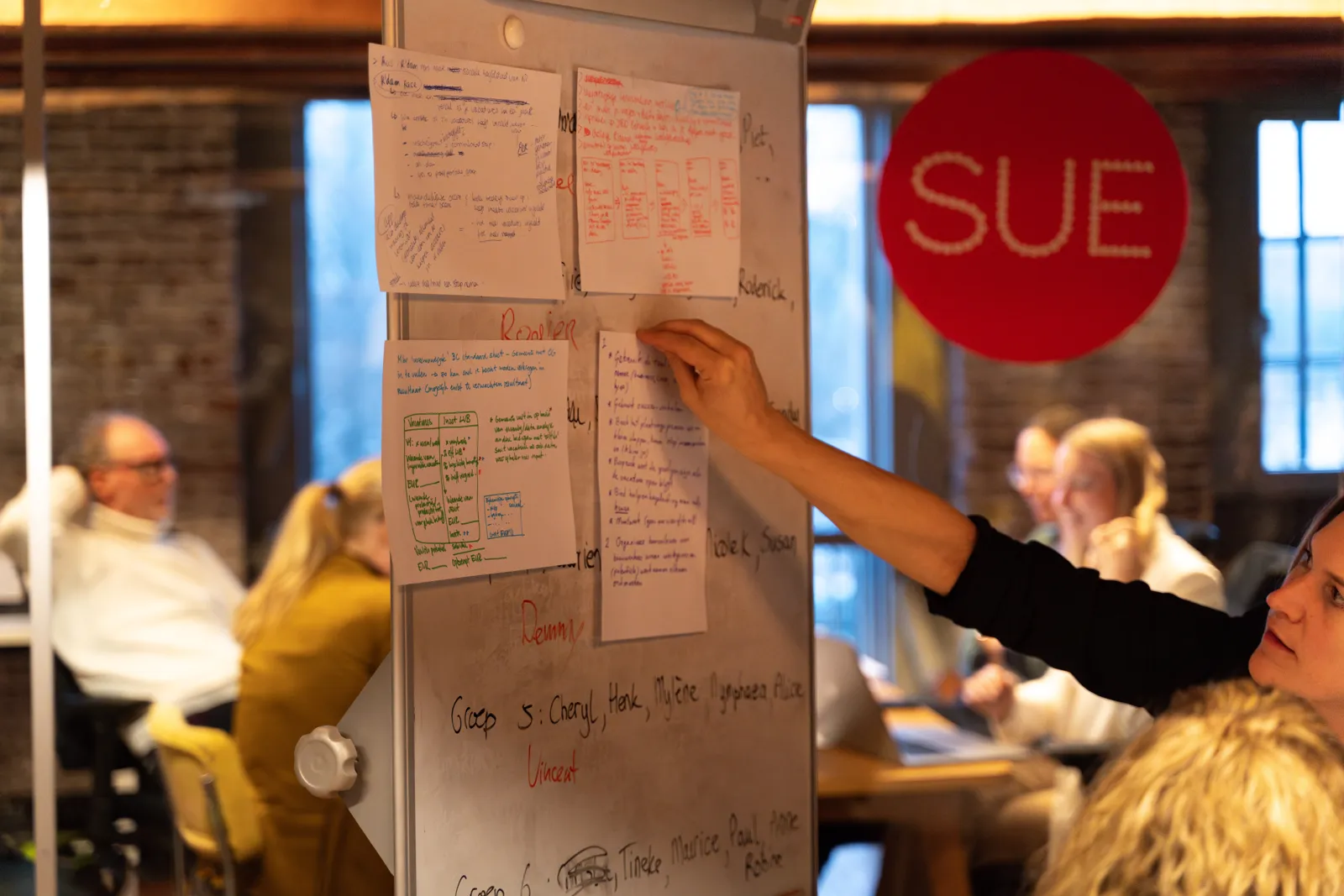
Change professionals working together on behavioural interventions during the SUE Behavioural Design training
Familiar challenges for change professionals

"How do I get people on board with a change they never asked for?"

10.000+ professionals trained, including people from

Heineken ING Bank KPN Randstad Achmea Adyen Eneco ANWB Roche European Commission Gemeente Amsterdam DPG Media Sony eBay Heineken ING Bank KPN Randstad Achmea Adyen Eneco ANWB Roche European Commission Gemeente Amsterdam DPG Media Sony eBay
The root of the problem

Does this sound familiar?

Click on a situation you recognise.

01
The change plan everyone understands but nobody executes
The strategy is sound, the presentation went well, and still behaviour does not change. Understanding and doing are two very different things. Change management that only addresses the rational mind misses the 96% of behaviour that runs on autopilot.
02
The kick-off with applause that is forgotten three weeks later
Great energy in the room, constructive questions, and three weeks later everyone is working exactly as before. A kick-off is no match for the power of habit. The brain always takes the path of least resistance.
03
The employee who nods yes but does no
In the conversation: agreed. In practice: the old behaviour. Resistance is rarely conscious or malicious, but automatic. That is precisely what makes it so hard to break through with communication alone.
04
The new way of working that reverts to old behaviour
Six weeks after go-live, 40% are already back to the old way, not out of protest, but because the new way takes more effort. Lasting behaviour change needs more than a launch. It needs context design.
05
The communication campaign that increases resistance
More information, better framing, a clearer message. Still the organisation closes up further. Communicating about change is not the same as designing change. The difference lies in how you shape the context.
Behavioural Design for change professionals
Behavioural Design is the missing layer.

There is an explanation.

Behavioural Design for change professionals is the application of behavioural science to change challenges: from creating buy-in and reducing resistance to embedding new ways of working and preventing relapse. The method helps you understand why people resist, disengage or revert, and how to design the context so that the new behaviour becomes the easiest choice.

1
96% of behaviour is automatic. Change programmes that only address the rational mind target the wrong 4% of the brain. The Behavioural Design Method teaches you to read the unconscious, and design for it.
2
Resistance is a design problem, not ill will. The environment makes the new behaviour harder and the old behaviour easier. Behavioural Design teaches you to tip that balance, not through persuasion, but through context design.
3
Behaviour is designable. The Behavioural Design Method gives you a step-by-step process to change the context so that the new behaviour becomes automatic, even after the project team has moved on.
Behavioural Design × AI

What makes you an indispensable change professional in the age of AI?

Understanding, predicting and designing human behaviour is the one skill AI cannot take over.

The context

AI is changing how change professionals work, from stakeholder analysis to intervention design.

But AI only makes you more effective if you understand how people really decide. Without that foundation, you use AI to design the wrong interventions faster. Technology amplifies what you already understand, not what you cannot yet see.

Behavioural Design × AI

AI gives you speed. Behavioural Design gives you direction.

The change professional who understands behaviour gets more out of AI than the professional who only masters AI tools. All SUE training programmes include AI applications as standard.

Read our view on Behavioural Design and AI →
Why the SUE Behavioural Design method

Behavioural science made practical for professionals who are not behavioural experts.

Most behavioural science knowledge is locked in academic papers and consultancy reports. SUE built its own method, the Influence Framework, which translates that knowledge into a practical step-by-step process any change professional can apply, without a scientific background.

SUE Influence Framework
No academic theory , you work on your own change challenge during the training and go home with a worked-out intervention plan you can apply the next day
Built on Kahneman, Cialdini and Thaler, scientifically grounded but accessible for practitioners
Our own method, the Influence Framework is not taught anywhere else, described in the #1 management bestseller
16 years of experience, from ING to Buurtzorg to the Dutch government: the method is proven on the largest change challenges in the Netherlands
Springest
9.7/10
★★★★★
Google
4.8/5
★★★★★
Bloomville
5.0/5
★★★★★
Certified by
EQAC accredited
What change professionals say after the training

10.000+ professionals have followed a SUE Behavioural Design training.

The change professionals among them have one thing in common: afterwards they look at resistance and adoption differently.

The best first step

Understanding behaviour is the skill that makes change programmes stick.

And the Behavioural Design Fundamentals is the training that teaches you exactly that. In two days, or 33 online lessons, you learn the method that will permanently change how you approach change.

Behavioural Design Fundamentals training for change professionals
Most popular
9.7/10
rating
EQAC
accredited
Max 16
participants
Behavioural Design Academy

Behavioural Design Fundamentals

You learn the full Influence Framework, the JTBD method and all core tools of Behavioural Design. You work on your own change challenge and go home with a worked-out intervention plan you can apply the next day.

Three ways to participate
Live in Amsterdam, 2 intensive days, max 16 participants Online self-paced, 33 lessons at your own pace With your team, in-company, at your location or in Amsterdam
View the Fundamentals → See start dates

Want to explore which format suits you best first? Choose the format that fits you →

How do you want to learn?

Choose the format that fits you

Individually, with your change team, or organisation-wide. Every format works on a real change challenge.

After the training

What you do differently from then on

Not abstract knowledge. Concrete changes in how you approach change programmes.

You analyse behaviour before you intervene

You use the Influence Framework as your starting point: what drives these people, what holds them back, which context makes the new behaviour harder than the old? Only then do you design an intervention.

You design context, not messages

You know how to shape the work environment so that the new behaviour becomes the easiest choice, not the most communicated message. Resistance is then not something to overcome, but something to design away.

You build change that sticks

You focus on the environment and habit structures that support the new behaviour, even after the project organisation has been disbanded. Relapse is not ill will, it is a context problem.

Frequently asked questions

One more thing

Most participants start without any prior knowledge. The training gives you the behavioural science you need, directly connected to your own change practice. No academic theory, just actionable insights you can apply the very next day in your change programmes.

You learn the SUE Influence Framework: a method to analyse why people resist, disengage or revert to old behaviour, and to design interventions that genuinely change behaviour. During the training you work on your own change challenge and go home with a worked-out plan you can apply the next day.

Precisely for experienced change professionals this training is most valuable. You have the practical experience. The training gives you the scientific framework that supports your intuition and strengthens your approach. Many participants say afterwards: I was already doing parts of this, but now I finally understand why it sometimes does not work.

Deliberately a mixed group: change managers, HR professionals, communication advisers, policy makers and leaders together. Maximum 16 participants. That mix is what makes it valuable: you learn not just from the content, but from how people in other sectors deal with similar behavioural challenges.

Yes. We invoice to a company name and the training is EQAC-accredited, which makes expensing straightforward. Get in touch if you need a quote or additional information for your request.

Start with the Fundamentals. It gives you the complete Behavioural Design framework: the Influence Framework, the JTBD method and all core tools. The Deep Dive Creating Buy-in builds on this with change-specific applications. Without Fundamentals, the Deep Dive lacks its foundation.

Ready to take the step? View the next start date or ask your question.

View start dates → Ask a question

10.000+ professionals have gone before you · 9.7/10 rating · EQAC accredited

Further reading

Change management and behavioural science: the most-read articles

Change Management
Why change programmes fail: the behavioural science
Adoption
Engaging employees in change: how to do it
Communication
Change communication that works: design, not information
View all articles on change management → The Art of Designing Behaviour
Book by Astrid Groenewegen
The Art of Designing Behaviour
The complete practical guide to using behavioural science to change what people do.
#1 Bestseller · The standard in behavioural design
Astrid Groenewegen
Astrid Groenewegen
Co-founder, SUE Behavioural Design
Weekly newsletter

1.5 minutes of Influence

Every week I notice something: a hospital sign, a supermarket shelf, a phrase in a meeting. Always something that shows exactly how context drives behaviour. I write it down. Every Thursday morning it lands in your inbox. In 90 seconds.

Read by 10.000+ professionals · Free · Unsubscribe any time

Next edition
Behavioural Design Fundamentals , 21 & 22 May 2026 5 spots remaining
Enrol now →