Behaviour change by the numbers: 8 research results
At SUE we get asked the same question a lot: does behaviour change actually work, or is it a collection of nice anecdotes from a TED talk? The honest answer is that it depends on the intervention, and the difference is measurable. Below are eight results from published research and documented practice cases, each with a source and a year.
Behaviour change in organisations is measurable: making pension choices concrete at ING led to 20% more enrolments (Holzwarth et al., 2020), and switching a default from opt-in to opt-out at Home Retail Group raised participation in a charity scheme from 10% to 49%. Interventions that change the environment consistently outperform interventions that rely on persuasion alone. More on behaviour change in organisational change →
Why this list exists
Most articles about behaviour change stay at the level of principles: nudging, defaults, social proof. Useful, but vague. What is often missing is the answer to the question every client asks us: how much difference does this actually make, in percentages?
I have collected eight results that answer that question directly. Some come from our own work at SUE, others from published academic research. Every one of them is an intervention in the environment, not in people's mindset. That distinction is the whole point.
1. Concreteness raises pension enrolment by 20%
According to Holzwarth et al. (2020), making future pension choices concrete, instead of showing abstract percentages and years, led to 20% more enrolments in a pension product.[1] People procrastinate on abstract, distant decisions. Once a choice becomes concrete and imaginable, part of that tendency to delay disappears.
"We are far less rational in our decision making than standard economic theory assumes."
— Richard Thaler, Misbehaving (2015)
2. Flipping a default raises participation from 10% to 49%
At Home Retail Group, the share of employees donating part of their salary to charity rose from 10% to 49%, simply by switching the scheme from opt-in to opt-out. No one was forced: everyone could still leave. Only the default changed.
This is the default effect in its purest form: people follow the path of least resistance, even for a financial choice. Of all the interventions within choice architecture, switching a default is usually the cheapest with the largest effect.
3. Loss framing breaks a stalled response
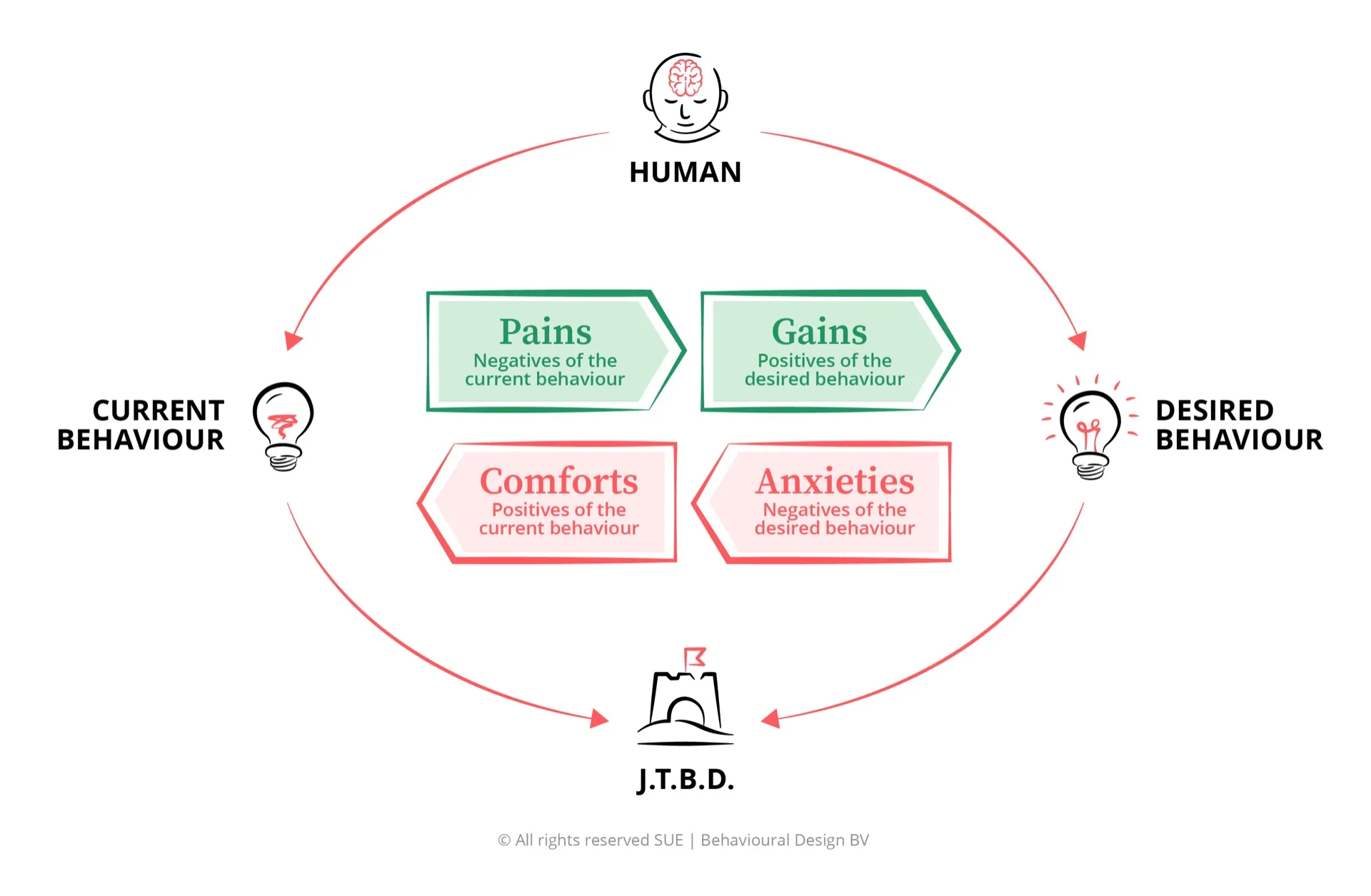
When the city of Denver wanted to raise the number of online tax filings, the response rate plateaued despite repeated campaigns emphasising the benefits. Only when the message was rewritten to focus on what residents were missing out on by not filing online, rather than what they stood to gain, did the response rate break through the plateau.
The pattern is well known from Kahneman and Tversky's prospect theory: a loss weighs psychologically heavier than an equivalent gain. A message that names a loss activates that mechanism. A message that only lists benefits does not.
4. One less click sells more
Amazon's 1-Click ordering removed the step where customers had to confirm their basket. The patented mechanism is widely cited as one of the clearest examples of how removing friction at the decisive moment raises conversion, regardless of how convinced a customer already was before that final step.
Within the SWAC model we use at SUE, this is the CAN dimension: how easy do you make the desired behaviour? Motivation (WANT) without ease (CAN) achieves little. A buyer who is convinced but faces three extra steps drops off more often than you would think.
5. A bonus that cut productivity by 13%
Dan Ariely tested at Intel what an announced performance bonus did to the productivity of technicians. The group offered the bonus performed 13% worse than a control group that received no bonus.[2] Large, conspicuous extrinsic rewards for cognitive work raise performance pressure and can crowd out intrinsic motivation, backfiring on the intended result.
"The bigger the bonus, the worse the performance, when the tasks required even rudimentary cognitive skill."
— Dan Ariely, Intel field study, published in Predictably Irrational (2008)
This is why SUE is cautious about recommending financial incentives as a first intervention. For complex, cognitive work, redesigning the environment often outperforms raising the reward.
Why the standard approach usually falls flat
What these five cases have in common: none of them started with persuasion. No organisation tried to motivate people harder with arguments. Every intervention changed something in the environment: the default, the framing, the number of steps, the incentive.
That is exactly where most change programmes get stuck. Organisations invest in communication, town halls and emails full of arguments, while the problem is rarely a lack of information. System 1, the fast and automatic part of our thinking, does not respond to arguments. It responds to the environment in which a choice is presented.
All eight results at a glance
The table below sets the interventions side by side, with the measured effect and the source.
| Intervention | Measured effect | Source |
|---|---|---|
| Concretising pension choice (ING) | +20% enrolments | Holzwarth et al., 2020 |
| Flipping the charity scheme default | 10% → 49% participation | Home Retail Group, published case |
| Loss framing for tax filing | Breaks a stalled response rate | City of Denver, behavioural team |
| Removing checkout friction | Higher conversion at the decision point | Amazon 1-Click, patent + widely cited case |
| Announced performance bonus (Intel) | -13% productivity | Ariely, Predictably Irrational, 2008 |
| Social proof on energy bills | Measurable drop in energy use | Schultz et al., 2007 |
| Deadline in reminder email after a long sign-up form | +24% completed sign-ups | Kiva (see also Gneezy & Shu, 2009) |
| Reciprocity principles in sales | Higher acceptance rate of proposals | Cialdini, Influence, 1984 |
Social proof on the energy bill
Schultz et al. (2007) showed that households who saw how much their neighbours used on their energy bill adjusted their own use toward that average.[3] Above-average users cut their consumption. Below-average users sometimes increased theirs, unless a positive message, such as a smiley, was added to dampen that effect.
A deadline brings drop-outs back
Kiva, the microlending platform, had an eight-page sign-up process. Only 20 per cent completed it. Kiva then sent drop-outs a reminder email with a deadline, and completed sign-ups rose by 24 per cent. A deadline plus a small reward added another 26 per cent. Gneezy and Shu (2009) showed why: people act as a deadline approaches, whether the task is pleasant or not. If you can't shorten a long form, you can still give finishing it a moment.
What you do with these numbers
These eight results are not a blueprint you can copy one to one. A default that worked at Home Retail Group will not automatically work in your organisation. What they do show is a pattern: the interventions with the largest measured effect change the environment, not the message.
If you want to apply this yourself, start with the question of which element of SPARK, WANT, AGAIN or CAN sits at zero in your situation. Often it is not motivation. Often it is a default pointing the wrong way, or one step too many in the process.
Frequently asked questions about behaviour change by the numbers
What evidence is there that behaviour change actually works in organisations?
There is a growing body of measured, real-world results. Making future pension choices concrete led to 20% more enrolments at ING (Holzwarth et al., 2020), and flipping a default option at Home Retail Group raised the share of employees supporting a charity scheme from 10% to 49%. These are interventions in the environment, not in people's mindset.
Why do financial bonuses sometimes backfire?
Dan Ariely's field experiment at Intel found that an announced performance bonus lowered productivity by 13% compared with a control group that received no bonus. Large extrinsic rewards for cognitive work can crowd out intrinsic motivation and raise performance pressure, the opposite of the intended effect.
What is the default effect and how large is its impact?
The default effect is people's tendency to stick with the pre-set option. At Home Retail Group, participation in a charity scheme rose from 10% to 49% by switching from opt-in to opt-out, without removing anyone's freedom to choose. Defaults are among the cheapest, most powerful interventions in choice architecture.
Doesn't informing and persuading people work just as well?
Rarely, in practice. More information appeals to the slow, deliberate System 2, while most choices run through the fast System 1. Interventions that change the environment or the default consistently show larger, faster effects in comparable cases than campaigns that rely on persuasion and awareness alone.