Organisational change: Why it almost always fails, and how to make it work
Every organisation knows the pattern. The board announces a new strategy. A steering committee is formed, a communication plan drafted, a roadmap approved. The first months show movement. Then energy fades. A year later, half the organisation has reverted to old behaviour. The change programme gets quietly shelved, the consultants leave. Two years later, it starts again.
The surprising part isn't that this happens. It's that we keep being surprised by it. McKinsey research shows that roughly 70% of all organisational changes fail to achieve their intended goals. The plans are usually fine. The technology works. But the behavioural side of change is structurally underestimated. We unpack that structural cause in why change initiatives fail.
What makes organisational change so persistently difficult? And what does behavioural science teach us about how to approach it differently?
Organisational change is any fundamental shift in how an organisation works, thinks, or is structured. From restructurings and mergers to culture change and digital transformation. The failure of organisational change rarely comes from bad plans, and almost always from ignoring the comforts, anxieties, and habits that keep people locked into old patterns. More on change management and behavioural design →
What is organisational change?
Organisational change is a catch-all term for anything that fundamentally alters how an organisation operates. It can involve structure (a restructuring, merger, or split), culture (the shift to self-managing teams, a different way of collaborating), processes (digital transformation, automation), or strategy (a new business model, a different market).
In practice, these forms always overlap. A digital transformation is also a culture change. A merger is also a strategic shift. And every structural change requires new behaviour from the people working within it.
That last point is where most change programmes go wrong. They treat organisational change as a structural problem, when at its core it's a behavioural problem. You can redraw an org chart in an afternoon. But it takes months before people actually start behaving differently, if they do at all.
The difference with change management: organisational change describes what happens. Change management describes how you approach it. This article covers both, but through the lens of behavioural science.
Main causes of failed organisational change
Analyse a hundred failed change programmes and you'll see the same patterns. Not as incidents, but as structural thinking errors in how organisations approach change.
1. Change is treated as a communication problem
The most common reflex: if people aren't moving, we need to communicate better. More town halls, more internal newsletters, more "ambassadors." The assumption is that people don't change because they don't understand.
That's almost never true. Employees understand perfectly well what's being asked of them. The problem is that knowing is fundamentally different from doing. Information changes awareness, not behaviour.
2. The plan targets the organisation, not the person
Change plans describe new structures, new processes, new KPIs. What they rarely describe: what should employee X do differently on Monday morning? And why would they want to? Organisational change without concrete desired behaviour is a plan without execution.
3. The power of the status quo is underestimated
This is the most underestimated mistake. Every current way of working, however inefficient, solves a problem for the people using it. That spreadsheet system nobody understands? It gives the department a sense of control. That meeting culture everyone criticises? It provides social safety. People don't cling to the old out of laziness. They cling to it because it gives them something.
We choose comfort over effort. Not because people don't want to change, but because old behaviour delivers something the new behaviour doesn't offer yet.
4. Fear of the new is ignored
Every organisational change triggers uncertainty. Will I lose my position? Can I do this? What will my colleagues think? These anxieties aren't irrational, they're human. And they don't disappear by ignoring them or by saying "nothing changes about your role." They disappear by addressing them in the design of the change itself.
The behavioural science behind organisational change
Behavioural science offers an explanation for why organisational change fails so consistently. It starts with a fundamental insight from Kurt Lewin, the founder of change science: every situation is maintained by a balance between forces that drive change and forces that resist it.
The SUE Influence Framework translates this principle into four concrete forces that determine whether someone changes or not:
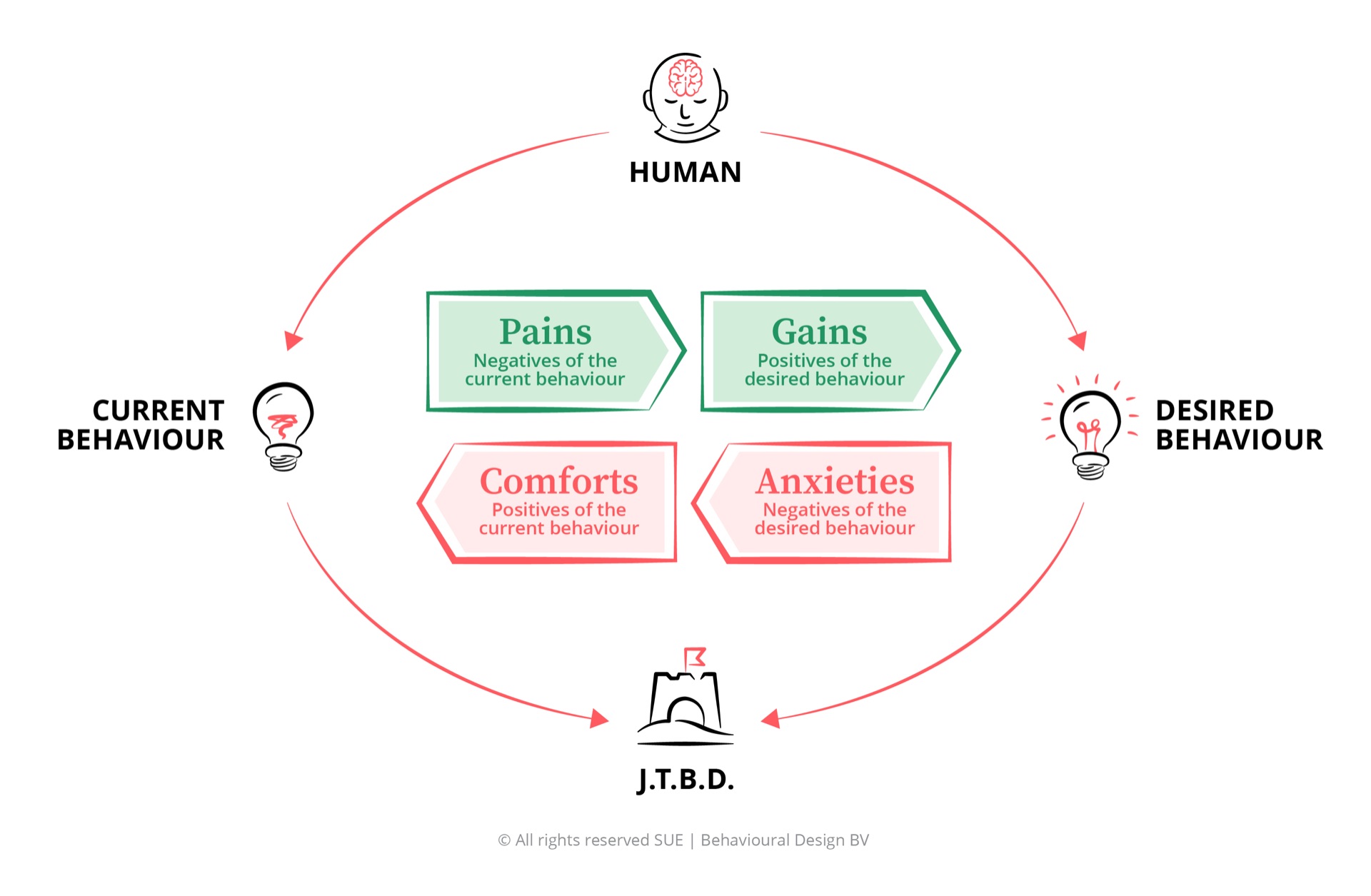
Two forces push toward change:
- Pains - everything that's not working about the current situation. The frustrations, inefficiencies, the feeling that things should be better.
- Gains - the benefits of the new situation. What gets better, easier, more interesting?
Two forces keep people locked in the old:
- Comforts - everything the current behaviour delivers. Familiarity, routines, social safety, a sense of competence.
- Anxieties - everything people dread about the new. Uncertainty, loss of status, fear of not being able to cope.
The problem with most organisational changes: all attention goes to the top of the framework. We make the vision document more appealing (gains). We emphasise that things can't continue this way (pains). But we forget the bottom: the comforts and anxieties that act as anchors.
Lewin's most important discovery was that the most effective strategy isn't to strengthen the driving forces (push harder), but to weaken the restraining forces. That's why the SUE Influence Framework puts such emphasis on Comforts and Anxieties.
Influence is far more judo than karate. In karate you attack. In judo you work with the force of your opponent.
Applied to organisational change: stop pushing harder. Start removing what holds people back.
The phases of organisational change
Almost every change model splits organisational change into phases. The best known comes from that same Kurt Lewin: unfreeze, change, refreeze. First loosen what is stuck, then make the shift, then let the new behaviour settle into routine.
In plain terms, that is three phases:
- 1. Unfreeze. Let people feel why the old way is no longer tenable. The trap is a threatening slide about why things have to change. What actually loosens people is the conversation about what the current situation still gives them. As long as the old behaviour feels safer than the new, nobody moves.
- 2. Change. Introduce the new behaviour and make it as easy as possible. This is the phase where most programmes celebrate too early. One kick-off, one training, and then they hope it sticks. Behaviour does not shift in an afternoon.
- 3. Refreeze. Lock the new behaviour into systems, agreements and the social norm, so it does not spring back the moment attention fades. This is the phase almost everyone skips. And that is exactly where the change slides back to the old.
There are variants with more phases. Kotter describes eight steps, from creating urgency to anchoring change in the culture. Prosci's ADKAR model has five: awareness, desire, knowledge, ability and reinforcement. Useful checklists, all of them. They just describe the shape of change, not the mechanism.
Because every phase is, at its core, a behavioural transition. Unfreeze is weakening comforts and anxieties. Change is making the desired behaviour easy. Refreeze is repeated sparks until it becomes a habit. The phases tell you where you stand. They don't tell you what to do to actually get someone moving. For that you need the Influence Framework.
Five principles for organisational change that sticks
If organisational change is a behavioural problem, then you need to approach it as one. Here are five principles, based on the behavioural science of behaviour change and the SWAC Tool we use at SUE.
1. Define concrete behaviour, not abstract goals
"We're becoming a data-driven organisation" is not a goal anyone can act on Monday morning. "Every project proposal will include three data points from the customer satisfaction survey" is. Organisational change only works when you can specify which behaviour you expect from which people at which moment. Without concrete desired behaviour, there's nothing to design.
2. Remove obstacles before you motivate
Most change programmes start with motivation: inspiring keynotes, success stories, a burning platform. But motivation is fleeting. It peaks at the kick-off and drops back to baseline within weeks.
The more effective route: make the desired behaviour as easy as possible. What's concretely standing in people's way? Is the system too complicated? Does it take too long? Do they have to go against the social norm? Remove those obstacles and people don't need to be as motivated to still show the new behaviour.
Simplicity always beats willpower.
3. Replace the comforts of the old
This is the point almost everyone misses. If the old system gives employees something, status, social connection, a sense of competence, then the new system must offer that too. Otherwise people revert automatically.
A clear example: when Basecamp switched from office to fully remote, they realised the office served a social function that went beyond work. Colleagues chatted at the coffee machine about holidays, hobbies, weekend plans. Those social comforts vanished with remote working.
Their solution: they deliberately built online channels for exactly those conversations. Not because it was "nice," but because they understood that without replacing those comforts, people would want to return to the office regardless of the benefits of remote work.
4. Address anxieties upfront, not afterwards
Every organisational change triggers anxieties. Four sources recur consistently:
- From within: "I don't know if I can do this. It doesn't fit who I am."
- From others: "What will my colleagues think? Will I be the odd one out?"
- From the organisation: "Can I trust management? Last time they promised things too."
- From the new behaviour: "I've tried this before and it didn't work."
The default response is to ignore or dismiss these anxieties: "Don't worry, it'll be fine." That doesn't work. Anxieties aren't arguments you can refute. They're feelings you need to address in the design. Just as resistance to change isn't something to fight, but information about what you haven't yet resolved.
5. design repeated sparks at the right moments
No behaviour happens spontaneously. Every new behaviour needs to be triggered, and not just once, but repeatedly. It takes an average of 66 days to form a new habit, not the commonly cited 21 days.
For organisational change, this means: build reminders, triggers, and feedback moments into the places where the new behaviour should occur. Not in a monthly newsletter, but at the moment someone needs to make a decision. The best sparks are embedded in the daily workflow, not outside it.
Organisational change in practice: three patterns
ING: 3,500 employees to self-managing teams
In 2015, ING Netherlands restructured its entire organisation into self-managing, agile teams, inspired by Spotify. It was one of the most radical organisational changes in Dutch banking. All 3,500 headquarters employees had to reapply for their own positions.
What made this different from most restructurings? ING understood that the structural change (the Spotify model) would only work if employee behaviour changed with it. They invested not only in the org chart, but in daily work routines: standups, retrospectives, autonomous decision-making. The new behaviour was built into the work process itself, not bolted on as an afterthought.
Without that behavioural design, a restructuring is just a new org chart. With it, it becomes a different way of working.
Virgin Atlantic: the gap between what people say and what they do
Virgin Atlantic wanted to improve the customer experience. Traditional research, surveys and focus groups, produced answers like "adventure," "discovery," "excitement." Inspiring, but unusable.
Only when they switched to behavioural interviews, conversations about what travellers actually did and experienced, did the real driver surface: what customers valued was "stress-free," "responsive," and "helpful." Not adventure. A flight attendant who quickly solved a problem.
The result: £1 million extra profit compared to the same period in the previous three years. Virgin called it "the most successful reframing exercise they had ever undertaken."
Applied to organisational change: don't ask what employees think about the change. Observe what they do. The gap between attitudes and behaviour is the blind spot of nearly every change programme.
Google: why a cash bonus backfires
How you reward employees changes their behaviour, but not always in the direction you expect. Research by Dan Ariely at Intel showed that a cash bonus had the shortest positive effect on motivation. The day after the bonus, employees were 13% less productive than colleagues who received no bonus at all.
Google took a different approach: "We can see you've been working hard and missed many evenings with your family. Take your partner and kids to Disneyland. It's on us." The effect on loyalty, engagement, and retention was structurally stronger than any financial bonus.
That's relevant for organisational change, because change requires new behaviour. And how you reinforce that behaviour makes the difference between a one-off spike and a lasting shift.
 Training for professionals
Frequently asked questions about organisational change
What is organisational change?
Organisational change is any fundamental shift in how an organisation works, thinks, or is structured. This includes restructurings, mergers, digital transformation, culture change, or a new strategy. The difference with change management: organisational change describes what happens, change management describes how you approach it.
Why do most organisational changes fail?
Roughly 70% of all organisational changes fail to achieve their goals. The main reason: change plans focus on structures and processes, but ignore the behaviour of the people who need to work with them. Employees are held back not by lack of information, but by uncertainty, habits, and the comforts of the existing system.
How do you implement organisational change successfully?
Start not with the plan, but with the people. Map which forces keep employees locked into old behaviour (comforts and anxieties) and which forces push them toward the new (pains and gains). Then design the environment so the new behaviour becomes easier than the old one, instead of trying to convince employees they should change.
What is the difference between organisational change and change management?
Organisational change is the phenomenon: what happens when structures, culture, or processes shift. Change management is the discipline: how you guide that process. You can experience organisational change without change management, but then you leave the outcome to chance.
What types of organisational change exist?
There are four main types: structural change (restructurings, mergers), cultural change (self-managing teams, new collaboration models), process change (digital transformation, automation), and strategic change (new business model, new market). In practice, these types almost always overlap.
What are the phases of organisational change?
The classic model comes from Kurt Lewin and has three phases: unfreeze (loosening the old behaviour), change (the shift to new behaviour) and refreeze (anchoring the new behaviour so it does not spring back). Later models add phases, such as Kotter's eight steps and the five-phase ADKAR model. They all describe the shape of change. From a behavioural science view, each phase is a behavioural transition: first weaken the comforts and anxieties, then make the new behaviour easy, then repeat it until it becomes a habit.
What are the success factors for organisational change?
Five factors determine whether organisational change sticks: define concrete desired behaviour so people know what to do differently tomorrow, remove obstacles before you motivate, replace the comforts of the old system with something comparable, address anxieties in the design of the change, and build repeated triggers into the moments when the new behaviour needs to happen. Skip these five and the plan stays a plan while the behaviour goes untouched.
Conclusion: organisational change is a design problem
Most organisational changes don't fail because of a lack of vision, strategy, or communication. They fail because they treat people's behaviour as a side issue rather than the core of the challenge.
Behavioural science teaches us that people don't cling to the old out of stubbornness, but because their environment, habits, and anxieties push them there. The solution isn't to communicate harder. The solution is to redesign the environment so the new behaviour becomes the path of least resistance.
That may sound soft, but it's the most effective change strategy science has to offer.
Want to tackle this with your own team? One-day in-company training is built to turn exactly this kind of stalled change process into a concrete intervention, in a single day.