UX design training with behavioural psychology
Your design tests well, and users still drop out.
How much effect your design has depends on how much influence you have on the choices and behaviour of your users. Fortunately, that can be learnt. In our two-day training you learn how to find and remove the barriers no test reveals.How much effect your design has depends on how much influence you have on the choices and behaviour of your users. Fortunately, that can be learnt. In our online course you learn how to find and remove the barriers no test reveals.
Send me the brochure
€1,490 excl. VAT · 16 and 17 September 2027 · Amsterdam · max 16 participantsOnline · 33 lessons at your own pace · €1,190 excl. VAT
What you do differently on Monday.
- You know why users drop out.You see the doubt and the effort a usability test does not show.
- You know how to design a choice.The default, the order and the moment of decision.
- You can back your design with product and business.With behavioural principles they understand too.
10,000+ professionals trained, including people from















Extremely inspiring training, with which you start thinking even more from the needs of the target group. Thanks to the “Influence Framework” “The Job To Be Done” remains central and you learn to remove “Anxieties”. I can't wait to put this method into practice!
As a UX Designer I have always had a passion for understanding user behaviour and how they make decisions. This course had provided me with the Influence Framework and tips that I can use in my day to day projects.
Inspiring two-day training with plenty of room for questions and personal guidance. Nice and pleasant alternation between theory (with surprising examples) and practice. Gives many handles to apply this in my daily work.

The same two days they had. Then Monday, on your design.The same method, online, at your own pace.
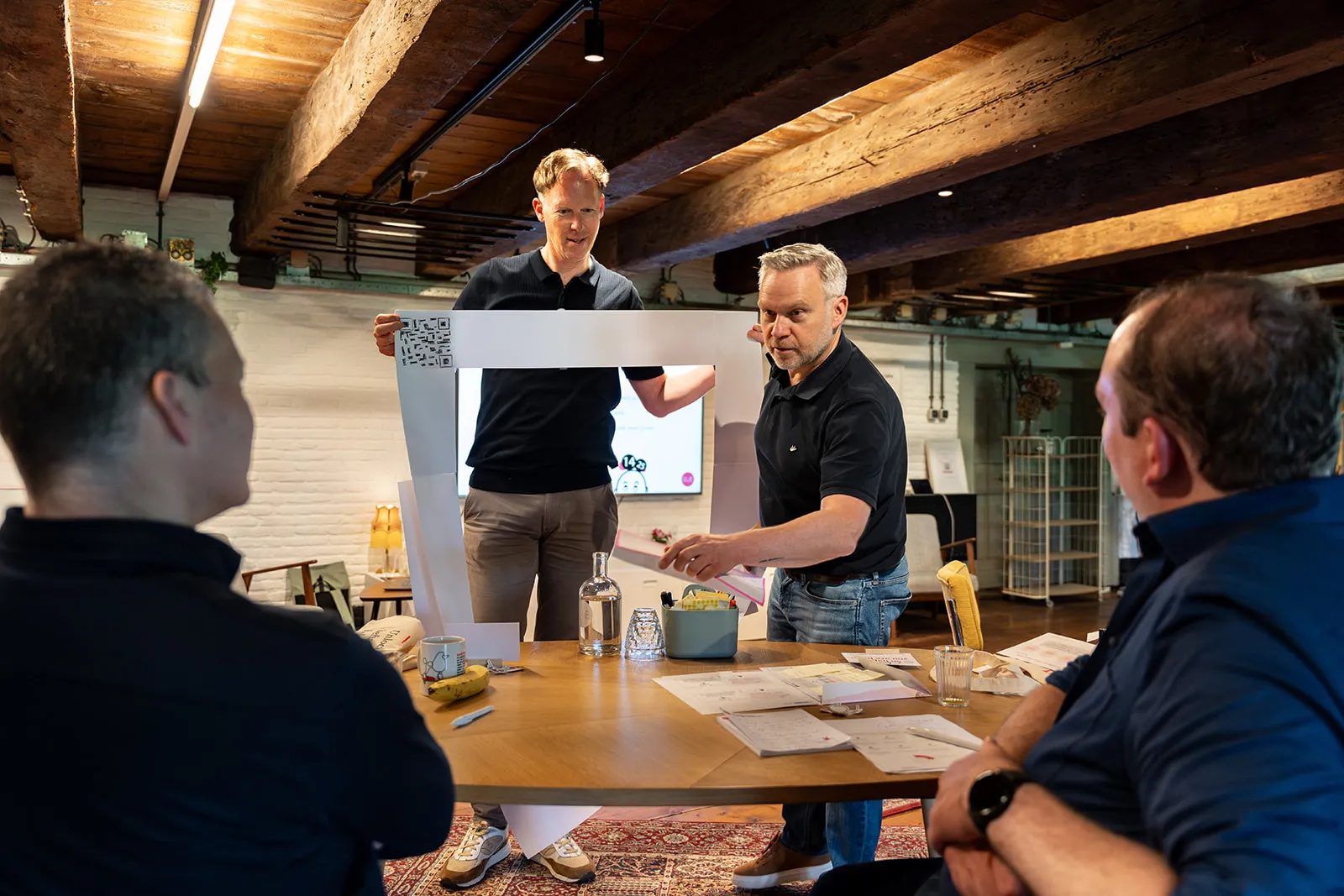
Day 1 is about one question: why does your user do what they do? You apply it straight away with the tools of the SUE Influence Framework©. Day 2 is about the fix. How do you make the choice you want the easiest choice? And how do you put AI to work on it? You go home with downloads and tools you use for your own flow, form or prototype on Monday. People from marketing, HR and policy sit next to you. That is on purpose.Lesson by lesson you work on one question: why does your user do what they do? You apply it straight away with the tools of the SUE Influence Framework©. Then the fix: how do you make the choice you want the easiest choice, and how do you put AI to work on it? In 33 lessons at your own pace you collect downloads and tools you use for your own flow, form or prototype on Monday.
Need to run it past your manager first?
Forward them the brochure: the programme for each day, what you take home and what it costs. It lands in your inbox within a few minutes.Programme, outcomes and price in one place, ready to forward.
How to get your employer on board
Most participants take the training on their employer’s budget or their own training budget. The VAT invoice goes to your organisation: €1,490 excl. VAT. Open the email below, fill in three things and send it to your manager.
Six questions every UX professional recognises.
Why do users drop out of a flow that tests well?
In a test, people pay attention. At home they are tired and distracted, and they drop out at the first doubt.
More on designing customer experience →How do I design choices without dark patterns?
You can make the good choice easy without misleading anyone. The difference is whose interest you serve.
More on consumer behaviour →Why does the user say one thing in the interview and do another?
People often do not know why they do things. Watch what they do and ask what they want to get done.
More on behaviour change →How do I get my design choices past stakeholders?
A beautiful design does not convince on its own. Show which behaviour it changes.
More on persuasion →How do I write microcopy that helps people choose?
People read a button or an error message at the moment they doubt. Say exactly what happens when they click.
More on communication training →What is my role when AI can design screens?
AI makes a screen quickly. You know which behaviour that screen needs to produce.
More on working with AI →What UX professionals ask before they sign up.
I know nothing about behavioural science. Is this still right for me as a UX professional?
Most participants start without any prior knowledge. You learn exactly the behavioural science you need, and you apply it straight away to real-life examples. Afterwards you know how to use it in your research, flows and prototypes.
I already know the UX principles. Will I still learn something new?
That is exactly when it pays off. You already know how to make something usable. The training shows why a usable design still does not make people choose. After two days you design that moment too.
Who will I be in the group with?
A mixed group of up to 16 people: marketers, HR, communications, lawyers, policymakers and managers. The mix is on purpose. You see how someone from another sector wrestles with exactly the same kind of question.
Can I claim this back from my employer?
Yes. We invoice in your company’s name and the training is EQAC-accredited. That makes reimbursement easier. Need a quote or more information for your request? Get in touch.