Change management models: the 6 classics, and what they all miss
I've watched dozens of change programmes up close over the years. And almost every time, the same handful of names come up. Kotter. Lewin. ADKAR. Someone on the steering committee once took a course on it, and that model becomes the scaffolding for the whole programme.
That's not strange. These models became classics for a reason. They bring structure to something that feels chaotic. But I've also watched what happens when a team follows the model perfectly and the change stalls anyway. People understand exactly what's being asked of them. And still don't do it.
This article puts the six best-known change management models side by side. Not to tear them down, they're all valuable in their own right. But to show what they have in common: they design the process of change. Not the behaviour.
Change management models are structured step-by-step frameworks that help organisations plan, communicate and carry out change, such as Kotter's 8-step model, Lewin's three-stage model and ADKAR. Each model describes a different part of the change process, from creating urgency to embedding the result. None of the six explicitly design what stops people in their behaviour, that's the layer behavioural design adds.
Six change management models you'll always run into
The six models below aren't picked at random. They're the models that show up in almost every textbook, every course and every steering committee, each from a slightly different angle: some describe the process, others the organisation as a system, and others the emotional experience of the individual.
1. Lewin's three-stage model: unfreeze, change, refreeze
Kurt Lewin described change in 1947 as a process of three stages: you loosen up the current situation (unfreeze), carry out the change (change), and lock in the new behaviour (refreeze).[1] Underneath this sits his force field analysis: every situation is a balance between driving forces pushing towards change and restraining forces holding onto the status quo.
The model works well for smaller, well-defined changes with a clear start and end point. It breaks down on behaviour once the change runs longer than a few months: people don't move neatly from stage to stage, they shift back and forth continuously between the comfort of old behaviour and the pull of the new. Lewin's own insight, that weakening restraining forces is often more effective than strengthening driving forces, is exactly the part most change managers skip.
2. Kotter's 8-step model
John Kotter turned Lewin's broad stages into eight concrete steps in 1996: creating a sense of urgency, building a guiding coalition, developing a vision, communicating that vision, empowering broad-based action, generating short-term wins, consolidating gains, and anchoring the change in culture.[2] It's the most widely used change model in the world, for good reason: it's concrete and action-oriented.
It works well for large, organisation-wide transformations with strong leadership commitment. Where it breaks: step four, communicating the vision, assumes understanding leads to action. In practice, people usually understand the vision fine. They even believe in it. And still don't change, because the new behaviour simply costs more effort than the old one.
3. ADKAR
Where Kotter operates at the organisational level, ADKAR works from the individual. Jeff Hiatt of Prosci introduced five sequential building blocks in 2006: Awareness of the need for change, Desire to participate, Knowledge of how, Ability to do it, and Reinforcement to make it stick.[3]
ADKAR is strong as a diagnostic tool: it helps you pinpoint exactly which letter someone is stuck on. The weak link is Desire. The model treats desire as something you switch on with the right message, as if it were a dial. Behavioural science shows desire is the outcome of a trade-off between pains, gains, comforts and anxieties, and almost nobody makes that trade-off explicit before writing a communication plan.
4. McKinsey 7S framework
Robert Waterman, Tom Peters and Julien Phillips introduced the 7S framework in 1980: seven interconnected organisational elements, strategy, structure, systems, shared values, style, staff and skills, that all need to align.[4] It's less a step-by-step plan than a diagnostic lens for organisational design.
It's strong for checking whether structure, systems and strategy aren't working against each other. Where it breaks: it describes the organisation as a system, not the person in the middle of it. Two teams with identical structure and systems can react completely differently to the same change, and the 7S model doesn't explain that difference.
5. The change curve
The change curve you'll see in most training decks builds on Elisabeth Kübler-Ross's work on the stages of grief: shock, denial, resistance, exploration, acceptance.[5] Applied to organisations, it normalises resistance as a phase rather than a permanent obstacle, which helps leaders stay patient.
The problem is its linear shape. The model suggests people travel neatly from left to right along the curve. In reality, people continuously weigh a force field of pains, gains, comforts and anxieties against each other, not in a fixed order. Two colleagues in the exact same situation rarely move through the same stages at the same time.
6. Bridges' transition model
William Bridges made a distinction in 1991 that still holds up: change is the external event, transition is the internal, psychological process people go through because of it. His model has three phases: ending (letting go of the old), the neutral zone (the uncomfortable in-between), and new beginning.[6]
Bridges is the strongest of the six at naming loss. That makes it indispensable during reorganisations or layoffs, where people genuinely lose something. The limitation: it names the loss well, but offers little concrete guidance on what to design in the neutral zone to actually move people towards the new behaviour.
The six models side by side
Each model puts the emphasis somewhere different. This table lines them up on focus, what they ask of people, and the behaviour gap left over.
| Model | Focus | What it asks of people | The behaviour gap |
|---|---|---|---|
| Lewin (1947) | Stages of the organisation | Move through unfreeze, change, refreeze | Stages are schematic, people don't move linearly |
| Kotter (1996) | Leadership and momentum | Understand and follow the vision | Understanding doesn't guarantee action, CAN is missing |
| ADKAR (2006) | The individual | Build awareness, desire, knowledge, ability | Desire isn't diagnosed, only prompted |
| McKinsey 7S (1980) | The organisation as a system | Fit within structure, systems, strategy | No attention to individual behavioural drivers |
| Change curve (Kübler-Ross based) | Individual emotion | Move through stages from resistance to acceptance | Emotion treated as linear, no design variables |
| Bridges (1991) | Psychological loss | Let go of the old in the neutral zone | Names the loss, doesn't design a path to new behaviour |
The SUE layer: what you add to every model
At SUE, we don't build a seventh model to compete with these six. That wouldn't even be fair: Kotter, Lewin and the rest are good at what they promise, structure, sequencing, leadership momentum. What we add is a behaviour layer, on top of whichever model you're already using.
It starts with the SUE Influence Framework: you map current and desired behaviour concretely, and analyse four forces. Pains and Gains drive motivation, they explain why someone would want to change. Comforts and Anxieties hold people back, they explain why someone keeps choosing the old behaviour despite that motivation.
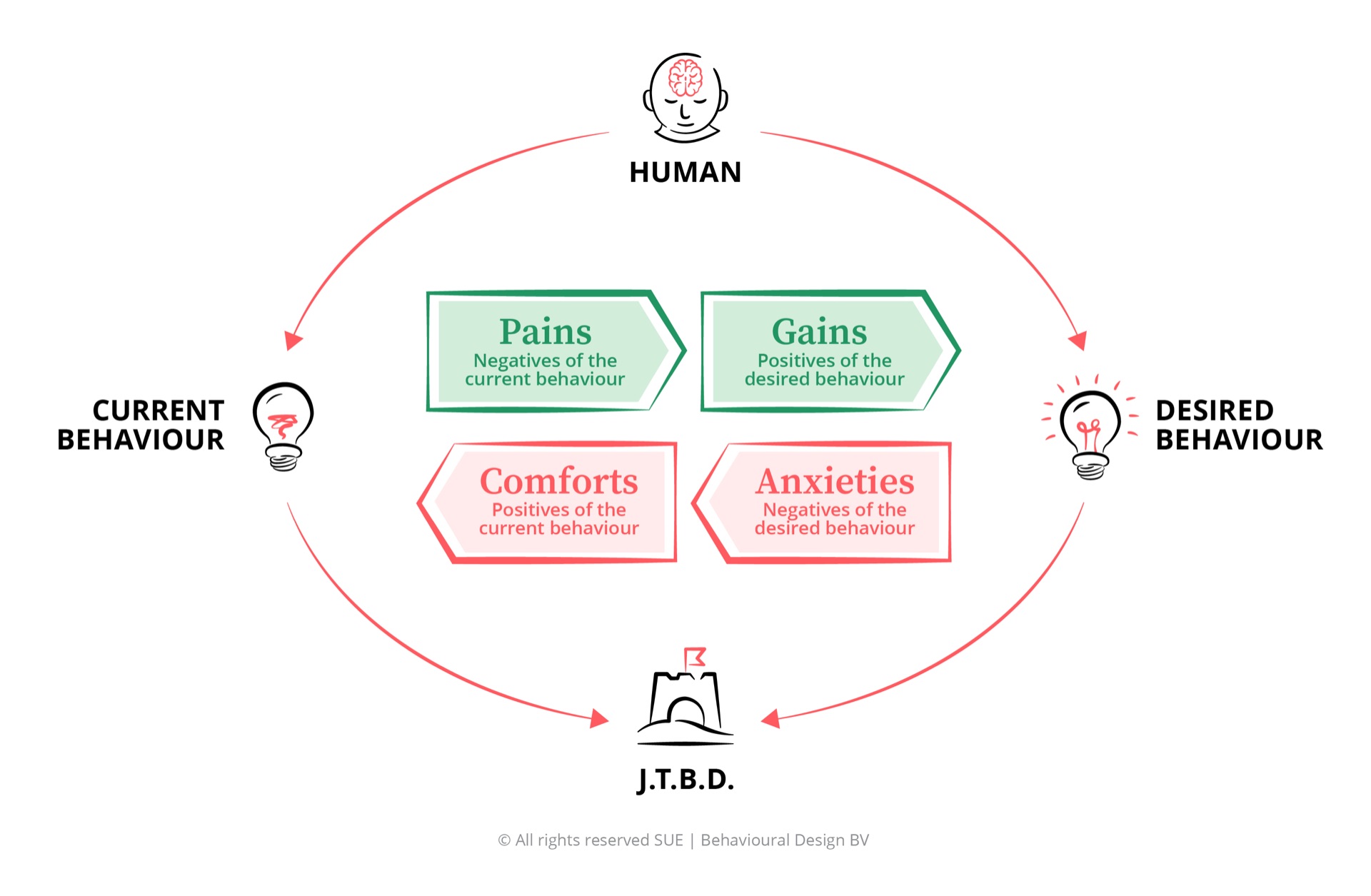
A small example. A sales team has to switch to a new CRM system. The Kotter playbook is followed: urgency has been communicated, training is scheduled, the director explained the benefits at the kick-off. Four weeks later, almost nobody is using the new system consistently.
The Influence Framework question is different. Pains: the old spreadsheet system is error-prone and time-consuming. Gains: the new system automates reporting. But Comforts: the sales reps know every shortcut in the old system by heart, it costs them zero effort anymore. Anxieties: what if I lose a deal because I don't understand the new system yet? That last one outweighs every training session combined, and no communication plan solves it.
The fix isn't another email about the benefits of the new system. It's the SWAC model: make the new behaviour easier than the old one (CAN, for instance by switching off the old system after two weeks), use the moment someone is already starting with a new client anyway (WANT), and build in repetition through short weekly check-ins instead of a single training day (AGAIN).
Want to know exactly where the resistance in your programme is coming from? Read Reducing resistance to change. And if you're still building support: Building support for change shows what actually works.
Conclusion
None of these six models is wrong. Lewin, Kotter, ADKAR, McKinsey 7S, the change curve and Bridges are each the result of decades of practical experience, and they offer exactly the structure a change programme needs. What they share is a blind spot: they describe the process of change, not the behavioural trade-off someone makes at the moment they have to choose between the old and the new.
That doesn't mean you should replace one of the six. It means you add something to it: a concrete diagnosis of what's holding people back, and a design that actually makes the new behaviour easier than the old one. Why change management fails so often digs deeper into what goes wrong when you skip that layer.
Frequently asked questions about change management models
What is the best change management model?
There is no single best model, each one highlights a different part of change. Kotter works well for large, organisation-wide transformations with strong leadership commitment. Lewin suits smaller, well-defined changes. ADKAR is useful for diagnosing where one person or team is stuck. Bridges is strong when something is genuinely lost, such as in a reorganisation. Choose based on the nature of your change, and add a behaviour layer in every case.
What is the difference between Kotter and Lewin?
Lewin (1947) describes change in three broad stages: unfreeze, change, refreeze, with an emphasis on the force field of driving and restraining forces. Kotter (1996) turned that into eight concrete steps, purpose-built for large organisational transformations. Kotter is the most widely used model because it's more concrete, Lewin's strength lies in the underlying logic that also partly inspired the SUE Influence Framework.
Is ADKAR still relevant?
Yes, ADKAR remains valuable because it's one of the few models that works at the individual level rather than the organisational level. The limitation is that ADKAR assumes desire is created through communication, while behavioural science shows desire is a trade-off between pains, gains, comforts and anxieties.
What do most change management models miss?
Most models focus on process, structure and communication, and assume people change once they understand the change. Behavioural science shows understanding is rarely the problem. People keep holding onto old behaviour because it's more comfortable, out of fear of looking incompetent in the new behaviour, or because the new behaviour simply takes more effort.
Can you combine multiple change management models?
Yes, and in practice this happens often. A common combination is Kotter for the organisation-wide steps and ADKAR to diagnose where a specific team is stuck. The models don't compete with each other, they work at different levels. What they all miss is the same behaviour layer.