Six parties, six interests, one plan
You have a plan and six parties who need to have a view on it. The director wants speed. Finance wants certainty. The department that has to carry it out mostly wants things not to get any busier. And the others each have their own reason to wait a little longer.
Stakeholder management, says the handbook. So you draw up a stakeholder map: a two-by-two matrix with names in it. High influence, low interest: keep satisfied. Low influence, high interest: keep informed.
Now think of the person on that grid who gives you the biggest headache. You know which box they are in. You still do not know what to say to them. Winning parties over is a question of influence, and for that you need to know what someone is weighing up.
Stakeholder management is the work of winning over the people and parties who can help or block a plan. The usual approach maps them by influence and interest. What decides the outcome is what the plan costs and gives each of them. That makes stakeholder management a question of influence: shaping choices and behaviour. More on influencing without authority →
What is stakeholder management?
Stakeholder management is everything you do to bring the parties around your plan along with you. A stakeholder is anyone who can affect the result or will feel its consequences: sponsors, neighbouring departments, board members, suppliers, customers, local residents.
In most handbooks it comes down to three steps. You identify the stakeholders, you sort them and you write a communication plan per group. The sorting is nearly always done with the same matrix, with influence on one axis and interest on the other. That gives four types of stakeholder: the ones you manage closely, keep satisfied, keep informed and monitor.
Nothing wrong with that. It allocates your attention. Only that is where it stops.
What does a force field analysis tell you, and what does it leave out?
The matrix is a map of the players around your plan, ordered by power and interest. It tells you how often to talk to someone. It does not tell you what to say, because it contains no information about that person.
Take two people in the same box: high influence, currently not cooperating. One is holding back because your project takes two people out of his team next quarter. The other because she proposed something similar two years ago, it was turned down, and she has no intention of watching you succeed with it now. Same box, opposite problems.
The matrix tells you how often to talk to someone. It cannot tell you what to say.
This is where a force field analysis helps, in the sense psychologist Kurt Lewin meant it in 1947. Lewin was not listing players. He described behaviour as an equilibrium between forces that push and forces that hold back.[1] While those are equally strong, nothing happens. According to Lewin you can shift the equilibrium in two ways:
"... by adding forces in the desired direction or by diminishing opposing forces."
Kurt Lewin, Human Relations (1947)
Lewin had a clear preference. Pushing harder raises the tension, and that tension goes together with more fatigue, aggressiveness and emotionality. Diminishing the opposing forces produces the same shift with less tension.
A force field in Lewin's sense is about what is at play for one person. What pushes them towards your plan, and what holds them back? No matrix contains that.
Why do stakeholders resist when the benefits are clear?
Every stakeholder does their own sum, and it has three terms: what does this cost me, what does it give me, and how certain is either.
The first term weighs most. In 1979 Daniel Kahneman and Amos Tversky showed with prospect theory that a loss weighs more heavily than a gain of the same size.[2] Your plan offers a stakeholder a share in a gain for the whole organisation, some time next year. It asks them for something concrete this quarter: headcount, budget, the say over a decision.
For things people already hold, the effect is stronger still. Daniel Kahneman, Jack Knetsch and Richard Thaler showed in a series of experiments that people demand far more to give something up than they would pay to acquire the same thing.[3] Translate that to a reorganisation. The two roles a manager has in his team now are worth more to him than two roles he might get back later, even when the sum on paper is identical.
Then there is freedom of choice. In 1966 psychologist Jack Brehm described how people respond when their freedom to choose is restricted. A 2015 review by psychologist Christina Steindl and colleagues sums up what follows: people want that freedom back, and the option they are about to lose becomes more attractive.[4] So a decision presented as final provokes more resistance than the same decision with something left to choose.
This is why building support so often means, in practice, a longer presentation. It is the only move left when you assume the problem is understanding. They understood, from the very first meeting. What you call resistance is the outcome of a sum you never saw.
How do you map the forces per person?
This is what the SUE | Influence Framework© is for. It is the model from Behavioural Design that builds on Lewin's force field and works it out into four forces: pains, gains, comforts and anxieties.[5] Fill it in per person, never per group.
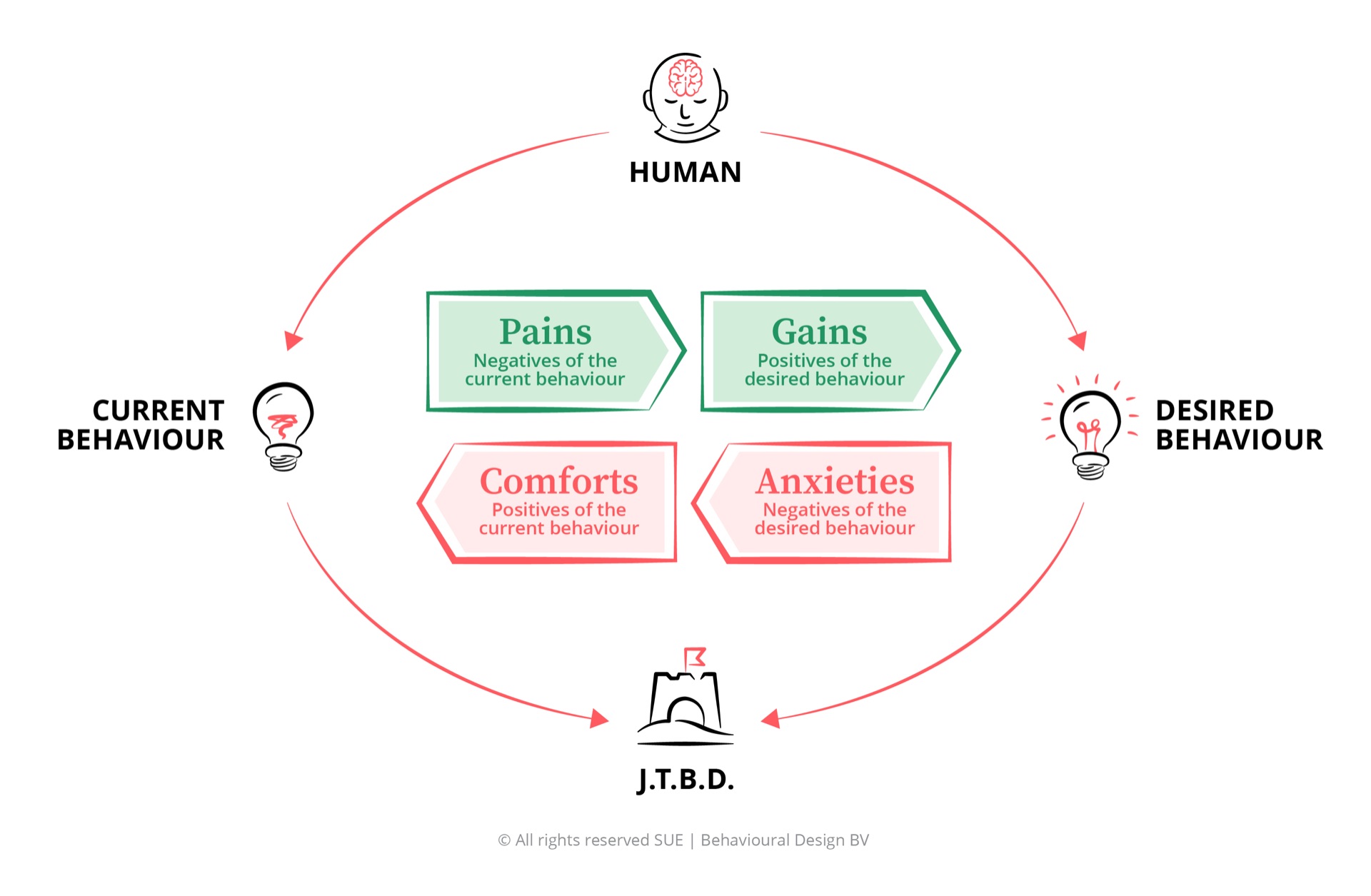
The pains are the problems your plan solves for them. And here is the uncomfortable part: often there are none. Your plan solves a problem for the organisation, not one this person feels on a Tuesday. If you cannot name a pain of theirs, there is little to persuade and you will have to compensate them for something.
The gains have to be theirs. Efficiency for the organisation is no gain for the person whose team gets smaller. What they might want: visibility, a headache file off their desk, a resource they have been asking for.
The anxieties are usually the real blocker, and they are almost never spoken in the meeting. What if this fails and I backed it? What does it do to my headcount, my remit, my standing with the people I depend on?
And the comforts of the current situation are underestimated. They know how things work now. Their team is set up for it. The present needs no explaining to anyone.
Put this next to your matrix. The matrix tells you who to talk to. The four forces tell you what about.
How do you win stakeholders over? Six steps
1. Do the exercise for five people, not twenty
Pick the ones who can really stop this, and write out the four forces for each. Twenty stakeholders is an archive, five is a plan. If your list is longer than five, you have not yet decided who matters.
2. Ask before you tell
The whole sum is guesswork until someone confirms it. Have one conversation before the proposal exists, and ask what would make this hard for them. You collect data, and you show at the same time that their side of things counts.
3. Name the cost out loud
"This takes two people out of your team in the third quarter and I do not have a solution for that yet." A sentence like that does more for your credibility than any slide of benefits. Costs nobody mentions do not go away. They come back later as an objection about something else, usually with an audience.
4. Hand back a decision where you can
Resistance comes from a choice that was taken away, so give one back. Let them choose the timing, the pilot team, the order. What people defend is seldom the decision itself. Mostly it is the fact that they get to make one.
5. Ask for something small first
Ask a hesitant stakeholder to read a document, to sit in on one session or to lend you one person for two weeks. A small step asks little of their worries, and it gives you both something concrete to have the next conversation about.
6. Find out who they answer to
Your stakeholder has stakeholders. What looks like obstruction is often someone protecting a position with a manager you never meet. Once you know what they are held to account for, your plan often turns out to help with it. Then they have a reason of their own to take part.
If the people you need do not report to you either, read influence without authority. If your stakeholder is a client deciding on your advice, the article on becoming a trusted advisor goes further into that.
What do you do when a stakeholder will not move?
Some sums do not work out. Your plan really does cost them something, and no design changes that.
Then say so, to them and to whoever sponsors the work. Continuing to manage a stakeholder while everyone knows the answer is no is a slow and expensive way of arriving at a decision that could have been taken in week two.
After that, choose: compensate the cost, take the decision higher up, or narrow the scope so they are no longer in it. Those are the three real options. Explaining the benefits again is a fourth, and it is the one most projects pick.
Frequently asked questions about stakeholder management
What is stakeholder management?
Stakeholder management is the work of winning over the people and parties who can help or block a plan. Usually you identify them, sort them by influence and interest and write a communication plan. The part that decides the outcome is understanding what the plan costs and gives each of them.
What are the four types of stakeholders?
The four types come from the matrix of influence and interest. Stakeholders with high influence and high interest you manage closely. High influence and low interest you keep satisfied. Low influence and high interest you keep informed. Low influence and low interest you monitor. The sorting says how much attention someone gets, not what to say to them.
What is a force field analysis?
A force field analysis maps the forces for and against a change. The idea comes from psychologist Kurt Lewin, who in 1947 described behaviour as an equilibrium between forces that push and forces that hold back. Applied to stakeholders, you look per person at what pushes them towards your plan and what holds them back.
Why do stakeholders resist when the benefits are clear?
Because clarity is seldom the obstacle. A loss weighs more heavily than a gain of the same size, and your plan usually offers a shared gain in the future in exchange for a concrete cost now. Repeating the benefits does not change that sum.
How do you win over a difficult stakeholder?
Find out what your plan costs them, ask before you tell and name that cost out loud. Then hand back a decision where you can, because resistance comes from a choice that was taken away. Ask for something small first and find out who they answer to.
What do you do when a stakeholder simply will not cooperate?
Say it out loud instead of continuing to manage them. There are three real options: compensate the cost, take the decision higher up, or narrow the scope so they are no longer in it. Explaining the benefits again is not one of them.
Conclusion
Stakeholder management is taught as a drawing exercise and behaves like a sum. Every party works out what your plan costs, what it gives them and how certain that is. None of those three numbers is on the chart on your wall.
So put the chart away for an afternoon and write out the four forces for the five people who can really stop this. Then go and ask whether you had it right. That is influence: knowing what someone is weighing up before you ask them for anything. In the online training The Art of Influence© you learn how people choose and how to design your plan around that.
Expect to be wrong about a few of those five. It is the best thing that can happen to your plan this month.