Your advice is right. The client chooses something else.
You have done the analysis. The numbers hold up, the recommendation is clear and everyone nodded in the meeting. Two weeks later you hear the client went for the other option. Or for nothing at all, and your advice is sitting in a drawer.
It happens to consultants, accountants, lawyers and internal advisers. The reflex is nearly always the same: the advice has to get better. A sharper analysis, one more scenario, a tighter report. Anyone who sets out to improve their advisory skills, or to become a trusted advisor, tends to end up with conversation technique and report writing.
Only that is rarely where it goes wrong. Advice that is right and still not followed is a question of influence: how do you shape a choice that somebody else makes.
Advisory skills are the skills an adviser uses to make sure advice is understood, trusted and followed. Subject knowledge is only one part. Whether a client follows your advice depends on what it costs them to let go of their own judgement. That makes advising a question of influence: shaping choices and behaviour. More on influencing without authority →
What are advisory skills?
Advisory skills are everything you need to bring someone else to a good decision when the decision is not yours. That takes more than expertise. An adviser needs three things, and most programmes spend their time on the first two.
The first is content. You can analyse a problem and arrive at a recommendation that holds up. The second is the conversation: probing, summarising, structuring a client meeting and writing a report someone wants to read. The third is influence. You understand how the other person chooses, and you set up your advice so that choosing your recommendation becomes easy.
That third part decides whether anything happens with your work, and it gets the least practice. Advising means somebody else decides. Everything you achieve, you achieve through another person's choice.
Why do clients ignore good advice?
A client who sets your advice aside has usually understood it perfectly well. Three things are at play that have nothing to do with the quality of your analysis.
People weigh their own judgement more heavily than an adviser's
Psychologists Ilan Yaniv and Eli Kleinberger of the Hebrew University of Jerusalem measured, across three studies, how much weight people give to advice compared with their own opinion.[1] Their finding: advice is systematically discounted. They call it egocentric discounting.
Their explanation is simple. Your client knows their own reasons from the inside. They know why they think what they think. Your reasons they only know from your slides. So their own judgement feels better founded than yours, even when you put three weeks of research into it.
The same study showed something about an adviser's reputation. It forms fast and it is revised unevenly.
"It may be easier for advisors to lose a good reputation than to gain one."
Ilan Yaniv and Eli Kleinberger, Hebrew University of Jerusalem (2000)
The one piece of advice that turned out badly stays with your client longer than all the times you were right.
Your advice costs the client something they already have
Nearly every piece of advice asks the client to give something up. A supplier they are used to. A plan they came up with themselves. A position they defended in the board meeting last month.
In 1979 Daniel Kahneman and Amos Tversky showed with prospect theory that a loss weighs more heavily than a gain of the same size.[2] Your advice promises a gain that comes later and is uncertain. What it costs is immediate and fixed. That sum goes against you more often than your report would suggest.
Firm advice provokes resistance
In 1966 psychologist Jack Brehm described what happens when people sense their freedom to choose is being restricted. He called it reactance. A 2015 review by psychologist Christina Steindl and colleagues lists the consequences: people want their freedom back, take the source of the pressure less seriously and find the option they are about to lose more attractive.[3]
Advice with a single recommendation and the message "this is what you must do" is exactly that kind of restricted choice. The firmer you are, the more attractive the other option becomes. Which is bitter, because you were firm for the very reason that you were sure.
What is a trusted advisor, and why does trust outweigh being right?
A trusted advisor is the adviser a client calls before there is an assignment. The term comes from The Trusted Advisor, the 2000 book by David Maister, Charles Green and Robert Galford. They capture trust in one equation: credibility, reliability and intimacy add up, and that sum is divided by self-orientation.[4]
The denominator is the interesting part. Self-orientation is about where your attention sits: on yourself or on the other person. An adviser who mainly wants to be proved right, to account for the hours or to show off the method is occupied with themselves. The client notices, even without being able to name it.
Put that next to Yaniv and Kleinberger. The client can only check part of your reasoning. What they can judge is whether you understand their situation. So that is what they watch.
What is holding your client back? Four forces
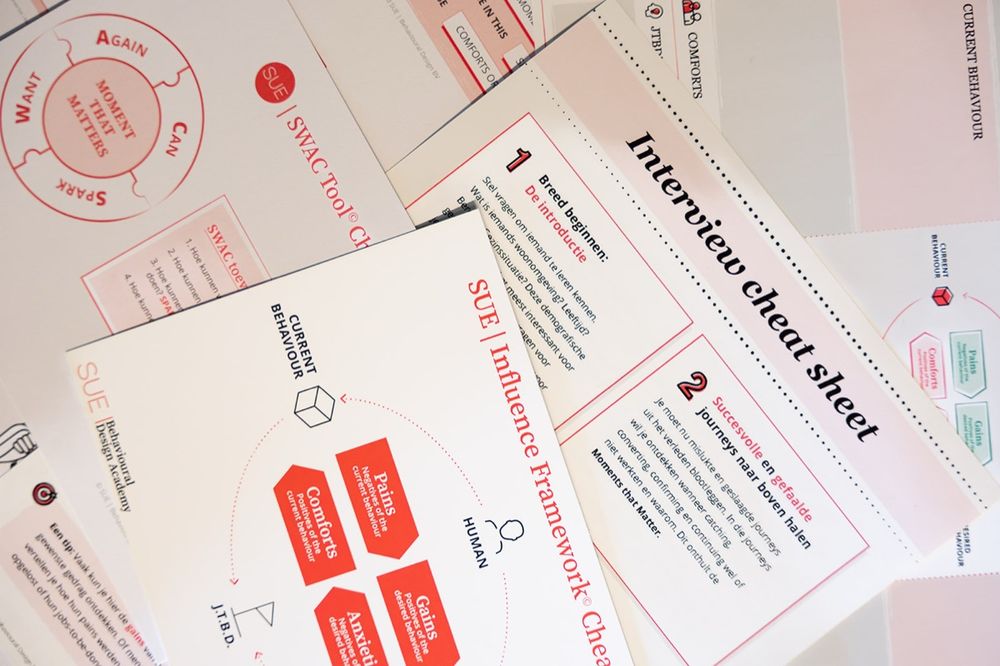
If being right is not enough, you need something else. It helps to swap the question "how do I convince my client" for "what are they weighing up". At SUE we use the SUE | Influence Framework© for this, the model from Behavioural Design that maps which forces push someone towards new behaviour and which keep them where they are.[5]
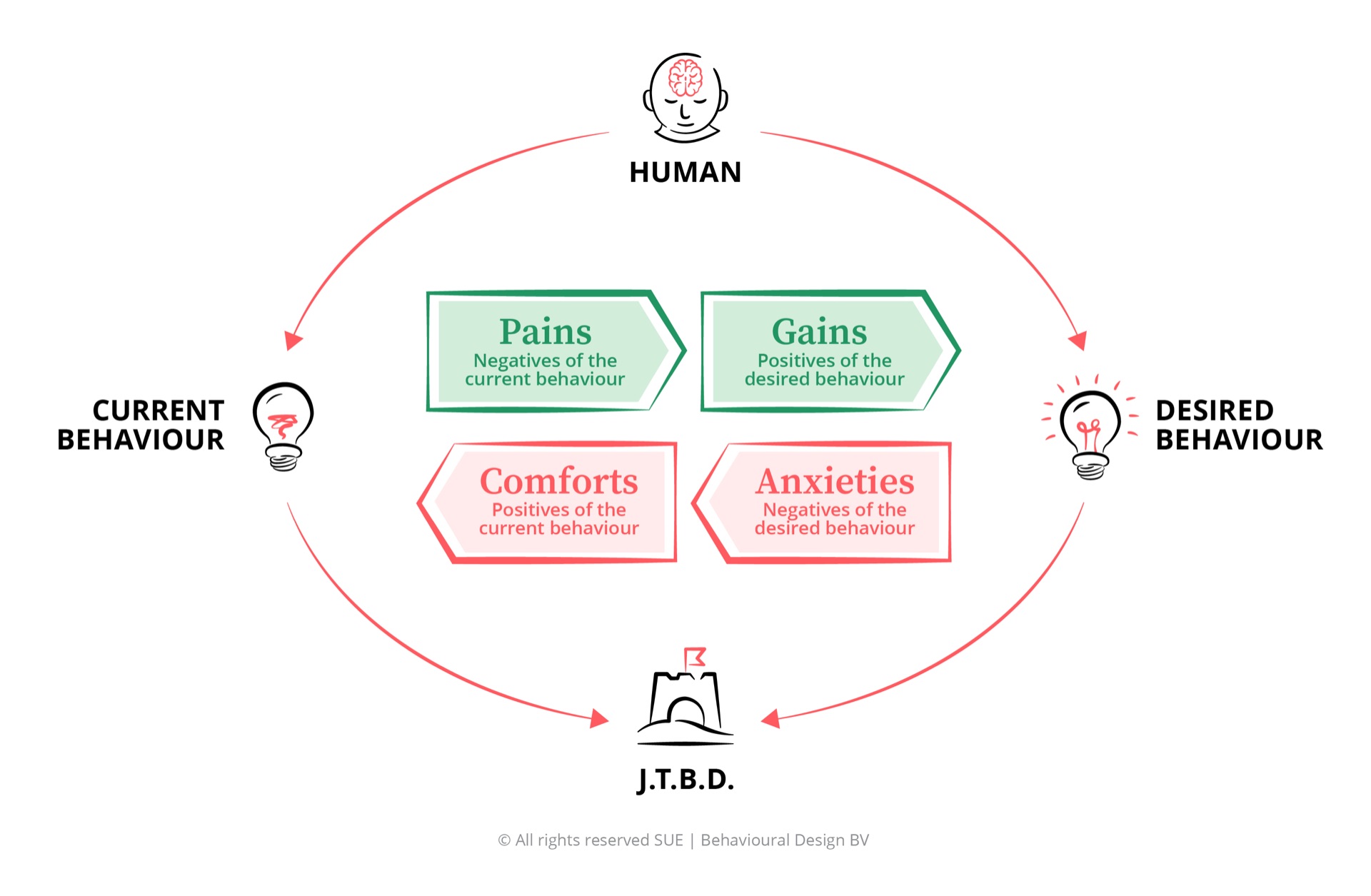
Two forces work for you. The pains are what bothers the client in their current situation. The gains are what the new situation would give them. Nearly every advisory report is full of these: the problem, the opportunities, the business case.
Two forces work against you. The comforts are everything that is pleasant about how things are now. The familiar way of working, the supplier they have known for years, the fact that the present needs no explaining to anyone. The anxieties are the doubts about the new. What if this fails and I signed off on it? What will my board say? Can my team handle it?
Most advice only strengthens the first two forces. One more argument, one more figure. Meanwhile the client is stuck on the last two, and your report usually says nothing about them. Why facts and arguments rarely persuade explains how that comes about.
Nearly every piece of advice explains why the client should move, and stays silent on what keeps them in place.
How do you get your advice followed?
You do not have to become a different person. There are five things to do differently, before and during the client meeting.
1. Find out who decides and what it costs them
Before you write down a single recommendation: who takes this decision, and what does that person have to give up if they follow your advice? Write out the four forces for them. If you cannot get beyond a guess on comforts and anxieties, you know what to ask in the next conversation. With several decision makers, do it per person. The article on stakeholder management shows how.
2. Ask before you tell
Start the meeting with the questions your advice is the answer to. What needs to be different a year from now? What happens if nothing changes? A client who puts their own problem into words hears their own reasons. And their own reasons weigh more than yours.
3. Hand back a choice
Present two or three workable options, and say which one you would choose and why. You stay the adviser with a view, and the client stays the one who decides. Reactance comes from a choice that was taken away. So you give it back.
4. Name the cost
Say out loud what your advice costs the client. "This means the project you started last year stops." It feels as if you are undermining your own advice. In practice the client sees that you understand their situation, and a cost that is on the table can be made smaller together. A cost nobody mentions comes back later as an objection about something else.
5. Make the first step small
Advice that opens with a reorganisation asks for a leap. Advice that opens with a trial in one department asks for a step. Look for the first action that is small enough for the client's worries not to outweigh it, and recommend that as the start.
This is persuading clients without pushing. You take away what holds them back, and your argument has far less work to do. If you work internally, as a staff adviser or project lead, the same goes for colleagues who do not report to you. That is the subject of influence without authority.
Frequently asked questions about advisory skills and the trusted advisor
What are good advisory skills?
Good advisory skills have three parts: subject knowledge, conversation skills and influence. The third gets the least training and decides the most. It is about understanding how the client chooses and setting up your advice so that they follow it.
Why do clients ignore good advice?
Usually for reasons that have nothing to do with the quality of the advice. People weigh their own judgement more heavily than an adviser's, a loss counts for more than a gain of the same size, and firm advice feels like a restricted choice. So start by finding out what your advice costs the client.
What is a trusted advisor?
A trusted advisor is an adviser a client trusts with questions that go beyond the assignment. The term comes from the 2000 book of the same name by Maister, Green and Galford. In their equation trust grows with credibility, reliability and intimacy, and falls as the adviser becomes more occupied with themselves.
How do you develop advisory skills?
By practising the part that gets the least attention: influence. For every piece of advice, map what is holding the decision maker back, ask before you tell, hand back a choice and make the first step small. The SUE | Influence Framework© gives you a fixed structure for doing that.
How do you convince a client to follow your advice?
By convincing less and removing more. Extra arguments reinforce what the client already knew. What holds them back is the comfort of the current situation and their worries about the new one. Name those and make them smaller, and your advice needs far less push.
Conclusion
Advisory skills are usually taught as a craft of analysing, structuring and presenting. That is necessary. It is also only half the work, because a client decides on something other than the quality of your report. They decide on what your advice costs them, on how much choice they have left and on whether you understand their situation.
That makes advising a craft of influence. Influence on a choice that is not yours, with someone who does not have to take anything from you. In the online training The Art of Influence© you learn how people choose and how to design your advice, proposal or plan around that.
Advice is only finished when someone does something with it.