Why facts and arguments rarely persuade
You have undoubtedly been there. You try to explain something to a colleague or a client, with your facts lined up and your reasoning watertight. And still nothing changes. If anything, the other person seems to dig in further.
That is not down to stubbornness or a lack of intelligence, but to how the brain works. This article explains why rational persuasion rarely works, and what behavioural science offers as an alternative.
Rational persuasion is the assumption that people change their minds or behaviour when given enough facts and logical arguments. Behavioural science shows this rarely works. Most decisions are made automatically and intuitively, and arguments often trigger resistance rather than reconsideration. What does work: framing, identity, social norm and ease. More on the SUE Influence Framework →
The assumption we all make
We were all raised with the same idea: if you have the right arguments and you present them well, the other person will come along. We were trained in essays at school, in business cases at work, and in evidence in science. We live in a culture of arguments.
The problem is that we see ourselves as rational beings who occasionally make an emotional mistake. Research by Daniel Kahneman and colleagues has shown the opposite for decades: we are intuitive beings who occasionally do something rational.[1]
We are not rational beings who decide emotionally. We are emotional beings who reason rationally.
That single sentence is the entire insight. And still we keep acting as if the first reading is correct. We talk louder, supply more evidence, repeat the argument. And we are surprised when it does not work. If you want to increase your influence, stop talking louder and look at the situation in which the other person chooses.
What the brain actually does with facts
The brain has two modes for processing information. Kahneman calls them System 1 and System 2. System 1 is fast, automatic, emotional and effortless. System 2 is slow, deliberate, analytical and energy-hungry. Around 95 to 98 percent of our thinking runs through System 1.
Facts and arguments are fuel for System 2. The problem: System 2 is rarely switched on. The brain conserves energy. It hands most decisions to System 1 and only engages System 2 when it absolutely must.
So what does System 1 do with a fact that contradicts someone's position? Three things, often at once:
- Confirmation bias. The brain scans the fact for anything that confirms what it already believes and ignores the rest.
- Motivated reasoning. The brain looks for arguments to keep the existing position intact, not to test it.
- Identity defence. If the fact touches who someone believes they are, it feels like an attack. Resistance is ready.
The effect: the stronger your argument, the firmer the resistance can become. Researchers call this the backfire effect.[2] A counter-argument confirms for the other person that you do not understand what is really at stake.
Three reasons arguments backfire
Beyond the mechanics of System 1, three social processes make rational persuasion even harder.
1. Arguments touch identity, not topic
A position is rarely just an opinion about a topic. It often signals who you are, who you belong with, and what you care about. When someone criticises the position, the other person experiences it as criticism of themselves. The brain does not defend a fact, it defends self-image.
2. Arguments feel like a loss of autonomy
People want autonomy. A good argument often feels like pressure. As in: you must move because I am right. The brain responds with reactance, an automatic urge to restore autonomy by doing the opposite.[3]
3. Arguments cut social ties
We do not think only for ourselves, we think for our group. If a position is connected to a group someone belongs to, changing the position often means distancing themselves from that group. The cost of that is usually higher than the benefit of the new position.
What does work: four levers from behavioural science
Behavioural science offers an alternative. Not one magic bullet, but four levers you use together. They map onto the places where System 1 actually moves. We bring them together in the SUE Influence Framework: an outside-in way of looking that starts with what moves the other person, not with what you want to say.
Lever 1: framing
The same fact can be told in ten different ways. Each frame triggers a different reaction. The framing effect shows that the packaging often weighs more than the content. Not because people are shallow, but because System 1 recognises patterns before System 2 weighs the facts.
In practice: instead of saying a ninety percent chance it will go wrong, say a ten percent chance it will work. Same fact, very different reaction. The skill is not manipulation. The skill is choosing the frame that helps the message land.
Lever 2: identity
People do what fits who they are, or who they want to be. Someone who wants to lose weight gains more from you are the kind of person who looks after themselves than from a calorie chart. Someone hesitating about a new way of working moves faster if that way fits the kind of professional they are.
In practice: address people through an identity they are proud of, and connect the desired behaviour to it. Not you must, but you are someone who.
Lever 3: social norm
What people like you do is one of the strongest drivers of behaviour.[4] Not what they ought to do, not what is statistically best, but what they actually do. Cialdini calls this social proof. It works especially well when the group you compare with feels relevant to the other person.
In practice: make visible what the majority of a relevant group already does. Not as a statistic, but as a pattern of behaviour. Nine out of ten colleagues in your team start the week this way is stronger than five good reasons why you should do it too.
Lever 4: ease
The most powerful mechanism of all, and the most underestimated. People nearly always choose the path of least resistance. Anyone who wants to see the desired behaviour must make it as easy as possible. And make the undesired behaviour a fraction harder.
In practice: lower thresholds, remove steps, prescribe defaults. The difference between ten clicks and one is often the difference between nothing and everything.
How to apply this in your next conversation
The four levers are not an abstract model. You can use them in your next difficult conversation. A mini-protocol in five steps.
- Listen before you speak. Find out what the other person is holding on to. Which pain, which habit, which fear. Without that, your levers miss.
- Affirm identity. Acknowledge out loud who the other person is and what they care about. That takes the defence out. Identity is never in the wrong camp, a behaviour sometimes is.
- Shift the frame. Tell the same fact from a different angle. Not to mislead, but to give the facts room again.
- Point to what others do. Not as a reproach but as an observation. Most people in a similar situation choose X.
- Make the step small. Do not ask for the whole change, ask for one concrete first step that can happen tonight.
What you notice: you slow down and persuade less, and precisely because of that you see more movement.
When rational arguments do work
This article is not arguing against arguments. There are situations where rationality makes the difference:
- When someone is already leaning towards your position and looking for confirmation to take the step.
- When the decision is new and does not touch any existing identity.
- When there is time, calm and attention for a weighing of options, and System 2 is awake.
- When transparency and honesty are at stake, such as contracts, policies and advice where the other person actually needs the facts.
Arguments are not the enemy. Arguments are one of the levers, and rarely the strongest. Anyone with only arguments is missing most of the toolkit.

Conclusion
The next time you want to persuade someone, ask yourself one question before you start. What might be going on beneath the surface? Which pain, which habit, which fear? Which identity is attached to this? Which group is watching?
Only once you know that, do you know where to start. Not with the facts. With the person. And you will often find that you do not need an argument, but a better question.
Frequently asked questions
Why do facts and arguments rarely persuade people?
Because most decisions are not made rationally but automatically. System 1 (fast, intuitive) sets the direction, System 2 (slow, deliberate) supplies the arguments afterwards. Anyone offering arguments addresses the wrong system, and often reinforces the existing belief through confirmation bias.
What is the backfire effect?
The backfire effect describes the pattern where people, when confronted with counter-arguments, sometimes defend their original belief more strongly. With strongly held views, arguments trigger resistance rather than reconsideration.
What works when persuasion does not?
Four levers consistently work: framing (how you present something), identity (fitting who someone wants to be), social norm (what people like them do), and ease (how easy you make it). Together they form the core of the behavioural science approach.
When do rational arguments work?
When someone is already leaning towards your position and looking for confirmation, when the choice is new and does not touch identity, and when the decision is made consciously and with attention. In all other situations, framing, identity and ease are stronger levers.
How do I apply this in a conversation?
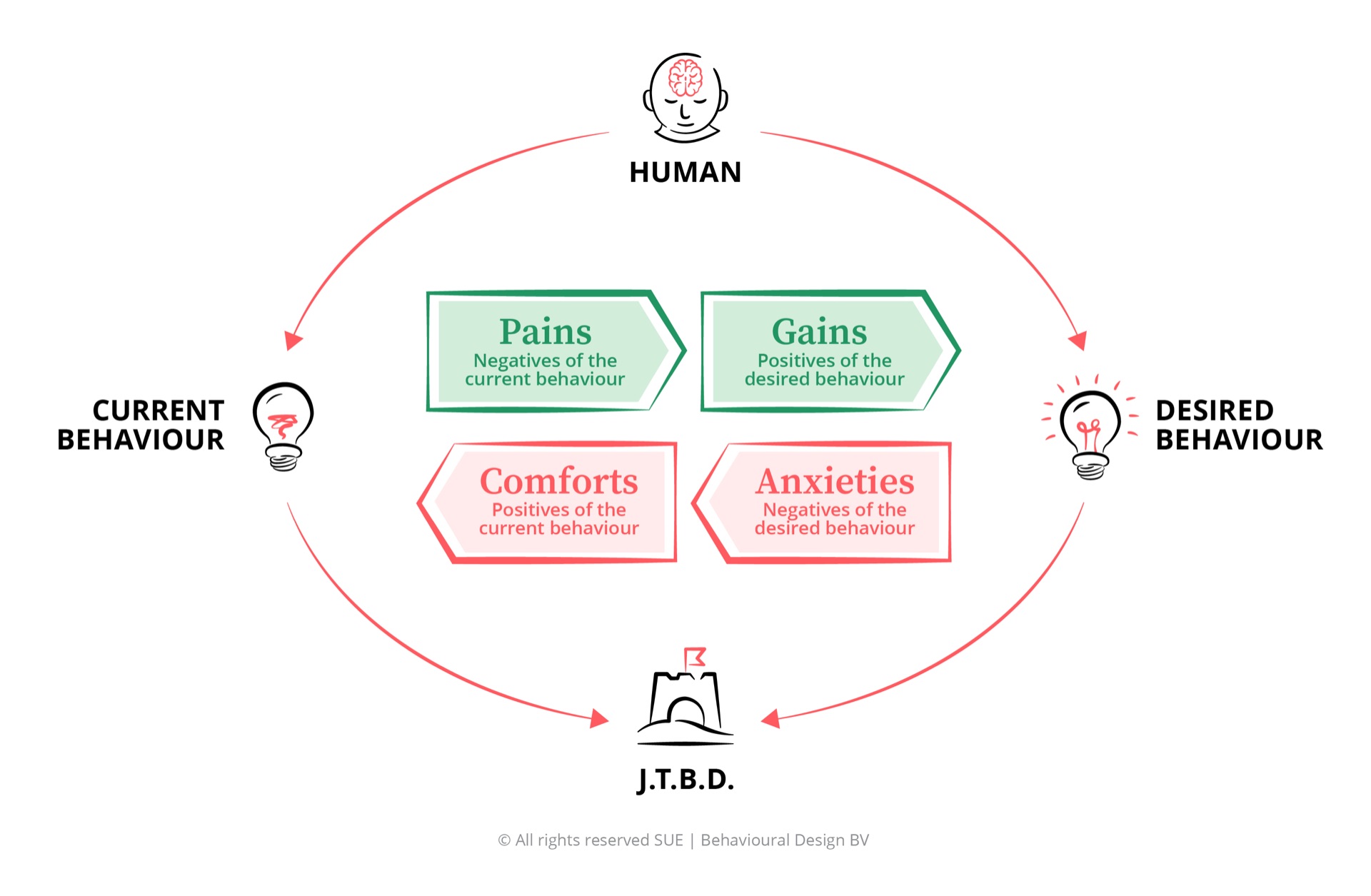
Start with listening rather than persuading. Find out which job, pain or comfort the other person is holding on to. Connect to what matters to them, not to you. Make the desired step small and easy. And affirm identity: show that the behaviour fits who they already are.
Apply this in your field: Communications · HR · Marketing · Managers · Change management · Sales · Government · UX design · Product management
See our training programmes →