Change fatigue: people are not tired of change, they are tired of change that never ends
Announce a new programme in a team that has been through four of them and watch what happens. Nobody argues. Nobody objects. People nod, write it down, and carry on doing what they were doing.
That polite non-response gets diagnosed as change fatigue, and then treated as a volume problem: we are asking too much of people, we should slow down, we should sequence better.
It is worth checking that diagnosis, because the same teams will happily absorb an enormous amount of change when a different condition is met. And it is not a lower workload.
Change fatigue is the exhaustion and quiet disengagement that builds after repeated change programmes. It is usually blamed on the amount of change. The more useful explanation is that none of it visibly finished: people were asked to start five things and never got to see one of them end. More on behavioural design for change →
What is change fatigue?
Change fatigue is the state a team reaches when new initiatives stop producing any response at all. Not resistance, which is loud and at least tells you something. Compliance without belief: the plan gets acknowledged, the training gets attended, and behaviour stays exactly where it was.
The standard explanation is cumulative load. Four restructures in three years, a new system, a new strategy, and people are simply worn out.
Look closer at the four restructures, though, and something else stands out. Ask anyone in that team how the second one ended and you will usually get a shrug. Nobody can say when it stopped, which is a different thing from saying it failed. It did not conclude. It faded, got absorbed into the next thing, and quietly stopped being mentioned.
Nobody is exhausted by finishing things. They are exhausted by carrying things that never close.
Why volume is the wrong diagnosis
If change fatigue were caused by the amount of change, you would expect the most-changed organisations to be the most exhausted. In practice, teams in genuinely fast-moving environments often show the opposite: high tolerance for disruption, provided each disruption reaches a visible end.
The mechanism was described almost a century ago. Bluma Zeigarnik found in 1927 that people remember interrupted tasks far better than completed ones: an unfinished task keeps occupying attention in a way a finished one does not.[1] That effect is useful for a waiter holding six orders in his head. It is corrosive when the unfinished items are organisational programmes, because they never stop demanding a small share of everyone's attention.
Five open change programmes are not five times the work of one. They are one workload plus five permanently open loops, and it is the open loops that produce the tiredness.
There is a motivational cost too. Teresa Amabile and Steven Kramer analysed thousands of daily diary entries from people doing knowledge work and found that the single strongest driver of good inner working life was making visible progress in meaningful work.[2] Not recognition, not incentives. Progress you can see. A programme that never concludes systematically denies people exactly that.
Run that for long enough and you get something worse than tiredness. Steven Maier and Martin Seligman's work on learned helplessness showed what happens when effort and outcome become disconnected: the effort stops, even once the situation changes.[3] The team that nods and does nothing is not being difficult. It has learned, accurately, that engaging with the last four programmes changed nothing.
Why organisations skip the ending
If endings matter this much, why does almost nobody design one?
Partly because attention follows the launch. A kick-off has an audience, a deck and a sponsor's name attached. A closing has none of that, and by the time a programme could be closed the sponsor has usually moved on to the next thing, which needs a launch.
Partly because closing requires admitting scope. John Kotter observed decades ago that transformation efforts fail when leaders declare victory too early, and the lesson was widely absorbed as "never declare victory".[4] That is not what he said, and the overcorrection has been expensive. Kotter warned against celebrating a short-term win as if the whole change were done. He did not argue against ever finishing anything.
And partly because an ending forces a verdict. As long as a programme stays open, nobody has to say whether it worked. That ambiguity is comfortable for everyone involved, which is precisely why it persists.
Meanwhile the cost lands on the people who have to keep holding it. Daniel Kahneman and Donald Redelmeier showed that we judge an experience largely by its peak and its ending rather than its duration.[5] A programme with no ending has no final moment to be judged by, so it never gets filed as done. It stays in the mental pile of things still going on, indefinitely.

The forces behind the polite nod
Before you launch anything else, map what the change actually asks of the person in the room. The SUE | Influence Framework sorts those forces into pains, gains, anxieties and comforts.[6]
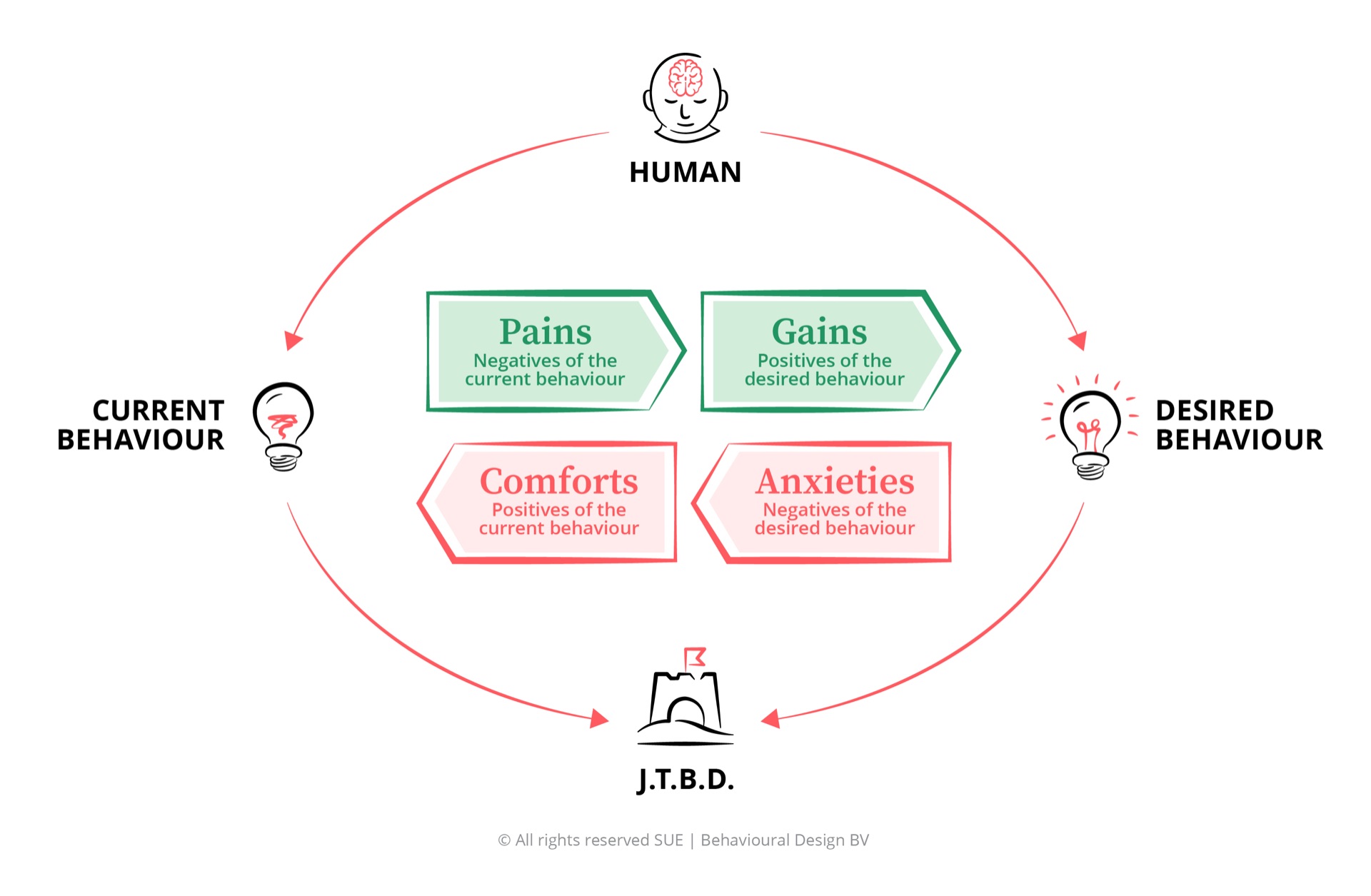
The pains of the current situation are real but familiar, and familiar pain is tolerable. Everyone already knows the process is clunky. They have known for two years.
The gains of the new programme are described at the kick-off in terms that belong to the organisation, not to the person: efficiency, alignment, future-readiness. None of those arrive on the desk of the person being asked to change on Monday.
The anxieties are specific and learned. Last time I invested in one of these, it was abandoned halfway and I looked naive for having taken it seriously. Enthusiasm has a cost here, and people have paid it.
And the comforts of nodding are considerable. Nodding is free, it ends the meeting, it upsets nobody, and based on the last four programmes it carries a decent chance of being the correct prediction.
Read that balance honestly and the polite nod stops looking like fatigue. It looks like a well-calibrated bet.
How to design an ending
Five interventions. None of them requires slowing down the pace of change.
1. Name the finish line before the start line
Every programme gets one sentence, written before launch, that describes what will be observably true when it is done. Not "improved collaboration" but "the weekly handover meeting no longer exists because the handover happens in the system". If you cannot write that sentence, you have a direction, not a programme, and you should say so.
2. Give it a date and treat the date as real
An end date that slips without comment teaches everyone that dates are decorative. If the date moves, say so explicitly and say why. The announcement costs one sentence and buys back the credibility of every future date.
3. Close things publicly, including the ones that failed
A programme that quietly evaporates leaves its loop open forever. One paragraph to the affected team, saying what happened and that it is now closed, shuts the loop. Doing this for a failure is more valuable than doing it for a success, because it proves that closure here does not depend on the outcome being flattering.
4. Cap the number of open programmes
Pick a number, make it visible, and make starting a sixth require closing one. The constraint does more for change capacity than any communication plan, because it turns "what shall we start" into "what shall we finish", which is a much better question.
5. Make progress visible weekly, in the work itself
Amabile and Kramer's finding is easy to act on and rarely acted on: people need to see movement in the actual work, not in a status report. Anything that shows the thing itself getting closer to done counts. A dashboard measuring engagement with the programme does not.
What to do with a team that is already tired
If you have inherited the fifth programme rather than started it, you cannot undo the previous four. You can close them.
Take an hour with the team and list every change initiative that is technically still running. Then go through them one by one and put each into one of three boxes: finished, abandoned, or genuinely still live. Say which is which out loud, and write it down where people can see it.
Expect that list to be longer than anyone guessed, and expect most items to belong in the first two boxes. That hour does more for change capacity than the next kick-off will, because it closes loops that have been quietly consuming attention for years.
Then start the new programme with the ending already written, and the team gets to watch you do the thing the last four never did.
Frequently asked questions about change fatigue
What causes change fatigue?
Not the volume of change, in most cases. It is change that never visibly finishes. Bluma Zeigarnik showed that unfinished tasks keep occupying attention in a way completed ones do not, so five open programmes cost far more attention than five completed ones would have. The exhaustion comes from the open loops, not the work.
How do you recognise change fatigue?
By the absence of resistance rather than its presence. People stop objecting, attend the sessions, acknowledge the plan, and change nothing. Genuine disagreement is a sign of engagement; polite compliance without behaviour change is the signal that people have stopped believing this one will land either.
Does slowing down the pace of change help?
Rarely on its own, and it is often the wrong lever. Teams in fast-moving environments tolerate a lot of disruption when each disruption reaches a visible end. Closing the initiatives that are still technically open does more for capacity than reducing the number of new ones.
How do you end a change programme properly?
Write one sentence before launch describing what will be observably true when it is done, attach a date, and when that point arrives say publicly that it is closed. Do this for the programmes that failed as well, otherwise closure looks conditional on success and nobody trusts it.
What is the difference between change fatigue and resistance to change?
Resistance is active and informative: someone is telling you something is wrong, and it is usually worth hearing. Change fatigue is passive and silent, and it carries no information. It is what remains after enough initiatives have been announced and none has been seen to conclude.
Conclusion
Change fatigue gets treated as a capacity problem and behaves like a design problem. People are not worn out by change. They are worn out by carrying an ever-growing pile of things that were started in their name and never closed.
Which means the fix is not a better communication plan or a slower roadmap. It is an ending: written before the start, dated, and announced when it arrives, including when the answer is that it did not work.
Close four things this month and watch what happens to the appetite for the fifth.
Want to design change that lands? The online Deep Dive Leading Change and Transformation teaches you to apply behavioural science to resistance, endings and follow-through.