AI change management: how to steer adoption, not just roll out tools

The licences are bought. The training was delivered, twice. There is a policy document, a Teams channel and an enthusiastic pilot group who present their results at the quarterly update.
And when you look at the actual usage data, the same fifteen per cent are doing the same three things, and everyone else opened the tool once in March.
The instinct at that point is to buy more training. Which is understandable, and mostly wasted, because the organisation did not fail to learn. It failed to change how work gets done, and those are different projects run by different logic.
AI change management is the discipline of steering the introduction of AI as a behavioural change rather than a technical rollout. It designs which task changes first, who demonstrates the new way of working, what social risk gets removed, and how usage is measured. Access is a precondition. Adoption is a design problem. More on why AI adoption fails →
A rollout is not a change
Most AI programmes are built as deployment plans: procure, configure, train, communicate, report. Every step is real work, and none of it touches the moment that matters, which is a Tuesday afternoon when someone has ninety minutes to write a proposal and has to decide whether to do it the way they always have or the new way they are slightly unsure about.
John Kotter's core argument in Leading Change was that transformation efforts stall not for lack of a plan but for lack of the conditions that make people act differently: urgency, a coalition, short-term wins, and consolidation before the pressure comes off.[1] The AI version of that failure has a particular signature. There is no shortage of urgency. There is an abundance of it, aimed at nobody in particular.
"We need to be an AI-first organisation" is not a behaviour. Nobody can do it on Tuesday afternoon. And a change ambition that cannot be performed by a named person on a named task is a slogan with a budget attached.
If your change ambition cannot be performed by one person on one task this week, it is not a plan. It is a slogan with a budget.
Why AI is harder to steer than previous technology
Organisations have introduced new systems for decades and mostly survived it. AI is different in three specific ways, and each one breaks a mechanism that ordinary change management relies on.
The end state is unknown. Classic change models ask you to describe the target situation. With a CRM migration you can: here is the old process, here is the new one. With AI, nobody can credibly describe how the marketing team will work in eighteen months, because the capability keeps moving. That is not a communication failure. It is a genuine property of the change, and pretending otherwise costs you credibility with exactly the people you need.
The work is invisible. Everett Rogers, whose research on diffusion of innovations remains the most useful map we have of how new practices spread, identified observability and trialability as two of the strongest predictors of whether an innovation catches on.[2] Using AI scores badly on both by default. A colleague drafting with a model looks exactly like a colleague typing. Nobody can watch, copy or borrow, so the social mechanism that normally does most of the spreading is switched off.
The identity risk is higher. A new expenses system threatens nobody's sense of who they are. A tool that produces a decent first draft of the thing you are respected for does. Chris Argyris observed that the most skilled professionals are often the worst learners, because success has given them little practice at being bad at something and a strong reflex to defend against situations where they might look incompetent.[3] AI creates those situations continuously, in front of colleagues.
Notice what none of those three are: a knowledge gap. Which is why the training-first reflex keeps producing certificates and no change.
Willingness comes before capability
There is a useful piece of research from the technology acceptance literature that predates all of this. Fred Davis showed in 1989 that two beliefs predict whether people actually use a system: whether they think it is useful for their work, and whether they think it is easy to use.[4] Later work by Viswanath Venkatesh and colleagues added two more that matter enormously here: social influence, whether people important to you think you should use it, and facilitating conditions, whether the support exists when you get stuck.[5]
Read your own programme against those four. A generic AI course establishes neither usefulness for a specific job nor ease on a specific task. It says nothing credible about what respected colleagues actually do. And it usually leaves people alone the moment the session ends, at precisely the point where the first attempt goes badly.
There is also good evidence that usefulness is real but uneven, which makes the diagnosis worth doing properly. In a field experiment with 758 consultants at Boston Consulting Group, researchers led by Fabrizio Dell'Acqua found that on tasks within the current capability of the model, consultants using GPT-4 completed significantly more tasks, faster, and at higher assessed quality. On a task deliberately placed outside that capability, users of the model were markedly less likely to reach the right answer than those working without it.[6]
The change management implication is not "AI is unreliable". It is that the unit of adoption is the task, not the tool. Pick the wrong tasks and your best people will conclude, correctly and permanently, that this thing makes their work worse.
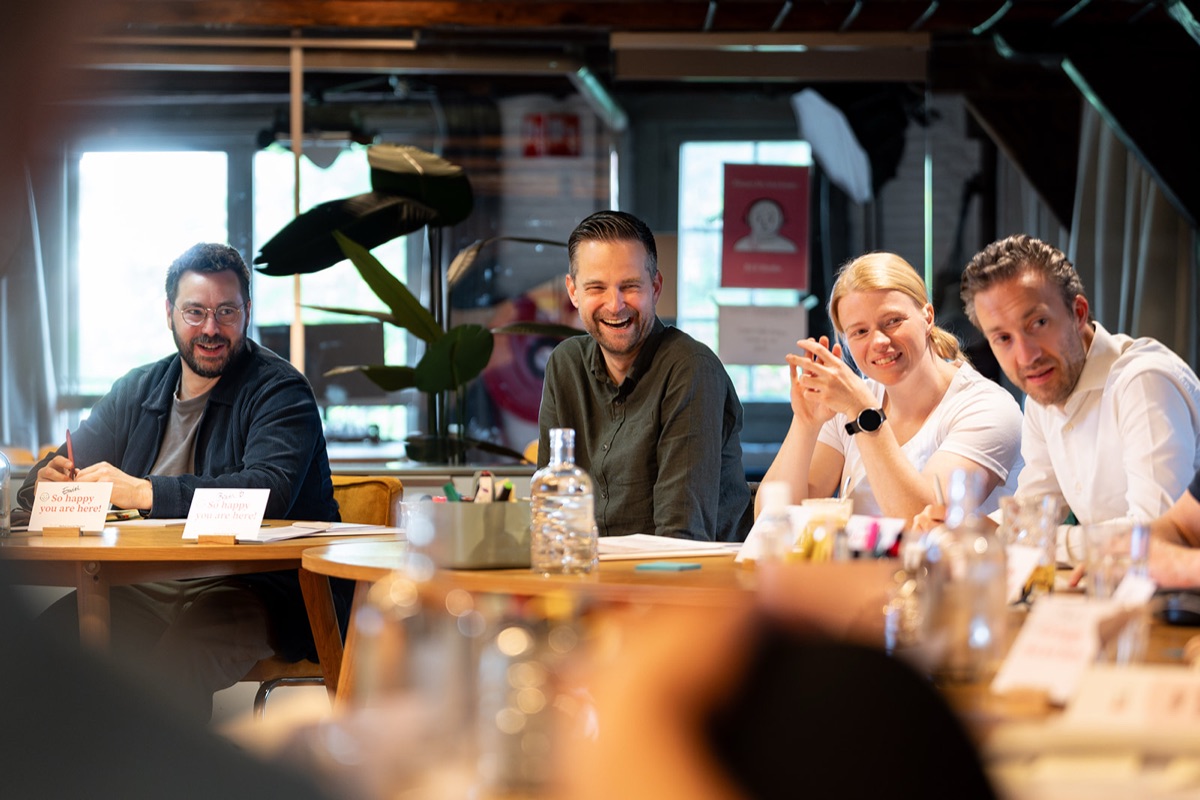
The forces around the person you are asking to change
Before you sequence anything, map the forces. The SUE | Influence Framework structures them into pains, gains, anxieties and comforts, around the progress the person is actually trying to make.[7]
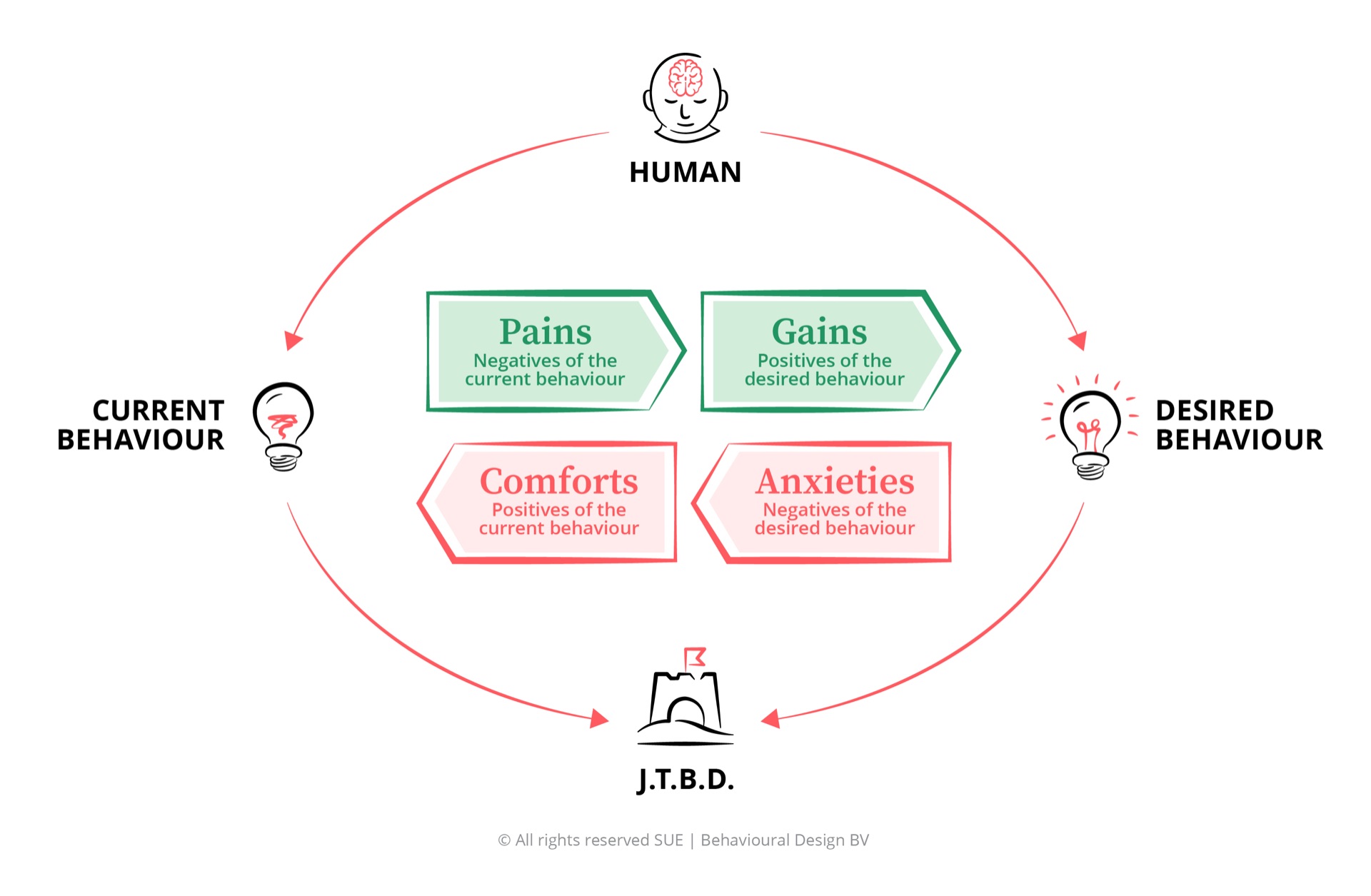
The pains are the ones your business case already lists: the work that takes too long, the backlog, the tedium of a first draft. Real, and rarely the deciding factor.
The gains are the promise: time back, better output, being the person who is ahead of this. Also real, and distant.
The anxieties are immediate and almost never discussed in the steering committee. Looking slow in front of a colleague who seems fluent. Producing something that turns out to be wrong and having your name on it. The quiet calculation about whether being efficient is the same as being replaceable. Every one of those is a reason to keep the tab closed.
The comforts are the strongest force in the room, and the most underestimated. The current way works. It is defensible. It carries no risk of embarrassment, and it has never once required you to explain yourself in a review. Doing nothing is not laziness. It is the rational choice under the conditions you have created.
Look at that balance and the design task becomes obvious: your programme almost certainly spends its energy on the top half, where the arguments are, and almost none on the bottom half, where the decision is made. This is the same diagnosis that explains why AI adoption stalls in organisations, applied to the question of how you steer it.
How to steer the introduction: four moves
Four moves that change the conditions rather than the message. In this order, because the order is most of the value.
1. Choose one task, not one tool
Pick a single recurring task in a single team, ideally one that is frequent, low-stakes and currently annoying: meeting notes into actions, first-draft responses to a standard enquiry type, summarising a research batch. Frequency matters more than importance, because frequency is what builds a habit. And a low-stakes task is where someone can afford to be bad at this for two weeks.
2. Make the work visible
This is the direct answer to Rogers's observability problem, and it is the intervention most programmes skip. Run the task live, in a shared session, with the screen shared and the failures included. Keep a channel where people post the prompt they used and what went wrong, not just wins. The purpose is not knowledge transfer. It is proof that competent colleagues are also fumbling, which is the thing that unlocks everyone who is currently waiting to see whether it is safe.
3. Let the most senior person go first, badly
Amy Edmondson's research established that psychological safety, the shared belief that the team is safe for interpersonal risk-taking, is what determines whether people admit errors and try new things at work.[8] You cannot announce it. You can only demonstrate it, and the demonstration that counts is a senior person visibly struggling in public and saying so. One director showing a prompt that produced nonsense does more than a fortnight of internal communication, because it changes what everyone else believes the cost of failing is. If you want that mechanism in detail, we wrote about psychological safety and AI adoption separately.
4. Change the routine, not the enthusiasm
Enthusiasm decays; routines persist. So attach the new behaviour to something that already happens on a fixed rhythm: fifteen minutes in the existing weekly team meeting where one person walks through how they used it, a standing agenda item, a shared prompt library that someone actually owns. Samuelson and Zeckhauser named the force you are working against, status quo bias, the well-documented tendency to stick with the current option simply because it is current.[9] The counter to a default is another default, not a reminder.
Measure the task, not the licence
Most AI dashboards report the wrong thing with great precision. Licence activation tells you procurement worked. Weekly active users tells you people opened something. Neither says whether work changed.
Measure at the level of the task you chose. What proportion of that task now runs through AI? How long does it take compared with the baseline you took before you started, and you did take one? How often is the output used without substantial rework, which is the honest quality measure?
Then add the leading indicator that predicts everything else: are people sharing their prompts and their failures without being asked? That number tells you whether the social conditions have shifted. When it rises, usage follows. When it stays flat, you have a compliance programme, and compliance programmes end the day the reporting does.
Frequently asked questions about AI change management
What is AI change management?
AI change management is steering the introduction of AI as a behavioural change rather than a technical rollout. It answers four questions a licence cannot: which specific task changes first, who demonstrates the new way of working, what social risk is removed so people dare to be beginners, and how usage is measured. Access is a precondition. Adoption is a design problem.
Why does AI training not lead to usage?
Because training addresses capability, and the blocker is usually willingness. Fred Davis showed in 1989 that people adopt technology when they believe it is useful for their work and easy to use; a generic course rarely establishes either for a specific job. Add Chris Argyris's finding that skilled professionals are especially defensive when they risk looking incompetent, and a training session becomes a place to be seen struggling rather than a reason to change.
How is AI change management different from ordinary change management?
Three differences. The end state is unknown, so you cannot describe the target situation the way classic change models assume. The work is invisible, because using AI leaves no trace others can copy, which removes the observability Everett Rogers identified as a driver of diffusion. And the identity risk is higher, because the tool touches exactly the expertise people are paid for.
How do you measure AI adoption properly?
Not with licence activation or weekly active users. Measure the task: what proportion of a named recurring task is now done with AI, how long it takes compared with before, and how often the output is reused without rework. Also track whether people share their prompts and their failures, because visible sharing is the leading indicator that predicts sustained use.
Conclusion
The organisations that get this right are not the ones with the best tooling or the biggest training budget. They are the ones that picked a small, frequent, unglamorous task, made the fumbling visible, let a senior person go first and be bad at it, and then attached the new behaviour to a routine that was already running.
None of that requires a new platform. All of it requires accepting that you are running a behaviour change programme wearing a technology programme's clothes.
So at your next steering meeting, drop the slide about how many people have access. Put up the one that says what somebody in this organisation now does differently on a Tuesday afternoon. If you cannot fill that slide, you have not started yet.
Want to design that properly? The online Deep Dive AI Adoption teaches you to diagnose why people are not using the tools you bought and to build the interventions that change it. Rated 9.3/10 by 10,000+ professionals.