You are sitting across from your employer in a salary negotiation. You have prepared well: market data gathered, your achievements lined up, a number in your head. Then the employer puts a number on the table first. Lower than you expected. And something strange happens: you feel the room shrink. Not because the number is realistic. Not because you agree with it. Simply because it is already there. The first number has set the walls of the conversation.
Move the scene to a project team. The project manager asks for a time estimate on a new feature. Someone says: “Four weeks, I think.” Everyone adjusts their own estimate toward those four weeks, including the team members who were privately thinking eight. The anchor has done its work before the discussion even started.
Or move to the menu of a fine dining restaurant. A dish costs £95. Nobody orders it. But that was never the intention. It is there to make the £45 option look reasonable.
This is anchoring bias at work. One of the most powerful and most overlooked forces in decision-making, negotiation and strategy.
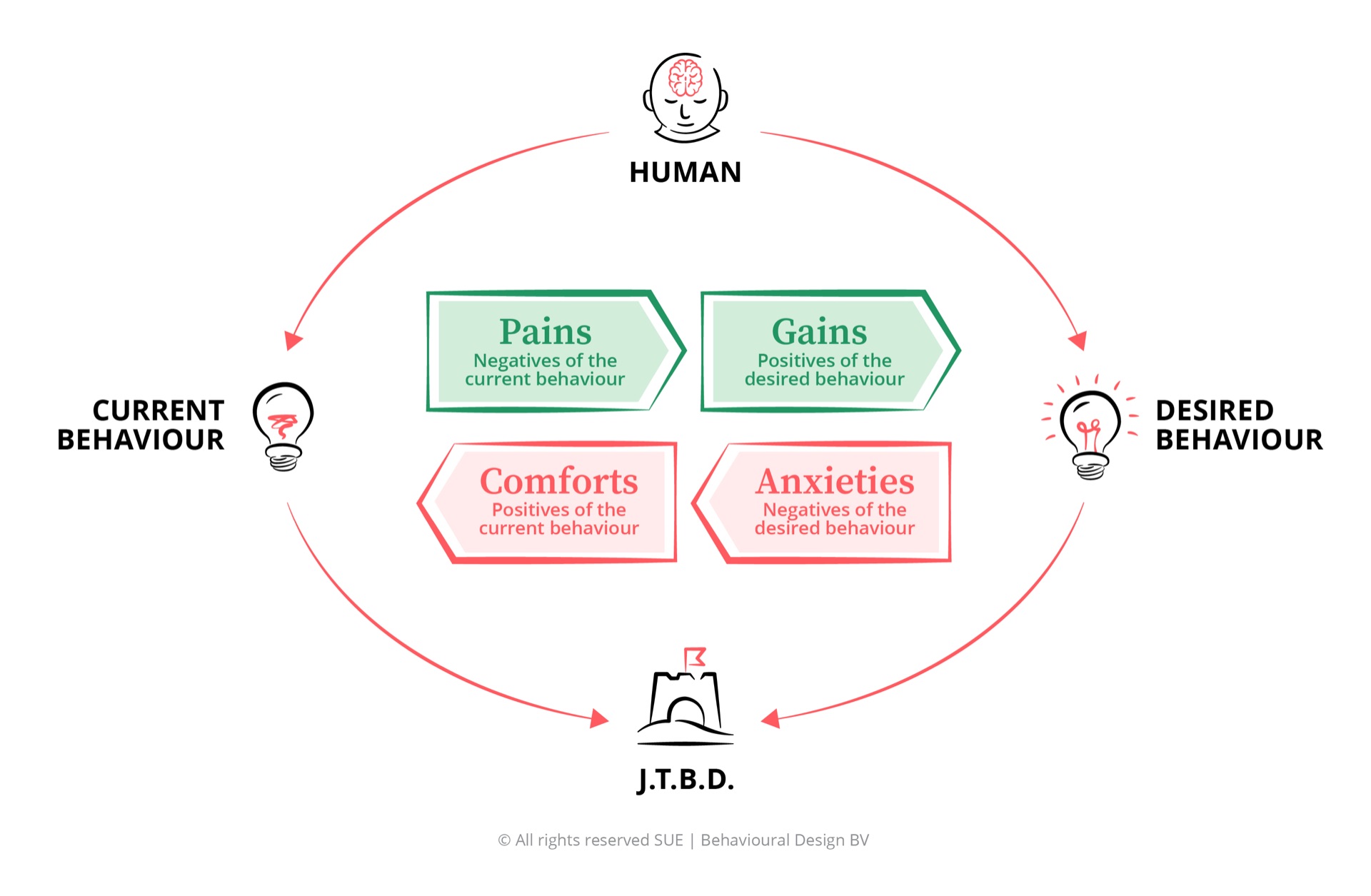
Anchoring bias is the tendency to place disproportionate weight on the first piece of information you receive. That first number, that first estimate, that first impression becomes the reference point against which all subsequent judgements are measured. At work, this unconsciously determines salaries, project timelines, budgets and performance reviews, even when the anchor is arbitrary, incorrect or strategically placed. In the SUE Influence Framework, anchoring falls primarily under Comforts: the first number offers cognitive ease and saves mental energy, which is why the brain leans on it without question.
What is anchoring bias?
In 1974, Amos Tversky and Daniel Kahneman published an experiment that permanently changed the behavioural sciences. They had participants spin a wheel of fortune that was secretly rigged to land on either 10 or 65. They then asked participants to estimate what percentage of African countries were members of the United Nations.
The wheel had nothing to do with UN membership. Everyone knew it was random. And yet: the group that spun 10 estimated an average of 25 percent. The group that spun 65 estimated an average of 45 percent. A completely arbitrary number had systematically shifted the judgements of intelligent, informed people.[1]
This is what anchoring does. It is not a matter of naivety or lack of knowledge. It is a System 1 mechanism: fast, automatic and entirely below conscious awareness. Your brain uses the first available number as a starting point and adjusts from there. But that adjustment is always insufficient. You always end up too close to the anchor.
At work, this plays out across three dimensions simultaneously. Numerical anchoring: the first number that enters a discussion, whether it is a salary, a deadline or a budget, defines the playing field for everything that follows. Perceptual anchoring: the first impression of a person, an idea or a presentation colours how all subsequent information about that same person or idea is processed. Contextual anchoring: the prices, options or comparisons you present to someone determine what feels “normal.” IKEA does this deliberately: the most expensive sofa sits at the front of the showroom, so everything further in feels affordable. Starbucks introduced the Venti so that the Grande would become the new normal size.
The anchor does not need to be accurate to be effective. It only needs to be early.
Three scenarios where it causes the most damage
The project estimate that never lets go
It is Monday morning. The product team has a kickoff for a new project. The product owner asks for a first time estimate. A senior developer says: “Eight weeks, I reckon.” It is a guess, based on a quick look at the requirements. But those eight weeks are now the anchor.
The rest of the meeting follows a pattern every project team will recognise. Other estimates cluster around eight weeks. Someone who was privately thinking fourteen weeks says “maybe ten” to avoid sounding pessimistic. Someone else says “seven” because they want to come across as optimistic. The average estimate converges on eight to nine weeks.
Six weeks later, the project is nowhere near done. The post-mortem reveals that the real complexity was visible by week two. But nobody used that information to revise the plan, because the eight weeks was already there. And once an anchor is set, it is remarkably hard to dislodge.
This is why large-scale IT projects structurally deliver later than planned. Not because project managers are bad at planning. But because the first estimate, made at the moment when information is most incomplete, carries the most weight. The anchor is set at the worst possible time: the beginning.
The price nobody orders
William Poundstone describes in his book Priceless an experiment he ran using a fictional restaurant menu. In the baseline version, a steak at £28 was the most expensive item. In the test version, he added a lobster dish at £95. Nobody ordered the lobster. But the £28 steak suddenly became far more popular than before. And people spent more on average.[2]
The lobster was never meant to be a product. It was an anchor. A reference point that redefined the perception of value. Forty-five pounds for a steak feels extravagant on a menu where the most expensive item is £52. The same £45 feels like a bargain on a menu with a £95 item.
This mechanism operates everywhere prices are presented. The premium tier in a software subscription that almost nobody chooses makes the middle option look reasonable. The “was £199, now £129” sticker shows you the crossed-out price, not the actual value. The opening price in a procurement negotiation determines how the buyer evaluates every number that follows.
What makes this particularly dangerous at work is that it operates internally too. When a procurement manager receives the first quote at £80,000, that becomes the reference point for every subsequent supplier. An offer of £65,000 feels like a bargain, even if the market rate is £50,000. The anchor was set by the supplier, not by the market.
The performance review that never starts from zero
It is November. HR has opened the annual review cycle. A manager opens a team member’s file. At the top: last year’s rating. A four out of five. That four is now the anchor for everything that follows.
If the manager is uncertain this year, whether performance was strong or mediocre, they will anchor to last year’s four. If the employee had a good year but also a visible stumble, the four weighs heavily on how that stumble is interpreted. If a new manager inherits a team and sees the old ratings, their first impression of each team member is anchored to their predecessor’s scores.
The same happens with first impressions in the review conversation itself. An employee who opens the meeting with a self-assessment of “I think it has been a strong year, I would give myself a five” fundamentally shifts the dynamic of the discussion. Their manager must now consciously drift away from that anchor. That is harder than it sounds.
The irony is that performance reviews are designed as objective reflections on performance. In practice they are a stacking of anchors: last year’s score, the first impression of the conversation, the first number the employee names. Objectivity is a design goal, not a default outcome.
Why your brain loves anchors
When you analyse anchoring bias through the SUE Influence Framework, something immediately stands out: the forces that keep people anchored in anchoring behaviour are overwhelmingly strong.
Comforts dominate the story. An anchor offers cognitive ease. The first number gives the brain something to hold on to in a situation that is inherently uncertain. How much will this project cost? You genuinely do not know. But there is a number. And that number is mentally more efficient than starting from zero. System 1 reaches for it like a lifeline. Not because it is accurate, but because it is available. The Comfort of cognitive rest is the engine behind anchoring.
Anxieties reinforce the stickiness. Deviating from the anchor requires defending your own, substantiated judgement. That feels socially risky. What if you are the only one with a different number? What if you contradict someone who has already committed to the anchor? The fear of being seen as unrealistic or difficult keeps people close to the reference point.
Pains are real but invisible. Poor estimates lead to failed projects, underpaid employees and wrong strategic choices. But that pain manifests later and is rarely traced back to the original anchor. Nobody says in the post-mortem: “This project failed because we named the wrong number on day one.”
Gains are abstract. Better estimates, fairer salaries, more realistic budgets. Valuable, but hard to feel at the moment the choice is made.
This is the classic pattern of every cognitive bias that persists stubbornly. The forces that maintain the behaviour (Comforts and Anxieties) are concrete and immediate. The forces that should drive toward better behaviour (Pains and Gains) are abstract and deferred. Awareness does not break this pattern. Process design does.
Five interventions that break the anchor
The key is always the same: change the environment, not the person. Anchoring bias is not a character flaw you can train away. It is an architecture problem you can solve.
Independent estimates before group discussion. Have every team member write down an estimate individually before any group discussion takes place. This prevents the first number anyone says aloud from becoming the anchor for everyone else. In project management: ask all stakeholders to submit their time estimates by email before the planning meeting. The variance in those estimates is more valuable information than any discussion that follows.
Reference class forecasting. Instead of starting with the current project, ask: how long did comparable projects take in the past? What were the costs in similar procurement processes? This anchors the discussion not to an internal number someone just said out loud, but to historical baselines. It is the counter-method Kahneman himself recommends: think outside the current case.
Red team reviews. Explicitly assign someone whose job it is to attack the anchor. Not to be negative, but to ask the question: “What would have to be true for this number to be correct?” If nobody is allowed to ask that question aloud, nobody asks it internally either. A red team makes counter-evidence socially acceptable.
Structured evaluation criteria before the discussion. In performance reviews: have managers complete their assessment per competency using pre-defined behavioural anchors, without seeing last year’s scores. Add the historical data afterwards as context, not as a starting point. The same applies to procurement: define evaluation criteria and their weighting before opening the bids.
Blind inputs. For estimates that truly need to be free from anchoring: anonymise the sources. In salary benchmarking: have HR professionals evaluate market data without knowing the current salary. In creative reviews: evaluate ideas without knowing who submitted them. The anchor of “this is the CEO’s idea” or “this is the existing salary” is just as powerful as any numerical anchor.
How anchoring connects to other biases
Anchoring bias rarely operates alone. At work it reinforces and is reinforced by a whole ecosystem of other cognitive biases.
The framing effect is its most direct partner. An anchor of £100,000 combined with a gain frame (“you save £30,000 compared to the market”) is doubly powerful compared to the anchor alone. The framing determines how the distance from the anchor is interpreted.
Confirmation bias consolidates the anchor. Once you have accepted a number as a reference point, you unconsciously search for information that justifies it. You interpret ambiguous data as confirmation. The anchor becomes a belief.
The halo effect operates as a perceptual anchor. The first positive impression of a candidate, an idea or a supplier anchors how all subsequent information about that same person or idea is processed. It is anchoring without numbers.
Loss aversion makes anchors more dangerous in estimates. People are already inclined to be too optimistic. Combine that with an anchor set too low, and you get structural underestimation of costs, time and risk.
Understanding this is not academic. If you only address the anchor and leave confirmation bias intact, the anchor consolidates quickly into a shared belief. Effective interventions address the ecosystem, not just one bias.
Frequently asked questions
What is a concrete example of anchoring bias at work?
A manager opens a salary negotiation at £32,000 per year. The candidate wants £40,000 but anchors their counteroffer to the number already on the table and asks for £36,000. They settle at £34,000. Had the candidate named a number first, the outcome would likely have been fundamentally different. The first number defines the playing field for everything that follows.
How does anchoring bias affect project planning?
When a project manager names the first estimate, even one based on incomplete information, that estimate becomes the reference point for all subsequent discussions. Team members adjust their own estimates toward the first number, even when they privately hold a different view. This is why so many IT projects miss their originally planned deadline: the first timeline anchored expectations that had nothing to do with actual complexity.
Can you eliminate anchoring bias?
No. Tversky and Kahneman demonstrated as far back as 1974 that anchoring works even when people know the anchor is arbitrary. It is a System 1 process that operates outside conscious control. The solution is not awareness but process design: independent estimates before group discussion, reference class forecasting as a counterweight, and structured criteria that break the anchor’s grip.
How can you use anchoring bias to your advantage?
Whoever names the first number controls the playing field. In a price negotiation: name an ambitious but defensible number first. In a proposal: lead with the premium option. In a salary negotiation: make the first offer. The anchor does not need to be extreme to be effective. It only needs to be early.
What is the difference between anchoring bias and the framing effect?
Anchoring bias is specifically about numerical reference points: the first number you hear pulls all subsequent estimates toward it. The framing effect is broader: it is about how the presentation of information, as a loss or a gain, as a risk or an opportunity, shapes your judgement regardless of the numbers. They amplify each other: a high anchor combined with a gain frame is doubly powerful.
Conclusion
Anchoring bias is the quietest force in the meeting room. Whoever names the first number sets the walls within which all negotiation, estimation and evaluation takes place. It does not have to be deliberate. An unprepared project manager, an honest first impression, an opening price without strategy: these are all anchors that keep working months later in your results.
The solution is not more awareness. That sounds disappointing, but it is the only honest answer the science offers. Even people who know the Tversky and Kahneman experiment are affected by it. The solution is process design: independent estimates, reference classes, red teams and structured criteria. Environments that structurally give the anchor less power.
Want to learn how to apply this in your own organisation? In the Behavioural Design Fundamentals Course you learn to apply the Influence Framework and the SWAC Tool to diagnose cognitive biases and redesign decision-making processes. Rated 9.7 by 5,000+ alumni from 45 countries.
PS
At SUE, our mission is to use the superpower of behavioural psychology to help people make positive choices. Anchoring bias may be the most underestimated force in business decision-making, precisely because it operates so quietly. The first number feels neutral. It feels like a starting point. In reality it is a conclusion you have already drawn before the discussion began. The only question is: whose number was it, and did it serve your interests?