Picture this: a sales manager asks the team to estimate the budget for next quarter’s project. The first person to speak throws out a number: “I think we can do it for around 80,000.” The rest of the meeting orbits that figure. Someone suggests 75,000. Another says 90,000. Nobody asks: “Is that number actually right?” Or: “How did we get there?”
Three weeks later the actual cost comes in closer to 140,000. The underestimate had nothing to do with poor intentions or insufficient knowledge. It had everything to do with the first number that landed in the room. That number was the anchor. And once an anchor is set, it pulls every estimate that follows toward it, even when the original figure was plucked from thin air.
This is the anchoring effect at work. After confirmation bias, it is probably the most expensive cognitive bias I encounter in organisations. Not because people are careless. But because almost nobody realises how powerfully the first number shapes everything that comes after it.
The anchoring effect is a cognitive bias in which the first number or piece of information encountered disproportionately influences all subsequent judgements and estimates. At work it sabotages salary negotiations, budget rounds and performance appraisals by keeping everyone unconsciously tethered to the first figure mentioned. The solution is to treat anchors as a design choice, because whoever anchors first has a significant strategic advantage. For the behavioural forces at play, see the SUE Influence Framework.
What is the anchoring effect?
The anchoring effect was first described by Amos Tversky and Daniel Kahneman in their landmark 1974 paper “Judgment under Uncertainty: Heuristics and Biases,” published in Science.[1] In one of their most striking experiments, participants spun a wheel that had been rigged to land on either 10 or 65. They were then asked: “What percentage of African countries are members of the United Nations?” Those who had spun 10 gave an average answer of 25%. Those who had spun 65 gave an average answer of 45%. A roulette wheel, entirely random and wholly irrelevant to the question, shifted judgements by twenty percentage points.
That is the power of anchoring. The anchor does not need to be accurate, relevant, or even chosen by you. The brain takes the first number that appears and uses it as a starting point. Everything after is adjustment, and that adjustment is systematically insufficient. You move away from the anchor, but you never move far enough.
Later research by Englich, Mussweiler and Strack showed that even experienced judges and professional car appraisers are vulnerable to the effect.[2] In one study, experienced German automotive assessors were asked to value a damaged car and were given either a low or a high reference price from the other party: either 2,800 DM or 5,000 DM. The assessors who started from the higher anchor valued the car on average 40% higher than their colleagues with the low anchor. Same vehicle, same damage, same experts. Only the first number differed.
In the workplace, this mechanism is active in every conversation involving numbers. And most professionals have no idea.
The first number in a meeting is not a starting point. It is the gravitational centre of the entire discussion.
Three scenarios you will recognise from your own workplace
The salary negotiation where the candidate names a number too early
A marketing professional is interviewing for a senior role. She has done her preparation, researched market rates, and knows that comparable positions pay between £55,000 and £72,000 a year. In the conversation with HR, the recruiter asks about her salary expectations. She hesitates briefly, then says: “I think 58,000 is realistic.”
What she does not realise: the recruiter had budget for 66,000. But now an anchor of 58,000 has been set, the negotiation is conducted from that point. HR opens at 56,000. She pushes to 59,500. They land at 58,500. Everyone considers it a fair result. But she has left £7,500 a year on the table, purely because she named a number first that was below her market value.
She misread the situation. Not her competence. Not her value. Just the moment at which she set her anchor. Had she asked “What is the budget for this role?”, she could have used the employer’s anchor as a floor rather than a ceiling. Instead she anchored herself to a number that was too low.
The budget round where last year becomes the new ceiling
A large financial services firm runs its annual budget cycle every autumn. The process is always the same: department heads submit their forecasts, a finance team reviews them, and discussions follow. What nobody says out loud but everyone understands: last year’s budget is the anchor. Asking for more than last year requires justification. Asking for less goes without comment.
This produces some predictable distortions. Departments that genuinely need more resource learn quickly to open 15% high, so that after negotiation they land where they actually need to be. Departments that received one-off extra budget for a project two years ago are still anchored to that inflated figure. And strategically important new initiatives, which do not fit neatly into the “last year plus or minus” framework, are routinely under-resourced.
Nobody designed this deliberately. But the system has designed itself around the anchoring effect. Last year’s number is not a reference point; it is the gravitational centre around which all resource allocation orbits. The consequence is that money flows according to historical accident more than strategic priority.
The performance appraisal where the first impression colours everything
An HR director at a mid-sized manufacturing company introduces a new appraisal system. Managers rate employees on a ten-point scale across five dimensions. In the calibration meeting, all managers come together to discuss and align their scores.
What happens then is this: the manager who speaks first about a given employee sets an anchor. If she says “I give him a 7 for collaboration,” the other managers are influenced in their own judgement, even if they have never observed him collaborating. They adjust toward that number, or defend a deviation from it, but the conversation is structured around the first figure. The employee whose name appears first on the agenda faces a higher risk of an anchored, less considered verdict than the employee discussed last, when the group has had more time to calibrate its thinking.
And the managers who speak first and loudest set stronger anchors than those who are tentative. Not because their arguments are better. Simply because they named a number first.
For anyone working in HR or learning and development, this scenario is painfully familiar. And it has direct consequences for how fair an appraisal process actually is.
Why awareness alone does not fix it: an Influence Framework analysis
At SUE we use the SUE | Influence Framework to understand why behaviour is persistent and which forces drive or block change. When you apply it to the anchoring effect, it becomes clear why “just pay more attention” is never the answer.
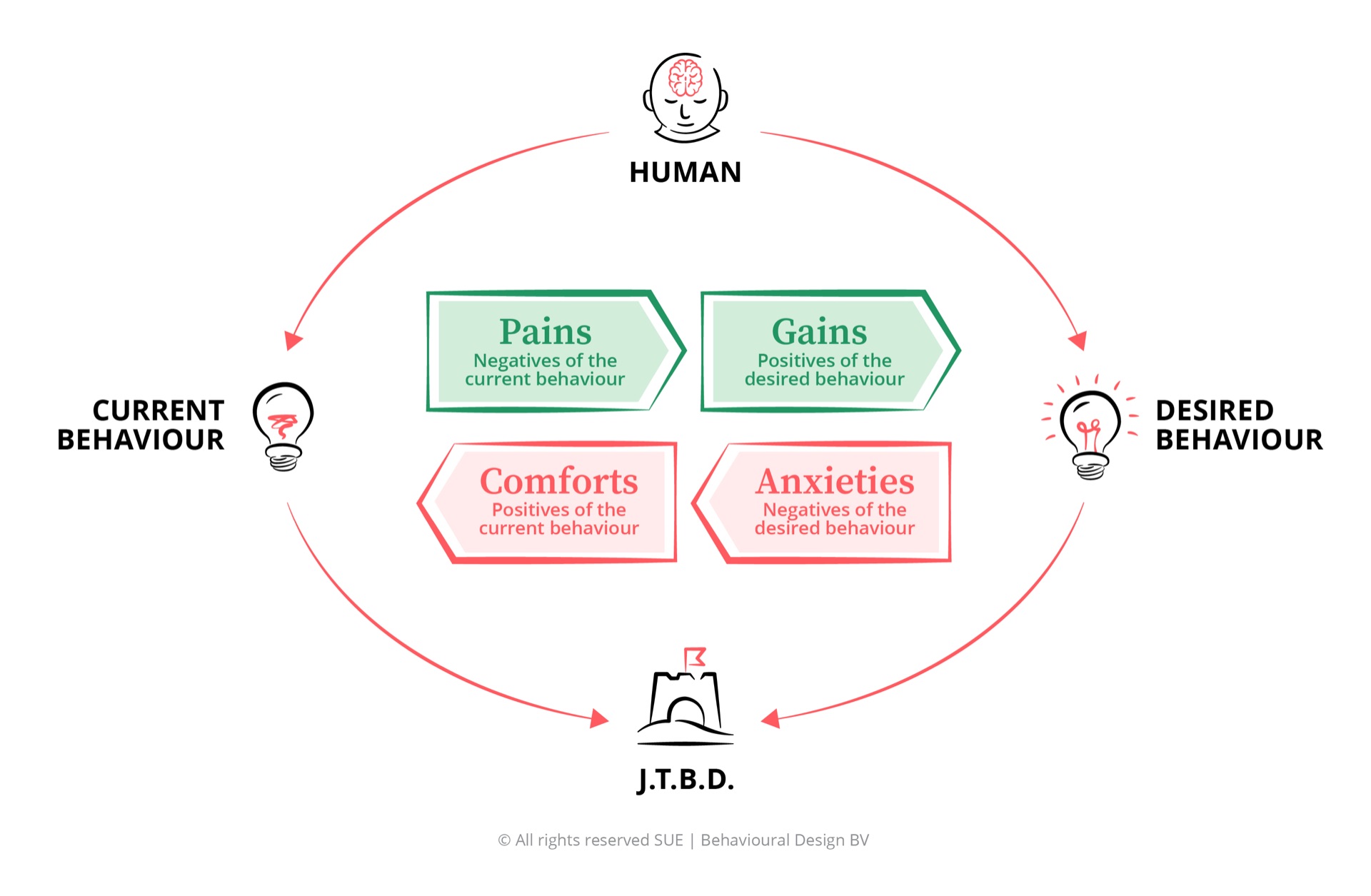
The pain of anchoring is real, but delayed. Poor salary agreements compound over years. Budgets that do not reflect strategic reality produce underperformance for years after the budget round. Appraisals shaped by whoever spoke first damage morale and talent development in ways that are hard to trace back to one calibration meeting. The pain is genuine. It just doesn’t show up in the moment when the anchor is set.
The gains of deliberate anchoring are significant. Whoever sets the first ambitious but defensible number in a negotiation has a structural advantage. Whoever sets the budget anchor strategically influences outcomes more than whoever brings the most compelling arguments. These gains are real and learnable. But most people do not know them because they have never been taught that anchoring is a design choice.
The comfort is the reason the anchoring effect persists so reliably: starting somewhere feels rational. “Last year’s budget” feels like an objective reference point. “What do you think?” asked first in a meeting feels open and democratic. The first estimate someone gives feels like information. None of these habits feel problematic, because they feel like normal meeting behaviour. The comfort here is not laziness; it is a sense of procedural fairness that is actually a trap.
The anxiety that blocks change: when you tell people they should set anchors deliberately, it feels like manipulation. “But we want to negotiate honestly, don’t we?” is a response I hear often. The discomfort with strategic anchoring is rooted in a moral misunderstanding. Everyone is always anchoring, consciously or not. The question is only whether you do it intentionally. Whoever does not set a deliberate anchor hands that power to the other party. That is not a more honest situation. It is simply a less strategic one.
Five interventions that work
1. Set your anchor before you enter the room. In any negotiation, budget conversation, or estimation session: decide in advance what number you want to name first. That number should be ambitious but defensible. Too high without a rationale erodes trust; too low gives away what you do not need to concede. The preparation is the intervention. Walking into a meeting without an anchor strategy means letting the other side set your reference point.
2. Have everyone estimate independently before any number is shared. In project estimates, appraisal meetings and budget rounds: ask everyone to write down their own figure before a single person speaks. This is the most direct structural intervention against anchoring. Once people have their own estimate on paper, they are less vulnerable to the first number someone else introduces. Their personal anchor provides partial protection against the external one.[1]
3. Recognise the anchor before you respond. When someone else names a number first, take a moment to explicitly ask yourself: “Is this an anchor? How is it shaping my thinking?” Tversky and Kahneman showed that the “consider the opposite” strategy, actively thinking through contrary scenarios, significantly weakens the anchoring effect. It does not eliminate it. But it weakens it. And in negotiations that difference is material.
4. Redefine the anchor in budget rounds. If last year is the default anchor in your organisation, change the starting point of the conversation. Do not ask: “What did you have last year and what do you need this year?” Ask: “What are the three strategic priorities for your department next year, and what budget do they require?” Reformulating the question changes the reference point. And that changes the outcome, without anyone needing more budget or better arguments.
5. Make anchors explicit in calibration meetings. Build it into your process that the chair of any calibration meeting opens by saying: “Remember that the first score stated in this room will anchor the rest of the discussion. Please make sure you have prepared your own assessment before we begin.” Awareness alone does not remove anchoring. But combined with structural change, everyone having noted their assessment in advance, it measurably reduces the effect. Changing the procedure changes the outcome.
Related biases that amplify it
The anchoring effect rarely operates alone. At work it consistently combines with two other biases that multiply its impact.
Confirmation bias reinforces anchoring: once a number is set, people unconsciously seek information that confirms it. If a project budget is anchored at 80,000, the team interprets new information in light of that figure. Contradictory data gets explained away. The anchor becomes a filter.
Status quo bias ensures that established anchors, such as last year’s budget or an initial salary agreement, gain additional stickiness. Because deviating from the anchor feels like an active choice that requires justification, while not deviating is the path of least resistance. And defaults nearly always win.
Loss aversion also plays a role: once an anchor has been accepted as a starting point, any downward movement away from it feels like a loss. This makes upward anchors in negotiations particularly powerful. The other party must psychologically “lose” to land lower.
Frequently asked questions
What is the anchoring effect?
The anchoring effect is a cognitive bias in which the first number or piece of information encountered disproportionately influences all subsequent judgements and estimates. The anchor does not need to be accurate or relevant to work. Tversky and Kahneman (1974) showed that even a random number from a rigged roulette wheel significantly shifted participants’ estimates of an unrelated factual question.
How does anchoring work in salary negotiations?
Whoever names a number first sets the anchor. If a candidate says £58,000, the employer negotiates from that point even if their budget was £66,000. The final outcome typically sits closer to the opening figure than to the candidate’s true market value. The practical advice: let the employer name a number first, or open high with market data to justify your position.
Can you avoid the anchoring effect?
You cannot avoid it entirely. Anchoring is a System 1 process, automatic and unconscious. But you can weaken it: by actively considering contrary scenarios before responding, by recognising anchors from others before reacting, and by building structures where everyone estimates independently before any number is shared. Changing the environment is always more effective than relying on willpower.
What is the difference between anchoring and framing?
Framing concerns how information is presented, positively or negatively, as gain or loss. The anchoring effect is specifically about a first number or reference point that pulls subsequent estimates toward it. They overlap, but anchoring is numerically specific: it always involves a reference value that structures thinking. A high anchor is also a form of framing, but not all framing involves anchoring.
Why do organisations unwittingly set poor anchors?
Because most people do not realise how much influence the first number carries. Budgets are built on last year’s figures, project estimates on the first guess a team member offers, appraisals on the first impression formed. Nobody deliberately sets a poor anchor. But without understanding how anchoring works, organisations systematically leave value on the table and make systematically worse decisions.
Conclusion
The anchoring effect is not subtle. Once you know it, you see it everywhere: in the proposal that leads with the total cost, in the salary negotiation where the candidate names a figure first, in the budget round where last year automatically becomes the norm. What makes it powerful is not just that it works when people are unaware of it. It keeps working after they become aware of it too. Because it is a System 1 mechanism, operating faster than deliberate reasoning can interrupt it.
The only real defence is structural. Build processes that delay or distribute the anchor. Have everyone estimate independently first. Name anchors explicitly in meeting norms. And train yourself to set a deliberate anchor before you walk into the room.
Want to learn how to diagnose the anchoring effect and other cognitive biases, and redesign the environments where decisions are made? The Behavioural Design Fundamentals Course teaches you the SUE | Influence Framework applied to real organisational challenges. Rated 9.7 by 10,000+ professionals from 45 countries.
PS
At SUE our mission is to use the superpower of behavioural science to help people make better decisions. What strikes me most about the anchoring effect is how invisible it is to the people setting the anchor. The recruiter who opens with a low offer does not think: “I am anchoring this candidate.” The manager who speaks first in a calibration meeting does not think: “I am setting the reference point for everyone else.” They are simply doing what feels natural. The design challenge is not to make people more suspicious of each other. It is to build systems in which first numbers are considered, not accidental.