Picture a strategy meeting. The CEO opens and shares their preference for a new direction. One by one, the room responds. The first director is enthusiastic. The second agrees. The third mentions that she “had been thinking along the same lines.” The fourth nods. The fifth person, who had a fundamental objection just minutes before the meeting started, now says: “I think we can go with this.”
Is the CEO simply that persuasive? Maybe. But the more likely explanation is this: the wagon was already rolling before anyone had properly checked where it was going.
This is the bandwagon effect at work.
The bandwagon effect is the tendency to adopt beliefs or behaviours because others are doing so. It is distinct from social proof: social proof is about evidence from others’ behaviour, the bandwagon effect is about momentum. You do not join because you think others are right - you join because the crowd is moving and standing still becomes increasingly uncomfortable. At work, it drives technology adoption waves, hiring trends and opinion cascades in meetings.
What is the bandwagon effect?
The term comes from politics. In the nineteenth century, the “bandwagon” - literally a music wagon - led a parade to demonstrate support for a candidate. Jumping on the wagon signalled your allegiance. The more people jumped, the more others followed. Not because they had evaluated the candidate, but because the wagon was full and staying behind felt strange.
Economist Harvey Leibenstein was the first to formalise the mechanism in economic terms in 1950: demand for a product rises purely because others are buying it.[1] But the behavioural foundation had already been made visible earlier in Solomon Asch’s conformity experiments. Asch had participants answer simple questions about line length in a group that was deliberately giving wrong answers. Nearly three quarters of participants gave at least one demonstrably incorrect answer - purely to avoid standing out from the group.[2]
It is a System 1 process. Your brain registers social movement as a signal: if this many people are doing something, there is probably a good reason. That inference is evolutionarily sensible - in a herd, staying behind is more dangerous than running with the group. But in the workplace, precisely this mechanism produces three persistent patterns.
Opinion cascades. Early voices in a discussion set the direction for everyone who speaks afterwards. The position of the first speaker, especially one with status, acts as an anchor point that everyone else calibrates against.
Adoption waves. Technologies, methods and ways of working are embraced not on the basis of proven value but on the basis of the speed at which others are embracing them. The curve becomes a self-referential argument.
Trend-following behaviour. Organisations adapt their strategy, hiring and communication to what “everyone” is doing, without ever asking whether that is relevant to their own context.
The question stops being ‘is this a good idea?’ and becomes ‘why aren’t we doing this yet?’
Three scenarios where the bandwagon effect takes the wheel
Scenario 1: The technology adoption wave that nobody stops
In 2023, organisations rushed to implement AI. Not all of them, but enough to create the feeling that you were falling behind if you were not moving. Boardrooms asked their IT departments for “our AI strategy.” Consultants warned that those who did not transform quickly would miss the boat. Budgets were released for pilots whose purpose was vague but whose urgency was clear: others are already doing it.
I recognise this pattern because it has played out before. In 2017 it was the “pivot to video.” Facebook reported exceptional video statistics. Media companies around the world restructured their newsrooms: out with text, in with video. Dozens of journalists were made redundant. Two years later it emerged that Facebook had systematically inflated its video metrics by a factor of three to five. The companies that had overhauled their strategy on the basis of the bandwagon were left with dismantled editorial teams and a strategy that had never made sense.
The pattern is always the same. A technology or approach gains traction. Early enthusiasts make it visible. The press picks it up. Competitors announce initiatives. And then the question begins that overrides everything: “Why aren’t we doing this yet?” Notice how that question is framed. Not: is this relevant to us? Not: what is the business case? But: why are we behind?
The Bitcoin hype of 2017 and the NFT craze of 2021 are the extreme end of the same spectrum. But the mechanisms are identical to what plays out in milder form when your organisation suddenly embraces agile, OKRs, design thinking or a digital transformation because the sector is embracing it.
Scenario 2: The hiring trend nobody questions
There was a moment when every company suddenly wanted a Chief Happiness Officer. Then it was the Agile Coach. Then the Head of Transformation. Then the Chief AI Officer.
I am not saying this to dismiss those roles. Some of them are genuinely valuable. But the way they are created reveals something telling about how organisations make talent decisions. They Google what competitors are hiring for. They read reports about “the jobs of the future.” They see a job title trending on LinkedIn. And then the internal conversation begins: “Do we need one of these?”
The question that is rarely asked first: what is the concrete problem this role solves, and is there evidence that this is the right solution for our specific problem?
The bandwagon effect in hiring is particularly costly because its consequences persist. You bring someone in for a role you cannot clearly define, with a scope that is not settled, to solve a problem you have not properly diagnosed. Eighteen months later the person is frustrated, the organisation is disappointed, and nobody quite knows why it did not work. But other companies are still doing it, so perhaps it was a matter of execution.
This is the circular logic of the bandwagon: if it does not work, you need to do it differently - not stop doing it.
Scenario 3: The meeting that was decided before it started
This scenario plays out every day in teams around the world, and it is the most hidden of the three because it looks so normal.
A team leader opens a meeting about a strategic choice. She shares her own preference. Not as a directive, but as: “I am personally leaning towards option A, but I am curious about your thoughts.” The first colleague to respond is a senior team member who agrees with option A. So does the next. Then there are two people who had reservations about option A, but those reservations are shrinking. They qualify. They relativise. They fall in line.
This is not intimidation. Nobody is acting badly. It is the bandwagon effect in its subtlest form. The social cost of dissenting rises with every voice that agrees. The first person to endorse option A pays zero social cost. The last person to reject option A stands alone.
Research into group decision-making consistently shows that the order of speakers has a significant effect on outcomes, independent of the quality of arguments. Who speaks first, and with what position, partly determines which direction the discussion goes.
The bandwagon effect through the lens of the Influence Framework
When we analyse the bandwagon effect using the SUE Influence Framework, something interesting emerges: this is one of the few biases you can use, not just overcome.
Gains. The bandwagon effect is group momentum. And group momentum is precisely what change needs. If you want to implement a new way of working, you do not need to convince everyone. You need a critical mass to set the wagon in motion. The rest follows not because they are persuaded, but because the wagon is moving and standing still becomes more uncomfortable than going along. This is why successful change initiatives deliberately begin with a small group of early adopters who make their use visible.
Comforts. Going along with the bandwagon feels safe. It is the comfort of social belonging: I am doing what the group does, so I am not exposed. This is the driving force behind the effect. It is also the reason you cannot break it with rational arguments alone - the comfort of conformity is affective, not cognitive.
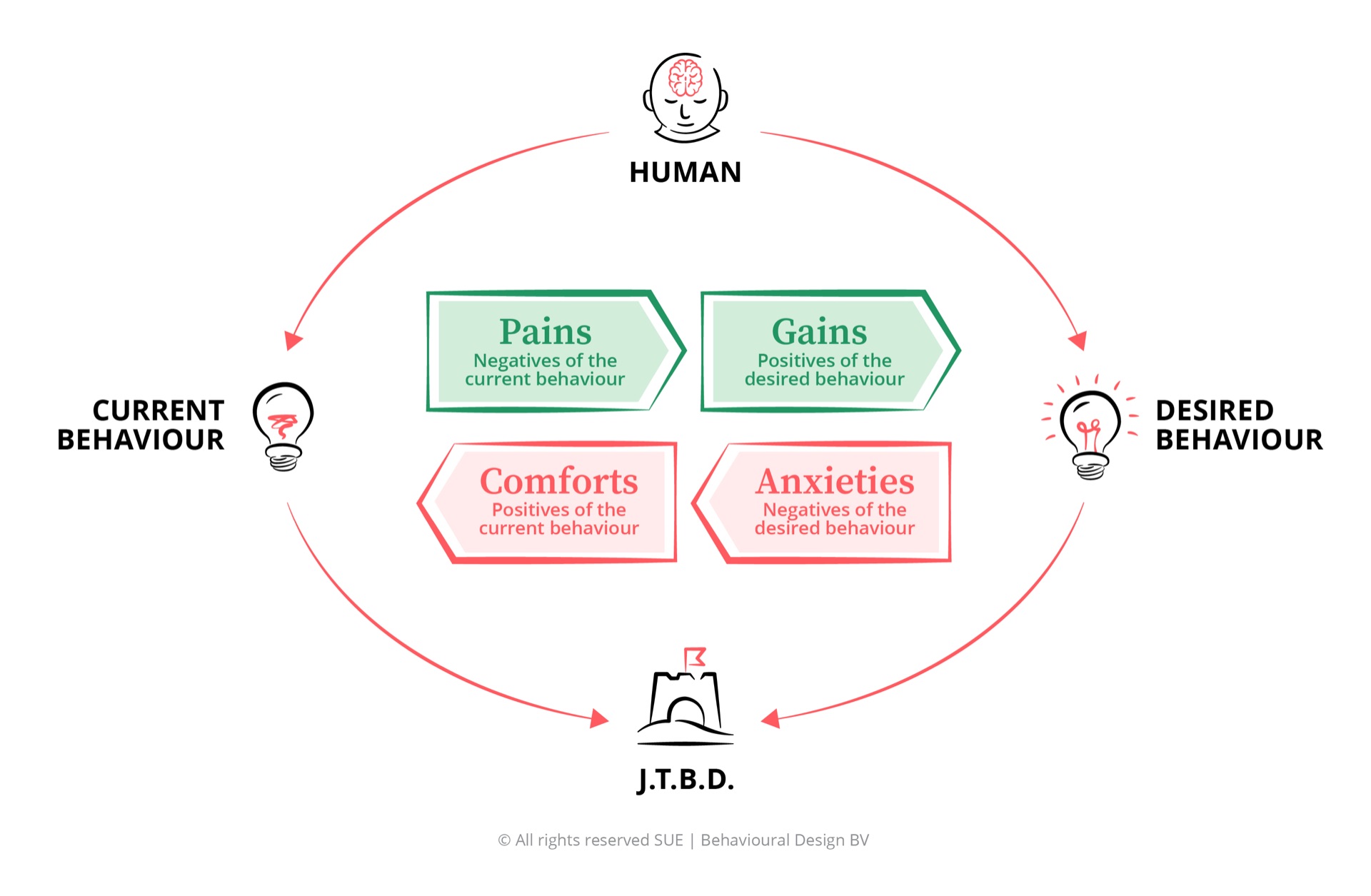
Pains. The pain of the bandwagon effect is delayed and collective. When the technology adoption fails, when the role does not work out, when the strategy is reversed - the cause is hard to trace back to the bandwagon decision made two years earlier. The pain is real, but the connection to the original decision is hazy.
Anxieties. Being left behind feels dangerous. “We will miss the boat.” “Competitors are ahead.” “The sector is changing.” This fear of falling behind is the driver of much bandwagon behaviour. And it is exactly the fear that consultants, technology vendors and media companies deliberately trigger to accelerate adoption.
The strategic insight is this: if you want people to stop riding a destructive bandwagon, do not reason with them - create an alternative bandwagon. Make the desired behaviour socially visible. Give early adopters a platform. Let the new wagon roll. The rest will follow.[3]
Five interventions that work
Most interventions against the bandwagon effect are environmental, not awareness-based. You cannot ask people to opt out of the bandwagon while the wagon is rolling. You have to structure the situation so that early voices carry less power.
1. Anonymous voting before the discussion. Have people establish and record their position before group discussion begins. Use a quick poll, a sticky note or a form. Once someone has committed their position before hearing what others think, they are less likely to simply fall in line with the dominant voice. This breaks the sequential nature of opinion cascades.
2. Reverse the order of speakers. Always start meetings about decisions with the least influential or most junior people in the room. Let the CEO or director speak last. This prevents early, high-status voices from anchoring the direction for everyone else. It is a small structural change with a significant effect on the diversity of perspectives that are actually voiced.
3. Deliberately create a positive bandwagon. If you want to drive a change, do not start with a persuasion campaign. Start with a small group of people you trust, give them the tools and autonomy to begin, and make their use visible. Share their experiences, their results, their names. Use the bandwagon in your favour rather than fighting against it.
4. Require an independent assessment first. For major technology or strategy decisions: have a small group evaluate the proposal without knowing what others think of it, and without context about “what the sector is doing.” A blind assessment on the substantive merits, free from social context, produces a different outcome than a group discussion where everyone already knows the proposal is popular.
5. Challenge “everyone is doing it” with data. Whenever the argument “all our competitors are doing this” surfaces in a meeting, always ask the follow-up question: how many competitors, exactly? Which ones? Since when? With what results? The bandwagon effect thrives on vagueness. “The whole sector is moving towards X” is a narrative, not evidence. Ask for the data behind the narrative and the effect often evaporates quickly.
Related biases
The bandwagon effect rarely operates alone. It reinforces and is reinforced by other cognitive shortcuts that are active in the workplace.
Social proof is the closest relative. Where social proof uses evidence (what are others doing and what does that tell me?), the bandwagon effect skips that step. In practice the two blur into each other: the line between “learning from others” and “going along with the crowd” is thinner than we think.
Confirmation bias makes the bandwagon effect more durable. Once you are on the wagon, your brain searches for evidence that the direction is right. Critical reports about the chosen technology or strategy are ignored or explained away. Positive reports are remembered and shared. The bandwagon has its own self-perpetuating mechanism.
Status quo bias plays a dual role. On one hand, it keeps people in their current behaviour - which works against the bandwagon. On the other hand: once the bandwagon has been rolling long enough, going along with the trend becomes the new status quo, and the same bias pulls people into the movement.
The halo effect makes already popular ideas even more popular. When an idea already has many supporters, that popularity reflects positively on the content. We attribute quality to the things that others apparently find valuable. The crowd becomes the quality stamp.
Frequently asked questions
What is the bandwagon effect at work?
The bandwagon effect is the tendency to adopt beliefs or behaviours purely because others are doing so. At work, it shows up in technology adoption waves where companies implement AI or agile because competitors are doing it, in hiring trends where everyone suddenly wants the same job titles, and in meetings where early voices set the direction for everyone who speaks afterwards.
What is the difference between the bandwagon effect and social proof?
Social proof is about evidence from others’ behaviour - you follow what others do because it gives you information about the right choice. The bandwagon effect is about momentum: you join the crowd purely because the crowd is moving, regardless of whether that movement is rationally justified. With social proof you ask: what are others doing and what does that tell me? With the bandwagon effect, you skip that question entirely.
Can you use the bandwagon effect positively?
Yes. The bandwagon effect is not inherently destructive. Used deliberately, you can create a positive adoption wave. Start with early adopters, make their use visible, and let the momentum work for you. This is at the heart of how successful change initiatives work: they deliberately create a bandwagon that rolls in the right direction.
How do I prevent the bandwagon effect from causing poor decisions?
The most powerful interventions are structural, not cognitive. Have people vote anonymously before discussion begins, so early voices cannot anchor the group. Reverse the order of speakers and start with the least senior person in the room. Ask everyone to write down their position before the meeting. And always challenge the claim that “everyone is doing it” with data: how many is everyone, exactly?
What is a concrete example of the bandwagon effect in an organisation?
The pivot-to-video disaster of 2017 is the clearest example. Facebook reported exceptional video statistics. Media companies worldwide restructured their newsrooms, laid off journalists and went all-in on video. Two years later it emerged that Facebook had systematically inflated its video metrics by a factor of three to five. The companies that had overhauled their strategy on the basis of the bandwagon were left with dismantled editorial teams and a strategy that had never made sense.
Conclusion
The bandwagon effect is different from most cognitive biases at work. It is not only a thinking error to overcome - it is also a force you can use. The organisations that best understand how group momentum works use it deliberately to accelerate desired changes and slow unwanted ones.
Want to learn how to apply behavioural psychology strategically - including how to make the bandwagon effect work for you? In the Behavioural Design Fundamentals Course you learn to apply the Influence Framework and the SWAC Tool to diagnose and influence behaviour in organisations. Rated 9.7 by 5,000+ alumni from 45 countries.
PS
At SUE our mission is to use the superpower of behavioural psychology to help people make positive choices. The bandwagon effect reminds us that behaviour is always social - we are herd animals, and that is not a weakness. The art is understanding which herd you are following, whether you are doing so consciously, and whether the direction is right. Because the wagon rolls whether you want to be on it or not. The only question is whether you are holding the reins.