We run a training academy at SUE. Over 5,000 alumni from 45+ countries. So I think about this problem every single day: how do you get people to actually apply what they’ve learned?
Because that’s the dirty secret of the education and L&D industry. Training gets high ratings. Participants feel inspired. They leave with notebooks full of insights. And three months later, almost nothing has changed. Not the meetings. Not the conversations. Not the decisions. The training was a success by every metric the industry tracks, and a complete failure by the one metric that actually matters: behaviour.
I see this pattern not only in our own work, but in every organisation we advise. E-learning modules with completion rates below 20%. Leadership programmes that produce breakthrough personal insights and zero change in how people lead on Monday morning. Compliance training that everyone completes on time and nobody remembers six weeks later.
The missing variable is not content. It is human behaviour. And the discipline that addresses it is called behavioural design.
Behavioural design for education applies behavioural science to the gap between knowledge and action. Instead of assuming that better content produces better behaviour, it maps the psychological forces that determine whether learners actually change what they do. Using the SUE | Influence Framework©, educators and L&D professionals redesign learning journeys, environments, and defaults to work with human psychology, not against it.
The numbers behind the knowing-doing gap
What jobs do students hire education to do?
Jobs-to-be-Done thinking, Clayton Christensen’s framework that asks what task a product or service must fulfil, is transformative for education. Because when you ask educational institutions and L&D teams why students or employees are attending their programme, you always get the wrong answer. They name the content, the qualifications, the market relevance.
But the real jobs run deeper. Students hire education for: career advancement (a qualification that opens doors that would otherwise stay closed), competence acquisition (being able to do something concrete that reduces their vulnerability), social connection (finding like-minded people in a new life phase), credential signalling (showing employers and peers they are to be taken seriously), and sometimes simply personal growth (a clearer picture of who they are and what they are capable of).
Institutions hire behavioural design for a different set of jobs: reducing dropout rates, improving learning outcomes, raising satisfaction scores, demonstrating measurable social impact.
People don’t resist change. They resist being changed. A student who designs their own learning behaviour changes. A student who has passive consumption imposed on them does not.
This distinction is essential. If an institution thinks the job is “delivering content,” they design a lecture. If they understand that the job is “enabling career advancement,” they design a learning environment that trains students at the moments that actually matter. The first approach produces completion rates. The second produces behaviour change.
At SUE we saw this in a project for an educational institution that had asked us to address dropout proactively. After a JTBD analysis, it turned out that the real job for first-year students was not “understanding the curriculum” but “feeling confirmed that I belong here.” That reformulation changed everything: the interventions that reduced dropout had nothing to do with academic support and everything to do with designing belonging into the first weeks.
Why education needs behavioural design
Education operates on a deeply embedded assumption: knowledge transfer equals behaviour change. If you understand something, you will do it. If you know what the right choice is, you will make it. If you complete the module, you will apply the skills.
This assumption is empirically false. Behavioural science has spent fifty years documenting the gap between knowing and doing. We know that regular exercise is good for us. Most of us do not exercise regularly. We know that feedback is the most powerful tool for improvement. Most managers give feedback poorly or not at all, even after attending a feedback skills workshop. We know that spaced practice is more effective than cramming. Students cram anyway, because it feels productive and cramming requires no behavioural redesign of daily life.
Carol Dweck’s decades of research at Stanford showed that learners with a growth mindset, the belief that abilities are developable through effort and strategy, approach challenges fundamentally differently from those with a fixed mindset. But teaching the growth mindset as a concept almost never changes actual learning behaviour. What does work is designing the learning environment so that failing and restarting are the normal course of events, not the exception.[5]
The problem is not that learners lack motivation or intelligence. The problem is that the learning environment is designed for passive consumption in a single moment, disconnected from the context where behaviour needs to change. Learners return to an environment that rewards old habits, offers no cue to apply new behaviour, and provides no friction when they slip back into existing patterns. The training was the anomaly. Their daily environment is the default.
The default always wins.
Learners don’t fail to apply training. Training fails to account for the environment learners return to.
This is what behavioural design does: it starts from the premise that behaviour is shaped by context, not by understanding. As I describe in The Art of Designing Behaviour (2024): the principle is always the same. Change the environment, not the person.
Three education challenges that behavioural design solves
Challenge 1: the compliance training nobody remembers
A financial services firm ran its annual anti-money-laundering compliance training. All 1,200 employees completed it within the deadline. The completion rate was 100%. The L&D team received congratulations from the board. Six months later, an audit revealed that the behaviours the training was designed to change, reporting suspicious transactions, following escalation protocols, had not changed at all. The compliance officer reviewed the training. It was clear, well-produced, and entirely focused on explaining what employees needed to know.
That was the problem. The training answered the wrong question. “How do we make sure they understand?” instead of “how do we make sure they act?”
Understanding is passive. The desired behaviours, noticing something suspicious, interrupting a workflow to report it, navigating an unfamiliar escalation process, all require active intervention in a moment of pressure. Present bias ensures that in that moment, the path of least resistance wins. And the path of least resistance is to complete the current task and deal with the suspicious transaction later.
Challenge 2: the student dropout that happens in silence
A Dutch university of applied sciences was alarmed by its first-year dropout figures. Roughly one in three students did not complete their first year. The institution had invested in orientation weeks, student counsellors, tutoring programmes, and an early-warning system that flagged students who missed three consecutive classes. None of it made a measurable dent in the dropout rate.
The problem with the institution’s approach was the assumption that dropout is a sudden event preceded by visible warning signs. It is not. Dropout is a gradual process of disengagement that happens in the background while the student is still present. The student attends lectures but stops engaging with the material. They participate less in seminars. They miss one assignment deadline without consequence, then another. They begin to feel like they don’t belong in the programme. Then they stop coming.
By the time the early-warning system flags them, the psychological decision to leave has already been made. The intervention is too late, too generic, and too dependent on the student taking action themselves, precisely the capacity that disengagement has already eroded.
Challenge 3: the leadership programme that creates insights but not leaders
A multinational ran its annual leadership development programme. Three days offsite, expert facilitators, a 360-degree feedback process, a personal leadership profile, a development plan. Participant satisfaction: 9.1 out of 10. The HR director described it as “genuinely transformational.” Back in the office two weeks later, the participants’ teams noticed no change. The same meeting behaviours. The same delegation patterns. The same avoidance of difficult conversations.
This is the insight-action gap, and it is endemic in leadership development. The programme was designed to produce insights. It did. Insights are not behaviours. You can have a profound insight about your own leadership style at 11am on day two of a residential programme and be completely unable to act on it when you’re back in a pressured environment surrounded by people who know you as you were, not as you intend to be.
Status quo bias operates powerfully in social contexts. Colleagues, direct reports, and managers all have an existing model of who you are. That model exerts gravitational pull. Changing it requires not just personal intention but environmental redesign.
Influence Framework analysis: what drives and blocks learning behaviour
The SUE | Influence Framework© maps the four forces that determine whether learners, students, or participants actually change their behaviour. Applied to education and L&D, a consistent pattern emerges: the blocking forces are more powerful than the driving forces, and they are almost entirely unaddressed by standard learning design.
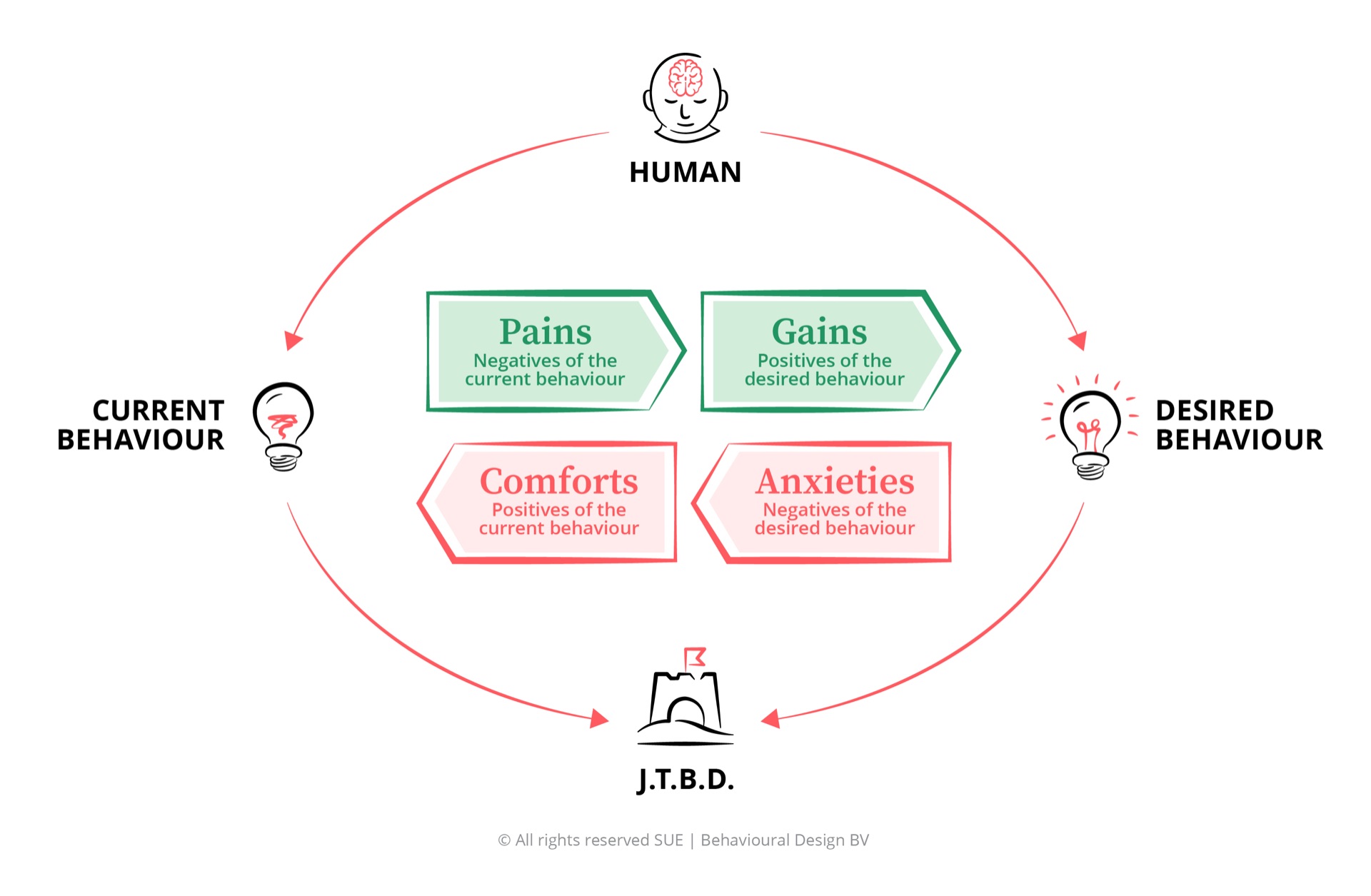
Why learners don’t apply what they know despite understanding it
Learning design addresses the driving forces effectively. Learners understand the value of the programme, the relevance of the content, and the consequences of not applying it. What remains unaddressed are the blocking forces: the profound comfort of passive learning and the anxieties that make active application feel genuinely threatening.
Performance pressure and career consequences: The threat of poor grades, failed performance reviews, or visible incompetence creates genuine urgency. For some learners, this is a powerful driver. For others, it triggers the very anxieties that block engagement. Performance pressure is the double-edged driving force in education: too little produces complacency, too much produces paralysis.
Awareness of a skill gap: When learners have a concrete, felt sense of something they cannot do that they need to do, present in front of senior stakeholders, navigate a difficult conversation, manage a complex project, this gap is a genuine pain that drives learning motivation. Abstract skill gaps do not produce the same urgency.
Organisational mandate: When training is required, employees attend. The mandate removes one level of friction from participation. It does not remove any of the friction from application.
Competence and confidence: The prospect of genuinely being better at something meaningful is a powerful motivator. This is the gain that well-designed learning can make vivid and immediate. The problem is that most training keeps this gain abstract and future-oriented, which makes it vulnerable to present bias.
Social recognition: Credentials, certificates, and visible markers of competence matter to learners. They signal status and belonging within a professional community. This gain is often more motivating than the competence itself, which is worth designing for explicitly.
Intellectual curiosity: For intrinsically motivated learners, the joy of understanding something new is its own reward. This is the gain that great teachers and facilitators know how to activate. It is also the first thing that disappears when learning design is boring or passive.
Passive learning feels productive: Watching a video, reading a slide, listening to a lecture: these feel like learning. They activate a sense of progress without requiring any change in behaviour. This is the most insidious blocking force in education. Learners genuinely believe they are learning when they are consuming. The comfort of feeling productive while remaining behaviourally unchanged is the design flaw at the heart of most training programmes.
Existing habits and routines are automatic: Whether students have developed study habits that work (for passing exams but not for retention) or employees have developed work habits that are efficient for their current role, these routines are deeply embedded and automatically activated. Any learning that requires disrupting them faces enormous inertia.
The current situation is tolerable: Most learners are not in acute crisis. The status quo, while imperfect, is functional. Status quo bias means that without a compelling and immediate reason to change, the path of least resistance is to leave things as they are. Training that connects to a vague future benefit does not overcome this comfort.
Fear of failure and public exposure: Active learning requires attempting things before you are competent at them, which means performing below your own standards in front of others. For many learners, this risk is not acceptable. The Dunning-Kruger dynamic operates in both directions: beginners often don’t know what they don’t know (which can create false confidence), but learners who are aware of their gaps often overestimate how visible and catastrophic their incompetence will appear to others.
Imposter syndrome and social comparison: In any learning group, participants compare themselves to each other. Those who believe they are less capable than the group average experience anxiety that suppresses participation. They ask fewer questions, take fewer risks, and default to the strategies that have worked for them before, even when those strategies are ineffective.
Application anxiety: Even learners who feel confident during training often feel anxious about applying new behaviour in their real context. The training environment is safe and controlled. The work environment is not. “What if it doesn’t work with my team?” “What if I get it wrong in front of my manager?” These anxieties are rarely voiced but reliably prevent transfer.
The key insight: Learning design overwhelmingly targets the driving forces: make the content relevant, make the gains clear, add a performance consequence. But learner behaviour is determined by the blocking forces, which operate below the level of rational argument. The comfort of passive learning and the anxiety of active performance are not overcome by better slides or more engaging facilitators. They are overcome by redesigning the learning environment so that active application is easier, less threatening, and more immediately rewarding than passive consumption.
Five behavioural interventions for education
-
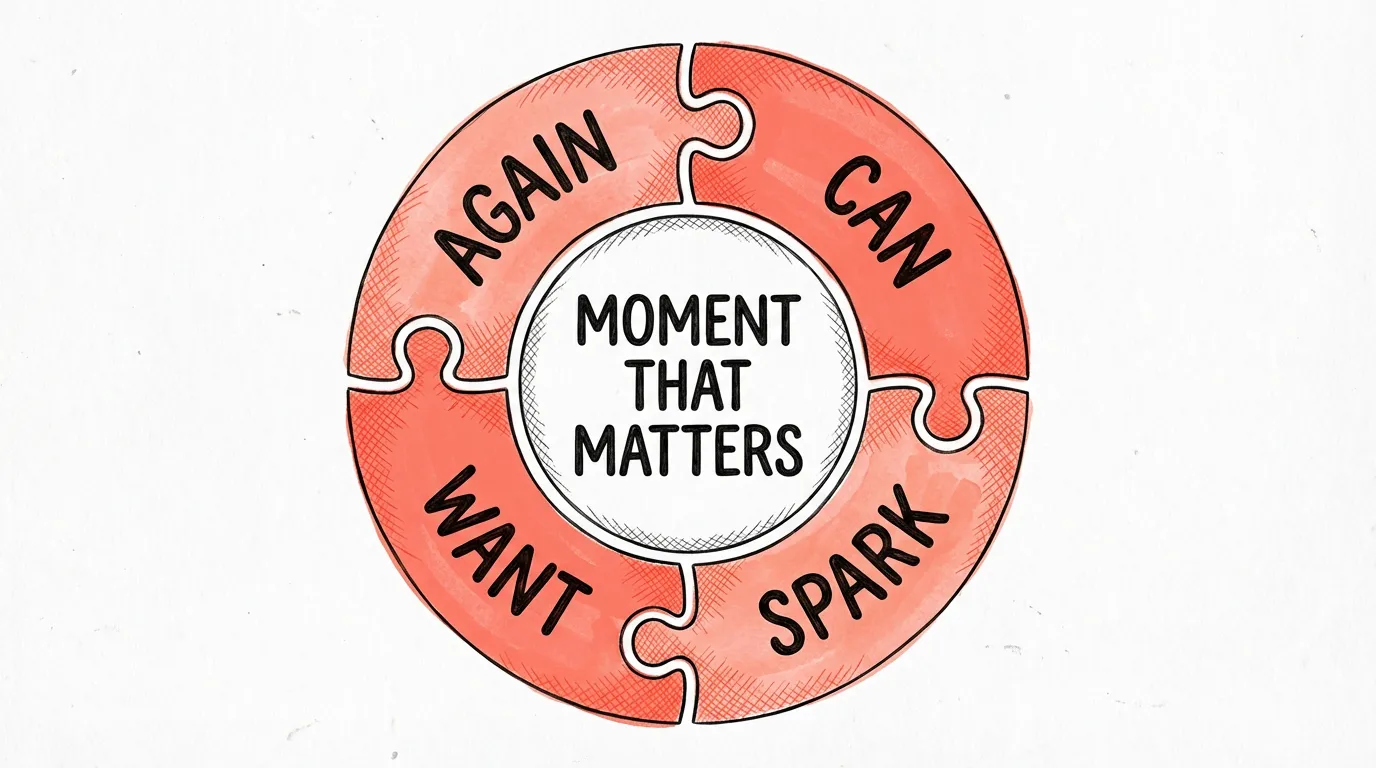
Design learning around moments that matter, not modules (SPARK)
The most powerful question in learning design is not “what do learners need to know?” It is “at what moment does this knowledge need to become action, and what is happening in that moment?” In our Fundamentals Course, we structure every learning element around a concrete professional situation where the new behaviour needs to appear. Not “understand the SUE Influence Framework.” But “use the SUE Influence Framework the next time you face a behaviour change challenge.” The Moment that Matters is the design anchor. Everything before it prepares the learner for that moment. Everything after it reinforces the behaviour in that moment.
-
Replace information dumps with spaced practice (AGAIN)
The forgetting curve is not a learner problem. It is a design problem. Without repetition in varied contexts, new knowledge and skills fade within days. Spaced practice does not mean weekly emails with tips. It means deliberately creating moments where learners must actively retrieve and apply what they have learned, in progressively more complex and realistic contexts. The science is unambiguous: spaced retrieval practice outperforms massed learning by a factor of two to six on long-term retention.[7] Most training programmes do not use it.
-
Default learners into active participation (CAN)
Passive consumption is the default in most education contexts. Learners sit and receive. Active participation requires effort, social risk, and the abandonment of the comfortable observer role. Behavioural design inverts the default. Instead of designing a lecture with optional discussion, design a discussion that requires preparation. Instead of a voluntary assignment, make peer feedback a structural component of assessment. Instead of an opt-in application exercise, make the exercise the entry point for the next module. When active participation is the only path through the programme, the question of motivation becomes less relevant. The environment produces the behaviour.
-
Build peer accountability into learning design (WANT)
Social accountability is the most powerful and most underused lever in learning design. People change their behaviour when other people they respect are watching. Not because of fear, but because belonging and social coherence are fundamental human motivations. Design peer accountability into the programme architecture from the start: learning pairs who check in fortnightly on application progress, small groups who share one concrete result of applying the new behaviour before the next session, public commitment rounds at the start of each module. The content becomes a conversation. The conversation becomes a community. The community sustains the behaviour change.
-
Reduce friction between learning and application (CAN)
The distance between a training room and a real work situation is larger than it looks. Learners leave the training energised and return to an environment that immediately reasserts the old habits. The job queue is full. The team is in their usual patterns. The new tool is not installed on the work computer. Behavioural design addresses this by building application bridges directly into the learning design: a concrete action the learner will take before the next session, a “first use” moment that is scheduled before leaving the room, a job aid that sits in the work environment and triggers the new behaviour at the right moment. Make the application step so small and so immediate that the inertia of the old environment cannot overcome it.
Which cognitive biases matter most in education
Learning decisions, whether to engage, how to study, whether to apply what was learned, are shaped by the same cognitive biases that operate in every other domain. Here are the five that have the most impact on learner behaviour, teaching effectiveness, and learning system design.
Dunning-Kruger Effect
Learners who are early in their competence development systematically overestimate their understanding. They believe they know it because they can recognise it. They discover they don’t know it when they try to apply it. This gap between perceived and actual competence is one of the most reliable barriers to effective learning design.
Read the full analysis → Behavioural DesignPresent Bias
The benefits of deep learning are future-oriented. The cost of active engagement is immediate. Learners systematically choose the low-effort, high-comfort option in the present: the quick scan over deep reading, the passive video over active practice, the cramming session over spaced repetition. This is not laziness. It is how the brain calculates value.
Read the full analysis → Behavioural DesignStatus Quo Bias
Employees return from training to a work environment that is optimised for the way they currently work. Every structural element, team norms, meeting formats, tool preferences, reinforces existing behaviour. The new behaviour has no anchor in this environment. Status quo bias ensures that without deliberate design, the old patterns reassert themselves within days.
Read the full analysis → Behavioural DesignSocial Proof
Learners look to their peers to calibrate what is normal, acceptable, and worth doing. In a learning environment where passive consumption is the norm, social proof suppresses active engagement. In a learning environment where contribution and application are visibly modelled by respected peers, social proof amplifies them.
Read the full analysis → Behavioural DesignConfirmation Bias
Learners process new information through the filter of what they already believe. Content that confirms existing mental models is absorbed easily. Content that challenges them is discounted, forgotten, or rationalised away. This means that the most important learning, the kind that genuinely requires behaviour change, is systematically the hardest to make stick.
Read the full analysis →Frequently asked questions
How does behavioural design apply to education?
Behavioural design for education maps the psychological forces that determine whether students and employees actually apply what they learn, rather than simply completing a programme and returning to old habits. Instead of optimising content delivery, it redesigns the learning environment: defaults, social structures, friction points, and moments of application. The SUE | Influence Framework© diagnoses the specific Comforts keeping learners in passive modes and the Anxieties blocking genuine engagement, then applies SWAC interventions at the moments where learning behaviour actually happens.
What jobs do students hire education to do?
Students hire education for: career advancement (a qualification that opens doors), competence acquisition (being able to do something concrete you could not do before), social connection (finding like-minded people and building networks), credential signalling (showing employers what you are worth), and personal growth. Institutions hire behavioural design for: reducing dropout rates, improving learning outcomes and making behaviour change measurable. When a programme design connects to the real job, both engagement and behavioural outcomes improve.
Can behavioural design improve e-learning completion rates?
Yes, but completion rate is not the real problem. Completion without application is as useless as non-completion. Behavioural design addresses both: it reduces friction at the entry point (which raises completion) and redesigns the learning journey to include spaced practice, peer accountability, and application moments (which raises transfer). Organisations that apply behavioural design principles to their learning architecture consistently see both completion and behaviour change improve together.
Why do employees forget training within days of completing it?
The forgetting curve is well documented: without reinforcement, people forget roughly 70% of new information within 24 hours. But the deeper problem is not forgetting. It is that training is designed as a single event, disconnected from the work context where behaviour needs to change. Learners return to an environment that rewards existing habits and offers no cue to apply the new behaviour. Behavioural design addresses this by designing spaced practice into the architecture, linking new behaviours to existing routines, and building peer accountability structures that make application the expected default.
How does the SUE Influence Framework work in an education context?
The SUE | Influence Framework© maps four forces for any learning behaviour: Pains (what makes the current situation feel unsustainable, like failing grades or poor performance), Gains (what learners stand to win, like competence and career progress), Comforts (what makes existing habits feel safe, like passive consumption and familiar routines), and Anxieties (what makes active learning feel risky, like fear of failure and imposter syndrome). In education, the blocking forces almost always dominate. That is why better content rarely produces better behaviour.
PS
This is personal for me. SUE’s Fundamentals Course is the product I am proudest of, and it is proud precisely because we designed it backwards from the question that every educational institution avoids: not “what do participants need to learn?” but “what do they need to be able to do, in what situations, and what is stopping them?” We designed the learning around Moments that Matter. We built in spaced practice, peer accountability, and immediate application assignments. We made passive consumption structurally impossible. The result is a 9.7 out of 10 rating and, more importantly, participants who come back and tell us they are still using the framework two years later. That is the bar for education. Not “did they enjoy it?” Not “did they learn something?” But “are they still doing something differently?” If the answer is no, the training failed. No matter what the satisfaction scores say. You can read more about how we think about this in The Art of Designing Behaviour (2024), and you can experience it directly in the course. Education doesn’t need better content. It needs better design.