Last week I was standing in the supermarket, and I was not looking at the products. I was watching the hands. It is something I have done for years, and it never stops being fascinating. The hand reaches for the same shelf position, grabs the same brand, drops it in the trolley. Total time: two seconds. No deliberation. No comparison. Pure autopilot.
95% of purchase decisions in the supermarket aisle happen in under four seconds. I have watched FMCG companies spend millions on campaigns trying to change this, only to discover that the consumer who told a focus group they would “definitely try the new brand” is the same person who reached for the familiar pack on muscle memory and walked straight past the display.
At SUE we have worked with FMCG companies on exactly this problem. The product wins the blind taste test. The campaign drives awareness. Distribution is solid. And market share does not move. Because no campaign in the world can compete with a habit.
The missing variable is not reach, not awareness, not even preference. It is behaviour. And the discipline that addresses it is called behavioural design.
Behavioural design for FMCG applies behavioural science to purchase decisions, brand habits and sustainable consumer behaviour. Rather than investing more in advertising, it maps the psychological forces that determine shelf behaviour. Using the SUE | Influence Framework©, FMCG companies redesign packaging, placement and product experiences to work with System 1 decision-making, rather than against the habits competitors built first.
The numbers behind FMCG behaviour
The real reason why people buy products: Jobs-to-be-Done
Clayton Christensen of Harvard Business School conducted research in the early 2000s that should have fundamentally changed the FMCG industry, but which most brands still ignore. A fast-food chain wanted to sell more milkshakes. They asked consumers what they wanted: thicker, thinner, more flavours, cheaper. Standard market research. Standard recommendations. No improvement in sales.
Then a researcher asked a different question: what job is the consumer hiring a milkshake to do? What he discovered was striking. In the early morning, people bought a milkshake on the way to work. Not for the taste. Not for the calories. To survive the boring commute. The milkshake had the perfect properties for that job: it fit in the cup holder, it was thick enough to last the whole journey, it gave you something to sip while sitting in traffic.[5]
The milkshake’s competitors were not the McFlurry or the Starbucks frappuccino. The competitors were a banana, a bagel and the radio. The milkshake did not win that competition by becoming thicker or thinner. It won by better understanding the emotional and functional job it needed to do.
People do not buy products. They hire them to do a job. And that job is rarely what the product description suggests.
This is the core of Jobs-to-be-Done thinking in FMCG. Consumers hire products for functions that go far beyond what the product category suggests. They buy convenience to eliminate daily friction. They buy identity expression to communicate who they are. They buy social signals to show what they stand for. They buy familiar comfort in difficult moments.
Tony’s Chocolonely was built on the job “I want to enjoy chocolate and also show that I stand for something.” Oat milk gained market share by addressing the job “I want to feel part of a modern, conscious lifestyle,” long before the sustainability claims were fully convincing. Red Bull sells energy, but the real job is “help me function socially at a moment when I do not feel capable of it on my own.”
When you know what job consumers hire your product to do, everything changes: the format, the packaging, the shelf position, the communication moment, the habit cue you design. As I describe in The Art of Designing Behaviour (2024): the question is never “how do we convince people about our product”, but always “which job do we need to do better than the competitor.”
Why FMCG needs behavioural design
FMCG operates on an assumption that sounds reasonable but fails at the shelf: that if consumers know a product and score it well in testing, they will buy it. This is the rational consumer model. Fifty years of behavioural science have shown it does not exist.
What does exist are people who have bought the same shampoo for eleven years, not because it is the best shampoo on the market, but because their arm knows where it stands on the shelf. People who in a focus group agreed they would pay a little more for a sustainable yoghurt, but reached for the conventional one at the checkout because the sustainable option was two shelves lower and required an active decision. People who can name three competing brands and cannot tell you why they have never tried any of them.
This is not consumer irrationality. It is consumer efficiency. The brain automates repeated decisions to free cognitive resources for genuinely new choices. Brands that have made it into that automation system have an extraordinary advantage. Brands that have not are competing against a competitor whose product is almost invisible to the consumer’s conscious mind.
North, Hargreaves and McKendrick demonstrated this mechanism in an elegant experiment in a British supermarket. On days when French music played, shoppers bought more French wine. On days when German music played, they bought more German wine. The ratio was roughly five to one. Afterwards the researchers asked shoppers why they had bought that wine. Nobody mentioned the music. They had rational explanations for a decision that had been made entirely below the level of conscious awareness.[6]
The shelf is not where consumers choose. It is where habits are executed, and where environmental signals steer behaviour the shopper does not consciously register.
Simplicity eats willpower for breakfast. If you want consumers to choose your product, make sure choosing it requires no willpower at all.
This is what behavioural design does: it starts from the principle that purchase behaviour is designable. Not by advertising harder, but by redesigning the moments, defaults and environments where consumer decisions are made and where habits are formed.
Three FMCG challenges that behavioural design solves
Challenge 1: the new product launch that nobody tries
A global FMCG company spent 18 months developing a new drinks product. Consumer panels were enthusiastic. In-home placement tests scored the product above competitors on taste and value. National distribution was secured at major retailers. Brand awareness reached 60% via TV and digital within three months. Trial rate: 4%.
The product was good. The problem was that buying it required a conscious decision in an aisle where nobody makes conscious decisions. Consumers did not reach for it because their arm already knew where to reach. The new product looked visually similar to a dozen competitors, sat in the middle of the shelf, and gave no System 1 reason to break the existing pattern.
80% of new FMCG products fail within the first year. The core reason is always the same: market research measures System 2 preferences, but shelf behaviour is System 1. But there is also a JTBD mistake: the company had designed for the product category, not the job consumers needed done. What was the actual job? Did they even know?
Challenge 2: the sustainable range that does not sell
Unilever has extensively documented what every FMCG sustainability director already knows from experience: the intention-action gap is real, persistent and devastating for the P&L of sustainable products. Consumers genuinely want to buy sustainably. Ask them and they will tell you. Observe them at the shelf and they reach for the conventional product.
This is not hypocrisy. It is the gap between System 2 intentions and System 1 behaviour. The sustainable option typically requires an active choice: it is priced higher, positioned differently on the shelf, packaged with more information to process, and lacks the visual familiarity that makes the conventional product feel safe. All of these factors increase friction. And at the moment of purchase, friction wins.
Sheena Iyengar demonstrated this in an elegant experiment at a supermarket. When shoppers could choose from 24 jams, most disengaged and bought nothing. When there were six jams, they bought ten times as often. Choice overload is a real force at the shelf. Sustainable ranges make that overload worse by requiring more processing, not less.[7]
Challenge 3: the habit you have not built yet
At SUE we worked with a major brewer who had built substantial brand awareness in a target segment. Brand health scores were strong. Purchase intent was good. But repeat purchases were half of what the category average would predict based on trial. Consumers tried the product and did not come back.
The problem was not the product. The problem was that one purchase does not make a habit. Phillippa Lally’s research at University College London showed that habit formation takes an average of 66 days, not the often-cited 21. And those 66 days require consistent repetitions in a consistent context.[4] The brewer had a trial strategy. They had no habit-formation strategy.
Once a consumer habitually reaches for a brand, competitors are effectively invisible. But until that moment, every purchase is a conscious decision, vulnerable to comparison, price sensitivity and promotion-driven switching.
Influence Framework analysis: what drives and blocks FMCG purchase behaviour
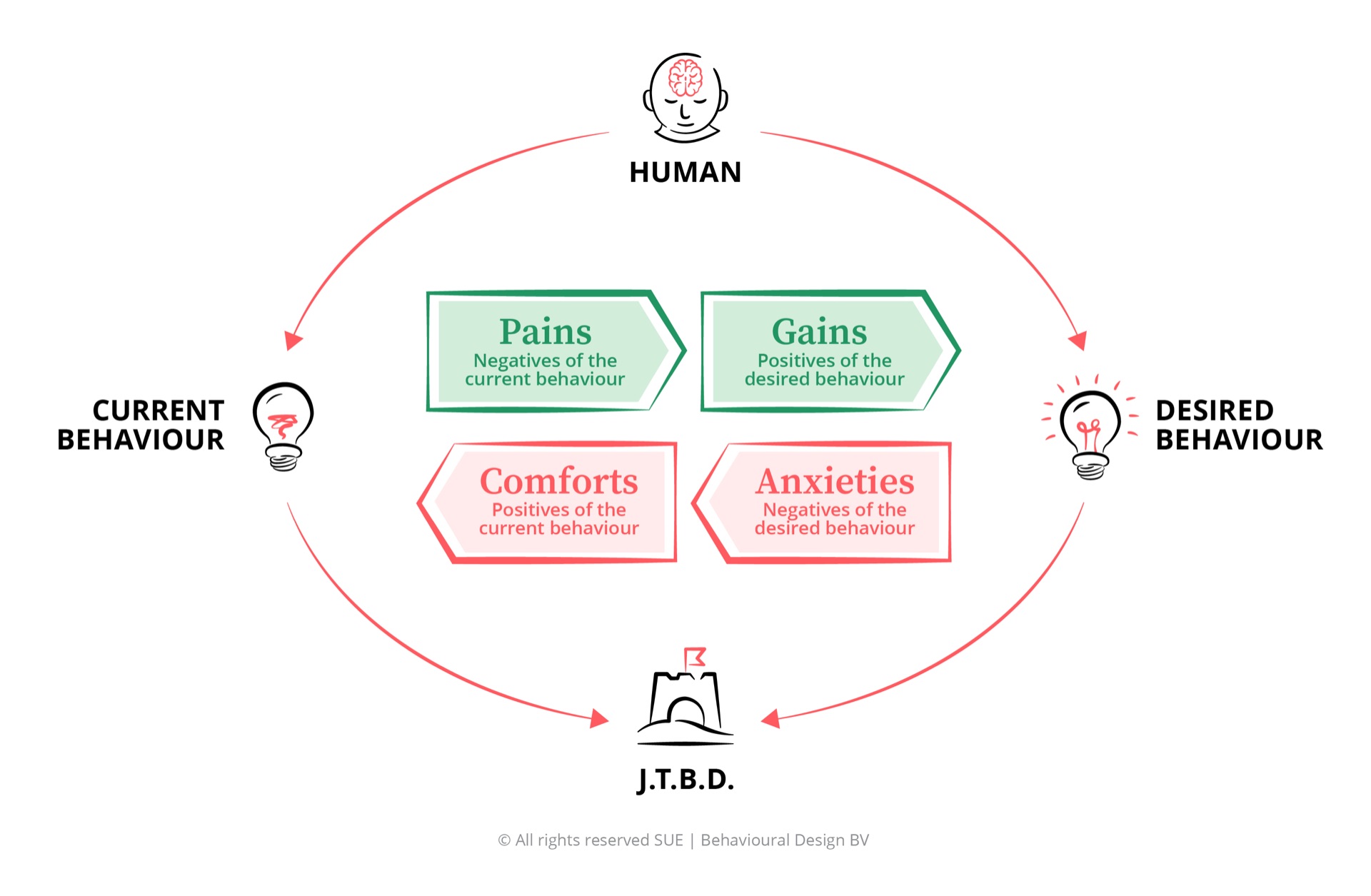
The SUE | Influence Framework© maps the four forces that determine whether consumers actually change their purchase behaviour. Applied to FMCG, a consistent pattern emerges: the blocking forces are almost always stronger than the driving forces, and they are almost entirely ignored by standard brand communications.
Why consumers do not switch brands even when they prefer your product in testing
FMCG brand communications address the driving forces effectively: product superiority, taste, sustainability credentials, value. What remains untouched are the blocking forces that operate below the level of conscious consideration. The comfort of the familiar brand and the anxiety about something new are not overcome by a better campaign. They are overcome by redesigning the environment so that the new behaviour is easier than the old one.
Dissatisfaction with existing products: Quality complaints, price increases or changes to a familiar product create real trial opportunities. When a competitor reformulates and consumers notice, that disruption temporarily suspends the habit purchase. This is the most effective moment for a challenger brand to be visible and distinctive.
Category entry moments: Starting a new diet, moving home, having a baby, recovering from an illness. These life events disrupt existing purchase habits and create genuine openness to new products. Reaching consumers at these moments is exponentially more effective than reaching them during habitual purchases.
Value pressure: As own-label quality has improved significantly, branded FMCG faces real price-driven switching pressure. This creates pain in the existing brand relationship and openness to alternatives, including the brand’s own cheaper range.
Sensory superiority: A product that genuinely tastes, smells or feels better creates a Gain that can override habit. But this only works if the consumer actually tries it. The problem is getting to trial. Once the consumer has tasted it and prefers it, the gain is real and motivating.
Sustainability alignment: For a growing segment of consumers, buying sustainably is a genuine Gain: identity alignment, values expression, the feeling of making a difference. This is a powerful motivator for the right consumer segment. The challenge is that this motivator operates in System 2 and is consistently overridden by System 1 at the shelf.
Social currency: Some FMCG products carry real social signalling value. Tony’s Chocolonely became a social statement brand. Oat milk became identity-related before it became habitual behaviour. The social currency Gain is a legitimate purchase driver for brands that earn it. Byron Sharp showed that mental availability, the ease with which a brand comes to mind in a buying situation, is the strongest predictor of FMCG market share.[8]
Habitual brand purchase is effortless: The strongest force in FMCG is the automaticity of habit purchase. When a consumer reaches for P&G’s Ariel for the twelfth time in a row, they are not choosing. They are executing a motor routine. This routine requires zero cognitive effort and delivers consistent satisfaction. Disrupting it requires a compelling reason and a visible trigger. Neither is delivered by standard awareness advertising.
The comfort of knowing what you get: Risk aversion is a fundamental human characteristic. In FMCG the stakes feel low, but the comfort of predictability is real. “I know this product. I know it will not disappoint me.” This is a powerful blocking force for challenger brands, even when their product is genuinely superior.
Mass marketing as the default strategy: Within FMCG organisations, the Comfort of established marketing practice is itself a blocking force. “We always build brands through TV and digital,” “our research shows positive intent,” “our pricing is competitive.” These internal Comforts prevent organisations from addressing the real behavioural barriers at the shelf.
Risk of trying something new: Even a £3 yoghurt carries trial anxiety. What if it does not taste good? What if the family does not like it? What if the sustainable option does not clean as well? These anxieties are small in absolute terms but large relative to the perceived cost of simply buying the familiar product. Anchoring to the known product makes every alternative feel risky.
Sustainable defaults feel like loss of choice: Internally, FMCG teams worry that making the sustainable option the default will irritate conventional-preference consumers and damage premium sales. This anxiety is addressable: defaulting to sustainable while keeping conventional available is not coercion. But the anxiety prevents FMCG organisations from implementing the most effective behaviour change available to them.
Packaging redesign feels risky: Packaging redesign is expensive and risks alienating loyal consumers by disrupting the visual cue that triggers habit purchase. This is a real risk, but it operates in both directions: the packaging that triggers habit purchase in existing loyal consumers is the same packaging that is invisible to potential new consumers because it offers no disruption.
The key insight: FMCG brand communications focus overwhelmingly on the driving forces: communicate the product benefit, show the taste win, demonstrate the sustainability credentials. But consumer behaviour is determined by the blocking forces, which operate below the level of rational argument. The comfort of the habitual brand purchase and the anxiety about something new are not overcome by better advertising. They are overcome by redesigning the purchase environment: the sustainable option as default, packaging as a System 1 cue, and the first three purchases as a deliberate habit-formation strategy.
Five behavioural interventions for FMCG
-
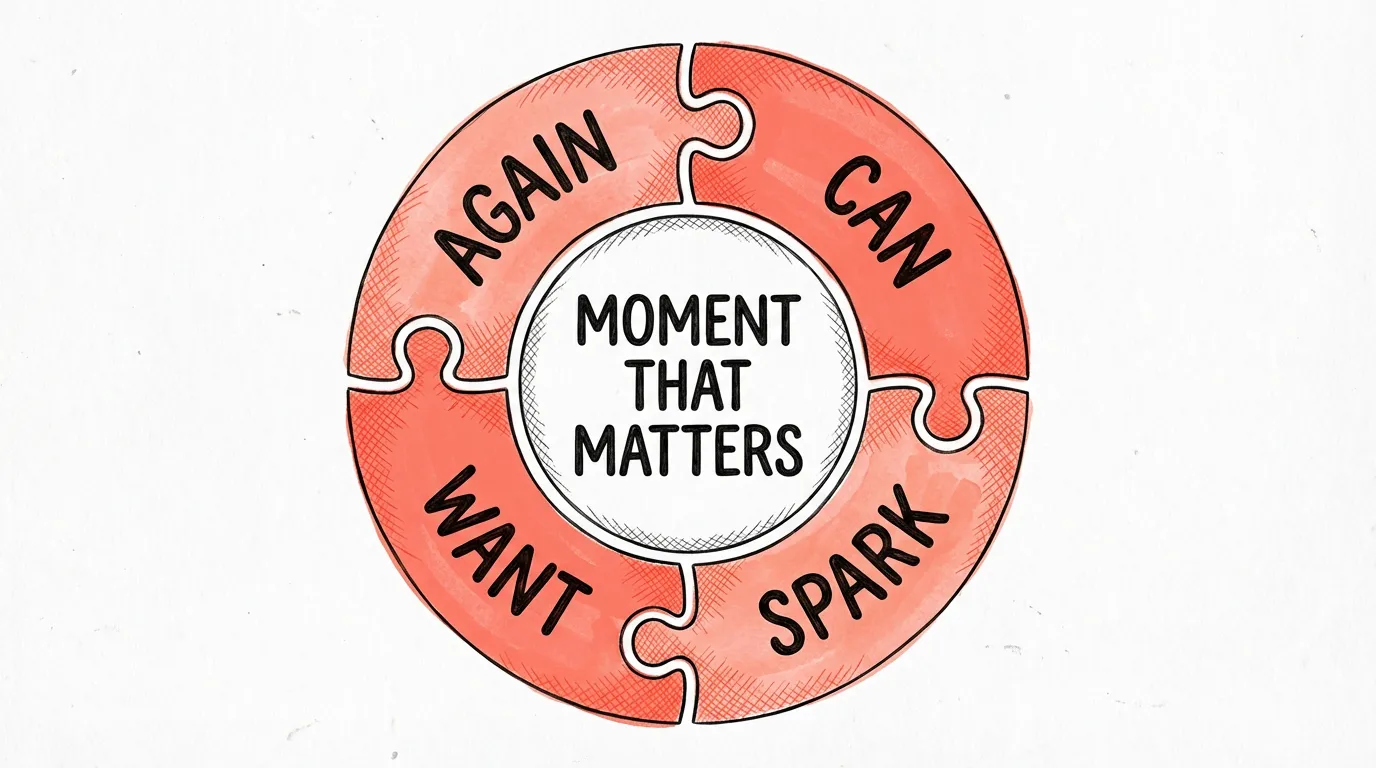
Design from the job, not the product (SPARK)
Before spending a euro on campaigns, conduct JTBD research: interview 15 to 20 existing buyers about the moment just before their purchase. Not “why do they buy this product” but “tell me about the last time you bought this: what were you doing before, how did you feel, what needed to be solved?” The job you discover determines everything. Christensen’s milkshake chain discovered through this method that the morning job and the afternoon job were completely different: same consumer, different moment, different job, different optimal product. FMCG brands that understand this do not design campaigns. They design situations.
-
Distinctive packaging as a System 1 cue (SPARK + CAN)
The Heineken star. Coca-Cola red. Tony’s Chocolonely unequal pieces. These are not aesthetic choices. They are behavioural design decisions that create System 1 shortcuts at the moment of purchase. When a consumer scans a shelf in two seconds, distinctive packaging triggers recognition before the conscious mind engages. For challenger brands, the goal is to disrupt the existing visual pattern in the category with something distinctive enough to force a moment of attention. That moment is the only window for persuasion in a four-second decision.
-
Sustainable as the default (CAN + WANT)
The most powerful intervention for sustainable FMCG adoption is making the sustainable option the default and requiring an active choice for the conventional alternative. When a retailer gives the sustainable variant the most prominent shelf position and the first click in online shopping, sustainable product sales rise without any reduction in consumer choice. The social proof strategy amplifies this: “Most popular in this category” labels on sustainable products remove the early-adopter anxiety that drives consumers towards the conventional product as the safe default.
-
Social proof on packaging (WANT)
“Chosen by 3 million households.” “Most popular in the UK.” “Britain’s favourite brand.” These statements do more behavioural work per unit of packaging space than any product claim. Social proof bypasses the conscious evaluation process and activates the System 1 heuristic: if millions of people choose this, the risk of choosing it is eliminated. The bandwagon effect is not a weakness to resist. It is a force to design with.
-
Reward the first three purchases (AGAIN)
Habit formation in FMCG requires 3 to 5 consistent repetitions before a purchase becomes automatic. The first purchase is trial. The second is cautious confirmation. The third is the beginning of a routine. Most FMCG brand strategies treat trial as the endpoint. Behavioural design treats trial as the beginning. Design the first three purchase experiences to be explicitly rewarding: an on-pack narrative that develops across multiple purchases, an immediate sensory payoff that reinforces the association, a habit cue that links the product to an existing ritual. A consumer who has bought your product three times and found something memorable each time is building a habit. A consumer who bought it once and found nothing memorable will slip back to their previous brand without thinking.
Which cognitive biases matter most in FMCG
Purchase decisions in FMCG are shaped by the same cognitive biases that operate in every domain, but the purchase speed and repetition frequency amplify their effect. These are the five biases with the most impact on shopper behaviour, brand switching and sustainable consumption.
Social proof
In a four-second purchase decision, “most popular” is the most powerful claim on the shelf. Consumers use what others choose as a proxy for quality when they have no time to evaluate. This is why bestseller labelling consistently outperforms product feature claims.
Read the full analysis → Behavioural DesignAnchoring bias
The price of the first product a consumer sees sets the anchor for the entire category. Premium brands that anchor high make mid-range products feel like value. Own-label positioned next to premium looks like a bargain. Shelf positioning is anchoring strategy.
Read the full analysis → Behavioural DesignDecoy effect
Introduce a third SKU priced between your entry and premium products but with attributes closer to the premium. Suddenly the premium sells more. The decoy does not need to sell well to do its job. Its job is to make the premium feel like the rational choice.
Read the full analysis → Behavioural DesignScarcity principle
Limited edition packaging, seasonal variants and low-stock indicators all activate the scarcity heuristic. “Only 4 left in stock” at the shelf motivates more than any product claim. The scarcity principle converts browsers into buyers by making the cost of not acting visible.
Read the full analysis → Behavioural DesignBandwagon effect
When consumers see that a product is popular, they infer quality and reduce the perceived purchase risk. For new FMCG products trying to establish themselves, demonstrating early popularity through sales figures, awards or endorsements is more persuasive than demonstrating product features.
Read the full analysis →Frequently asked questions
How does behavioural design apply to FMCG?
Behavioural design for FMCG applies behavioural science to the decisions consumers make in the supermarket aisle, in digital channels and at home. Rather than relying on advertising and claimed preferences from consumer research, it maps the psychological forces that actually determine shelf behaviour. The SUE | Influence Framework© diagnoses the Comforts that keep consumers loyal to existing brands and the Anxieties that block trialling, then designs SWAC interventions at the moments where purchase decisions actually happen.
What is Jobs-to-be-Done and why is it relevant for FMCG?
Jobs-to-be-Done (JTBD) is a framework from Clayton Christensen that asks: what job is the consumer hiring this product to do? Not the product category, but the functional, social and emotional task it needs to solve. Christensen’s milkshake research showed that people bought a milkshake in the morning to survive a boring commute, not to satisfy hunger. That changes everything: the format, the packaging, the placement, the communication moment. FMCG brands that design from the real job build fundamentally stronger purchase habits.
Why do most new FMCG products fail despite positive market research?
Market research measures claimed preferences, which are System 2 responses: considered, conscious, rational. Shelf behaviour is System 1: fast, automatic, habit-driven. The consumer who tells you in a focus group they would definitely try your new product is the same person who walks straight past it in the supermarket because their hand already knows which brand to reach for. Behavioural design bridges this gap by designing for how people actually shop, not how they say they shop.
How can FMCG brands close the intention-action gap for sustainable consumption?
The intention-action gap in sustainable FMCG is not a values problem. Consumers genuinely want to buy sustainably. The gap exists because sustainable options typically require more effort, cost more, or are less prominently positioned than conventional alternatives. Behavioural design closes the gap by making the sustainable option the default, reducing friction and price barriers, using social proof on packaging, and applying loss framing so consumers feel what they lose by not choosing sustainably.
What is the role of packaging in behavioural design for FMCG?
Packaging is the most important behavioural design instrument in FMCG because it operates at the moment of purchase, in under four seconds, when System 1 is making the decision. Distinctive packaging creates a System 1 shortcut: the Heineken star, Coca-Cola red, Tony’s Chocolonely unequal pieces. These are not design choices. They are behavioural signals that bypass rational evaluation and trigger habitual reaching. Packaging that interrupts the autopilot forces reconsideration. Packaging that fits the habit pattern reinforces it.
How does the SUE Influence Framework apply to FMCG brand strategy?
The SUE | Influence Framework© maps four forces for any purchase behaviour: Pains (what makes the current brand choice unsatisfying), Gains (what the consumer wins by switching), Comforts (what makes the existing brand feel safe and effortless), and Anxieties (what makes switching feel risky). In FMCG, the blocking forces dominate: the comfort of habitual brand purchase and the anxiety about something new are far more powerful than any rational argument for a competitor. This is why advertising that addresses only Gains rarely changes behaviour at the shelf.
PS
I have worked with FMCG brands for years, and the same conversation happens every time. Strong brand equity, excellent product scores, declining repeat purchases. The instinct is always to invest in more reach, a better campaign, a stronger value proposition. These are all System 2 strategies for a System 1 problem. The moment a team stops trying to win the rational argument and starts asking “which job do we need to do better than the competitor, and how do we design the environment so that job is hired from us automatically”, everything changes. That is the core of what we do at SUE, and it is what I describe in The Art of Designing Behaviour (2024). The shelf is not a communication problem. It is a design problem.