I was in a meeting with a municipal policy team last year. They had just launched an energy transition subsidy programme. The budget was generous, the criteria were clear, the application process had been simplified three times. Take-up was at 6%.
‘We don’t understand,’ one of the programme managers told me. ‘The citizens we speak to say they want this. They tell us energy costs are too high. They tell us they want to invest in sustainability. And then they don’t apply.’
This is the pattern I encounter in almost every public sector project we do at SUE. Solid policies, clear communication, genuine citizen interest. And behaviour that stubbornly refuses to follow. The government keeps assuming it is a communication problem and keeps investing in clearer language, better channels, more accessible formats. Awareness goes up. Behaviour does not.
The missing variable is human behaviour. And the discipline that addresses it is called behavioural design.
Behavioural design for government applies behavioural science to the gap between policy intention and citizen action. Instead of assuming citizens are rational decision-makers, it maps the psychological forces that drive compliance, participation, and sustainable behaviour through the SUE | Influence Framework©. By thinking from the citizen’s Job-to-be-Done rather than the policy objective, governments and municipalities redesign public services, choice environments, and default options to work with human psychology, not against it.
The numbers behind the policy gap
The wrong question government asks
Government operates on an assumption that sounds democratic but is empirically wrong: that informed citizens make rational choices. Provide the right information, set the right rules, offer the right incentives, and citizens will act accordingly. This is the rational actor model. Behavioural science has spent fifty years demonstrating that it does not describe how people actually behave.
What does exist are citizens whose Job-to-be-Done is never the policy outcome itself, but always something more personal: reduce energy costs without disrupting my life. Keep the neighbourhood safe without a six-week construction project. Contribute without being buried in bureaucratic process. The moment you make that shift, from policy logic to citizen logic, you understand why 6% uptake is not the result of disinterest but of a system designed for a citizen who does not exist.
As I write in The Art of Designing Behaviour (2024): “Influence is far more judo than karate.” Government tries to move citizens by pushing: information campaigns, subsidies, regulation. Behavioural design works with the forces already present, rather than pushing against them. And those forces are always there. Citizens want to reduce their energy bills. They want to keep their neighbourhood safe. They want to participate in democratic processes. The problem is the design of the access, not the motivation.
Citizens don’t fail policies. Policies fail to understand what citizens actually want to achieve.
This is what behavioural design does: it starts from the citizen’s JTBD, not the policymaker’s objective. It then maps the environment driving or blocking that behaviour, and redesigns it so the desired behaviour becomes the path of least resistance.
Three public sector challenges that behavioural design solves
Challenge 1: the recycling campaign that raised awareness but did not change bins
A large Dutch municipality we worked with had run a twelve-month recycling awareness campaign. The campaign was well-executed: clear messaging, broad reach, genuinely creative. Post-campaign measurement showed that knowledge of correct separation rules had increased significantly. Actual separation rates at household level had barely moved.
They were solving the wrong problem.
Awareness was never the barrier. Most citizens already knew they should separate their waste. The actual barriers were contextual: the bins were inconveniently placed, the categories were confusing at the moment of decision, and the immediate effort cost of doing it correctly was just high enough that the path of least resistance won every time. Information addressed none of these barriers. Information never does when the problem is not knowledge but friction. Research on the visibility of recycling behaviour shows that when good separation is made publicly visible, it creates a social norm effect that moves significantly more people than private messaging.[5]
Challenge 2: the energy transition programme citizens resist
A regional energy agency launched a subsidised home insulation programme targeting homeowners aged 45-70. The economics were compelling: a well-insulated home would pay back the investment within seven years, with government covering 40% of upfront costs. The programme was extensively promoted. Uptake after the first year: 6% of the eligible population.
The policy team was baffled. The incentive was generous. The information was clear. What was wrong with these homeowners?
Nothing was wrong with them. Everything was wrong with the programme design. Loss aversion meant citizens focused on the 60% they had to pay rather than the 40% subsidy. Status quo bias meant the comfort of the current situation outweighed the future benefit. And the process of applying, sourcing contractors, managing the work, and living through the disruption was a friction mountain most people chose not to climb. The subsidy addressed rational cost barriers. It left every behavioural barrier completely intact. Opower research showed that social comparison messages on energy bills permanently reduced consumption, with the effect persisting even after the intervention stopped.[6]
Challenge 3: the citizen participation portal nobody visits
A municipality invested significantly in a new digital platform for citizen participation. The platform was technically well-designed: accessible, mobile-friendly, clear navigation, multiple participation formats. After three months, 2.8% of the target population had registered. Of those, fewer than half had contributed anything.
The platform team concluded that citizens were simply not interested in participating. This conclusion was wrong.
Focus groups revealed the opposite: citizens wanted to participate. They cared about their neighbourhood. But the participation process felt disconnected from actual decisions, required creating yet another online account, offered no feedback on what happened to contributions. Present bias meant the immediate friction of registering outweighed the abstract future benefit. A randomised experiment with 61 million Facebook users during the 2010 US elections showed that social proof messages showing that friends had already voted mobilised 340,000 additional voters.[3] Identity framing works even more powerfully: people asked to “be a voter” rather than “go and vote” turned out significantly more often at the polls.[7]
Influence Framework analysis: what drives and blocks citizen behaviour change
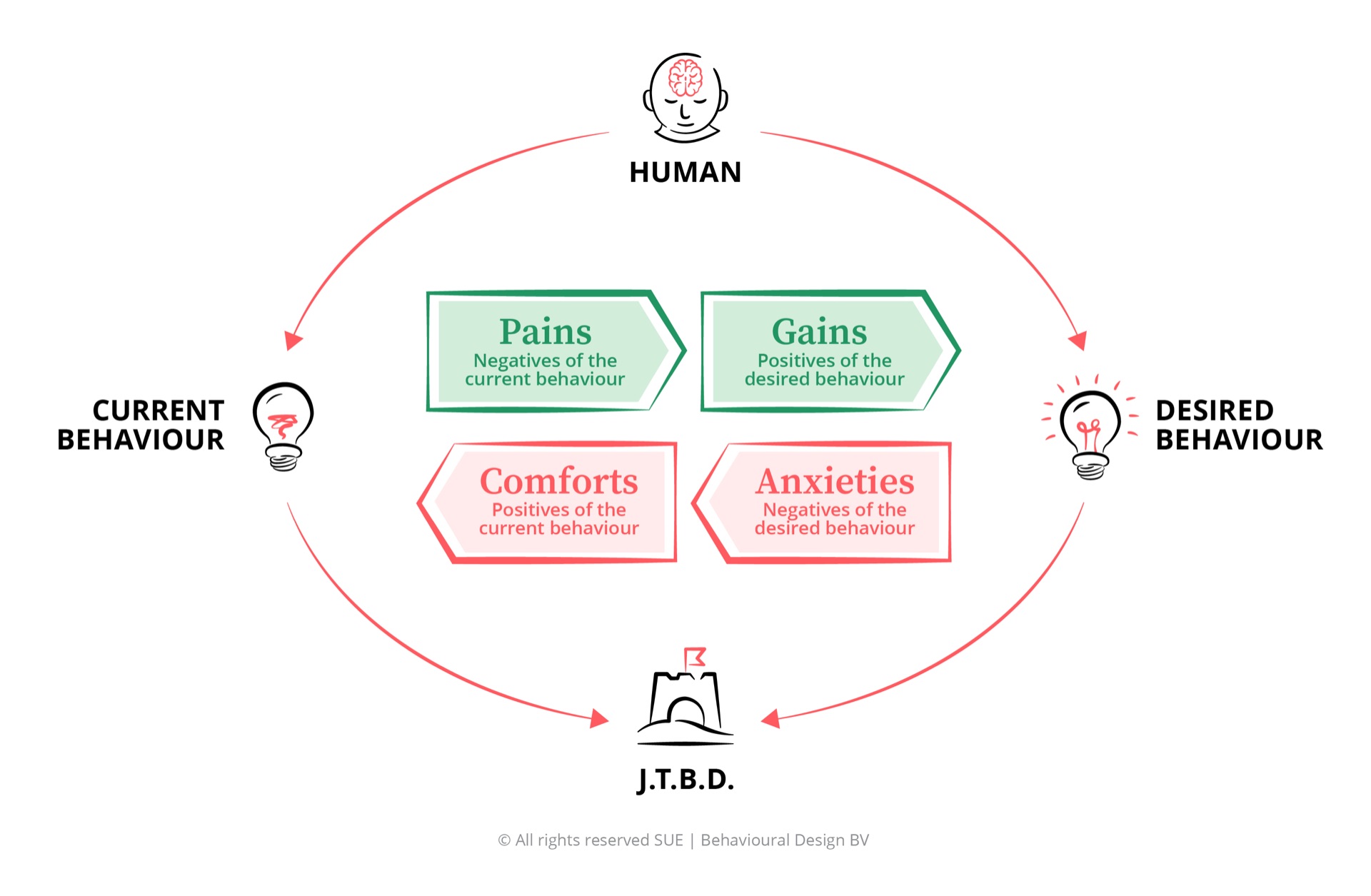
The SUE | Influence Framework© maps the four forces that determine whether citizens change their behaviour in response to policy. It always starts from the JTBD: what progress is this citizen trying to make? Only once you know that can you diagnose the forces driving and blocking that behaviour. In the public sector, a consistent pattern emerges: government communication almost exclusively targets the driving forces, while leaving the blocking forces, which are far more powerful, entirely unaddressed.
Why citizens don’t respond to good policy despite understanding it
A citizen’s JTBD is never the policy outcome. It is always something more personal: cut energy costs without disruption, keep the neighbourhood liveable, contribute without being overwhelmed by bureaucracy. Once you understand that, you understand why policy communication that focuses on societal urgency systematically falls short. Citizens understand the problem, understand the policy response, and often genuinely intend to comply or participate. What remains unaddressed are the blocking forces: the deep comfort of existing routines and the immediate anxieties that make government engagement feel burdensome, opaque, or futile.
Civic frustration and urgency: Citizens are aware of the problems government is trying to address: climate change, housing shortages, inequality. When problems become personal and visible, this awareness creates genuine urgency. But urgency at a societal level rarely translates into urgency at the level of individual daily decisions. An abstract threat mobilises less than a concrete problem in one’s own street.
Financial pressure: Rising energy costs, housing costs, and cost of living create real economic pain. Policies that offer financial relief can be powerful motivators. But the financial argument works only when the friction of accessing the relief is lower than the benefit. That is rarely the case.
Social responsibility: Many citizens feel a genuine sense of civic duty. This is a real driving force, but it competes with every other demand on their attention, time, and energy. Civic identity is strongest at election time and weakest on a Tuesday evening when there is a participation portal to register for.
Financial benefit: Subsidies, tax reductions, and cost savings from sustainable choices are genuine gains. But they are future-oriented, abstract, and contingent on a behaviour change that requires present effort. Present bias systematically underweights these future gains.[8]
Quality of life improvements: Cleaner air, quieter streets, a more beautiful neighbourhood, a more efficient public service. These gains are real but diffuse and often invisible until achieved.
Community belonging: Participation in civic life and neighbourhood improvement can be genuinely rewarding. But this gain is only accessible to those who already feel part of a community that values participation. For many citizens, it is an invisible gain.
Existing habits are automatic and frictionless: Citizens have deeply embedded daily routines. Every deviation requires conscious effort. Government policy consistently underestimates how powerful existing habits are as blocking forces. A behavioural intervention that adds one step to an existing habit almost always loses to the habit itself.
“The government will sort it out”: A significant proportion of citizens operates on the assumption that large-scale problems are fundamentally government’s responsibility. This belief is a powerful comfort that reduces individual urgency to act. It is not irresponsibility. It is a rational division of labour.
Good enough is fine: The status quo is comfortable precisely because it requires nothing. The draughty house is liveable. The recycling is approximately right. The participation process can be skipped.
Distrust of government: Decades of missed targets, broken promises, and bureaucratic frustration have left many citizens with a baseline distrust of government initiatives. Even well-designed programmes carry the inherited suspicion of all the ones that came before. This is the most powerful and least addressed anxiety in public sector behaviour change. You cannot overcome distrust with better information.
Complexity and bureaucratic friction: The experience of interacting with government is, for most citizens, one of the least enjoyable things they do. The mere anticipation of this complexity is enough to prevent engagement before it starts. This is not laziness. It is rational avoidance of a reliably unpleasant experience.
Fear of losing autonomy: Government intervention in personal choices triggers psychological reactance: the instinctive resistance to perceived loss of freedom. The less visible the intervention, the less this anxiety is triggered. This is also why transparent nudges are more ethically acceptable than directive communication.
The key insight: Government communication overwhelmingly targets the driving forces: explain the urgency, describe the gains, present the evidence. But citizen behaviour is determined by the blocking forces, which operate below the level of rational argument. The comfort of existing habits, distrust of government, and anxiety about complexity and autonomy loss are not overcome by better brochures or more accessible websites. They are overcome by redesigning the citizen journey so the desired behaviour is easier, more familiar, and more directly connected to the citizen’s JTBD than the alternative. As I write in The Art of Designing Behaviour: “People don’t resist change. They resist being changed.” Design the change so citizens want it themselves.
Five behavioural interventions for the public sector
-
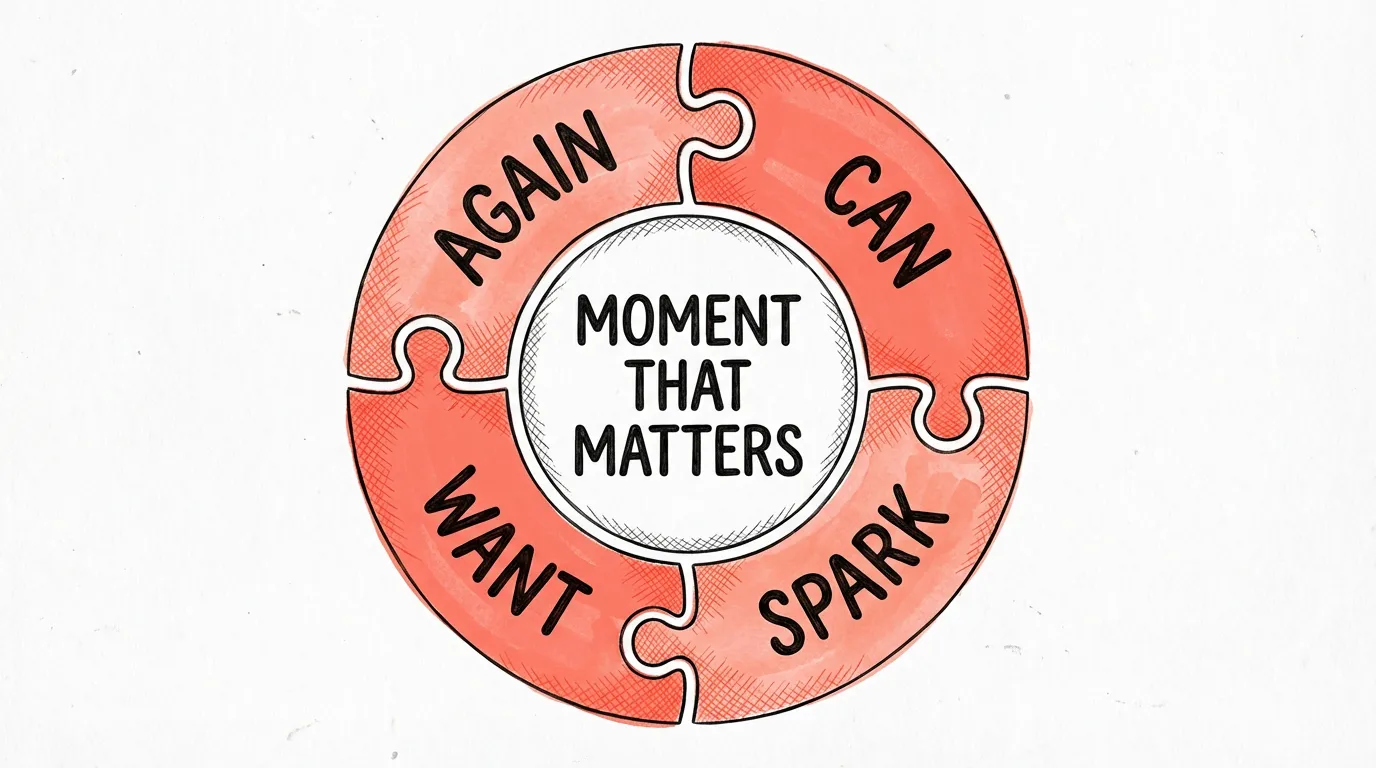
Default citizens into sustainable options (CAN)
The single most powerful behavioural intervention available to government is also the simplest: change the default. When organ donation is opt-out rather than opt-in, donation rates rise dramatically.[9] When green energy is the default contract with an opt-out, most people stay on it. When the most environmentally efficient bin collection is the standard package rather than an upgrade, take-up is near-universal. Defaults work because most people accept the status quo. Government has the unique ability to make the desired behaviour the status quo. Use it deliberately, across every public service and policy programme.
-
Redesign public service forms to reduce friction (CAN)
Every unnecessary field in a government form is a drop-off point. Every unclear instruction is a source of anxiety. Every requirement to provide information the government already holds is an indignity that confirms citizens’ worst assumptions about bureaucracy. Redesign public forms from the citizen’s perspective. Pre-fill everything you already know. Reduce steps to the minimum required. Remove the jargon. Test with real citizens, not policy experts. The UK Government Digital Service demonstrated that reducing a benefits form from 45 pages to 12 doubled completion rates without changing eligibility criteria. The policy did not change. The design did.
-
Use social norms and identity framing in citizen communication (WANT)
Citizens are powerfully influenced by what they believe other citizens do. “73% of households in your neighbourhood already separate their organic waste” is more effective than any environmental argument. But identity framing works even more powerfully. Research by Bryan and colleagues showed that people asked to “be a voter” rather than “go and vote” turned out significantly more often at the polls.[7] The being-frame activates identity. The doing-frame activates task. Identity is more powerful. Apply this in participation communications: “Be a neighbourhood maker”, not “complete the survey.”
-
Create commitment devices for long-term behaviour change (AGAIN)
The energy transition and other long-horizon policy goals require citizens to make decisions now that pay off over years. Commitment devices bridge the gap between present intention and future action. A signed pledge at a neighbourhood information evening, a scheduled call from a programme coordinator, a public commitment board in the community centre. In a large municipality pilot I worked on, a simple commitment card distributed at neighbourhood meetings increased subsidy application rates by 38% compared to the same information communicated without the commitment prompt.
-
Design policy moments that trigger behaviour at the right time (SPARK)
Government communication typically happens on the government’s schedule, not the citizen’s. Moments of Behavioural Opportunity, the moments when citizens are actually making the decisions your policy is trying to influence, are predictable. Moving house is a moment of maximum openness to changing energy contracts, waste habits, and transport choices. Having a baby triggers a re-evaluation of financial arrangements. Arriving in a new city activates interest in local services. Design government touchpoints to hit citizens at these moments. Behaviour is far more changeable at transition points than during stable periods.
Which cognitive biases matter most in the public sector
Public policy decisions, and citizen responses to them, are shaped by the same cognitive biases that operate in every other domain. Here are the five biases that have the greatest impact on citizen compliance, participation, and sustainable behaviour change.
Status quo bias
Citizens default to existing behaviour not because they have evaluated the alternatives and rejected them, but because the current behaviour requires no decision. In energy transition, waste management, and public service adoption, status quo bias is the primary barrier governments must overcome.
Read the full analysis → Behavioural DesignLoss aversion
Citizens feel the cost of a policy change more intensely than the benefit of its promise. Upfront costs, disruption, and perceived loss of autonomy loom larger than future gains. Government subsidies address the financial cost but not the psychological weight of loss.
Read the full analysis → Behavioural DesignPresent bias
The benefits of policy compliance are almost always future-oriented. The effort is always immediate. Citizens systematically discount future benefits in favour of present comfort, which is why long-horizon policies like the energy transition consistently underperform their projections.
Read the full analysis → Behavioural DesignSocial proof
Citizens look to each other to determine what is normal and acceptable. When sustainable choices, civic participation, and policy compliance are visibly normal behaviours in the community, uptake rises. Social proof is one of the most underused tools in the public sector communication toolkit.
Read the full analysis → Behavioural DesignFraming effect
How a policy is presented determines how citizens respond to it, often more than the substance of the policy itself. A tax described as avoiding a penalty produces higher compliance than the same tax described as a surcharge. A subsidy framed as a community investment attracts more takers than the same subsidy framed as a government handout.
Read the full analysis →Frequently asked questions
How does behavioural design apply to government?
Behavioural design for government maps the psychological forces that determine whether citizens comply with policies, participate in public consultations, adopt sustainable behaviours, or engage with public services. It always starts with the citizen’s JTBD: what progress is this person trying to make? Not “apply for the subsidy”, but “reduce energy costs without disrupting my life.” The SUE | Influence Framework© then diagnoses the specific Comforts keeping citizens in existing behaviour and the Anxieties blocking change, and applies SWAC interventions at the moments where citizen behaviour actually happens.
What is nudging in public policy?
Nudging in public policy means changing the choice architecture of public services and communications to make the desired behaviour easier, more salient, or the default, without restricting freedom of choice or changing financial incentives. Nudging is one tool within behavioural design. Behavioural design is broader: it starts with a diagnostic phase using the Influence Framework to understand all four forces driving and blocking the target behaviour before designing any intervention.
Can behavioural design improve citizen participation?
Yes, significantly. Low citizen participation in public consultations is rarely a sign of disinterest. It is almost always a design failure. Empirical evidence shows that social proof messages showing that others have already participated mobilised 340,000 additional voters in a 61-million-person Facebook experiment. Identity framing, asking people to “be a voter” rather than “go and vote”, increases turnout further. Behavioural design addresses participation by reducing friction at every step, creating social proof that participation is normal, and designing the process to fit citizens’ existing routines.
How does the SUE Influence Framework work in a public sector setting?
The SUE | Influence Framework© maps four forces for any citizen behaviour: Pains (what makes the current situation unsustainable), Gains (what citizens stand to win), Comforts (what makes current behaviour feel acceptable), and Anxieties (what makes change feel risky). In public sector contexts, the blocking forces dominate: citizens distrust government intentions and find bureaucratic processes exhausting before they start. Understanding these forces before designing any policy implementation is the single most valuable thing a public sector organisation can do.
Does behavioural design in the public sector raise ethical concerns?
This is the right question to ask. Behavioural design that helps citizens access services they are entitled to, reduces friction in compliance processes, or makes sustainable choices easier is aligned with citizens’ own interests and values. The ethical line is crossed when government uses behavioural techniques to override genuine preferences or manufacture consent for policies citizens would reject if they understood them. Transparency, reversibility, and genuine public benefit are the three tests we apply to every public sector behavioural design project at SUE.
PS
I’ve worked with municipalities, ministries, and public agencies across the Netherlands and beyond, and the pattern is always the same. Thoughtful people working hard on genuinely important problems, designing policies that make sense on paper, and then watching citizens not respond. The frustration in these organisations is real. And it is misdirected, because the problem is almost never the policy. It is the assumption embedded in the policy: that citizens are rational, informed, motivated actors whose JTBD is the policy outcome. It never is. It is always something more personal and more concrete. The moment you design for the citizens who actually exist, in place of the ones you wish existed, everything changes. That is what we do at SUE, and it is what I describe in The Art of Designing Behaviour (2024). Good policy is necessary. But good design is what makes it work.