Last year I switched mobile providers. Not because I was unhappy with my old one. I actually rated them quite highly. But when my contract expired, a competitor happened to catch my attention at exactly the right moment. I didn’t compare network speeds. I didn’t read the fine print. The switching process took four minutes and I never looked back.
I think about that experience a lot when we work with telecom companies at SUE. Because my switch wasn’t rational. It wasn’t driven by price or quality or any metric the industry typically tracks. It was driven by timing, friction, and a default that happened to expire.
This is the reality that telecom companies face. Customers who score you 8 out of 10 and switch anyway. Retention campaigns built on loyalty points that don’t change the behaviour at contract expiry. Plan pages with fifteen options that paralyse rather than convert. The industry keeps competing on network quality and pricing while the actual churn decision happens in a psychological window of about three days.
The missing variable is human behaviour. And the discipline that addresses it is called behavioural design.
Behavioural design for telecom applies behavioural science to customer retention, plan selection, and digital channel adoption. Instead of assuming customers make rational comparisons, it maps the psychological forces that drive switching behaviour. Using the SUE | Influence Framework©, telecom companies redesign customer touchpoints to work with human psychology, reducing churn through smarter design rather than deeper discounts.
The numbers behind telecom churn
Why telecom needs behavioural design
Telecom companies operate on an assumption that sounds commercial but is behaviourally wrong: that customers churn because a competitor offers a better price. If that were true, retention discounts would solve the problem permanently. They don’t. They attract price-chasers, erode margin, and train customers to expect a discount at every renewal. The customer who stayed because you matched a competitor’s offer is not retained. They are deferred.
The real churn driver is much more interesting. Most customers don’t actively decide to leave. They drift. They receive a renewal notification, don’t open it, forget about it, and then, three weeks later when the contract has lapsed, find themselves on a comparison site not because they were unhappy but because the switching process is now more salient than the staying process. Status quo bias cuts both ways: it keeps satisfied customers locked in, but the moment friction appears in the renewal journey, that inertia inverts.
This is a design problem. And the same logic applies to plan selection, digital self-service adoption, and upselling. Customers don’t choose the wrong plan because they’ve evaluated the options. They choose the wrong plan because the choice architecture made the cheapest option feel safest, or because decision fatigue set in halfway through a comparison page with twelve plan variants. Barry Schwartz demonstrated this clearly: more options do not lead to better decisions, but to less decision-making and more regret.[5]
Customers don’t leave because your product failed. They leave because your renewal journey wasn’t designed for how humans actually make decisions.
This is what behavioural design does: it starts from the premise that behaviour is designable. Not by offering more competitive prices, but by redesigning the moments, defaults, and environments where retention decisions are actually made. As Tom de Bruyne and I describe in The Art of Designing Behaviour (2024): influence is far more judo than karate. Use the forces that are already present rather than trying to overpower them.
Three telecom challenges that behavioural design solves
Challenge 1: the contract renewal nobody reads
At SUE we worked with a major Dutch telecom provider that sent contract renewal notices to customers 60 days before expiry. The email was clear, well-designed, and personalised with the customer’s current plan details. Open rate: 18%. Of those who opened, fewer than a third took any action. The commercial team’s response was to redesign the email template. Better subject line, clearer CTA, more prominent discount offer. Open rate improved marginally. Churn did not.
Because the email was not the problem. The problem was that “renew your contract” is an abstract task that feels non-urgent until the moment it becomes very urgent. And by then, the customer is already on a comparison site.
The real barrier was a combination of status quo bias operating in reverse (inaction led to contract expiry, not continuation), present bias (renewal is 60 days away, not now), and the absence of a concrete, immediate reason to act.
Challenge 2: the plan page that causes paralysis
T-Mobile ran an A/B test on their consumer plan page. Version A showed all eleven available plans with full feature comparisons. Version B showed three plans, with the middle option flagged as “Most popular”. Version B converted at 34% higher. T-Mobile had not changed their pricing. They had changed the choice architecture.
This is decision fatigue meeting anchoring bias. When customers face eleven options, they either default to the cheapest (loss aversion: the safest choice if I don’t fully understand what I’m buying) or they abandon the decision entirely and call customer service. Either outcome is expensive. The first leaves ARPU on the table. The second costs call centre capacity.
Vodafone faced the same issue with their business accounts. Enterprise customers were routinely choosing plans that were technically inadequate for their actual usage, not because of price, but because the plan selection interface did not make the right choice obvious. Research by Huber, Payne and Puto (1982) shows how powerfully the decoy effect operates in exactly this situation: a carefully positioned third option reliably steers customers toward the desired choice.[6]
Challenge 3: the app customers call instead of using
Ziggo invested substantially in their customer app. It handles billing, usage tracking, plan changes, technical support, and appointment booking. It is well-designed, fast, and available 24/7. And yet, a majority of customers who have the app still call the contact centre for tasks the app performs perfectly well. Why?
Because telecom companies build apps and then assume customers will discover their value. They don’t. The app is downloaded because you were asked to download it at contract signing, probably forgotten within two weeks, and then when something goes wrong at 9pm, the path of least resistance is to call a number you’ve used before. Habit beats rational convenience every time. Lally et al. (2010) showed that it takes an average of 66 days to form a new habit, not the mythical 21 days.[7] Those first weeks are decisive.
Spotify and Netflix understand this. Their onboarding journeys create app habits in the first week. Telecom companies send a welcome email with a PDF. The first meaningful interaction most telecom customers have with the app is when they are already frustrated about something, which is the worst possible context for learning a new interface.
What customers are actually hiring their telecom provider for
Christensen’s Jobs-to-be-Done framework offers the sharpest diagnostic lens for telecom too. The core idea: people don’t buy subscriptions. They hire a provider to make specific progress in their lives.[8]
For telecom, this means customers hire a provider for one of these jobs:
- Staying connected: always reachable, never signal failure, reliable for work and family
- Reliability: no bill surprises, predictable costs, a provider who does what they promise
- Status: the latest device, the best plan, something worth mentioning
- Entertainment: access to streaming, enough data for video, uninterrupted enjoyment
- Ease: one point of contact, problems resolved quickly, I don’t have to think about it
The problem is that most telecom companies compete on functional specifications (GBs, network coverage, plan features) while customers stay or leave based on how the emotional job felt: was I taken care of? Did I feel seen as a customer? Did it just work?
EE, Vodafone, and O2 offer virtually identical network quality in most areas. The customer who switches anyway doesn’t do so because the network is better. They do so because the renewal journey felt effortful, or because a competitor managed to create the feeling of ‘finally, someone who understands what I need’ at exactly the right moment.
Influence Framework analysis: what drives and blocks retention
The SUE | Influence Framework© maps the four forces that determine whether customers stay, upgrade, and engage digitally. Applied to telecom, a consistent pattern emerges: the blocking forces are far stronger than the driving forces, and they are almost entirely unaddressed by standard commercial communication.
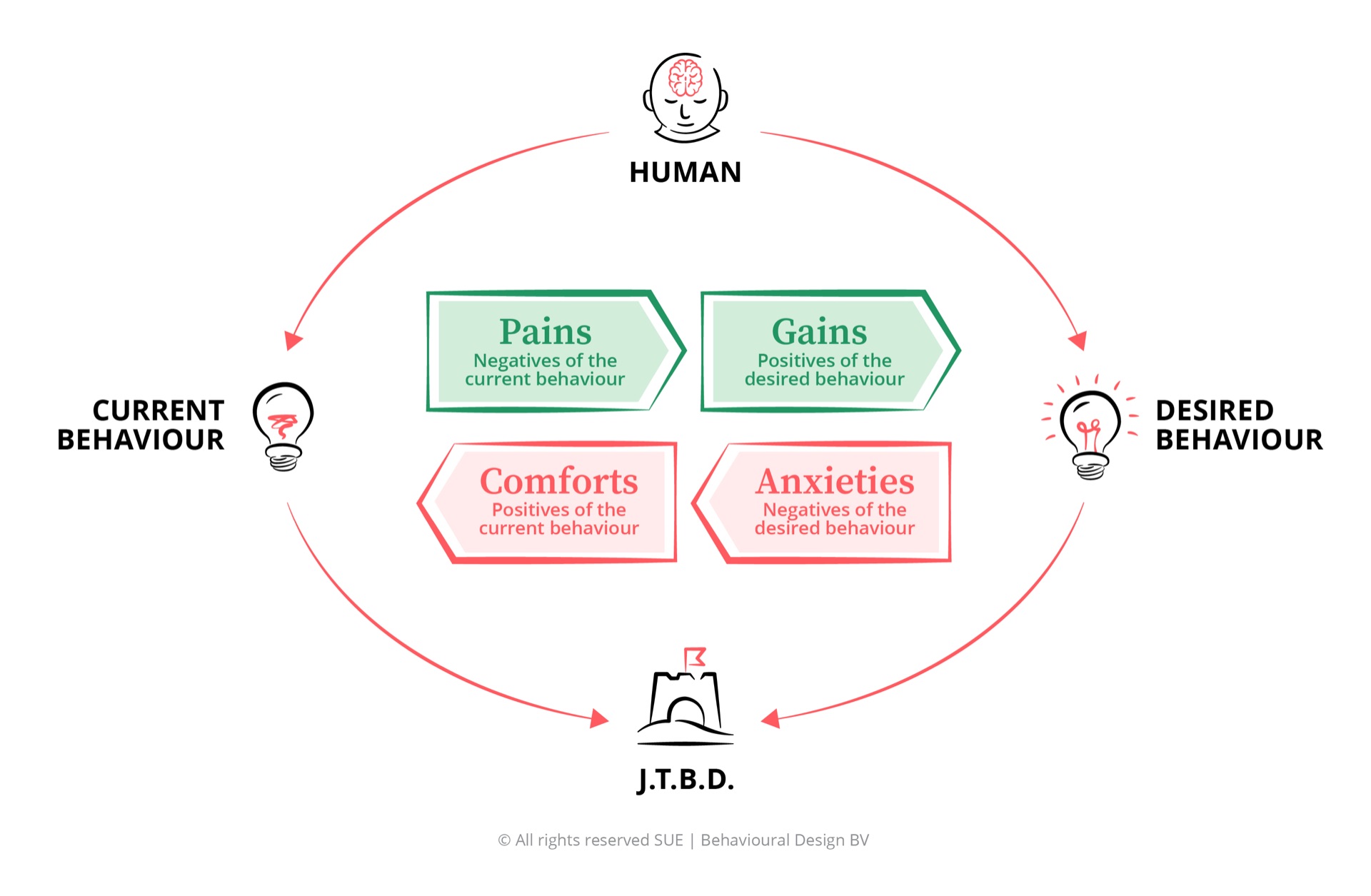
Why customers churn despite a competitive offer
Telecom commercial communication addresses the driving forces effectively. It highlights network quality, competitive pricing, and loyalty rewards. What remains unaddressed are the blocking forces: the deep comfort of the discount expectation and the anxieties that make any change to the retention approach feel risky.
High churn destroys profitability: Acquiring a new mobile customer costs five to seven times more than retaining an existing one. The commercial pain of churn is real and measurable. But it is felt by the CFO, not by the customer. The customer has no visibility of the cost they are creating by leaving. Loss aversion operates in one direction here: the customer experiences no loss by switching, but the provider does.
Massive call centre costs: A single phone interaction costs on average 8-12 times more than the same interaction resolved digitally. Telecom companies running large contact centres are, in part, running them because they never designed effective digital alternatives. The operational pain is clear. The behavioural design opportunity is equally clear.
Price war pressure eroding margins: When every competitor matches every offer, competing on price becomes a race with no winner. The pain of margin erosion creates urgency to find a different approach. Behavioural design offers that different approach: compete on experience design rather than price.
Reduced churn saves millions annually: A one-percentage-point reduction in annual churn rate for a mid-size telecom operator can be worth tens of millions in lifetime customer value. This is the gain that makes the investment case for behavioural design straightforward. The ROI on behavioural interventions is demonstrably higher than on price campaigns.
Digital self-service dramatically cuts costs: Moving 20% of contact centre interactions to digital self-service can generate eight-figure cost savings in operational terms. The gain is not just financial: customers who use the app have measurably higher NPS scores and lower churn rates.
Higher ARPU through smart upselling: Customers who understand what they have are more likely to upgrade. Plan selection interventions that help customers choose the right plan reduce under-serviced accounts while increasing revenue per user. The decoy effect can be used ethically here to make the right choice the obvious one.
Retention discounts “work” short-term: The commercial team has data showing that retention discount campaigns reduce churn in the quarter they run. This is real. The problem is it’s measuring the wrong thing. Discounts defer decisions. They don’t change the underlying behaviour. The comfort of a metric that looks good in Q3 blocks investment in interventions that would produce better results in Q1 of next year.
“Our network quality speaks for itself”: The product team believes network speed and reliability should be sufficient differentiation. And objectively, they may be right. But behaviour doesn’t respond to objective quality. It responds to perceived salience. A customer who has never been prompted to notice their network speed will not weight it in a renewal decision.
Competitors do the same thing: When the industry norm is to compete on price, departing from that norm requires behavioural courage as well as commercial insight. The comfort of doing what everyone else does is a genuine blocking force at the executive level.
Adding friction to the phone channel might frustrate customers: The most common anxiety when we propose reducing call centre accessibility is the fear of NPS damage. This is worth taking seriously. The answer is not to block access to the phone, but to make digital alternatives genuinely more attractive. Done well, guided digital migration improves NPS, not reduces it.
Reducing plan options seems counterintuitive: Commercial teams worry that showing fewer plans means fewer customers find their perfect fit. The research says the opposite. Fewer, better-labelled options convert higher and generate less post-purchase regret. The anxiety is understandable. The evidence is clear.
The behavioural approach feels risky versus proven discounting: Any new approach carries implementation risk. The anxiety about abandoning discount-based retention for a behavioural approach is rational in the short term. It is also how the price war accelerates.
The key insight: Telecom commercial communication overwhelmingly targets the driving forces: promote the network, match the price, offer the discount. But customer retention behaviour is determined by the blocking forces, which operate below the level of rational comparison. The comfort of the discount expectation and the anxiety about change are not overcome by a better offer. They are overcome by redesigning the renewal journey, the plan selection experience, and the digital onboarding so that the desired behaviour is easier, more immediate, and more natural than the alternative.
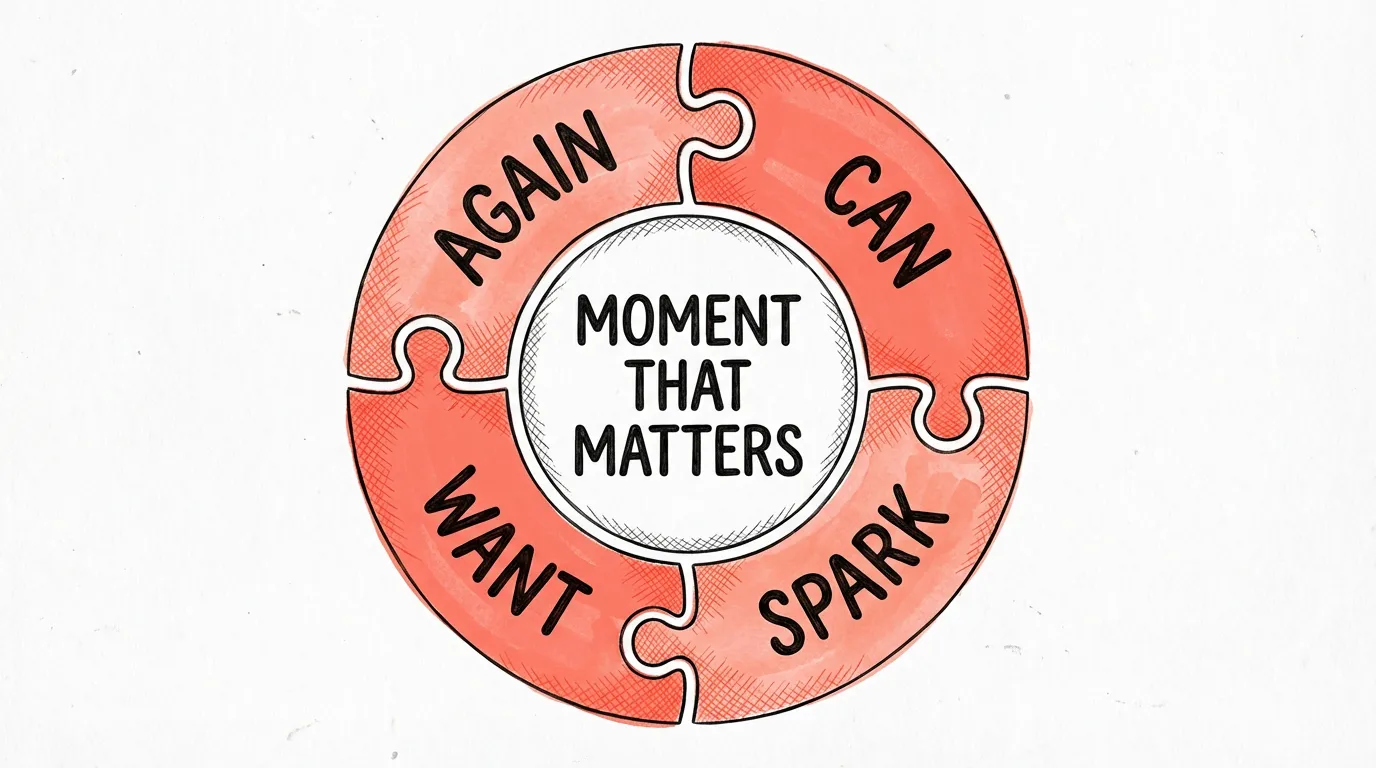
Five behavioural interventions for telecom
-
Pre-commitment at contract start (SPARK - W15: implementation intention)
The renewal decision is not made at renewal. It is made, implicitly, during the first three months of a contract. Customers who are onboarded well, who understand their plan, who have used the app at least three times, and who have noticed the network quality they are paying for, are measurably less likely to churn at renewal. Design the first 90 days as a retention investment: a usage insight at day 30, a personalised benefit highlight at day 60, a proactive renewal preview at day 90. Set the expectation that renewal is a service event, not a commercial event.
-
Smart defaults for plan recommendations (CAN - C01: redesign defaults)
Stop presenting plan selection as a comparison exercise. Use actual usage data to pre-select the recommended plan before the customer arrives at the decision page. Frame it as personalisation: “Based on your usage, we’ve matched you to this plan.” Reduce visible options to three. Apply the anchoring principle: place the recommended plan in the centre at a mid-range price, with a premium option to the right that makes the recommendation feel like the sensible middle ground. The customer who feels guided rather than overwhelmed converts higher and churns less.
-
Loss-framed renewal messaging (WANT - W03: loss aversion framing)
Loss aversion is one of the most reliably documented findings in behavioural science: people are more motivated by the prospect of losing something they have than by the prospect of gaining something equivalent.[9] Apply this to renewal messaging. Instead of “renew now and keep your current rate”, show customers what they stand to lose: their loyalty price, their data rollover, their early upgrade benefit. Not as a threat, but as a genuinely personalised value statement. What you have built with this provider is specific to you. Starting again means starting from zero.
-
Guided digital onboarding (AGAIN - C14: habit design at first bill moment)
The first bill is the highest-engagement moment in a telecom customer’s first year. Use it. Send the first bill exclusively through the app with an embedded tutorial that shows three things the customer can do right now: check their data usage, set a usage alert, and access their account settings. Each interaction with the app in month one increases the probability of digital self-service adoption by month six. Design the habit before the problem occurs, and you reduce call centre volume without adding friction to the customer experience.
-
Social norms for plan selection (WANT - W08: descriptive social norm)
The bandwagon effect operates powerfully in low-involvement decisions like plan selection. Customers who are uncertain about which plan to choose look for social cues. “Most customers with your usage pattern choose this plan” is not a sales line. It is a genuine signal that reduces uncertainty and makes the decision feel safe. Used honestly, based on real data, social norm framing increases conversion to the recommended plan and reduces post-purchase regret. Both outcomes benefit retention.
Which cognitive biases matter most in telecom
Telecom decisions are shaped by the same cognitive biases that operate in every other domain, but the combination is particularly potent here. Low involvement, high switching friction, complex options, and annual renewal cycles create a bias minefield. These are the five that have the most impact on customer behaviour in telecom.
Status quo bias
Customers don’t evaluate alternatives at renewal. They evaluate the effort of switching versus the comfort of staying. If staying requires no action and switching requires multiple steps, most customers stay. But if renewal requires action, that same inertia works in reverse and they drift toward switching.
Read the full analysis → Behavioural DesignDecision fatigue
A plan page with twelve options is not a feature. It is a customer exit door. When cognitive resources are depleted, customers default to either the cheapest option or no decision at all. Reducing visible options is a direct intervention on decision fatigue.
Read the full analysis → Behavioural DesignLoss aversion
Customers are more motivated by what they’ll lose at renewal than by what they’ll gain by staying. Loss-framed retention messaging consistently outperforms gain-framed messaging in telecom contexts. The loyalty price, the rollover data, the upgrade benefit: these are worth showing as things at risk.
Read the full analysis → Behavioural DesignAnchoring bias
The first price a customer sees on a plan page becomes the reference point for evaluating all subsequent prices. A premium anchor makes the mid-tier plan feel like a bargain. Place the recommended plan in the right position relative to the anchor and you change what customers choose without changing any prices.
Read the full analysis → Behavioural DesignBandwagon effect
In low-involvement categories, customers copy others. “Most popular” labels on plan pages, social proof in renewal messages, and usage-based norm comparisons all leverage the bandwagon effect to guide customers toward decisions they feel confident about.
Read the full analysis →Frequently asked questions
How does behavioural design reduce churn in telecom?
Churn is not primarily a price problem. It is a behaviour problem. Customers don’t actively decide to leave. They drift. Behavioural design maps the psychological forces at the contract renewal moment and redesigns the touchpoints where the switching decision forms. Pre-commitment at contract start, loss-framed renewal messaging, and smart defaults that make staying easier than switching are among the most effective interventions. The SUE | Influence Framework© provides the diagnostic structure to identify exactly which forces to address.
Why do retention discounts fail to stop churn long-term?
Retention discounts attract price-sensitive customers who will leave again at the next renewal when no discount is offered. They also train customers to expect a discount, increasing the cost of retention over time. Behavioural design takes a different approach: instead of making switching financially unattractive, it makes staying psychologically easy. Pre-commitment, valuable feature lock-in, and personalised loss-framed messaging create genuine behavioural retention without eroding margins.
What is the role of choice architecture in telecom plan selection?
Most telecom plan pages present too many options. Research shows that beyond three to four options, customers experience choice paralysis and either default to the cheapest or abandon the decision entirely. Behavioural design restructures plan selection by anchoring with a recommended plan based on actual usage data, reducing visible options to three, and using social norms to guide decisions without pressure. The customer who feels guided rather than overwhelmed converts higher and churns less.
How can telecom companies increase digital self-service adoption?
Digital self-service adoption fails because telecom companies design the app and then expect customers to find its value. Behavioural design inverts this. The first bill arrives via the app with a built-in onboarding tutorial. Phone channel usage can be gently redirected through wait-time transparency and an in-moment app prompt. Social proof normalises the behaviour. The channel shift is a design problem, not a marketing problem. Spotify and Netflix build app habits in the first week of onboarding. Telecom can do the same.
How does the SUE Influence Framework apply to telecom?
The SUE | Influence Framework© maps four forces for any customer behaviour in telecom. Pains: high churn rates, call centre costs, price war pressure. Gains: reduced churn worth millions annually, digital self-service cost reduction, higher ARPU. Comforts: retention discounts look good on quarterly metrics, network quality should speak for itself. Anxieties: reducing plan options seems counterintuitive, adding friction to phone might hurt NPS. The framework reveals exactly where to intervene and how to sequence the interventions.
PS
At SUE, I work with telecom companies that are genuinely excellent at what they do. Fast networks, fair pricing, professional service teams. And yet 20% of their customer base leaves every year. That frustration is real. But the cause is not competitive disadvantage. The cause is a customer journey designed for rational decision-makers who don’t exist. As Tom de Bruyne and I write in The Art of Designing Behaviour (2024): people don’t resist change. They resist being changed. The moment staying becomes the easier, more familiar, and more rewarding option, they will stay. That is the core of what we do at SUE. Telecom doesn’t need better offers. It needs better behavioural design.