Over the past few years I have seen them dozens of times: change programmes launched with all the right intentions, equipped with a solid project plan, a communication strategy and a training programme, which six months later are quietly adjusted, extended or abandoned. Buy-in was never really there. The new way of working was neatly presented but never truly embraced.
This is not coincidence. It is a structural problem that flows from a fundamental misunderstanding of how behaviour works. And that misunderstanding is baked into most Change Management methodologies.
Change Management (Kotter, Prosci ADKAR) focuses on managing the change process: phasing, communication, training and sponsorship. It assumes resistance can be overcome by better informing and involving people. Behavioural Design focuses on the behavioural layer: why people hold on to current behaviour, which Comforts keep them there and which Anxieties put them off. The core difference: CM treats resistance as an obstacle. BD treats resistance as information about the real behavioural barriers. The key insight is that you cannot communicate your way past habits, social norms and loss aversion.
| Dimension | Behavioural Design | Change Management |
|---|---|---|
| Focus | Why people hold on to current behaviour | Managing the process of organisational change |
| Scientific basis | Behavioural economics, cognitive psychology | Organisational theory (Kotter, ADKAR) |
| Primary method | Influence Framework, environmental interventions | Communication, training, sponsorship |
| Output | Interventions that redesign the choice environment | Project plans, communication campaigns |
| When to use | Change meets resistance that information cannot solve | You need governance, phasing and stakeholder management |
| Blind spot | Less focus on governance and planning | Assumes rational actors who need information |
What Change Management does and why it is incomplete
Change Management as a discipline is not inherently flawed. Kotter’s 8-step model provides a useful process framework for organising large-scale change.[1] Prosci’s ADKAR model helps project teams think through awareness, desire, knowledge, ability and reinforcement. Those are all relevant dimensions.
The problem is the underlying assumption: that people are rational actors who need information. When people resist, the standard response in most CM programmes is to communicate more, explain better, train managers to “land the message”. And if that does not work, communicate more still.
But behaviour does not work that way. People are not machines that update when they receive the right information. They are creatures of habit, social norms, status concerns and a brain that constantly seeks the path of least resistance. That reality is almost entirely absent from most change methodologies.
Change Management asks: how do we get people willing to change? Behavioural Design asks: why would they not want to change in the first place?
Resistance as signal, not as obstacle
This is the most fundamental shift Behavioural Design brings. When people resist a change, the CM reflex is to overcome that resistance: build more buy-in, provide better arguments, get influential people on board. BD asks something different: what is this resistance telling us?
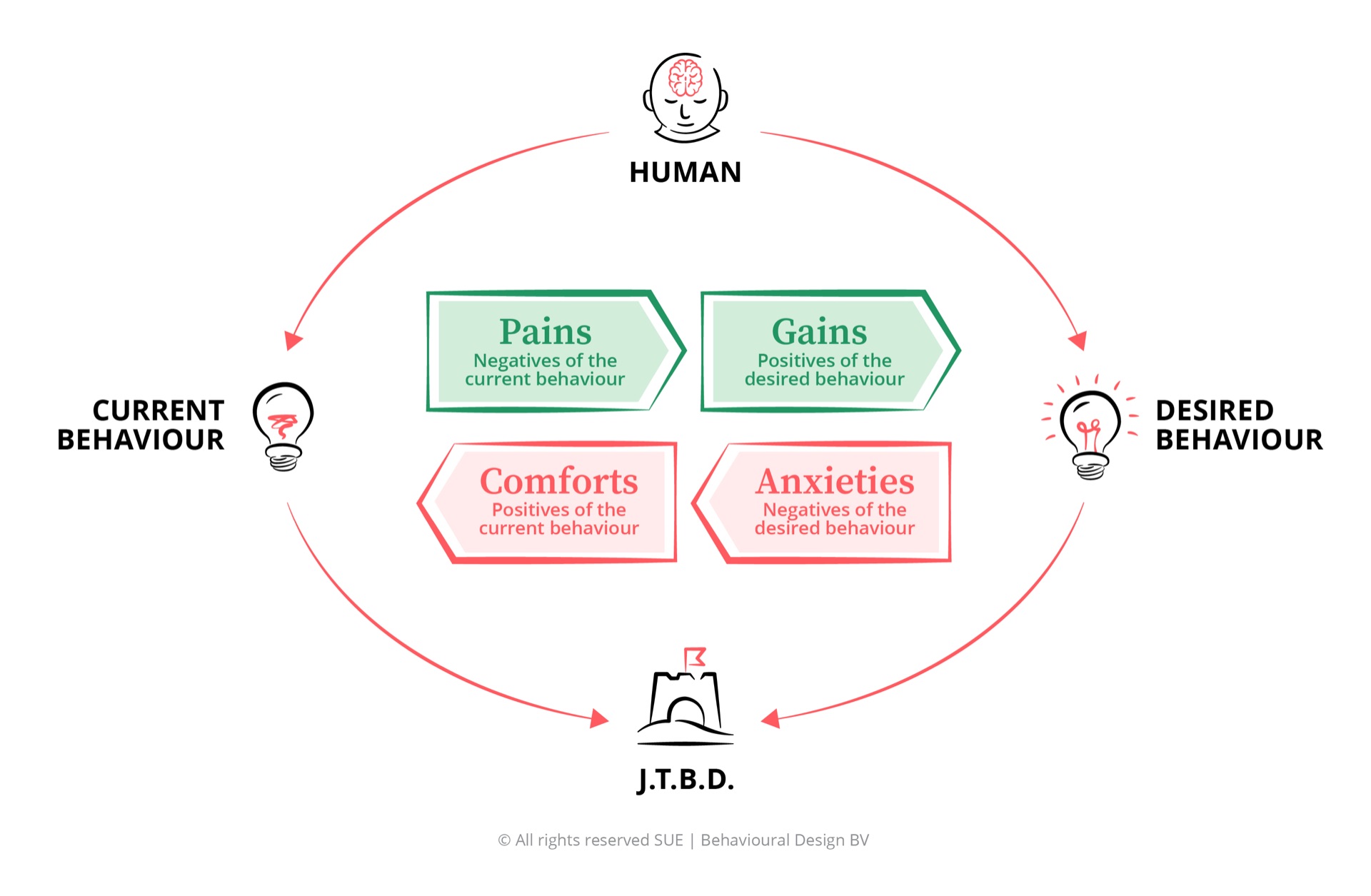
At SUE we use the Influence Framework to analyse this systematically. Resistance is almost always a combination of two forces: Comforts and Anxieties.
Comforts are the forces that keep people in their current behaviour. The current system is familiar. People know how it works. They are good at it. It costs no extra energy. There are informal social norms that reward the current behaviour. All those comforts are invisible in a standard stakeholder analysis, but they explain a large part of the resistance project teams encounter every day.
Anxieties are the forces that prevent people from adopting the new behaviour. Fear of making mistakes with a new system while colleagues are watching. Uncertainty about whether their position will be equally strong after the reorganisation. Worry that the new way of working simply means more effort. The conviction that this is another management fad that will blow over on its own.
No communication campaign addresses these forces in any fundamental way. Informing changes knowledge. It does not change habits, social norms or fears.
The rational actor versus the irrational human
The fundamental difference between the two approaches lies in their model of the human being.
Change Management is built on a model of the person as a rational actor. If people understand the benefits of the change and see the necessity, they will cooperate. Training provides the skills. Communication provides the motivation. Leadership sponsorship provides the legitimacy. These are all System 2 interventions: they appeal to rational, conscious thinking.
Behavioural Design starts from a different premise, namely that most behavioural choices are driven by System 1: automatic, fast, habit-driven and socially determined. People tell you they understand and support the change, and they may sincerely mean it, but in practice they fall back on old behaviour as soon as the pressure eases slightly. Not because they are unwilling, but because their environment makes that old behaviour easier than the new.
This is also precisely why status quo bias plays such a powerful role in change programmes. The brain has a strong preference for the current situation, not because it is better, but because it is the default. Change requires cognitive energy. Doing nothing does not. And if the environment does not actively support the new behaviour, the default always wins.
The Influence Framework applied to change
Let me make this concrete with an example I encounter regularly. A healthcare organisation wants to introduce a new digital way of working. The project team has a solid business case, an implementation plan and communication materials. Six months in, adoption is disappointing. The project team concludes that more training is needed.
What the project team has not done is systematically investigate which forces are blocking adoption. With the Influence Framework you would discover the following:
Pains (what pushes staff away from the current way of working): the existing approach is cumbersome, leads to double registration and costs time. These are real pains. But they have been there for years, and the behaviour has not changed. That tells you something.
Gains (what pulls staff toward the new way of working): time savings, fewer errors, better collaboration. All credible. But abstract and future-oriented. The brain systematically weighs future benefits lower than current costs - that is loss aversion in action.
Comforts (what keeps staff in the current behaviour): they are expert in the current way of working. They know exactly which shortcuts work and how to resolve problems. The new system makes them temporarily incompetent, and that feels uncomfortable, especially when colleagues can see it. Additionally, the informal collaboration around the current workflow has social value that disappears with digitalisation.
Anxieties (what prevents staff from adopting the new behaviour): fear of making errors in front of patients or colleagues. Uncertainty about whether their role will remain equally relevant. Concern that the volume of administration will increase. And a justified scepticism based on earlier failed digitalisation projects.
No training programme addresses the Comforts and Anxieties. Those call for environmental interventions: a safe practice environment for the new system, peer learning in small groups, adjustment of the physical workspace so the new system is easier to reach than the old one, and visible social norms from early adopters demonstrating that it works.
How to combine both approaches
Behavioural Design is not a replacement for Change Management. It is a deepening of the behavioural layer that is missing from most CM programmes.
Change Management provides valuable structure for governance, planning and stakeholder management. It helps organisations think through phasing, communication and leadership. Those are useful ingredients.
But the effectiveness increases dramatically when you add a behavioural diagnosis. Before designing a change approach, you systematically map which Comforts and Anxieties are blocking the new behaviour. Then you design environmental interventions that make the right choice easier, more attractive and socially normalised.
That is the difference between change that is rolled out and change that sticks.
Frequently asked questions
What is the difference between Behavioural Design and Change Management?
Change Management focuses on managing the change process: communication, training, sponsorship and phasing. It assumes people resist because they are insufficiently informed or involved. Behavioural Design focuses on the behavioural layer: why people do what they do regardless of what they say or know. It treats resistance not as obstacles but as signals of underlying Comforts and Anxieties.
Why do most change programmes fail?
Research consistently shows that 60 to 70 percent of change programmes do not achieve their intended goals. The primary reason is that Change Management methodologies such as Kotter and ADKAR assume rational people who need information. But behaviour is largely driven by habits, social norms, status quo bias and loss aversion. Those do not change through a communication campaign or a training programme.
What are Comforts and Anxieties in the context of change?
Comforts are the forces that keep people in their current behaviour: habits that work, social norms that reward them, a sense of competence in the existing way of working. Anxieties are the forces that prevent people from adopting new behaviour: fear of making mistakes, uncertainty about status, worry that the change means more work. Together they form the core of resistance. Change Management tries to persuade people past them. Behavioural Design designs around them.
Can you combine Behavioural Design with Change Management?
Yes, and that is often the most pragmatic approach. Change Management provides a useful process framework for governance, planning and communication. Behavioural Design adds the behavioural layer: what actually keeps people in their current behaviour, and which environmental interventions make the new behaviour easier, more attractive and socially normalised? Without the behavioural layer, Change Management remains a management exercise.
What is the Influence Framework and how does it help with change?
The SUE Influence Framework makes visible the four forces that determine whether people change behaviour: Pains, Gains, Comforts and Anxieties. By systematically analysing all four, you discover the real barriers to change and can design targeted interventions that go beyond communication alone.
Conclusion
Change programmes rarely fail through a lack of communication or stakeholder buy-in. They fail because the behavioural layer is not understood. Change Management gives you a process framework. Behavioural Design gives you insight into the person behind the process. Want to learn how to apply this in practice? In the Behavioural Design Fundamentals Course you learn to apply the Influence Framework to real change challenges, rated 9.7 out of 10 by 5,000+ alumni from 45 countries.
PS
At SUE we believe most change programmes do not fail through bad intentions or weak leadership. They fail because the right questions are never asked. Not “how do we communicate the change?” but “what makes the current behaviour so attractive and the new behaviour so threatening?” The moment you take those questions seriously, you start designing instead of managing.