I get this question every week. Sometimes from a strategist who has heard both terms in the same meeting. Sometimes from a designer who wonders whether what she does is essentially the same thing. Sometimes from a manager trying to figure out which method to use for a change programme.
What is the difference between Behavioural Design and Design Thinking?
The confusion is understandable. Both methods are human-centred. Both start with empathy for the user or citizen. Both try to design solutions that fit how people actually are, not how we would like them to be. But after that, their paths diverge. Because they solve fundamentally different problems.
Short answer: Design Thinking starts with the question of what people need and designs products or services to meet those needs. Behavioural Design starts with the question of why people do not do what they already know they should and diagnoses the psychological barriers that block behaviour. The SUE Influence Framework is the core of that second approach.
| Dimension | Behavioural Design | Design Thinking |
|---|---|---|
| Focus | Why people do not do what they should | What people need and how to meet those needs |
| Scientific basis | Behavioural economics, cognitive psychology | Design methodology, empathic research |
| Primary method | Influence Framework, behaviour diagnosis | Empathise, define, ideate, prototype, test |
| Output | Behavioural interventions (nudge, reframe, default) | New products, services or experiences |
| When to use | People know what to do but are not doing it | You do not yet know what to build |
| Blind spot | May miss opportunities for fundamentally better solutions | Assumes a good solution leads to adoption |
What is Design Thinking?
Design Thinking is a creative problem-solving methodology that became widely popular in the late 1990s through IDEO and the Stanford d.school. The idea: the way designers approach problems is valuable for everyone. Not only for designers, but also for strategists, managers and policy makers.
The methodology has five phases. You begin by empathising: immersing yourself in the world of the user through interviews, observation and contextual inquiry. Then you define the problem from the user’s perspective. In the ideation phase, you generate as many solutions as possible without judgement. Then you prototype quickly and cheaply, before testing with real users.
Design Thinking excels when the problem space is still unknown. It helps you discover what people actually need, not just what they say they want. It is a powerful tool for product development, service innovation and creative problem-solving. Tim Brown of IDEO described it as “a human-centered approach to innovation that draws from the designer’s toolkit to integrate the needs of people, the possibilities of technology, and the requirements for business success.”[1]
But Design Thinking has an assumption built in that rarely gets stated: if you understand the problem well and build a well-designed solution, people will use that solution. And that assumption is very often wrong.
What is Behavioural Design?
Behavioural Design does not start from a design methodology but from behavioural science. It builds on decades of research in cognitive psychology and behavioural economics: the work of Daniel Kahneman on System 1 and System 2, Richard Thaler on nudging, Robert Cialdini on social influence.
The core question is fundamentally different: how do we change behaviour? Not: how do we design a better product? But: why do people not do what they already know they should? Why do people download an app they loved during onboarding but never open again? Why do employees fail to adopt new tools, even when they are simple and logically designed? Why do citizens not change their driving behaviour, even when they know that speeding is dangerous?
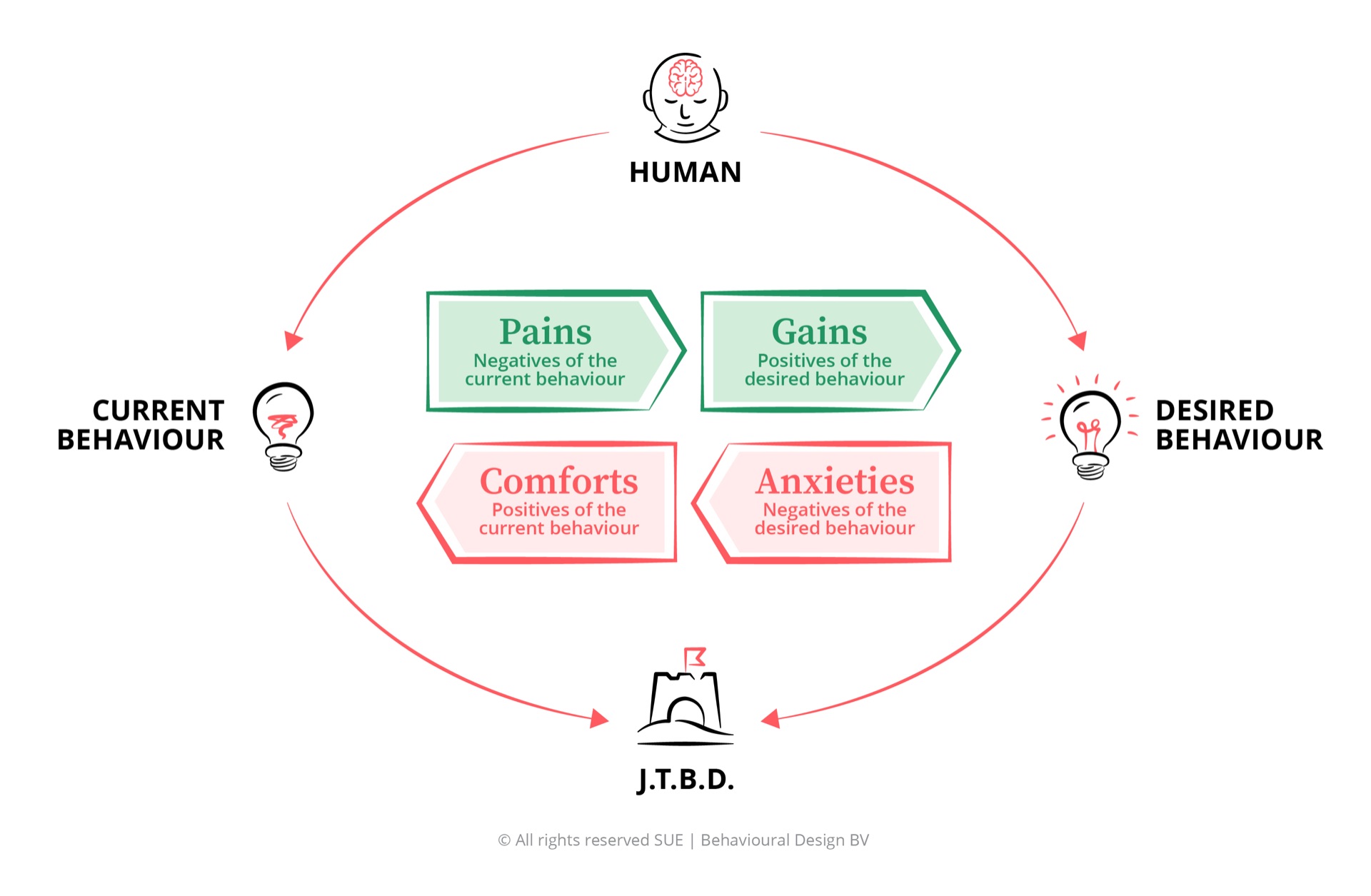
At SUE we use the Influence Framework to answer these questions. The framework diagnoses four forces that govern behaviour: the Pains that push people away from their current behaviour, the Gains that pull them towards new behaviour, the Comforts that keep them in their current behaviour and the Anxieties that hold them back from changing. The output is not a product but an intervention: a nudge, an architectural change, a reframe, a smart default.[2]
Where Design Thinking asks “what should we build?”, Behavioural Design asks “why are people not using what we already built?”
The core differences explained
Starting point: user needs versus behavioural barriers
Design Thinking always starts with the user in a particular context: what are they experiencing, what are they feeling, what are they trying to achieve? It searches for unmet needs and latent frustrations. The starting point is discovery: understanding the world as the user experiences it.
Behavioural Design starts with a behaviour question. There is already something people should be doing, but they are not. Or they are doing something harmful to themselves or others, and we want that to change. The starting point is not discovery but diagnosis: what exactly keeps people locked in their current behaviour? The skill is not jumping to solutions too quickly, but truly understanding the barriers first.
Science base: design methodology versus behavioural science
Design Thinking is primarily a creative and process-driven methodology. It has empathic research as its foundation but does not systematically draw on behavioural science. The question “what are the cognitive biases that explain this behaviour?” is not part of the standard Design Thinking process.
Behavioural Design is explicitly rooted in the scientific literature. Kahneman showed that people have two thinking systems: a fast, automatic System 1 and a slow, deliberate System 2. Most everyday decisions are made by System 1, based on heuristics and emotions, not rational consideration. Thaler and Sunstein showed how you can design the choice environment to make desired behaviour easier without restricting freedom. Cialdini described six principles of social influence. Behavioural Design turns all this research into actionable interventions.
Output: products versus interventions
The output of a Design Thinking process is typically a product, a service or an experience. A new app. A redesigned customer journey. An improved service procedure. Something tangible that delivers value to the user.
The output of a Behavioural Design process is typically an intervention. A nudge that changes the default option. A reframe that leverages loss aversion. A social proof mechanism that reduces threshold anxiety. An architectural change that makes the desired behaviour the easiest path. The intervention sometimes lives inside a product, but more often in the context surrounding the product.
When to use which: building versus adopting
This is the most practical question. Use Design Thinking when you need to discover what to build. When you are at the beginning of a new product or service. When you do not yet know which problem you are actually solving.
Use Behavioural Design when you already know what people should do, but they are not doing it. When your app already exists but is not being used. When your change programme is stuck because of resistance. When your communication campaign is well understood but produces no behaviour change.
The blind spots of both methods
Design Thinking has one significant blind spot: it assumes that a well-designed, well-understood solution will also actually be adopted. This is the “intention-action gap” that behavioural science has described for decades. People know what they should do, want to do it, but do not. Design Thinking has very little to say about this gap.
Behavioural Design has its own blind spot: it can become so focused on removing barriers that it forgets to ask whether we are solving the right problem in the first place. If you only diagnose why people are not doing something, you may miss the opportunity to design something fundamentally better. Behavioural Design needs the creative innovation power of Design Thinking.
When to use which method?
Let me make this as concrete as possible.
Choose Design Thinking when you still need to explore the problem space. When you are entering a new market and do not know what users actually need. When you want to radically reinvent an existing product and need a creative, open process for that. When the question “what should we build?” has not yet been answered.
Choose Behavioural Design when the desired behaviour is already known but is not happening. When people know your product but are not using it. When you launch a health campaign that is well understood but changes nothing. When an organisational change meets resistance that cannot be explained rationally. When the question “why are they not doing it?” has not yet been answered.
The honest truth is that most complex challenges need both methods. You need to understand what people need (Design Thinking) and you need to understand why they do not change their behaviour (Behavioural Design). One without the other produces incomplete answers.
How SUE combines both methods
At SUE we combine both. Not as an official “hybrid framework”, but as a pragmatic way of working we have developed over years of working with government organisations, large companies and international NGOs.
We almost always start with a Behavioural Design diagnosis. What is the desired behaviour? Who is the target group? What forces keep them locked in their current behaviour? We do that using the Influence Framework: mapping the Pains, Gains, Comforts and Anxieties that determine why people do what they do.
Then we shift to a more Design Thinking approach for designing the interventions. We prototype quickly, test with real people, iterate based on what we learn. The behavioural science diagnosis gives us the direction; the design methodology gives us the creative process to build on it.
The result is not a product that is well designed. It is an intervention that actually changes behaviour, because it connects to how people truly think and decide - not to how we would like them to think and decide.
Frequently asked questions
What is the biggest difference between Behavioural Design and Design Thinking?
Design Thinking starts with the question: what do people need? It searches for unmet needs and designs products or services to meet them. Behavioural Design starts with a different question: why do people not do what they already know they should? It diagnoses the psychological barriers that block desired behaviour and designs interventions to remove them.
Can you combine Design Thinking and Behavioural Design?
Yes, and that is exactly what the most effective teams do. Design Thinking helps you discover what to build. Behavioural Design helps you ensure people actually use it. At SUE we often start with Behavioural Design to diagnose the behavioural barriers, then switch to a design approach to prototype and test the solutions.
Is Design Thinking based on behavioural science?
Design Thinking is primarily a design methodology, not a behavioural science approach. It is human-centred and empathic, but does not systematically draw on insights from behavioural economics or cognitive psychology. Behavioural Design is explicitly rooted in behavioural science: it draws on research by Kahneman, Thaler, Cialdini and others.
When should I choose Design Thinking?
Choose Design Thinking when you do not yet know what to build. When you want to develop a new product, redesign a service or find an innovative answer to an unmet need. Design Thinking excels at exploring the problem space and generating creative solutions.
When should I choose Behavioural Design?
Choose Behavioural Design when you already know what people should do, but they are not doing it. When people download your app but do not use it. When an organisational change meets resistance. When health advice is well understood but not followed. Behavioural Design diagnoses why well-designed solutions fail to produce behaviour change.
Conclusion
Want to learn how to combine both methods in practice? In the Behavioural Design Fundamentals Course you learn how to apply the Influence Framework to diagnose behavioural barriers and design interventions that actually move people. Rated 9.7 by 5,000+ alumni from 45 countries.
PS
At SUE we combine both methods because we believe the world needs better designers who also understand behavioural science, and better behavioural scientists who can also design. Design Thinking and Behavioural Design are not competitors. They are complementary. Design Thinking enables you to discover what is worth building. Behavioural Design enables you to design for how people truly are, not for how you would like them to be. Together they form an approach that both innovates and changes.