I have seen this scenario dozens of times. A team has spent months on a new product. Extensive user research done. Tested, iterated, refined. The interface is clear, the steps are logical, the usability score is high. Then it launches. And nobody uses it.
This is the gap that UX Research does not close. Not because UX Research is bad, but because it answers a different question from the one that ultimately matters: why do people not do what they say they want to do?
UX Research studies what users need, what they want and where they struggle. It is descriptive and observational. Behavioural Design studies why people do not do what they say or intend to do, and then designs the environment so that desired behaviour becomes easier. The two are complementary: UX tells you where the interface fails, Behavioural Design tells you why adoption fails even when the interface is perfect. Together they give the full picture.
| Dimension | Behavioural Design | UX Research |
|---|---|---|
| Focus | Why people do not do what they intend | What users need and where they struggle |
| Scientific basis | Behavioural economics, cognitive psychology | Cognitive psychology, ergonomics |
| Primary method | Influence Framework, behaviour mapping, nudging | Usability tests, interviews, analytics |
| Output | Behavioural interventions and environment design | Usability insights and interface improvements |
| When to use | People know the product but do not adopt it | You need to test and refine an interface |
| Blind spot | Can miss concrete usability problems | Assumes good interface leads to adoption |
UX Research: strong at describing
UX Research is the practice of systematically understanding users: their needs, mental models, frustrations and goals. The field has its roots in cognitive psychology and ergonomics, and builds on foundational work by Don Norman, who coined the term “user experience”. UX Research has developed a rich set of methods for observing and understanding user behaviour.
Usability tests show where people get stuck in an interface. In-depth interviews reveal what users really want, not just what they say they want. Surveys measure how significant a problem is. Analytics show where users drop off. Heuristic evaluations identify design flaws based on accepted principles.[1]
UX Research is essentially descriptive: it describes how users are, what they do, and what goes wrong in the interaction with a product. It answers the question: “Is this usable?”
And that is valuable. Incredibly valuable. A bad interface can completely block behaviour change. If people cannot find what they are looking for, they leave the page. If a form is too long, people drop off. UX problems are real problems.
UX Research asks whether people can do what you want. Behavioural Design asks whether they actually do it, when the interface is perfect.
Behavioural Design: prescriptive and focused on behaviour change
Behavioural Design asks a different question. Not: “Is this usable?” But: “Will people use this?” The difference sounds subtle, but it is fundamental.
A product can be completely usable and still have zero adoption. Not because the interface fails, but because behavioural barriers exist outside the interface. Loss aversion: the fear of losing what you currently have, however small. Status quo bias: the strong preference for the familiar over the new. Lack of social proof: if nobody in your network uses it, adoption feels risky. Cognitive overload: not from the interface, but from the entire context in which people make decisions.
Behavioural Design is prescriptive: it designs the environment so that desired behaviour becomes easier, undesired behaviour becomes harder, and choosing the desired behaviour feels natural. It is not just about the interface, but about everything that influences the decision to use: timing, social context, framing, defaults, friction and reducing anxieties.
Where UX Research tells you that users drop off at step three, Behavioural Design tells you why they never start at all.
Methods that differ fundamentally
The methods of both disciplines reflect their different focus.
UX Research methods are designed to observe and understand the user experience: usability tests (where people think aloud while using a product), in-depth interviews, contextual inquiry (observing people in their own environment), card sorting (to understand information architecture), analytics and heuristic evaluations.
Behavioural Design methods are designed to analyse the psychological forces that drive behaviour: the Influence Framework (for mapping Pains, Gains, Comforts and Anxieties), behaviour mapping, intervention design, nudging and A/B testing of behavioural interventions. The focus is on identifying the psychological forces that maintain or block behaviour.
The methods are not interchangeable. A usability test does not tell you why people experience status quo bias. An Influence Framework analysis does not tell you which button colour produces the highest click rate. Both have their own domain of expertise.
The blind spots of both disciplines
Honesty requires that I name the limitations of both disciplines.
Where UX Research falls short: UX Research assumes that if the interface is good, use will follow. But use is the result of a decision, not an automatic consequence of usability. A perfect onboarding flow does not help if the user experiences loss aversion towards their current tool. Excellent navigation does not help if the user lacks the context to understand why they need the product. UX problems are sometimes symptoms of deeper behavioural barriers that UX Research does not detect.
Where Behavioural Design falls short: Behavioural Design can optimise for behaviour change while missing usability problems. You can have the most considered nudge strategy, but if people get stuck at step three, it does not work. Behavioural Design also has an ethical challenge: who decides which behaviour is “desired”? Nudging towards a choice that is good for the organisation but not for the user is manipulation, not design. UX Research has traditionally paid more attention to user autonomy.
This is precisely why the two disciplines should collaborate rather than compete. Neither gives you the complete answer.
How the Influence Framework bridges the gap
The SUE Influence Framework is an analytical model that systematically maps the four forces that determine whether someone exhibits behaviour or not.
Pains are the problems driving people away from their current behaviour. In an adoption question: what problem with their current tool or way of working is significant enough to motivate them to try something new?
Gains are the benefits attracting people towards new behaviour. What gets better if they use the new product? How concrete and immediate is that improvement?
Comforts are the reasons people cling to their current behaviour, even when it is suboptimal. Familiarity, routine, social norms. This is the force of status quo bias.
Anxieties are the fears that stop people from changing. Fear of losing control, fear of making mistakes, fear of being different from colleagues.
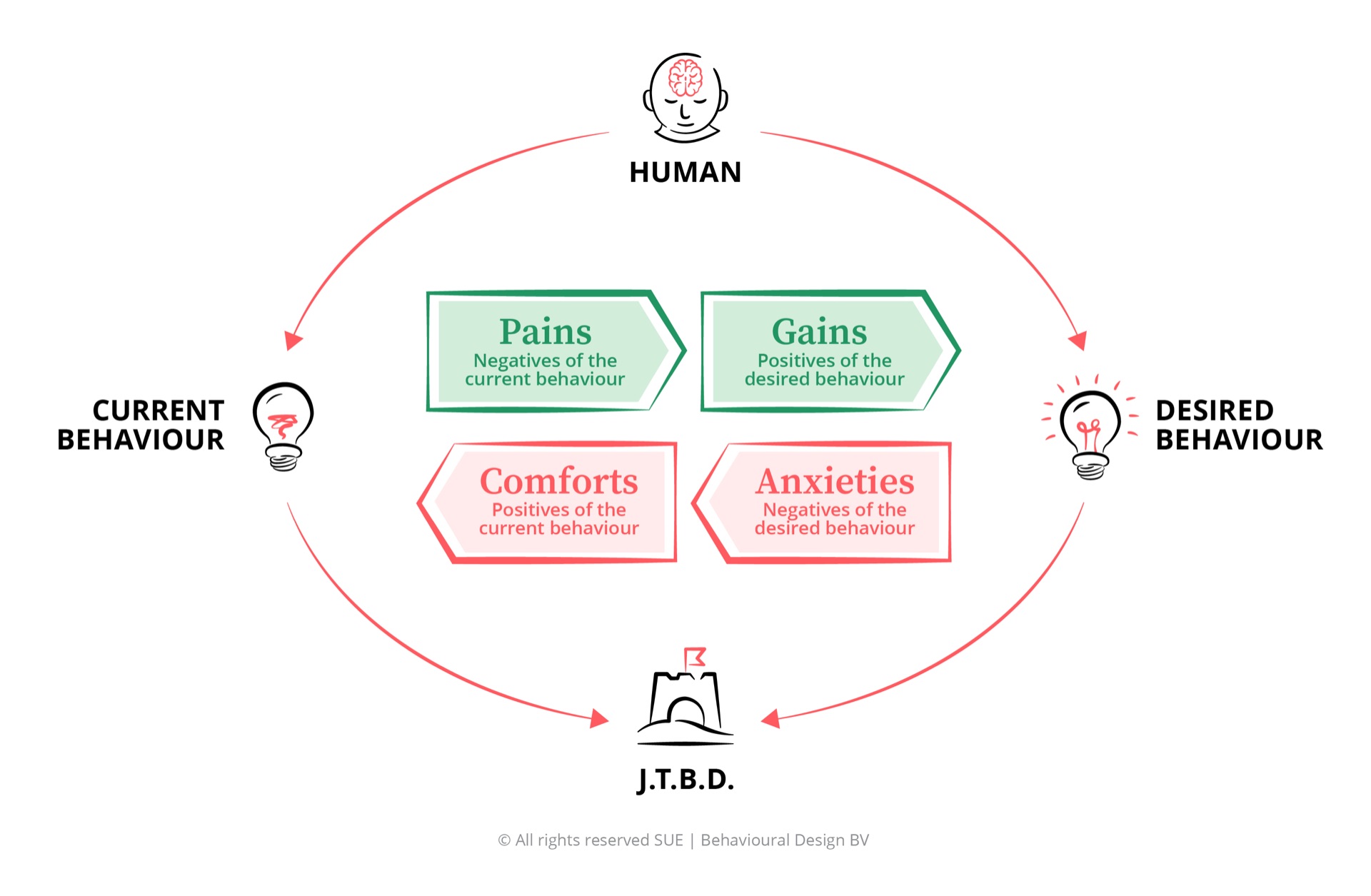
UX Research gives you insight into the interface layer. The Influence Framework gives you insight into the behavioural layer underneath. Together you know not only where the interface fails, but also why the decision to adopt is so difficult. And you can intervene deliberately at both levels.
Together they are stronger
The best approach combines both disciplines. In practice this means deploying UX Research and Behavioural Design in parallel or sequentially, depending on the phase of your project.
In the exploration phase, start with an Influence Framework analysis. Who is the target audience? What are their current Pains and Gains? Which Comforts keep them in their current behaviour? Which Anxieties block adoption of the new? This gives you the context within which your UX research becomes relevant.
In the design phase, use UX Research to test and refine the interface. But build in interventions that specifically address the behavioural barriers you found in the Influence Framework analysis. A smart default that reverses status quo bias. Social proof that reduces anxieties. A concrete and immediate benefit introduced in onboarding.
In the validation phase, test not only whether the interface works (UX) but whether behaviour actually changes (BD). These are two different success measures that both need to be tracked.[2]
Frequently asked questions
What is the difference between UX Research and Behavioural Design?
UX Research studies what users need, what they want and where they struggle. It is descriptive: it observes behaviour. Behavioural Design studies why people do not do what they say they want to do. It is prescriptive: it designs for behaviour change. UX asks whether an interface is usable. Behavioural Design asks whether people will actually use it.
Why does a well-designed product sometimes have no adoption?
Usability and use are two different things. A product can be perfectly usable and still have no adoption because behavioural barriers block the way: loss aversion, status quo bias, lack of social proof or too high a cognitive threshold. UX Research does not always detect these barriers because they are not in the interface but in the psychology of the user.
What methods does UX Research use?
UX Research uses usability tests, in-depth interviews, surveys, analytics and heuristic evaluations. The focus is on understanding user needs and identifying usability problems in interfaces and products.
What methods does Behavioural Design use?
Behavioural Design uses the Influence Framework (for mapping behavioural drivers and barriers), behaviour mapping, intervention design, nudging and A/B testing of behavioural interventions. The focus is on identifying the psychological forces that maintain or block behaviour.
Can you combine UX Research and Behavioural Design?
Yes, and that is the recommendation. UX Research is strong at diagnosing usability problems. Behavioural Design is strong at diagnosing behavioural barriers. Together they provide a more complete picture: a product that is not only usable but actually used. In practice, starting with a behavioural analysis (Influence Framework) before or parallel to UX research works best.
Conclusion
UX Research and Behavioural Design are not competitors. They are two different lenses on the same problem: why do people not do what we expect, want or hope? Whoever only does UX Research understands whether an interface is usable, but not whether people will actually use it. Whoever only does Behavioural Design understands the behavioural barriers but misses the concrete usability problems.
The most powerful approach combines both. Want to learn how to apply Behavioural Design systematically, including in combination with UX processes? Take a look at the Behavioural Design Fundamentals Course. Rated 9.7/10 by 10,000+ professionals from more than 45 countries.
PS
The most beautiful thing I have seen in the collaboration between UX designers and Behavioural Designers is the moment they realise they both want the same thing: for people to do what is good for them in a way that feels like free choice. The difference is where they look for the cause of failure. The UX designer looks in the interface. The Behavioural Designer looks in the psychology. The smartest organisations understand that both are right.