When I tell people I work in behavioural design, I regularly get the question: “Isn’t that just psychology?” The answer is: almost, but not quite. And the difference is exactly interesting enough to understand properly.
Psychology and behavioural economics overlap significantly. They share an interest in cognitive biases, heuristics and decision-making. But they are separate disciplines with different questions, methods and historical roots. And in the workplace, where it becomes practically relevant for most people, the distinction almost completely dissolves.
Psychology studies how people think, feel and behave in broad terms. Behavioural economics studies specifically how psychological factors influence economic decisions and thereby refute the classical rational actor model. Both fields are historically connected through Kahneman and Tversky (psychologists) and Thaler (economist). In the practice of Behavioural Design the distinction matters little: both supply insights you can use to design environments that make better behaviour possible.
| Dimension | Behavioural Economics | Psychology |
|---|---|---|
| Focus | How psychological factors distort economic decisions | How people think, feel and behave broadly |
| Starting point | Deviations from the rational actor model | The human being as a psychological entity |
| Primary method | Experiments on choice and decision-making | Clinical, experimental and observational research |
| Best-known concept | Loss aversion, nudging, mental accounting | System 1 & 2, heuristics, social influence |
| Application | Policy, marketing, choice architecture | Therapy, education, organisational behaviour |
| Blind spot | Narrow scope; mainly economic choices | Describes but does not prescribe interventions |
Psychology: a broad field with many subdisciplines
Psychology is the scientific study of human thinking, feeling and behaviour. That sounds straightforward, but the field is enormous. Clinical psychology deals with mental health and therapy. Developmental psychology studies how people change across the lifespan. Social psychology looks at how people influence each other. Cognitive psychology focuses on memory, attention and reasoning.
What all these subdisciplines share is their focus on the human being as a psychological entity. Why do people act the way they do? What drives their emotions? How do they make decisions? How are they influenced by others?
For our work at SUE, cognitive and social psychology are particularly relevant. They deal with the mechanisms that drive our choice behaviour: heuristics, biases, social norms, framing effects. But psychology describes and explains. It does not say what you should do with that.
Psychology describes how people are. Behavioural economics explains why that breaks economic predictions. Behavioural Design asks: so what do we do about it?
Behavioural economics: a narrower lens, a specific question
Behavioural economics is younger and narrower. It emerged as a correction to the classical economic assumption that people are rational, utility-maximising actors who make the best decisions on the basis of complete information. That assumption never matched reality, but economists maintained it for a long time.
The breakthrough came in the 1970s. Psychologists Daniel Kahneman and Amos Tversky published a series of influential papers on heuristics and biases: the systematic thinking errors people make when assessing probabilities, risks and values.[1] Their work was psychological in nature, but the implications were explosive for economics.
Richard Thaler, an economist, was among the first to see this clearly. He built on the work of Kahneman and Tversky to describe how psychological factors distort economic behaviour: the sunk cost fallacy, mental accounting, status quo bias, loss aversion. He called it “misbehaving” - behaviour that economists treated as anomalies but that Thaler recognised as the norm.[2]
The distinction from psychology lies in the question. Behavioural economics does not ask: “How does the human mind work?” It asks: “How do economic decisions deviate from what rational models predict, and why?” The scope is smaller. The focus is sharper.
Kahneman, Tversky and Thaler: the historical connection
It is worth pausing on the origin, because it explains why the distinction is sometimes confusing.
Kahneman and Tversky were psychologists. They worked at the Hebrew University of Jerusalem and later together in Jerusalem and Stanford. Their interest was purely psychological: how do people make decisions under uncertainty? What are the systematic errors in human judgement? They published in psychology journals for a psychology audience.
But their findings were too important to stay within psychology. Economists read their work and began to understand that their models were fundamentally flawed. Thaler was one of the first to make this connection explicit and build a new discipline from it. He worked with legal scholar Cass Sunstein on the concept of “nudging”: small environmental interventions that steer people towards better choices without restricting their freedom.
Kahneman received the Nobel Prize in Economics in 2002, as a psychologist. Thaler received it in 2017. Tversky had died in 1996 and was recognised posthumously. These prizes perfectly illustrate how intertwined the two disciplines are: psychological research that transformed economics.
Overlap and difference: an honest picture
Let me make the comparison concrete.
Where do psychology and behavioural economics overlap? Both study cognitive biases: the systematic thinking errors that distort our judgement. Both study heuristics: the mental shortcuts we use to make decisions quickly. Both study how context, framing and social environment influence choice behaviour.
Where does psychology differ? Psychology is broader. It also encompasses emotion and regulation, development across the lifespan, clinical application in mental health conditions, neurological processes and language processing. Behavioural economics barely touches those areas.
Where is behavioural economics more specific? Behavioural economics is focused on decisions with economic consequences. Choices about money, work, health, saving, consuming. It has a normative element: it compares human behaviour to what rational models predict. Psychology does not necessarily have that normative reference point.
In the workplace the distinction dissolves
When I work in organisations I notice that people want to know which label to put on an insight. Is loss aversion psychology or behavioural economics? Is status quo bias a psychological or an economic phenomenon?
The answer is: it does not matter in practice. Loss aversion was described by Kahneman and Tversky in a psychological framework and developed by Thaler in an economic one. It is both. And what counts in the workplace is not the disciplinary origin but the usefulness.
Think about change programmes. Why do people resist change? Partly because new behaviour costs cognitive energy (psychological). Partly because they weigh potential losses more heavily than potential gains (behavioural economic). Partly because group norms punish deviant behaviour (social psychological). An effective intervention addresses all these factors together.
The SUE Influence Framework does exactly that. It asks: what are the Pains driving people away from current behaviour? What are the Gains attracting them towards something new? What are the Comforts keeping them in their current behaviour? And what are the Anxieties stopping them from changing? Those four forces are simultaneously psychological, social and economic. The framework deliberately does not draw the line.
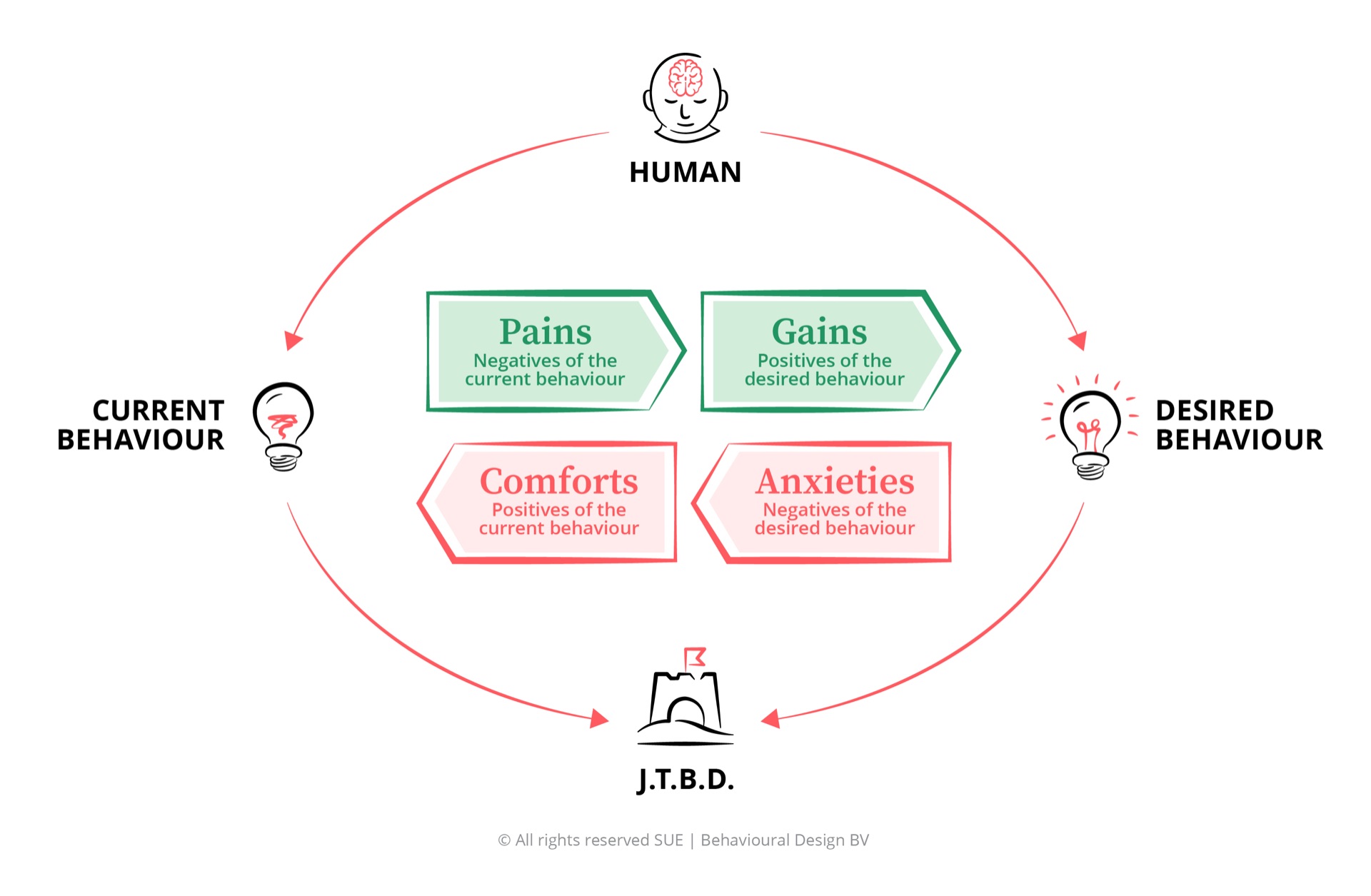
In a change programme you want to know which psychological forces maintain behaviour, which economic considerations are at play (time, effort, risk) and how social context amplifies or weakens the whole. Psychology and behavioural economics are complementary lenses on the same problem. Whoever uses only one lens misses half the picture.
Why the distinction is still worth knowing
I said just now that the distinction matters little in practice. But there is one reason it is still useful to know: it helps you find the right literature and talk to the right people.
If you are looking for insights about individual motivation, personality or emotion regulation, you will more often find them in psychological literature. If you are looking for insights about choice behaviour in markets, saving behaviour, health decisions or policy, you will more often find them in behavioural economics literature.
But for most organisational questions, the most useful insights sit precisely at the intersection. What makes employees choose a healthy breakfast at the office? What makes customers pick the more sustainable option? What makes citizens pay their taxes on time? These are simultaneously psychological and economic questions. They require both disciplines.
Frequently asked questions
What is the difference between behavioural economics and psychology?
Psychology is the broad science of human thinking, feeling and behaviour. Behavioural economics is a specific intersection: it studies how psychological factors influence economic decisions, challenging the rational actor model. Psychology includes clinical, developmental and social psychology. Behavioural economics focuses specifically on choice behaviour with economic consequences.
Who invented behavioural economics?
Behavioural economics was not invented by one person, but Kahneman and Tversky laid the intellectual foundation with their research into heuristics and biases in the 1970s. Richard Thaler, an economist, then built on their work to establish behavioural economics as a formal field within economics. Thaler received the Nobel Prize in Economics in 2017.
Is behavioural economics part of psychology?
Not exactly. Behavioural economics is an interdisciplinary field that combines psychological insights with economic models. The founders Kahneman and Tversky were psychologists, but the field emerged within economics as a correction to the rational actor model. It is a crossroads, not a subdomain.
What is the rational actor model and why is it wrong?
The rational actor model is the classical economic assumption that people always make rational, utility-maximising decisions based on complete information. Behavioural economics has shown this is wrong: people are systematically irrational. They are influenced by how choices are framed, by loss aversion, by anchoring effects and by social norms. Kahneman described this as the difference between System 1 (fast, intuitive) and System 2 (slow, analytical) thinking.
What is the connection between behavioural economics and Behavioural Design?
Behavioural Design applies the insights from behavioural economics and psychology to practical problems: how do you design an environment, communication or product so that it makes desired behaviour easier? Where behavioural economics describes and explains, Behavioural Design is prescriptive. The SUE Influence Framework is an example of such an applied instrument.
Conclusion
Psychology and behavioural economics are not competitors. They are historically connected, intellectually related and in practice complementary. The distinction is interesting to know, but should not stop you from using both disciplines where they add value.
If you want to learn how to apply these insights to real organisational problems, take a look at the Behavioural Design Fundamentals Course. You will learn the Influence Framework and other tools to analyse and change behaviour, based on the best insights from both disciplines.
PS
What fascinates me most about the intersection of psychology and behavioural economics is how fundamentally it changes the way you look at organisational problems. Almost every organisational problem is at its core a behaviour problem. People do not do what they say. They do not choose what they claim to want. They do not change when they say they want to. If you understand why that is, and you know how to redesign the environment rather than trying to persuade the people, then leadership and strategy become a fundamentally different discipline.