Building support for change does not work by persuading people with facts and business cases. Behaviour is driven by habits, social norms, and environmental cues, not by understanding. The behavioural science approach focuses on the environment: make the new behaviour the default, reduce friction at key moments, and build social proof through early adopters. Support is the result of smart environment design.
A large government organisation launches a new work process. Six months of preparation, a clear communication plan, town halls, FAQ documents, leadership briefings. At introduction, 84% of employees say they understand and support the process. Three months later, fewer than a third are using it consistently. The rest have quietly fallen back on what they always did.
We see this scenario repeated time and again at SUE. Not because the communication was poor. Not because the change was unnecessary. But because building support for change and producing agreement are two fundamentally different things. And most change initiatives are very good at the second while trying to achieve the first.
The misconception lies in how we think behaviour works. We assume that when people understand why a change is necessary, they will adjust their behaviour. That is not correct. Understanding is necessary but wholly insufficient. Behaviour is not primarily driven by what people think. It is driven by what is easy, what feels socially normal, and what the environment automatically triggers.
Agreement is what people say. Support is what people do. The distance between the two is always greater than you think.
Why building support consistently fails
When you ask why a change initiative did not gain support, you always hear the same answers. The communication was not clear enough. Management was not visible enough. Employees were not involved early enough. These explanations are not incorrect. They are simply incomplete.
The deeper explanation is behavioural psychological. The existing behaviour is embedded in System 1: automatic, fast, effortless. The new behaviour requires System 2: conscious, slow, effortful. Conscious effort is limited and cannot be sustained. The moment the pressure of the launch subsides and attention shifts, everyone falls back on automatic behaviour.
Our change management toolkit is entirely aimed at System 2. Communication campaigns, training sessions, business cases, leadership meetings: these are all System 2 interventions. They build understanding and intention. They do not change habits, social norms, or environmental cues. And those are precisely the three things that actually determine behaviour in the workplace.
Missing support therefore usually has nothing to do with resistance or unwillingness. It has to do with the fact that the environment continues to trigger the old behaviour while everyone expects people to consciously choose the new behaviour. That is an unreasonable expectation.
The four forces that determine support
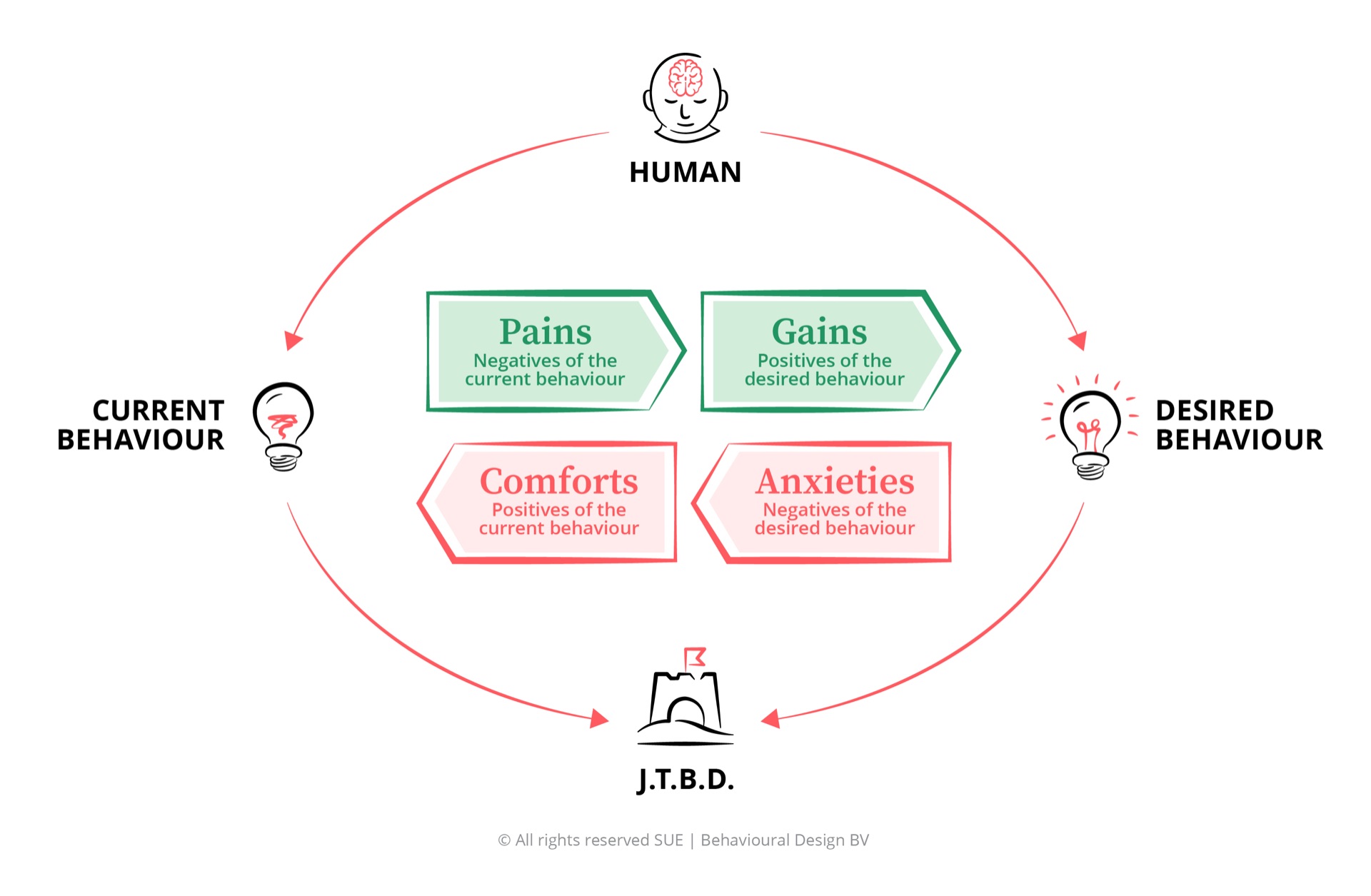
The SUE Influence Framework© provides the diagnostic structure that the standard toolkit is missing. It maps four forces that determine whether someone changes their behaviour. For building support, all four are relevant, but the blocking forces are by far the most underestimated.
What drives and blocks people
Every employee in a change initiative is subject to the influence of four forces. Understanding which forces are dominant in your specific organisation and change is the starting point for support that lasts.
The current situation is visibly painful: Employees recognise the problems with the existing process. They know it could be better. That frustration is real and widely shared. But a shared sense of urgency is not yet a guarantee for behaviour change.
External pressure creates visible necessity: Market pressure, regulation, or mergers make the necessity of change evident. People understand why it must happen. Understanding does not automatically translate into different behaviour.
The benefits are real but future: The new process will be faster. The new structure will improve collaboration. These benefits are genuine, but they are hypothetical until the new behaviour has already taken hold. People must invest now for a reward that materialises later. That investment is psychologically heavy.
Visibility pays off for early adopters: For some employees, being known as change-oriented is professionally attractive. Early adopters are valuable, but they do not form the majority.
The existing way works well enough: The current way is embedded in daily routines. It requires no conscious effort, no extra coordination, no new skills. The comfort of the familiar is enormous. This is not resistance. This is how System 1 works.
Social norms anchor the old behaviour: If your immediate colleagues are not using the new system, it does not feel necessary for you either. The social norm is one of the most powerful behavioural forces there is.
Competence anxiety is invisible but pervasive: The new system, the new way of working, the new responsibilities require new skills. The fear of appearing incompetent is never said aloud. It translates into "I prefer the old system."
Change fatigue is cumulative: For employees who have already lived through multiple large change initiatives, the expectation that this too shall pass is a rational prediction based on their own experience. This is not cynicism. This is pattern recognition.
The key insight: The standard approach to building support strengthens the driving forces: communicate the necessity, make the benefits visible, create urgency. But the blocking forces determine whether behaviour actually changes. Comforts and Anxieties require environmental interventions, not more communication.
What does work: three approaches that change behaviour
If building support does not work through communication and persuasion, what does work? Behavioural science consistently points to three approaches that change the environment instead of the person.
1. Involve people in diagnosing the problem, not in approving the solution
Most participation processes look like this: management already has the solution ready and organises sessions to generate support. Employees see through this. They know their input is only incorporated if it confirms the intended course. The result is cynicism, not engagement.
Genuine participation works differently. You involve people in establishing what the problem actually is. Not in presenting the solution. This creates ownership via the IKEA effect: people value outcomes more the more they have contributed to the design. A team that has helped diagnose the problem will much more actively support the solution, even if the eventual solution is not exactly what they themselves would have proposed.
2. Make the new behaviour the default
A mid-sized financial company wanted employees to work with a new project management tool. For months they communicated about the benefits. Adoption stalled at 30%. Then they took a different approach: all project updates now had to be submitted through the new system. The old channel was removed. Adoption was complete within two weeks.
This sounds harsh. It is. But it works because it removes the choice. As long as people can choose between old and new behaviour, System 1 always chooses what is easy and familiar. Change the default, and you remove the decision. You also remove the friction of daily decision fatigue.
3. Build social proof through early adopters
Social norms are one of the most powerful behavioural forces. If the people around you are not using the new system, not using it feels like the normal choice. If they are using it, not using it feels like falling behind.
This means: identify the five or six employees who are the first to embrace the new behaviour. Make their usage visible. Not through a campaign about "ambassadors", but through concrete visibility: their names in system logs, their input in team stand-ups, their success in concrete metrics. The point is not that they are enthusiastic. The point is that their colleagues see that it works and that it is normal.
SWAC interventions for building support
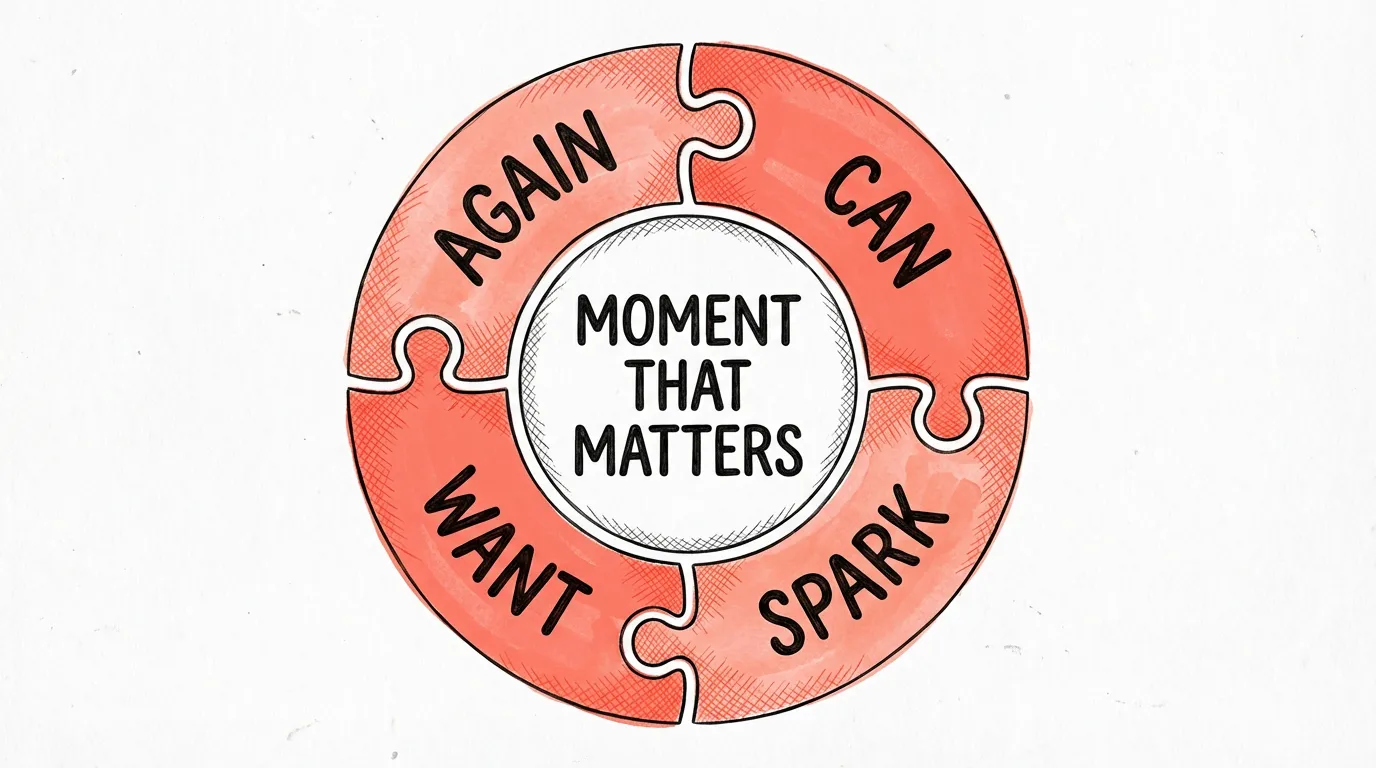
The SWAC Tool© structures behavioural interventions across four dimensions that precisely address the four blocking and driving forces. Applied to building support, it looks like this:
- Spark: Lower the threshold for performing the new behaviour for the first time. Make starting so easy that no conscious decision is needed. Install the tool on the laptop. Set up the first meeting in the new format. Remove the step where most people drop off.
- Want: Build social motivation. Ensure it is visible who is already showing the new behaviour. Use team-level metrics, not individual-level assessment. People change more readily when they see their direct colleagues are already leading the way.
- Again: Anchor the new behaviour in existing routines. Link it to a moment that already recurs every week. The best new habit is not scheduled separately; it is attached to something that already happens automatically.
- Can: Reduce competence anxiety. Give people the space to practise the new thing without visibly failing. Micro-trainings of five minutes in the daily work context work better than an extensive one-day training that took place six weeks before go-live.
Where to start tomorrow
Building support for change does not begin with a communication plan. It begins with an honest diagnosis. Take the change you currently have in front of you. Map the four forces for the employees who need to start showing the new behaviour. Which Comforts make the old behaviour so attractive? Which Anxieties make the new behaviour feel threatening?
Only when you have answered that question do you know where to redesign the environment. And only then do you build support that does not vanish the moment the launch is over.
More on how this works in the context of larger change initiatives can be found in the article why change initiatives fail. The structural diagnosis is the same; the scale is larger.
Frequently asked questions
How do you build support for change?
Building support for change does not work by persuading people with facts and arguments. It works by redesigning the environment so that the new behaviour is easier, more socially normal, and more immediately rewarding than the old one. Concrete steps: involve people early in diagnosing the problem, make the new behaviour the default, ensure visible social proof from early adopters, and reduce friction at the moments where behaviour needs to change.
Why does building support for change fail so often?
Building support fails because change managers treat it as a communication problem. They communicate why the change is necessary, organise town halls, and send newsletters. But behaviour is not driven by understanding. It is driven by habits, social norms, and environmental cues, all of which operate in System 1. Communication works in System 2. Support is built in System 1.
What is the difference between support and agreement?
Agreement is what people say: "Yes, I understand why this is necessary." Support is what people do: actually performing the new behaviour, day after day. Change initiatives produce mass agreement and little genuine support. The gap lies in the environment: people fall back on automatic behaviour as soon as conscious attention is removed.
How do you use the SUE Influence Framework for building support?
The SUE Influence Framework maps the four forces that determine whether people change their behaviour: Pains and Gains (driving forces) and Comforts and Anxieties (blocking forces). For building support, map per target group which Comforts make the old behaviour so attractive and which Anxieties make the new behaviour feel threatening. Only then do you design interventions that address those blocking forces.
Does participation work for building support?
Participation works, but not because people then "feel heard". It works via the IKEA effect: people value outcomes more when they have personally contributed to the design. But participation must take place early in the process, when diagnosing the problem, not only when presenting the solution.
PS
At SUE, we see the same pattern time and again: organisations that invest months in the right message, while the real work lies in redesigning three moments in the daily work routine. Support is not a matter of persuasion. It is a matter of design. And that is precisely what makes behavioural science so powerful: it gives you concrete handles for what you can change in the environment, not just insight into what is going wrong.