Everyone knows Cialdini's principles of persuasion. Reciprocity. Social proof. Scarcity. Authority. They appear in every marketing course, every communication handbook, every training on influence. And yet: most people who know them use them badly.
Not because the principles are wrong. They are solidly right. Robert Cialdini spent decades doing empirical research and described mechanisms that are deeply embedded in how System 1 operates.[1] The problem sits somewhere else. The principles tell you HOW you can influence someone. They don't tell you WHEN to deploy which principle, or WHY someone is receptive at that particular moment. That's the diagnostic layer that's missing. Without it, you spray the principles around and hope something sticks.
At SUE we call that spray-and-pray influence. And it's the most common mistake we see in professionals who know Cialdini but don't know the SUE | Influence Framework.
Cialdini's principles of persuasion are seven psychological mechanisms that describe HOW people are influenced: reciprocity, commitment and consistency, social proof, authority, liking, scarcity, and unity. They are powerful, but tactical. The SUE | Influence Framework adds the strategic layer: by first mapping pains, gains, comforts and anxieties, you know WHEN and WHY each principle works, so you can deploy influence as design rather than as a guess.
What Cialdini gives you, and what he doesn't
In 1984, Robert Cialdini published Influence: The Psychology of Persuasion, the most cited book on influence ever written. He described six principles that lead people to say yes. In 2016, he added a seventh in Pre-Suasion: unity.[2] The principles are:
Reciprocity. We feel obliged to give back when we have received something. Free samples in a supermarket, an unexpected favour from a colleague, a report shared without being asked: they all activate the same mechanism. People give back.
Commitment and consistency. Once people have said or done something, they want to remain consistent with that choice. A small commitment is the gateway to a larger one. This is also why attitudes follow behaviour rather than the other way around: you can change behaviour by designing small commitments first.
Social proof. In uncertainty, people look at what others do. I have written about this in the article on social proof at work: it is one of the most powerful behavioural interventions you can actively design.
Authority. We follow people who know what they're talking about. Credentials, track records, expertise: they lower the threshold for believing and following someone. This works not because people are naive, but because it is evolutionarily sensible to learn from those who already know what you want to know.
Liking. We are persuaded by people we like. Similarities, compliments, familiarity: they lower the threshold for saying yes. Liking is not a superficial mechanism; it is a signal that someone is trustworthy and understands your interests.
Scarcity. Scarce things are more attractive than abundant ones. Loss aversion combined with FOMO: the combination makes scarcity one of the most powerful drivers of urgency. But also one of the most dangerous when misused.
Unity. We are influenced by members of our own group. Family, culture, identity: whoever is “one of us” is automatically more trusted and followed. This goes beyond social proof: it is about shared identity.
Cialdini doesn't tell you which pain to address. He tells you how to address it once you know.
That is the fundamental limitation of the principles when used without context. They are techniques, not strategy. And a technique without strategy is a hammer when you don't know whether you have a nail or a screw in front of you.
Three scenarios where Cialdini fails without the IF, and works with it
The manager who can't get budget approved
You know the type: a manager with a solid plan, carefully substantiated, and still no budget. He tries again with more data. Then with an external expert endorsing the plan. Then with a presentation showing what competitors are already doing. Authority, then more authority, then social proof. Three Cialdini principles in one month. Still no budget.
The problem is not the quality of the arguments. The problem is that the manager never investigated what the real blockage was. If he had applied the SUE | Influence Framework, he would have found something different. The director approving the budget is not waiting for more evidence. She is sitting with an anxiety: what if this project fails and I'm the one who approved it? That anxiety does not shrink with more data. It shrinks with a completely different intervention: a pilot proposal that minimises her downside risk, or testimonials from comparable organisations that have tried it and can say what they learnt. That is anxiety removal, not authority building. Cialdini might well have worked here, if the manager had chosen the right principle.
The lesson: use your IF analysis to understand which force is blocking hardest. Then choose the Cialdini principle that addresses that force directly.
The HR team that finally got onboarding right
An HR team at a mid-sized company had the same problem for years: new employees arrived enthusiastically and were quietly disengaged by month three. The knowledge was there, the handbooks were there, the buddy scheme was there. What was missing was that new people never felt they truly belonged anywhere.
When they applied the IF to the new employee as the “person they were trying to influence”, they found something interesting. The biggest anxiety of a newcomer is not “do I understand the systems?” The biggest anxiety is: “do my values fit this organisation, and am I welcome?” And the strongest comfort is: “I already know everyone at my previous organisation; that felt safe.”
They redesigned onboarding around two Cialdini principles that addressed exactly those forces. Reciprocity: every new employee received a personal welcome package in week one with a handwritten card from their direct team, plus an invitation to a lunch organised by the team. Not as a formality, but as a genuine gift. Commitment and consistency: in week two, new employees were given a small task that let them contribute their own expertise to an existing project. That small commitment, of having contributed something, gave them the sense of already having built something in the organisation. Three months later, early attrition had fallen by a third.
This worked not because reciprocity and commitment are magic principles. It worked because these two principles addressed precisely the anxieties and comforts the IF had surfaced. Any other Cialdini principle would have been less effective, or actively counterproductive, here.
The marketing team that rebuilt its conversion page
A marketing team had a landing page for a paid programme. Conversion: 1.8%. They added testimonials. They added a countdown timer. They added a badge saying “recommended by experts.” Social proof, scarcity, authority. Conversion climbed to 2.1%. Disappointing, given the effort involved.
The real problem only emerged when they ran the IF analysis on the visitor to that page. That visitor was not someone uncertain about the programme's value. They had found the page through targeted searches and were already fairly convinced. The real blockage was an anxiety: “Is this for my level? Am I good enough for this programme?” And a comfort: “I can probably learn this myself via YouTube.”
They removed the countdown timer (which triggered distrust in an already sceptical audience), made the social proof more specific: not “5,000+ satisfied participants” but “5,000+ professionals from finance, HR and marketing,” so visitors could see themselves in the group. They added a section comparing the programme to self-directed learning: not defensively, but honestly. That addressed the YouTube comfort directly. Conversion rose to 4.3%. Same principles, but this time aimed at the right blockages.
That is the difference. Cialdini is always present in a well-designed page. But which principles you amplify, and how, depends entirely on what the IF tells you about the force that is blocking hardest. For more on how framing shapes perception, see the article on the framing effect.
The Influence Framework: when is someone receptive to persuasion?
The central question Cialdini doesn't answer is this: at what moment is someone actually open to being influenced? His principles describe how the mechanism works once you already have someone's attention and openness. But that openness is not always there. And when it isn't, no principle works.
The SUE | Influence Framework starts precisely where Cialdini stops. It asks: which forces determine whether someone is open to change?
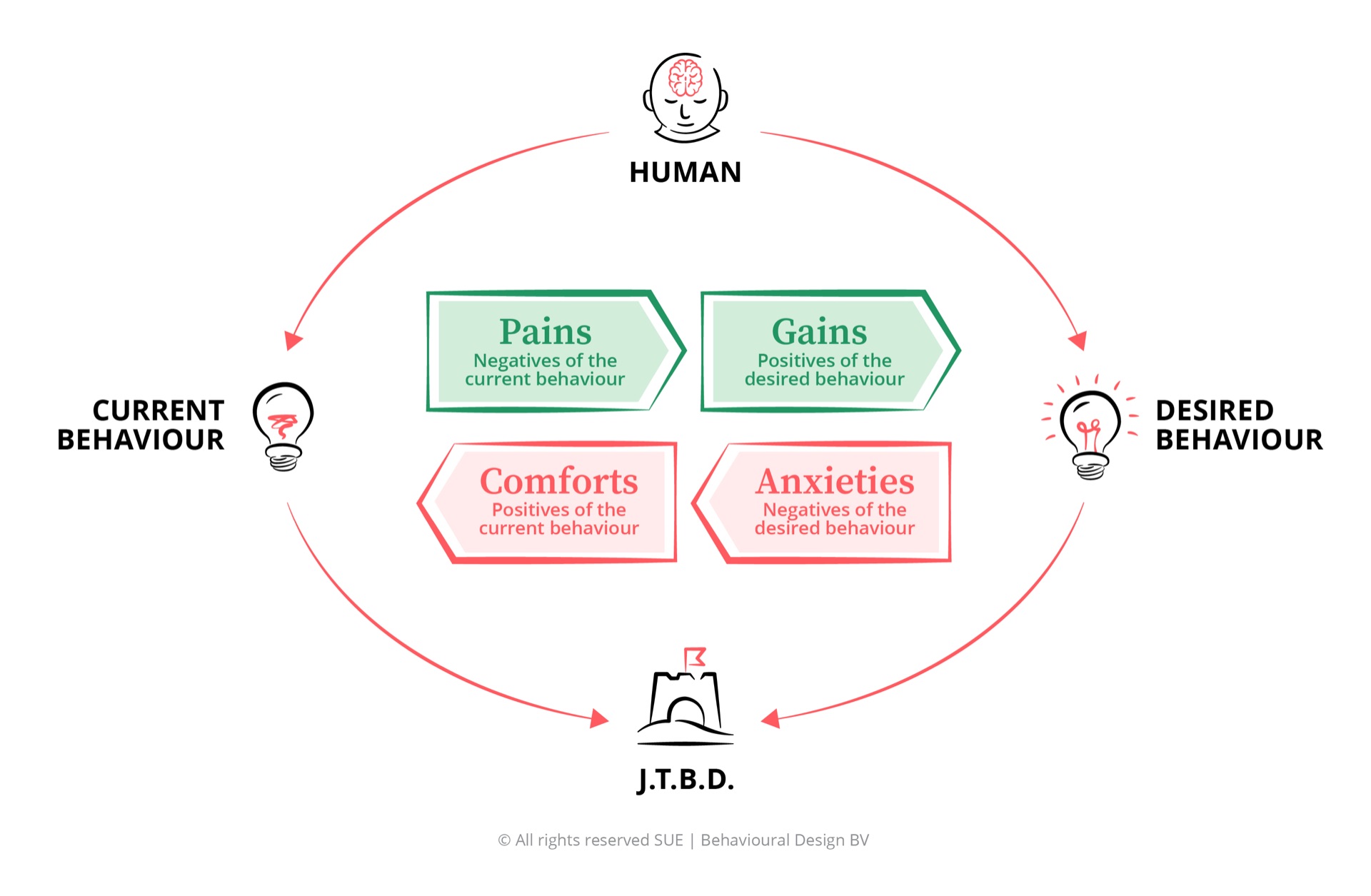
When you apply an IF analysis to influence as an overarching question, here is what you find. Pains are the frustrations and blockages that push people away from their current situation. The sharper the pain, the greater the receptivity to change. Scarcity and loss aversion work hardest when that pain is already felt. Gains are what draws people towards the desired situation. Social proof and liking amplify the attractiveness of the desired state by showing that people like them are already choosing it. Comforts are the reasons people stay in their current behaviour. They are the hardest to break through, and commitment-and-consistency is precisely the principle that creates an opening: you ask for a small step that disrupts the comfort of the old without requiring a large leap. Anxieties are everything that holds people back. Authority and social proof reduce anxiety by lowering uncertainty. Unity reduces the social anxiety of standing out, by showing that your group already does this.
Seen this way, each Cialdini principle is effectively an intervention on a specific force from the IF. Reciprocity creates a sense of obligation that disrupts comforts. Commitment and consistency strengthens the driving force of gains by getting people to invest a little. Social proof reduces anxiety and strengthens gains. Authority reduces anxiety. Liking strengthens gains through the emotional layer. Scarcity activates pain through loss aversion. Unity reduces social anxiety.
This is the connection most professionals miss. They see Cialdini as a toolbox and grab the first tool they know. The IF analysis tells you which tool fits which screw.
The seven principles and their IF mapping
To make this concrete: here is how each Cialdini principle connects to the four IF forces, and when you should therefore deploy it most forcefully.
Reciprocity works when the strongest blockage is a comfort: the desired behaviour feels like unnecessary extra effort. By giving something without expectation, you change the social ledger: now it feels uncomfortable to do nothing in return. Use this early in a relationship, when there is still little connection.
Commitment and consistency works when the pain is already felt but the step feels too large. Small commitments lower the threshold and build momentum. They also trigger a self-perception shift: “I am someone who does this.” Use this after a first positive action.
Social proof works hardest when the blockage is an anxiety: “Am I the only one? Is this the right choice?” Visible behaviour from comparable others reduces that anxiety directly. I wrote about this in the article on social proof at work.
Authority works when the blockage is an anxiety about legitimacy or risk: “Can I trust this? Is it proven?” Authority is not about status; it is relevant expertise that removes precisely the anxiety blocking hardest.
Liking works when the gain layer is not yet strong enough. People do things for people they like, even when the rational arguments don't fully convince. Liking is the bridge between a modest proposition and a positive decision.
Scarcity works when someone is already convinced of the value but is still hesitating. It combines loss aversion with urgency. Never use it as your first move. Use it when someone is already looking in the right direction but postponing the decision.
Unity works when the blockage is a social comfort: “This isn't something for someone like me.” By showing that the shared identity, the profession, the culture, the generation, already treats this as normal, you overcome the social resistance that rational arguments can never touch.
Frequently asked questions
What are Cialdini's 7 principles of persuasion?
Cialdini's seven principles of persuasion are: reciprocity, commitment and consistency, social proof, authority, liking, scarcity, and unity. The first six appeared in Influence (1984). Unity was added in Pre-Suasion (2016). They describe HOW people are influenced, but say nothing about WHEN each principle works in a specific context.
What is the difference between Cialdini's principles and the SUE | Influence Framework?
Cialdini describes the mechanisms of influence: what happens inside someone when you deploy a particular principle. The SUE | Influence Framework asks the prior diagnostic question: which forces are driving or blocking this behaviour right now? Only once you know which pain is felt, which anxiety is blocking, and which comfort is holding on, can you choose the right Cialdini principle. Without the IF analysis, Cialdini is a toolbox without a manual.
When does scarcity work as a persuasion principle?
Scarcity works best when someone is already convinced of the value of something but is delaying action. It combines loss aversion with urgency. If someone is not yet convinced of the basic value, scarcity backfires: it signals desperation rather than demand. Use scarcity after you have made the gains visible, never as an opening move.
How do you use reciprocity professionally without being manipulative?
Reciprocity is only manipulative when the gift has a hidden agenda the recipient would reject if they knew about it. Professional reciprocity is genuine: you give something of real value without an immediate expectation of return, knowing that people are naturally inclined to reciprocate. The key is that the gift addresses a real pain or need of the other person, not your commercial goal.
Why don't Cialdini's principles always work?
Cialdini's principles always work at the level of the mechanism, but not always at the level of the desired behaviour. The gap lies in context: if you deploy the wrong principle at the wrong moment against the wrong force, you may activate a feeling without producing the action you want. A manager who uses authority when the real block is an anxiety about risk will see no movement. Without a PGCA diagnosis, Cialdini is hit or miss.
Conclusion
Cialdini is not overrated. He is under-contextualised. His principles describe real, empirically grounded mechanisms. The problem is that most people deploy them as techniques rather than as answers to a diagnostic question. And the diagnostic question, which force is blocking this behaviour right now, you answer with the Influence Framework, not with Cialdini.
Once you combine the two, something shifts. Influence no longer feels like a gamble. It becomes a choice: this is the force that is blocking, this is the principle that addresses exactly that force, this is the moment I deploy it. That is the difference between spray-and-pray and behavioural design.
Want to learn how to apply the Influence Framework in practice? The Behavioural Design Fundamentals Course teaches you to use PGCA analysis to diagnose behaviour and select the right interventions. Rated 9.7/10 by more than 5,000 professionals from 45 countries.
PS
At SUE we sometimes say that influence is more judo than karate. In karate, you try to overpower your opponent. In judo, you use the opponent's force to your advantage. Cialdini is the judo manual. The SUE | Influence Framework tells you which force is coming at you. Know that, and the manual selects itself.