Picture a product team at a well-funded scale-up. They have spent ten months building a new feature. The first metrics are discouraging: activation is low, the cohort data looks weak, customer support tickets are piling up. In the next sprint review, someone puts up a dashboard full of amber and red. The product lead glances at it and says: “We’re still in the early adoption phase. This is perfectly normal for any new launch. We stay the course.” The room nods. Nobody pushes back.
Eight months later the feature is quietly deprecated. In the retrospective, everyone agrees the warning signs were there from week four. But in that sprint review, nobody saw them, or rather, nobody allowed themselves to see them. The team had invested too much to be able to stop. And the discomfort of admitting that investment had been wasted was greater than the discomfort of the bad numbers.
This is cognitive dissonance at work. And it is perhaps the most insidious force I have encountered in organisations. Not because it is rare, but because it disguises itself as rationality, as resilience, as “we still believe in this project.”
Cognitive dissonance is the psychological discomfort that arises when a person’s behaviour or decision conflicts with their beliefs, values, or new information. At work, it produces rationalisation, silence and the active defence of poor decisions, even when the evidence has long since pointed elsewhere. The solution is not greater self-awareness, but redesigning the environment using the SUE Influence Framework.
What is cognitive dissonance?
The concept was introduced by the American psychologist Leon Festinger in his 1957 book A Theory of Cognitive Dissonance.[1] Festinger observed that people have a powerful inner drive towards consistency. When two cognitions come into conflict, a belief and an action, or two contradictory beliefs, the result is discomfort. That discomfort motivates people to resolve the tension.
The problem is how they resolve it. In an ideal world, you would change the behaviour. You know smoking is harmful, so you stop. But in practice, changing behaviour is hard and painful. It is far easier to change the belief. You know smoking is harmful, but you tell yourself that stress is also harmful, that smoking helps you manage stress, that your grandfather smoked and lived to ninety-two. The rationalisation reduces the discomfort immediately. The cigarette stays.
Organisations work exactly the same way. And the mechanism operates largely as a System 1 process: automatic, fast and entirely below the threshold of conscious awareness.[2] You do not notice the rationalisation as you produce it. You experience it as reasoning.
Cognitive dissonance at work has three dimensions that make it particularly damaging:
It is collective. In a team, individual rationalisations reinforce each other. When nobody voices their doubts out loud, everyone assumes that the others are aligned with the chosen direction. Changing course then feels even more uncomfortable, because you would be the only one.
It scales with the stakes. The more that has been invested, in time, money, reputation, the greater the discomfort at the prospect of stopping, and the more compelling the rationalisations become. This is also why the bias works so closely in tandem with the sunk cost fallacy.
It masquerades as virtue. Holding firm to a decision sounds like perseverance. Dismissing a critical colleague sounds like confidence. Defending a choice sounds like leadership. Cognitive dissonance has the perfect cover.
The brain does not produce rationalisations that feel like rationalisations. It produces rationalisations that feel like reasons.
Three scenarios you will recognise
The product nobody dared to stop
A transformation team at a large financial services firm has spent two years building a new customer portal. The investment runs to several million. The CEO has announced the portal at two consecutive investor calls. Internally, doubts are circulating: the architecture has grown unwieldy, the pilot group is unrepresentative, the timeline has slipped three times. But in every steering committee meeting, the doubts are explained away.
What happens in those meetings is not bad faith. It is cognitive dissonance in action. Team members know somewhere that the signals are concerning. But that knowledge is incompatible with everything they have already invested, and with the public commitments of the CEO. The discomfort of holding both thoughts simultaneously is reduced by reinterpreting the signals: the doubts are normal for a complex transformation, the small pilot was intentionally conservative, the slippage shows mature risk management.
The portal launches. Fourteen months later, it is replaced by the legacy system that was supposed to be retired. The failure costs the firm not just the original budget but also the trust of the relationship managers who had been told, repeatedly, that this was the future.
In the post-mortem that follows, everyone says the same thing: “We actually knew.” Exactly. They knew. But the discomfort of knowing was smaller than the discomfort of saying it.
The manager who rationalised his own promotion decision
A senior manager at a professional services firm promotes a junior team member to a role that carries real client responsibility. The decision was driven partly by loyalty and personal rapport, less by a structured competency assessment. Three months in, the signals are mixed: the new hire is struggling with the scope of the role, senior colleagues are frustrated, client deliverables are slipping.
What does the manager do? Not what you would hope. Rather than evaluating the situation honestly and intervening, he begins rationalising the shortfalls. The team member just needs more time to settle in. The expectations were probably set too high. The colleagues are protective of their territory. Things will improve once the confidence builds. Every critical observation receives an explanation that leaves the original promotion decision untouched.
This is not stubbornness. It is self-protection. The manager made his professional judgement public. Acknowledging that the promotion was a mistake means acknowledging that his assessment was flawed. The discomfort of that admission is so great that the brain prefers to reinterpret reality rather than confront the error.
Meanwhile the team pays the price. And so does the promoted employee, who is now sitting in a role they are not yet ready for, without the honest coaching or course correction they actually need.
The system everyone hates but nobody admits it
An organisation invests two million euros in a new ERP system. The implementation takes sixteen months and is extraordinarily painful. Throughout that period, the leadership team has defended the system in every all-hands and in every email to staff: this is the future, this will make us more efficient, this investment will pay for itself. When the system goes live, celebratory communications are sent out.
Six months later, most employees are working around the system. Spreadsheets run alongside it, informal tracking lists multiply, core processes bypass it because it is too cumbersome. But nobody says this out loud in a meeting. Because saying it would mean that the investment, the decision, the communications, all those months of insistence, were wrong.
The leadership team knows too. But the cognitive dissonance is too strong. Admitting the system does not work requires admitting that the decision to buy it, the way it was implemented, and the enthusiasm with which it was defended, were all misplaced. That is too much to carry at once. So everyone silently settles on the rationalisation: the system is fine, people just need more time to adapt.
Three years later, a consultancy is brought in to investigate why the digital transformation has stalled.
Why awareness is never the answer: the Influence Framework analysis
At SUE we regularly hear the request: “Can you run a workshop on cognitive biases so our team starts recognising them?” My honest answer is always the same: that will help less than you think. The SUE Influence Framework explains precisely why.
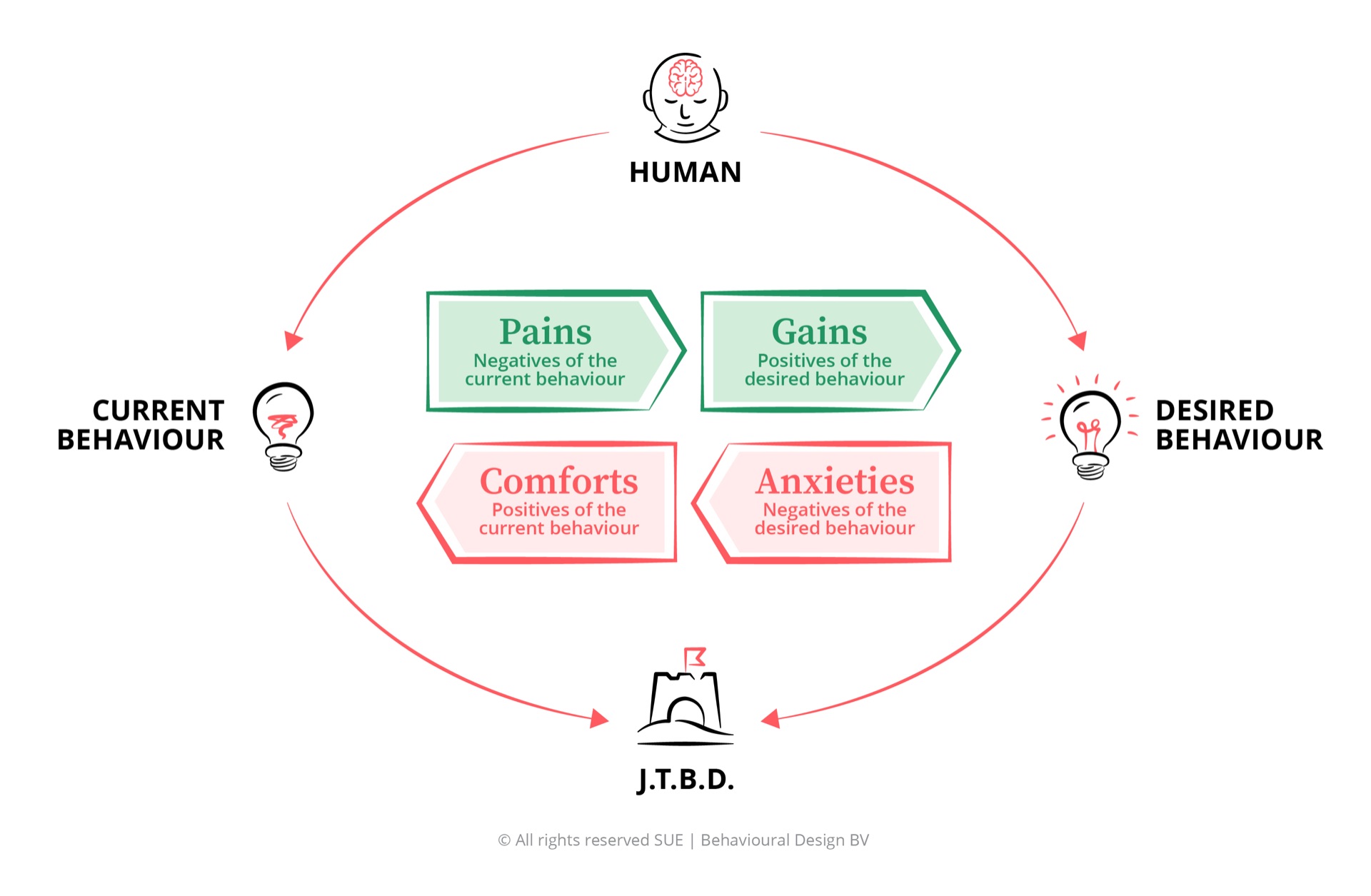
The Influence Framework analyses behaviour through four forces: the Pains that push people away from current behaviour, the Gains that pull them towards new behaviour, the Comforts that keep them anchored to what they currently do, and the Anxieties that prevent them from changing. When you apply this lens to cognitive dissonance at work, the problem becomes immediately clear.
Pains are certainly present. Poor decisions that persist too long cost time, money and trust. Employees who see their feedback repeatedly ignored disengage. Clients who were promised a future that never arrived leave. The pain is real. But it is delayed and diffuse: it manifests months later, not in the meeting where the decision was made.
Gains are also clear. Teams that course-correct earlier save resources, build credibility and learn faster. But those gains are abstract and future-facing. They rarely win against the immediate forces on the other side of the equation.
Comforts are the core of the problem. Rationalising feels good. It reduces discomfort immediately, without requiring any change. The brain rewards you with the feeling of consistency and certainty, even as you are deceiving yourself. This comfort is cognitively efficient: it demands far less mental energy than seriously entertaining alternatives. In a busy organisation where everyone is perpetually short of time, the comfortable path beats the difficult one almost every time.
Anxieties are the reason people do not intervene, even when they privately know they should. Admitting you were wrong feels like losing face. Especially when you have defended your decision publicly, when you have staked your reputation on it, when you have persuaded colleagues to back it. The fear of being judged for a course correction is greater than the fear of the consequences of staying on the wrong course. And that fear keeps everyone quiet.
The conclusion is uncomfortable but clear: you cannot reason people out of cognitive dissonance. The mechanism operates below the level of conscious reasoning. The only effective approach is to change the environment, making it easier to be honest than to rationalise.
Five interventions at the environmental level
1. Make the pre-mortem standard, not optional. Before every significant decision, ask your team: “Imagine it is twelve months from now and this project has failed. What went wrong?” This reframes the question from “shall we do this?” to “what could go wrong?” It gives people social permission to surface doubts without being labelled obstructionist. The pre-mortem makes it legitimate to name negative scenarios, and that is precisely the safety needed to interrupt the rationalisation cycle.[3]
2. Separate the decision-maker from the evaluator. If the person who made a decision is also the person who evaluates whether it is working, the probability of honest evaluation is low. Build into your processes the principle that decisions are reviewed by someone without ownership of the original call. This is not a matter of distrust, it is environmental design. Judges do not preside over their own cases for the same reason.
3. Define your stopping criteria before you start. Agree before a project launches: at which metrics do you reconsider the approach? Put it in writing and keep it visible. This moves the decision from an emotionally loaded moment in the middle of execution to a rational moment when cognitive dissonance is not yet active. It also gives everyone a credible, objective peg on which to hang a course correction without losing face.
4. Normalise course corrections in the language of your organisation. If changing direction always sounds like failure, people will avoid it. Change the framing: a course correction is evidence of organisational learning capacity. Amazon builds this explicitly into its operating principles, with norms around “disagree and commit” and the expectation that leaders change their minds when the data justifies it. The language you use shapes which behaviours are socially acceptable.
5. Make the tacit knowledge explicit through regular structured check-ins. Cognitive dissonance thrives on silence. Build short, structured moments into your rhythm, not the big monthly review, but a weekly question: “What would you decide differently today if you could make this call again?” When that question is asked routinely, answering it loses its threatening quality. And then the honest answers start to surface.
Related biases that amplify it
Cognitive dissonance rarely operates alone. At work it combines with other biases in ways that make it especially difficult to diagnose and address.
The sunk cost fallacy is its closest partner. The more that has been invested, the stronger the dissonance at the prospect of stopping, and the more powerful the rationalisations become. The sunk cost fallacy is the behaviour; cognitive dissonance is the mechanism that sustains it.
Confirmation bias acts as the preventive layer. While cognitive dissonance is reactive, reducing discomfort after the tension already exists, confirmation bias is preventive: filtering information so the tension does not arise in the first place. Together they form a closed loop: you do not see what you do not want to see, and what you do see, you reason away.
Status quo bias amplifies the preference for staying put. When people are already inclined to avoid change, and cognitive dissonance is operating on top of that tendency, course correction becomes nearly impossible without external intervention.
Loss aversion completes the picture. The pain of admitting that a decision was wrong feels like a loss. And psychologically, losses weigh more heavily than equivalent gains. Admitting an error therefore always feels disproportionately painful, which increases the resistance to honesty.
Frequently asked questions
What is cognitive dissonance at work?
Cognitive dissonance at work is the discomfort that arises when an employee or team acts in contradiction to their own beliefs or values, or when new information casts an earlier decision in a poor light. Rather than addressing that discomfort by changing the behaviour, people rationalise it away. A team that keeps developing a product when the data has long since suggested it is not working is a classic example.
What is the difference between cognitive dissonance and confirmation bias?
Confirmation bias is selectively seeking information that confirms an existing belief. Cognitive dissonance is the discomfort that arises once you already know that your belief and your behaviour are inconsistent. Confirmation bias is the preventive filter; cognitive dissonance is the reactive painkiller. They reinforce each other: to reduce dissonance, people filter information even more aggressively.
How do you spot cognitive dissonance in a team?
Look for three signals: (1) the team avoids specific data or questions around a decision, (2) critical feedback is reasoned away with arguments that do not quite hold up, even for the person making them, (3) people speak differently in the corridor than they do in the meeting room. If you notice this pattern, the team is likely sitting on uncomfortable information it does not feel safe to raise.
Can you solve cognitive dissonance in an organisation?
You cannot solve it by telling people they are rationalising. Cognitive dissonance is a System 1 mechanism: automatic and unconscious. The approach needs to work at the environmental level. Give people safe structures to step back from a decision, run pre-mortems, legitimise dissenting views and make sure there is no face-loss dynamic attached to changing course.
What is the relationship between cognitive dissonance and the sunk cost fallacy?
The sunk cost fallacy is the behaviour, continuing because you have already invested so much. Cognitive dissonance is the underlying mechanism that sustains it. The discomfort of admitting that an investment was wasted is so great that the brain produces rationalisations to justify continuing. The more that has been invested, the stronger the dissonance, and the more convincing the rationalisations become.
Conclusion
Cognitive dissonance at work is not a sign of bad intentions or low intelligence. It is a fundamental human mechanism that operates in every organisation, in every team, in every manager who has ever publicly defended a decision they privately began to doubt. The question is not whether it is happening in your organisation. It is. The question is whether you have designed the environments that make honesty easier than rationalisation.
Want to learn how to do that? In the Behavioural Design Fundamentals Course, you will learn how to apply the Influence Framework and the SWAC Tool to diagnose cognitive biases and redesign decision-making environments. Rated 9.7 out of 10 by 5,000+ alumni from 45 countries.
PS
At SUE our mission is to use the superpower of behavioural psychology to help people make positive choices. What fascinates me most about cognitive dissonance is that it is precisely the mechanism by which organisations sustain themselves while simultaneously setting the conditions for their own decline. Kodak understood that digital photography was coming. Nokia understood that smartphones would reshape the market. Blockbuster understood, somewhere in its organisation, what Netflix represented. The signals existed. The people who saw them existed too. But the system produced rationalisations that kept the existing model intact until it was too late. The courage to say “we got this wrong” is not a weakness. It is the only thing that keeps organisations viable in the long run.