Culture is behaviour under pressure.
Enron's annual report for 2000 listed four core values: communication, respect, integrity and excellence. A year later the company was bankrupt, after one of the biggest accounting scandals in American history. Patrick Lencioni opened a 2002 article in Harvard Business Review with it.[1] The values were there, they sounded good, and they said nothing about what was happening inside.
That is the tricky thing about organisational culture. You can write it down, put it on a poster and explain it in every induction programme. What an organisation really believes only shows when something is at stake. A deadline that will not be met. A mistake nobody wants to report. A client asking for more than was agreed.
Culture is behaviour under pressure. Which makes it something you can see as a leader, influence and even design. I call that leading with behaviour in mind.
Organisational culture is the behaviour people in an organisation show as a matter of course, especially when something is at stake. Core values describe how an organisation wants to be. What people do under time pressure, after mistakes and setbacks shows how it really is. More on culture change →
What is organisational culture?
Organisational culture is the set of habits, norms and assumptions that determines how people in an organisation deal with each other and with their work. It is the answer to the question: how do we actually do things here? Company culture means the same thing. You hear it more in commercial businesses, organisational culture also in public bodies, schools and healthcare.
Organisational psychologist Edgar Schein of MIT, one of the founders of the field, distinguishes three levels.[2] At the top is what you can see: the office, the clothes, the way meetings run. Below that are the values an organisation professes, such as the core values on the website. And at the bottom are the assumptions so self-evident that nobody says them out loud any more. Make a mistake here and it will be held against you for years. Or: the client always comes first, even at the expense of quality.
According to Schein, that bottom level drives behaviour. And it surfaces most clearly when things get tense.
Why do you only really see culture under pressure?
Psychologists John Darley and Daniel Batson of Princeton ran an experiment in 1973 that shows this painfully precisely.[3] They asked theology students to give a short talk in a building further along. Some were given the parable of the Good Samaritan as their topic: the story of the man who stops to help an injured stranger. On the way, someone sat slumped in a doorway, groaning and coughing.
Whether the students stopped had little to do with the talk they had just prepared. It depended mainly on how much of a hurry they were in. Of the students who had been told they had plenty of time, 63 per cent offered help. Of those told they were already late, 10 per cent. A few literally stepped over the man on their way to their talk about helping a stranger.
That is what pressure does. In a hurry, the fast, automatic part of our brain takes over, what Daniel Kahneman called System 1. It follows the situation and the habit, and much less the values you sign up to in a calm moment. That is why an organisation in a quiet week is a poster, and in a busy week a culture.
Core values describe who you want to be. Pressure shows who you are.
Why do core values change so little about behaviour?
Core values are made for the conscious brain. They are thought up on an away day, with time and a flip chart. They help when someone calmly thinks about the right choice. Only the choices that make culture are rarely made like that. They happen between two meetings, with a full inbox and a manager waiting for an answer.
Lencioni saw something else too. Many core values are so general that nobody can be against them, and so nobody steers by them.[1] Integrity, respect, customer focus. At the moment it pinches, between speed and care or between the client and a colleague, they give no direction.
Behaviour under pressure is decided by what happens when you do it. Someone who reports a mistake and is then eyed in every meeting will not report the next one. Someone who meets the deadline by skipping a check and gets praised for it will skip it again next time. That is how an organisation writes its real core values, every single day.
Which forces drive behaviour under pressure?
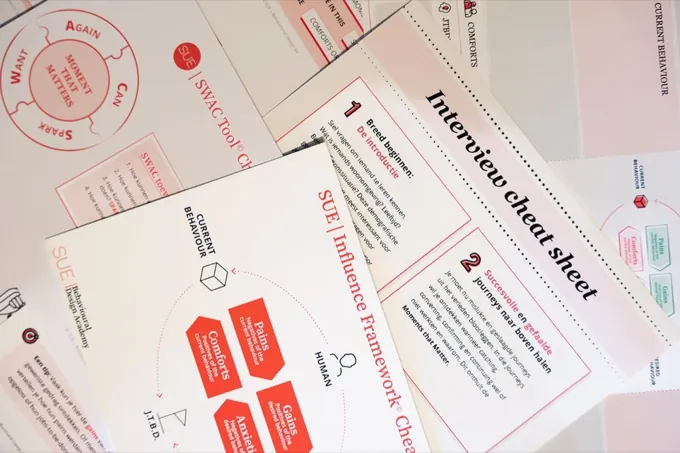
What people do under pressure depends on four forces. At SUE we map them with the SUE | Influence Framework©, the Behavioural Design model that turns psychologist Kurt Lewin's force field into something you can fill in for each situation.[4]

The pains and gains push people towards the behaviour you want to see: what goes wrong if they do nothing, and what it brings them if they do act. The comforts and anxieties keep them where they are: what is familiar and quick, and what they are afraid of.
Under pressure, those last two almost always win. Take reporting a mistake. The gain is clear: the organisation learns from it. But staying quiet costs no time now, and whoever reports it risks getting the blame. Amy Edmondson of Harvard showed in 1999 that teams only learn when people dare to say something went wrong.[5] She called it psychological safety: the shared belief that you can take a risk in this team without being punished for it. Read more in psychological safety at work.
Changing culture is rarely a matter of pushing harder with new values. It is about removing what holds people back in the busy moment.
What does leading with behaviour in mind mean?
Leading with behaviour in mind means you know as a leader that your behaviour in the tense moments makes the culture, and you design those moments deliberately. Schein names the way leaders react to incidents and crises as one of the strongest ways culture is formed.[2]
People don't remember what you said at the quarterly meeting. They remember what you did when the project overran.
That sounds heavy, and it is also hopeful. Because it means you do not have to wait for a culture programme as a leader. The next time someone walks in with bad news, you show what is normal here.
How do you design culture for the moments that matter? Five steps
Five steps for a leader or leadership team that wants to change the culture through behaviour under pressure.
1. Pick the pressure moments
Which three or four situations keep coming back and show how you really work? A deadline that slips, a mistake with a client, a disagreement in the leadership team. That is where your culture lives.
2. Write down what people do now
Describe what happens in each moment, in plain verbs. "We are open" is not behaviour. "Someone reports within a day that an assignment is running late" is.
3. Map the four forces for each moment
What pushes people towards the behaviour you want, and what keeps them where they are? Look hardest at the comforts and anxieties, because those win when things get busy.
4. Decide in advance how you will respond
Agree with yourself what you will do when someone shows the behaviour you want, especially when it is bad news. Thank them first, then deal with the content. That first reaction decides whether there is a second time.
5. Make the desired behaviour the easiest route
A fixed slot in the meeting for what went wrong. A short template for reporting a delay. A clear agreement on who may decide that quality comes before the deadline. Under pressure, people take the path that is already there.
Where does a leadership team start?
Culture under pressure is above all something for a leadership team to do together. People look at the pattern: if one manager responds to a mistake differently from another, what people mainly learn is that it depends on whose team you are in. Read also why culture change so often fails and how to design a culture people actually live.
Would you like to talk about what this looks like in your organisation? Book a free half-hour conversation and we will look together at how we can help with your leadership development. Or first read how Leading with Influence© works.
Frequently asked questions about organisational culture
What is organisational culture?
Organisational culture is the set of habits, norms and assumptions that determine how people in an organisation deal with each other and with their work. According to Edgar Schein, culture has three levels: what you can see, the values an organisation professes and the underlying assumptions. That last level drives behaviour.
What is the difference between company culture and organisational culture?
There is no real difference. Company culture is used more for commercial businesses, organisational culture also for public bodies, healthcare and schools. In both cases it is about how people actually work.
What does culture is behaviour under pressure mean?
It means you see the real culture of an organisation in what people do when something is at stake, such as a deadline, a mistake or a difficult client. Under pressure, people act on habit and on what they expect will happen, and less on their conscious values.
Why do core values change so little about behaviour?
Core values are designed for calm moments and the conscious brain. The choices that make culture are often made under time pressure. On top of that, many core values are so general that they give no direction at the moment two interests clash.
What does leading with behaviour in mind mean?
It means you know as a leader that your behaviour in the tense moments makes the culture, and you design those moments deliberately. You choose the situations that matter, look at what people do in them now and shape your own response and the environment so the desired behaviour becomes the easiest choice.
How do you change the culture of an organisation?
You change culture by working on behaviour in the moments that matter. Choose those moments, map what pushes people towards the new behaviour and what holds them back, and remove the forces that hold them back. New core values on their own change little.
Conclusion
Enron had the right words on paper. What went wrong happened in the moments that got tense, and there those words helped nobody.
Anyone who wants to change culture should start with those moments. Choose them, look at what people do in them now and design what happens when they do the right thing. In Leading with Influence© we do that with your own leadership team.
Core values hang on the wall. Culture shows at five o'clock on a Friday afternoon, when the deadline wobbles.