Almost every large organisation has invested in customer-centric transformation in recent years. Customer journey maps have been drawn up. NPS targets set. Core values drafted with phrases like ‘the customer comes first’. Employees have attended training programmes. And yet: a few months later the NPS score has dropped again, people are doing exactly what they always did, and you find yourself wondering what went wrong.
The question that is almost never asked is the right one: what psychological forces prevent employees from behaving in a customer-centric way? Not because they do not want to. But because the context in which they work, the system that rewards them and the habits that give them stability all make efficiency-focused behaviour the logical, safe choice. And customer-centric behaviour the difficult exception.
This is not a motivation problem. It is a design problem. And that makes it good news: it is solvable.
The customer-centric paradox: everyone wants it, nobody does it
If you ask any employee whether the customer matters, everyone says yes. If you ask whether they genuinely put the customer first in their daily work, most say yes too. And yet the customer rarely sees that in practice. How is that possible?
The gap lies not in intention but in execution. Customer centricity as a mission statement is something different from customer centricity as daily behaviour. The difference lies in what people actually do when they have to choose: help a customer whose situation falls outside the standard process, or follow the standard process that protects them from mistakes and criticism. Look for a creative solution, or take the safe option that fits within the KPI.
In virtually every organisation we analyse, we see the same pattern: the reward structures, the processes and the implicit norms incentivise efficiency-focused behaviour. Customer-centric behaviour is not rewarded - sometimes actively penalised - if it takes time, deviates from the norm or generates a complaint.
Organisations want customer-centric behaviour, but have built systems that make efficiency-focused behaviour the most comfortable choice.
This is not a will problem. It is a design problem. And if you treat it as a will problem - with more motivation, more training, more values posters - you will lose again.
What holds employees back from the customer?
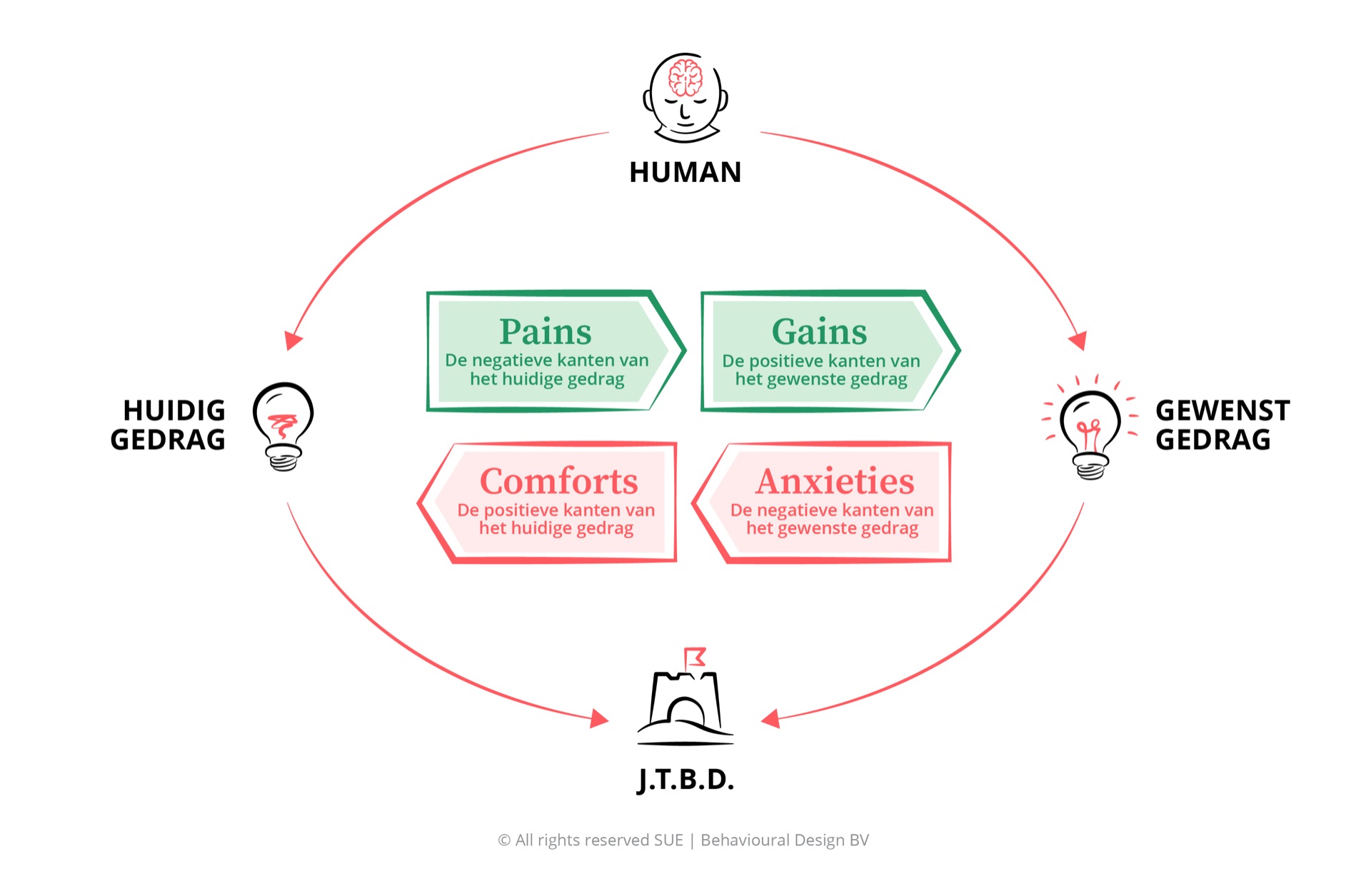
For customer-centric transformation to work, you must start with an honest question: what is currently preventing employees from acting in a customer-centric way? The SUE Influence Framework™ is the most powerful lens for analysing this. Not from the perspective of the customer - most organisations already do that - but from the perspective of the employee.
What you then encounter is illuminating:
Comforts - the habits that keep employees in their current behaviour - are powerful and varied. Internal processes that take precedence. KPIs that measure speed and volume, not customer satisfaction. Routines that protect them from mistakes. Colleagues who do it the same way. The implicit norm that “I am not in a customer-facing role.”
Anxieties - the fears that block new behaviour - are equally powerful. Fear of stepping outside the process and being held accountable for it. Fear of making a decision that their manager will not approve. Fear of investing time in a customer at the cost of other KPIs. Uncertainty about when it is and is not acceptable to deviate from standard procedures.
Pains that could prompt change also exist: complaining customers are exhausting. Unclear processes are frustrating. But this pain is rarely translated into a willingness to change, because the employee does not feel they can do anything about it.
And the Gains of customer-centric behaviour are vague and distant: “a satisfied customer” feels abstract, especially when it is not visibly measured or appreciated anywhere.
The conclusion is simple but uncomfortable: the organisation has built a system in which efficiency-focused behaviour is the most comfortable, safest and most rewarded choice. And then it is not fair to blame employees for not being customer-centric.
The human behind the employee
One of the central insights of the SUE Influence Framework is that customers are first and foremost human beings. That sounds obvious, but it has major practical implications: people do not behave based on what is logical, but based on what is psychologically comfortable.
The same applies to employees. They too are human beings first. Their behaviour follows the same psychological laws. And if you want to understand why they do what they do, you need to think about their Job-to-be-Done: what is actually the goal that a frontline employee pursues in their daily work?
The answer is almost never: “surprise the customer.” The actual Job-to-be-Done of most employees is: come across as competent, get through the day well, hit my targets, avoid causing trouble, be valued by my colleagues and manager. Those are the drivers that steer their behaviour.
This is not cynicism. It is humanity. And it is the reason why customer-centric transformation fails so often: organisations try to motivate employees from the perspective of the customer’s Job-to-be-Done, while employees are driven by their own Job-to-be-Done. The two are rarely the same - unless you deliberately align them.
Context beats willpower. Always. Design the context so that customer-centric behaviour is the logical, easy choice.
The behavioural design insight that follows: focus not on the motivation of employees, but on the context. If customer-centric behaviour connects to the employee’s Job-to-be-Done - if it makes them more comfortable, not more anxious; if it rewards them, not punishes them - then it is no longer the exception. It becomes the norm.
From customer promise to customer behaviour: the behavioural design approach
If customer-centric transformation is a behaviour problem, then behavioural design is the answer. In concrete terms, that means: stop investing in communicating the customer promise, and start designing the context in which customer-centric behaviour becomes self-evident.
We use the SWAC model for this: Spark, Want, Again, Can. Four questions that together determine whether behaviour changes sustainably.
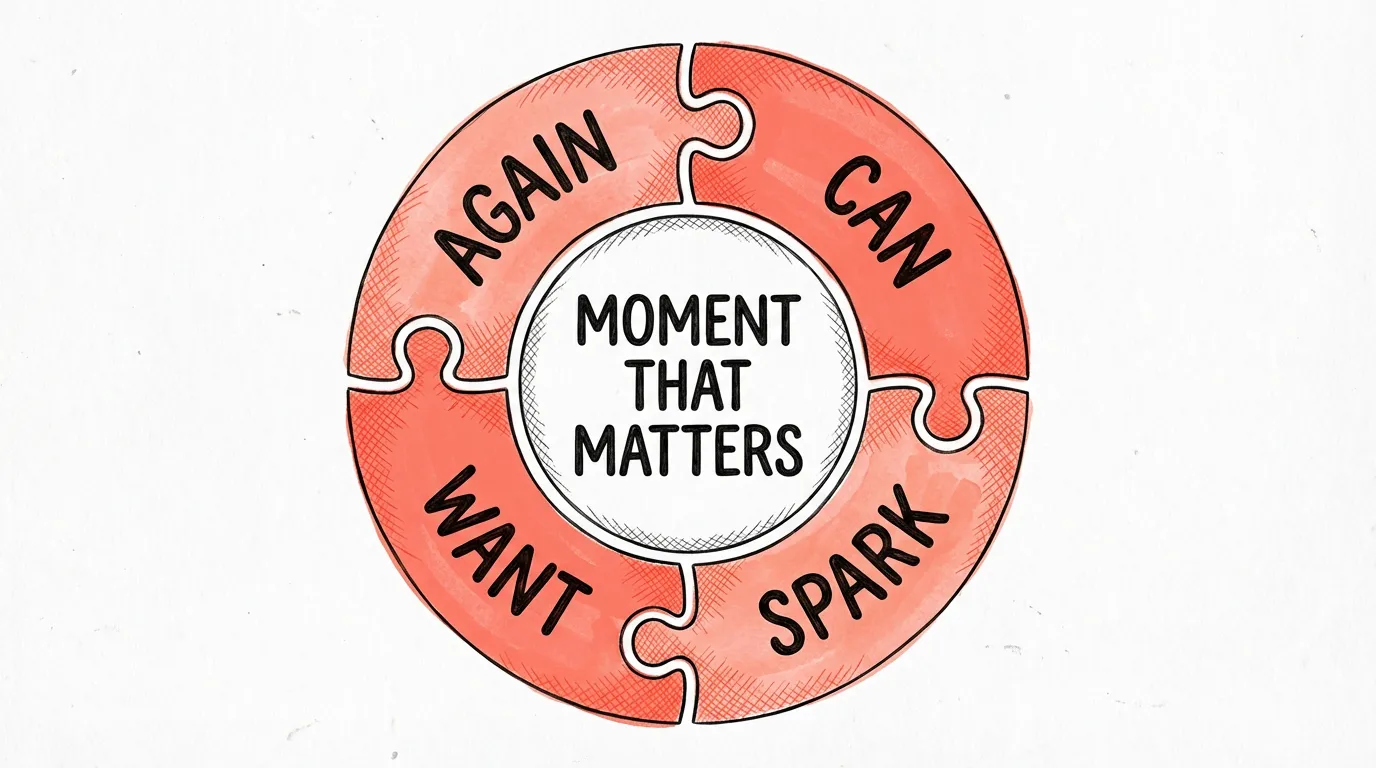
CAN - make customer-centric behaviour easier. Which internal barriers prevent employees from acting in a customer-centric way? Complex escalation routes, lack of decision-making authority, processes that treat the customer as an exception. Simplify those. Give employees the space and authority to make decisions on the spot. Remove the friction.
WANT - make customer-centric behaviour visible and rewarded. Recognition from direct colleagues works more powerfully than a compliment from senior management. Share stories about employees who made a difference for a customer. Make customer feedback personal and directly visible. Link appreciation to behaviour, not just to numbers.
SPARK - redesign the Moments that Matter. Which moments in the customer interaction are decisive for the experience? Design those moments deliberately. An onboarding conversation, a complaint resolution, a standard email that is currently cold and formal - these are the moments where customer-centric behaviour makes the biggest difference and where you can most easily design for it.
AGAIN - build rituals around customer behaviour. Sustainable behaviour change requires repetition and social embedding. Team rituals around customer behaviour - a weekly ‘customer of the week’ story, a dedicated slot in team meetings for customer feedback, thanking a colleague who made a difference - embed new behaviour in the culture without it feeling imposed from above.
The Virgin Atlantic case: measuring what truly drives people
One of the most instructive examples for customer-centric transformation is the Virgin Atlantic case I regularly use in our training programmes. The airline conducted attitudinal research among passengers and found that customers associated ‘adventure’ and ‘excitement’ with the brand. That sounded like a strong starting point for the brand strategy.
But behavioural research - research into what people actually do, not what they say they value - told a different story. What passengers were truly driven by was something far more prosaic: stress-free, responsive and helpful. Not adventure. Not excitement. Simply: that things are well organised and that someone helps when something goes wrong.
By redesigning the strategy based on those actual behavioural drivers rather than the stated preferences, Virgin Atlantic achieved a profit improvement of £1 million - “the most successful reframing exercise Virgin Atlantic had ever undertaken.”[1]
The lesson for customer-centric transformation is twofold. First: measure behaviour, not attitudes. NPS scores and customer satisfaction surveys measure what people say they think, not what truly drives them. Second: research not only what the customer wants, but also what the employee needs in order to deliver it. Most customer-centric transformations skip the second step entirely.
What customer-centric transformation truly requires
If you take behavioural science seriously, customer-centric transformation requires three things that most programmes do not do.
Leaders who demonstrate customer-centric behaviour, not preach it. Employees do not watch what leaders say, but what they do. If a manager says “the customer comes first” in a meeting and then makes decisions based on short-term efficiency, that sends a more powerful signal than any values campaign. Social proof works from up close and from above.[2] Leaders who visibly model customer-centric behaviour - who listen in on customer stories, who remove process friction, who publicly recognise employees for customer-centric action - are the most powerful intervention in any customer-centric transformation.
Removing internal friction that blocks customer-centric choices. Every internal process that forces employees to treat the customer as an exception is an obstacle to customer centricity. Bureaucracy that slows decisions. Escalation processes that take too long. KPIs that reward speed over quality. This friction is the real enemy of customer centricity - not the employee. Customer-centric transformation requires leaders to be willing to audit internal processes critically through the lens of: does this make customer-centric behaviour easier or harder?
Measuring the right behaviours, not just outcomes. NPS is an outcome measure. It tells you whether customers are satisfied, but not which behaviour is responsible for that or how you can strengthen it. Customer-centric transformation requires you to also measure the intermediate behaviours: How many decisions do employees make independently on the spot? How quickly are exceptions resolved? How much customer feedback reaches the employee directly? Behavioural measurements give you handles for improvement; outcome measurements alone do not.
Read more about why change programmes fail and how to break that pattern in an earlier article on this blog.
Conclusion: customer-centric transformation is a behaviour problem
Most organisations treat customer-centric transformation as a strategic or cultural question. They write new values, build better processes, measure NPS and steer toward targets. All of that is worthwhile. But it does not reach the core.
The core is behaviour. Every moment in which an employee chooses: do I follow the standard process, or do I do something extra for this customer? That moment is not influenced by a values poster or an NPS target. It is influenced by context: what is the easiest choice? What is rewarded? What is penalised? What are my colleagues doing?
Customer-centric transformation that works begins with the honest question: what are the psychological forces that block customer-centric behaviour? And then: how do we design a context in which customer-centric behaviour is the logical, comfortable and rewarded choice?
That is not a soft question. It is the most strategic question you can ask in a customer-centric transformation. Also read: how to reduce resistance to change and how commitment devices help embed new behaviour.
Frequently asked questions
Why do customer-centric transformations fail so often?
Most customer-centric transformations focus on processes, systems and values, but overlook the layer that truly matters: the day-to-day behaviour of employees. Customer centricity is not a mindset you can instil through a training or a values poster. It is behaviour that must be designed by removing the psychological forces that block customer-centric behaviour - the Comforts that keep people locked in efficiency-focused habits, and the Anxieties that make customer-centric choices feel risky.
What is the role of behavioural design in customer-centric transformation?
Behavioural design helps organisations understand why employees do not behave in a customer-centric way, even when they want to. By mapping the Job-to-be-Done of employees and analysing the Pains, Gains, Comforts and Anxieties using the SUE Influence Framework™, you design a context in which customer-centric behaviour becomes the logical and easiest choice. That is fundamentally different from trying to convince or motivate employees.
How do you start a customer-centric transformation based on behavioural science?
Start with a behavioural diagnosis: interview employees about their daily work, their frustrations, their fears and their habits. Map out which internal processes, KPIs and reward structures incentivise efficiency-focused behaviour at the expense of customer centricity. Then design interventions that make customer-centric behaviour easier, more visible and more rewarding. More on tackling behavioural design versus traditional change management can be found in an earlier article.