You have a beautiful journey map. Colour-coded post-its, neat touchpoints, a clear route from awareness to purchase. And yet: at a specific point in the funnel, customers drop off in large numbers. You've improved the UX. You've sharpened the copy. You've halved the load time. It's not enough.
The reason is almost always the same. Your journey map shows what customers do. Not why they stop.
And that difference is everything. Because customers don't drop off because a button is in the wrong place. They drop off because at that moment there is an anxiety that is bigger than the pull of the next step. That's where customer journey optimisation with behavioural insights begins: with the question of what your customer is afraid of right now.
Customer journey optimisation with behavioural insights goes beyond UX improvements. It maps the four psychological forces that determine whether a customer continues or drops off at every touchpoint: Pains, Gains, Comforts and Anxieties. Using the SUE | Influence Framework and the peak-end rule, you design journeys that are psychologically sound, not just technically correct.
What the standard journey map misses
Most journey maps are descriptive. They describe steps. Awareness, consideration, decision, use, retention. Sometimes with an emotion layer added on top: happy, neutral, frustrated. But that emotion layer is almost always based on what customers say in surveys, not on what they actually do. And that's precisely the problem.
What a customer says they feel and what is actually happening in their head at the moment they drop off are rarely the same thing. In an exit survey they write: "too complicated." What was really happening: they were halfway through an application form and thought, "what if I fill this in and get rejected?" The fear of rejection was greater than the pull of the outcome. That is not a UX problem. That is a psychological problem.
Behavioural Design looks differently. The question is not: at which step did the customer drop off? The question is: which psychological forces were dominant at that moment, and in which direction were they pointing?
Your customer journey is only as good as your understanding of what your customer is afraid of.
Three journeys that failed for the wrong reason
The retail bank with 70% drop-off
Picture this: a retail bank sees that seventy per cent of customers who begin an online mortgage application drop off at the step where they need to enter their income details. The bank has simplified the step. They've added a FAQ. They've improved the form's load time. Nothing works.
When you interview customers at that specific touchpoint about what is going through their mind, something different emerges. It is not the form that stops them. It is the question they are asking themselves: "What if I fill this in and then find out I don't qualify? Then I've shared my private information for nothing." That is an Anxiety in its purest form: fear of a negative outcome from the next step. Not a functional problem. An emotional block.
The solution was not in the interface. It was in what was communicated before and during that step. A simple progress indicator, combined with a line like "8 out of 10 people who enter their income details are eligible for at least one of our options," removed the uncertainty. The anxiety peak was dampened through social proof and expectation-setting. Drop-off fell significantly.
This is what behavioural insights add to journey optimisation: you no longer design just the form. You design the psychological context of the form.
The insurer that kept losing its own customers
An insurance company wanted to improve its claims process. Customers complained it was too complicated. The solution seemed straightforward: fewer steps, better interface, clearer language. But when the team started genuinely studying the journeys of customers who never submitted their claim, they discovered something different.
It was not customers who found it too complicated and gave up. It was customers who opened the form, saw how long it was, and thought: "I'll do this later." And later never came. Not because they forgot. But because the comfort of postponing was greater than the pain of the damage they had already processed. The Comfort force was dominant here: "I'll manage without the compensation." And the required action was burdensome enough to justify that comfort.
The intervention was surprisingly small. The confirmation email sent after a damage report had one sentence added to it: "Set yourself a reminder for tomorrow at 10am to complete your claim in fifteen minutes." An implementation intention trigger, based on research by Gollwitzer (1999) on the effect of if-then planning on actual behaviour. Customers who read that sentence came back three times more often than those who did not. The same customers, the same claim, the same form. The only thing that changed was that the desired moment was concretely anchored in their minds.
The lesson: the friction in a journey is rarely the friction that is visible. It is the psychological friction of having to choose, having to think, having to overcome the fact that postponing feels so comfortable.
The e-commerce brand that missed the repeat purchase
An e-commerce brand had an excellent product. Customer appreciation was high. Retention was poor. Most customers bought once and did not return. Funnel analysis offered no clear explanation: checkout was smooth, reviews were positive, no complaints after delivery.
Until someone looked at the right touchpoint. Not the checkout. Not the product page. The moment of unboxing and the following week. What was the experience after purchase? A generic confirmation email. Neutral packaging. A week of silence, followed by a discount code.
Kahneman, Fredrickson, Schreiber and Redelmeier showed in 1993 that people do not remember experiences as a fair average of all moments. They remember two things: the most intense moment, and the final moment. The peak-end rule.[1] For this brand, the unboxing moment was potentially the peak of the entire journey: the moment when something became tangible that had previously been only a pixel on a screen. That peak was completely undesigned.
What followed was a redesign of precisely those two moments. The packaging became an experience in itself: a small personal note inside it, an instruction that revealed something unexpected about the product. And the follow-up email, sent three days after delivery, did not ask for a review. It asked: "How has it changed your first week?" That single question created a closing moment that made the customer think back to the value of the product, not the transaction.
Repeat purchases rose. Not because the product improved. But because the memory of the product improved.
PGCA analysis: your journey map becomes a diagnostic instrument
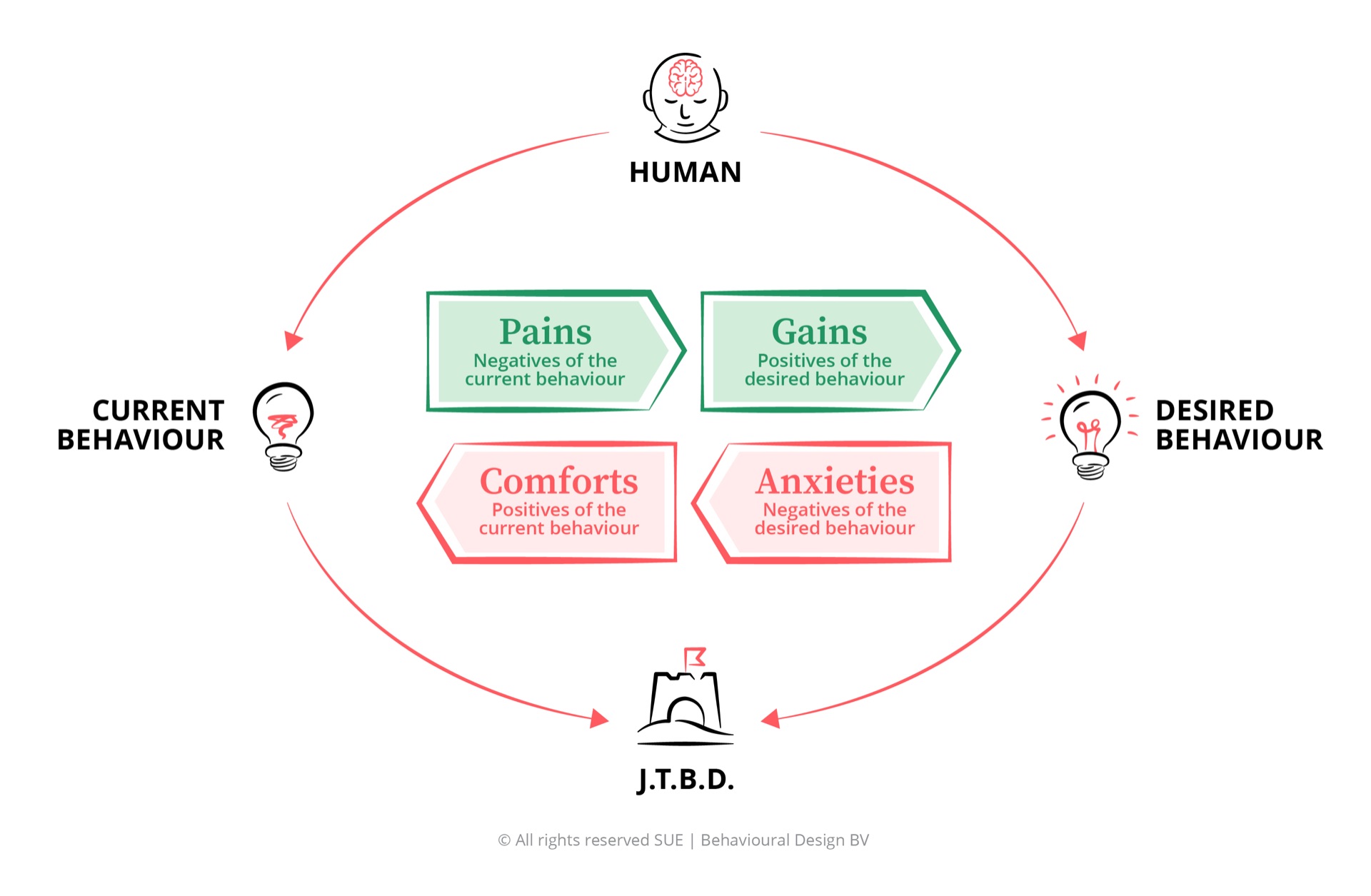
The SUE | Influence Framework gives you a diagnostic lens for every touchpoint in your journey. Instead of asking "how well is this touchpoint designed?" you ask: which four forces are active here?
Take the example of a typical bottleneck: the step where a customer moves from consideration to application. In standard journey maps this is a well-known drop-off zone. The standard diagnosis: "too many steps" or "unclear information." But when you run a PGCA analysis on it, you see something more layered.
The Pains driving the customer towards the application are real: they have a problem they want to solve, they are done deliberating, they want certainty. Those forces are present, but they are abstract. It is still an intention, not an action.
The Gains of completing the application are attractive but distant: they are thinking about the end result, not the step itself. If you make the Gains of the next step more concrete, closer to the present moment, it works better. Not "apply now and enjoy your product," but "in three minutes you'll know what your options are."
The Comforts of not continuing are also strong: they can always wait a bit longer. Do one more comparison. Read one more review. Postponing costs nothing, and it feels prudent. This is status quo bias in action: current behaviour has a comfort value that desired behaviour has not yet built up.
And then the Anxieties: what if this isn't right for me? What if there are obligations attached? What if I have to make a phone call? These are the questions System 1 asks, right before someone clicks the application button. They are not rationally weighed. They flash up. And if you don't neutralise them before they flash up, you lose the customer.
This is why defaults are so powerful in journey design: they remove the decision burden at exactly the moment when anxieties are greatest. When the default option is already selected for you, there is no choice to make. You only need to confirm. The anxiety of "what do I choose" disappears.
The touchpoints with the highest Anxiety scores are your priority. Not the touchpoints with the lowest NPS scores or the most complaints, because those tell you what customers say. Anxiety scores tell you what customers feel at the moment of decision.
The peak-end rule as a design principle
Most journey optimisations try to make every touchpoint slightly better. That is understandable, but it is also an inefficient strategy. Because customers do not remember their journey as an average of all touchpoints. They remember the peak and the end.
Kahneman and colleagues demonstrated this in 1993 in research on pain experience during medical procedures.[1] Patients who had a longer but less intense conclusion to a painful procedure rated the total experience as less unpleasant than patients who had a shorter procedure ending at a high pain moment. The objective pain was greater. But the memory was better, because the end was different.
Translated into customer journey design: you can spend hours improving the middle section of your journey. But if the peak is undesigned and the final moment is generic, it has little effect on how customers remember you, and therefore on repeat purchase, referral and loyalty.
The questions you need to ask are: which moment in my journey carries the most emotional weight for the customer? And what is the very last moment the customer has with me before they leave the journey? Are those two moments deliberately designed? Or are they the by-product of a technically correct process?
In practice, peaks are rarely the most visible moments. The peak is almost never the moment of payment or registration. It is the first moment when the promise of the product becomes concrete. The moment of unboxing, of first use, of "this actually works." If you can strengthen that moment, the entire memory structure of your journey changes.
Five behavioural interventions for your journey
Behavioural insights are not only diagnostic. They also give you concrete design directions. Here are five interventions you can apply immediately.
1. Set expectations before the anxiety arrives. Anxieties are strongest just before a threshold moment: an application, a payment, a commitment. At those threshold points, actively set expectations. "This takes three minutes." "80% of our customers received a response within 24 hours." That is not marketing. That is anxiety management.
2. Make the Gain of the next step concrete, not the end outcome. "Apply now and enjoy your product" activates System 2: the customer must fill in the abstract future themselves. "Fill this in and you'll know what to expect in three minutes" activates System 1: the gain is immediate, tangible, now. The closer the reward to the moment of action, the stronger the pull.
3. Use implementation intentions for deferred actions. Wherever customers need to do something "later," the risk of drop-off is high. Give them at that moment a concrete if-then formulation: "Send yourself a reminder now for [specific moment]." This is one of the best-documented behavioural interventions in the scientific literature and almost free to implement in any email flow.
4. Design the peak deliberately. Identify which moment in your journey carries the most emotional weight, and invest in it disproportionately. That is the moment customers remember and talk about. A strong onboarding email on day one. A surprising unboxing moment. A personal note that shows you knew this was their first order. Small investments in the peak have large effects on retention.
5. Make the final moment ask a question, not celebrate a transaction. Many closing moments in journeys are self-congratulatory: "Congratulations on your purchase!" But a closing moment that asks a question pulls the customer into the future: "How are you going to use this?" "What do you hope to see a week from now?" That is not a survey. That is the peak-end rule applied deliberately: the final moment activates thinking about value, not transaction.
Frequently asked questions
What is the difference between a standard journey map and a behavioural journey map?
A standard journey map describes the steps a customer moves through: from awareness to purchase to usage. It shows WHAT happens. A behavioural journey map adds the layer of WHY: which psychological forces are active at each touchpoint? Which anxieties block the next step? Which comforts keep the customer in current behaviour? Without that layer, you don't know where to intervene.
What is PGCA analysis in the context of customer journey optimisation?
PGCA stands for Pains, Gains, Comforts and Anxieties. These are the four forces from the SUE | Influence Framework that determine whether someone continues to the next step in a journey or drops off. In a PGCA analysis, you map which of these forces dominate at each touchpoint. High Anxieties and strong Comforts are almost always the real reason for drop-off, even when the UX is technically sound.
What is the peak-end rule and what does it mean for my customer journey?
The peak-end rule, described by Kahneman and colleagues in 1993, says that people do not remember experiences as a fair average of all moments. They remember two things: the most intense moment (the peak) and the final moment (the end). For customer journey optimisation, this means spending less energy on improving mediocre touchpoints and instead deliberately designing the peak moment and the closing moment.
Why do customers drop off even when the UX is technically good?
Because UX problems account for only part of drop-off. Customers also abandon journeys due to psychological barriers: fear of making the wrong choice, the feeling they don't have enough information, the comfort of the status quo, or simply the pain of uncertainty at the wrong moment. These barriers are invisible in standard usability testing, but become visible through behavioural interviews and PGCA analysis.
How do I use the SUE | Influence Framework for customer journey optimisation?
Take each touchpoint in your journey separately. Ask per touchpoint: what are the Pains driving the customer forward, which Gains does the next step offer, what are the Comforts keeping the customer in current behaviour, and which Anxieties block the step forward? The touchpoints with the highest Anxiety scores are your priority, not the touchpoints with the lowest NPS scores.
Conclusion
Customer journey optimisation is not a UX problem. It is a behaviour problem. Customers don't drop off because buttons are in the wrong place. They drop off because the psychological conditions at the decision moment don't hold: the anxiety is too large, the reward is too abstract, the comfort of postponing is too strong.
The power of behavioural insights is that they show you where those conditions fail, and make concrete what you can do about it. Not by technically improving the journey, but by psychologically redesigning it. By making the peak deliberate. By designing the final moment as the moment customers take with them.
Want to learn how to put this into practice? The Behavioural Design Fundamentals Course teaches you to apply the Influence Framework: from behavioural analysis to concrete interventions for every step in your customer journey. Rated 9.7/10 by 10,000+ professionals from 45 countries.
PS
At SUE we always say: most journey maps are monologues. They tell the story the organisation wants to tell about how customers move. Behavioural journey mapping is a dialogue: you listen to what the customer actually feels at every moment. That is more uncomfortable, because you hear things you don't want to hear. But it is also the only way to understand what is really happening.