Customer retention strategies that change behaviour, not sentiment

Ask a room of marketers why customers leave, and you will hear about price, competitors and, eventually, the loyalty programme that needs relaunching. Ask the customers who left, and you get something duller. They could not find the invoice. Nobody called back. The renewal email arrived at the wrong moment. It got annoying.
That gap is the whole problem with most customer retention strategies. They are built to answer the question we ask ourselves, which is how do we reward people for staying, instead of the question the customer is actually answering, which is whether continuing is still the easiest thing to do.
Retention is not a sentiment problem. It is a behaviour problem, and behaviour is designable.
Customer retention strategies are the designed interventions that keep existing customers using a product or service. Behavioural science reframes what works: retention is rarely bought with rewards. It is earned by removing effort, designing the moments customers remember, and making continuation the easiest available option. More on behavioural design for customer experience →
What are customer retention strategies?
A retention strategy is any deliberate intervention aimed at keeping the customers you already have. Onboarding flows, service design, pricing structures, renewal moments, win-back campaigns and, yes, loyalty schemes all sit under that heading.
The commercial case for taking them seriously is old and well documented. Frederick Reichheld and Earl Sasser reported in Harvard Business Review in 1990 that companies which reduced customer defections by five per cent saw profits rise by twenty-five to eighty-five per cent, depending on the sector, because the cost of serving a customer falls as the relationship matures.[1] Those numbers get quoted loosely and are worth treating as an order of magnitude rather than a formula. The direction, though, has held up: keeping customers is cheaper than replacing them.
What has not held up is the assumption about the mechanism. For thirty years the working theory was that retention runs on satisfaction and reward. Make people happy, give them points, and they will stay. Then the data started disagreeing. Satisfied customers leave all the time, which is a pattern worth reading about separately in why satisfied customers still leave.
Customers do not stay because you rewarded them. They stay because leaving became the harder option and staying stopped being annoying.
Why loyalty programmes underperform as a retention strategy
Here is the structural flaw. A points scheme invites the customer to calculate. It says, in effect: consider what you are getting for your continued custom. And once you have prompted a calculation, you have entered a market where anyone can outbid you. A competitor with a slightly better offer wins, because the relationship you built was arithmetic.
Real retention lives in the automatic side of behaviour, the fast, effortless thinking Daniel Kahneman called System 1. Habit. Familiarity. The absence of friction. None of these is addressed by a card in a wallet.
There is a second, more useful reading of loyalty programmes, which is that the good ones do not work as rewards at all. They work as status quo devices. Accumulated points, a tier you have reached, a history stored in an account: these turn switching into a felt loss, and that is a different psychological engine entirely.
The three behavioural forces that decide whether a customer stays
Strip retention back to the mechanisms and three of them do most of the work. None is about how much your customers like you.
1. Losses weigh more than gains
Daniel Kahneman and Amos Tversky established in 1979 that people react far more strongly to a loss than to an equivalent gain.[2] For retention, this runs in both directions at once.
In your favour, it is why customers stay with providers they would never choose again from scratch. Leaving means giving up a known arrangement for an unknown one, and William Samuelson and Richard Zeckhauser documented in 1988 how reliably people default to the current option for exactly that reason.[3]
Against you, it means one bad episode can undo a year of adequate service. A price increase, a failed delivery, a support call that went nowhere: each registers as a loss, and losses are loud. The mechanism is worth understanding properly, which is what loss aversion at work covers.
2. Effort predicts departure better than delight
Matthew Dixon, Nick Toman and Rick DeLisi spent years studying customer service interactions for the work published as The Effortless Experience. Their finding cut against the industry orthodoxy: attempts to delight customers produced very little loyalty benefit, while high-effort interactions produced disloyalty at scale. In their Harvard Business Review article with Karen Freeman in 2010, they reported that ninety-six per cent of customers who had a high-effort service experience became more disloyal, compared with nine per cent of those with a low-effort experience.[4]
Read that again, because it inverts most retention budgets. The surprise gift matters less than the second phone call the customer had to make. Effort is the variable, and effort is almost always designed in by accident. We wrote about how that accumulates in customer friction and why customers leave.
3. Customers do not remember experiences, they remember moments
Barbara Fredrickson and Daniel Kahneman showed in 1993 that retrospective judgements of an experience are dominated by its most intense moment and its ending, while the duration barely registers.[5] Donald Redelmeier and Kahneman then demonstrated it clinically in 1996: patients whose uncomfortable medical procedure was extended by a few extra minutes of milder discomfort remembered the whole thing as less unpleasant than patients whose shorter procedure ended at its worst point.[6]
A longer bad experience, remembered better, purely because of how it ended. Now apply that to your own service: what is the last thing a customer experiences after a complaint is resolved, or after they place an order? For most organisations the honest answer is a system-generated email nobody wrote on purpose. More on this in the peak-end rule at work.

Mapping the forces that keep a customer, and the ones that push them out
Before you design an intervention, map the forces acting on the customer at the moment they decide. The SUE | Influence Framework organises them into pains, gains, anxieties and comforts.[7]
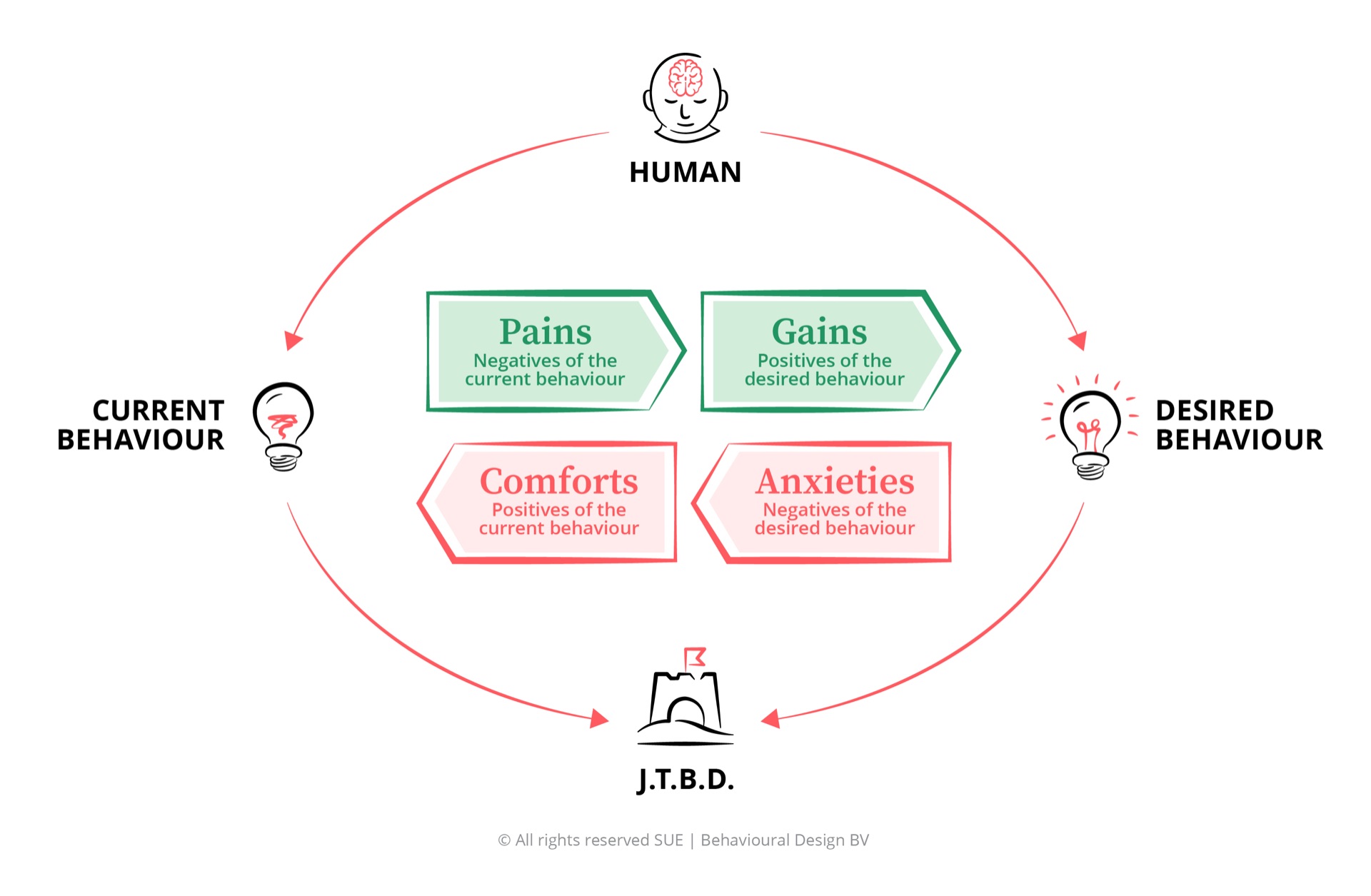
The pains of staying are usually small and repeated: the login that fails once a month, the invoice that arrives in a format nobody can process, the renewal that always needs a phone call. Individually trivial. Cumulatively decisive.
The gains of leaving are visible and easy to imagine, because your competitor has spent money making them so. A lower price, a cleaner app, a promise of better service.
The anxieties about leaving are your most underused asset, and the most abused one. Will the migration go wrong? Will I lose my history? Honest reassurance about continuity is legitimate design. Manufacturing exit obstacles is not, and we will come back to that line.
The comforts of the current arrangement are what actually retain most customers: habit, a saved payment method, a familiar interface, knowing who to call. Retention strategy is largely the work of protecting these and stripping out the pains that erode them.
Five customer retention strategies grounded in behaviour
Each of these changes the context rather than the customer's feelings about you.
1. Audit for effort, not for satisfaction
Walk your own recurring journeys as a customer would: changing an address, cancelling one item from an order, getting a duplicate invoice. Count the steps, the handovers and the times the customer has to repeat information they already gave you. Then remove the worst one. Richard Thaler named this class of unnecessary friction sludge in 2018, and the point of naming it was that most of it was never a decision, it just accumulated.[8]
2. Design the ending of every interaction on purpose
Given Fredrickson and Kahneman's finding, the last sixty seconds of an interaction carry disproportionate weight in what the customer remembers, and therefore in what they tell others and whether they come back. Most organisations leave this to a template. Decide instead what the final moment should be after a complaint, after a delivery, after a renewal. A human sentence confirming the problem is closed beats a case-number confirmation, and it costs nothing.
3. Make continuation the default, and make leaving honest
Eric Johnson and Daniel Goldstein demonstrated in 2003 how enormous the effect of a default can be, comparing organ donor registration rates between countries with opt-in and opt-out systems.[9] Defaults do the heavy lifting in retention too: automatic renewal, saved preferences, a subscription that continues without an act of will.
The ethical line sits right here. A default that spares the customer a pointless decision is good design. A cancellation process that requires a phone call during office hours is sludge dressed up as retention, and it converts a departing customer into someone who warns their colleagues about you. Make leaving as easy as joining, and earn the stay on the other side of the ledger.
4. Build in effort where it creates ownership
Not all effort is a cost. Michael Norton, Daniel Mochon and Dan Ariely showed in 2012 that people place a higher value on things they helped to build, an effect they named after a certain flat-pack furniture retailer.[10] Configuring a dashboard, setting up preferences, uploading a history: this kind of invested effort raises perceived value and makes switching feel like abandoning something you made. Remove effort from tasks the customer did not choose. Preserve it where the customer is building something of their own.
5. Intervene on behaviour, not on the calendar
Most win-back activity is triggered by dates: the renewal window, the quarterly campaign. But customers leave gradually, and the behavioural signals show up long before the cancellation does. Declining logins, a support ticket that took three contacts, a skipped delivery. Those are the moments to act, and by the renewal date the decision has usually already been made in private.
How to know whether it is working
Measure what customers do, not what they say. Repeat usage by cohort. The number of steps in your five most common tasks. Time to first resolution. The proportion of issues closed in a single contact. Cancellation rates split by tenure.
Satisfaction scores are not useless, but they are a lagging and forgiving indicator. People report being satisfied and leave anyway, which is precisely the phenomenon that makes retention interesting. Counting actions gives you a signal weeks earlier than asking for opinions does. That principle underpins our approach to customer research that works.
Frequently asked questions about customer retention strategies
What are the most effective customer retention strategies?
The evidence favours effort reduction over reward. Dixon, Toman and DeLisi found that customers who had to work hard to get an issue resolved became markedly more disloyal, while service that felt effortless protected loyalty far better than attempts to delight. Practical strategies follow from that: remove steps in recurring tasks, resolve issues in one contact, design the end of every interaction deliberately, and make continuation the default rather than a decision.
Why do loyalty programmes fail to retain customers?
Loyalty programmes address the wrong system of thinking. A points scheme invites a customer to calculate whether staying is worth it, and any calculation can be beaten by a competitor with a better offer. Retention that lasts comes from the automatic side of behaviour: habit, low effort, familiar defaults and positive memory. A programme that only rewards purchases does not change any of those.
How does loss aversion affect customer retention?
Kahneman and Tversky showed in 1979 that losses weigh more heavily than equivalent gains. For retention this cuts both ways. It explains why customers cling to an existing provider, because switching feels like giving something up, and it explains why a single negative experience, such as a price rise or a failed delivery, can outweigh months of quiet satisfaction and trigger a departure.
How do you measure whether a retention strategy works?
Measure behaviour, not sentiment. Track repeat usage, time to resolve an issue, the number of steps in recurring tasks, and cancellation rates by cohort. Satisfaction scores are lagging and unreliable predictors: customers who say they are satisfied still leave. Counting actions gives you an earlier and more honest signal than asking for opinions.
Conclusion
The retention strategies that survive contact with real customers have one thing in common. They do not ask people to feel differently about the brand. They change what the brand asks of people: fewer steps, better endings, defaults that do not require a decision, and effort spent only where it builds something the customer owns.
So before the next loyalty programme goes into development, try the cheaper diagnostic. Cancel your own subscription. Request your own invoice. Call your own support line. Whatever made you sigh is your retention strategy, and it is already running.
Want to design this properly? The online Deep Dive Designing the 9+ Customer Experience teaches you to find the friction and the decisive moments in your customer journey, and to redesign them.