Picture this: you present two training packages to leadership. Package A is basic and cheap. Package B is comprehensive and expensive. Nobody picks B. The price gap feels too large, the added value too abstract. Management chooses A, or decides to do nothing at all.
Now you add Package C: almost as comprehensive as B, but barely cheaper. Suddenly 70 percent choose B. After all, Package B is far more complete than C, while the price difference is minimal. Compared to C, B looks like a bargain.
You did not change Package B. You changed the comparison. This is the decoy effect at work.
The decoy effect (also known as the asymmetric dominance effect) describes how adding a strategically inferior third option significantly changes preference between the original two. The third option is not meant to be chosen. It is meant to reframe the comparison. Behavioural economist Dan Ariely popularised the effect and showed that people never choose in absolute terms, always in relative ones. The decoy effect sits within the Gains dimension of the SUE Influence Framework: you design the choice architecture so that the desired option has the greatest pull.
What is the decoy effect?
Joel Huber, John Payne, and Christopher Puto described the effect in 1982 in the Journal of Consumer Research under the name "asymmetric dominance effect."[1] Their finding was striking: adding a third option that performs worse than one of the two originals on every dimension changes which of those two originals people prefer. This violates a foundational assumption of classical economics: that the preference between two options should not depend on irrelevant third alternatives.
Dan Ariely brought it to a wide audience through his experiment with The Economist in his book Predictably Irrational.[2] The Economist offered three subscription options: digital only for $59, print only for $125, or print plus digital for $125. The print-only option, costing the same as the combo, was the decoy. Nobody chooses print alone when you can get digital included for the same price. But that option made the combo suddenly compelling: you get twice as much for the same money. Without the decoy, 68 percent chose the cheap digital version. With the decoy, 84 percent chose the expensive combo.
The mechanics are System 1 in action. Our brains are poor at assessing absolute value. They are excellent at assessing relative value. Give the brain a context, and it uses that context as a reference point. The decoy provides exactly that context: an inferior neighbour that makes the preferred option shine by contrast.
At work, the decoy effect operates on three levels: how products and services are priced, how proposals are presented to decision-makers, and how choices are designed in HR and compensation.
You never choose in a vacuum. You always choose in comparison. And whoever designs the comparison designs the outcome.
Three scenarios where the decoy effect works
SaaS pricing pages: the “popular” middle tier
Go to the pricing page of almost any SaaS company and you see the same pattern: three tiers. Basic, Pro, Enterprise. The middle tier has a label you do not see on the other two: "Most popular" or "Best value." That label is sometimes based on real data. More often it is a self-fulfilling prophecy, born of choice architecture.
The Enterprise tier is the decoy. It does not exist primarily to serve Enterprise customers. It exists to make the Pro tier more attractive. Compared to the high price and complexity of Enterprise, Pro feels like the sensible middle ground: powerful enough, but without overkill. Basic is too limited, Enterprise too much. Pro is the Goldilocks option, and the architecture is designed to make it look that way.
This is not cynicism. It is good product design. If Pro genuinely offers the most value for most customers, then a choice architecture that leads people to Pro is also honest. The problem arises when the architecture steers people toward options that are good for you but not for them. At that point the decoy crosses into manipulation.
What this means for product managers and marketers: the order, labels, and relative pricing of your tiers are not a detail. They are the product. The decision a customer makes is largely determined by how the options sit next to each other, not by the content of each option in isolation.
Internal proposals: three budget scenarios steer the decision
You have a proposal you want to put to the board. You have a clear preference: the middle scenario. Not the smallest, because that is insufficient. Not the largest, because that will never be approved. The middle one is realistic, ambitious enough, and executable.
The classic mistake: you present only that one scenario. You explain why it is the right choice. You back it with data. And then a board member asks: "Were alternatives considered?" Silence. Defensiveness. The proposal goes onto the pile for reconsideration.
The better approach uses the decoy effect deliberately. Present three scenarios. Scenario Small: minimal investment, limited impact, low risk but also low return. Scenario Large: maximum ambition, high investment, high potential but also high execution pressure. Scenario Medium: your recommendation, which in comparison with Small is ambitious enough and in comparison with Large is manageable.
You have not changed the content of your recommendation at all. You have designed the comparison. Leadership feels it is making a considered decision, because alternatives exist. In reality, the architecture of the three options is guiding them toward exactly the conclusion you already had.
This is not deception. All three options must be honest and executable. But if you know your preferred choice is the strongest, designing a choice set that makes that visible is a skill, not a trick.
Compensation packages: the decoy in HR
A recruiter offers a candidate two packages: Package A with a higher base salary but less flexibility, Package B with a slightly lower salary but more holiday days and remote working options. The candidate hesitates. The comparison is difficult because the dimensions differ.
Now the recruiter adds Package C: similar to Package B on flexibility, but with an even lower base salary. Suddenly Package B looks far more attractive: almost as flexible as C but with significantly more salary. The hesitation disappears. B becomes the obvious choice.
This works in reverse as well. If the organisation wants the candidate to choose the higher salary (Package A), you add a Package C that offers slightly less salary than A but also less flexibility. A becomes the dominant option: more salary, comparable flexibility to C.
In both cases the architecture is the intervention. The candidate believes they are making an autonomous choice. In reality their choice is largely determined by the structure of the choice set. This is why HR professionals and recruiters should understand the decoy effect, both to deploy it consciously and to recognise when it is being applied to them.
The Influence Framework: decoy effect as a Gains intervention
Within the SUE Influence Framework, the decoy effect falls primarily under the Gains dimension: the forces that pull people toward a specific behaviour or choice. The effect works by making the desired option relatively more attractive, not by changing the option itself.
But the full picture is more nuanced. When you apply the Influence Framework to choice design, you see all four forces at work:
Pains (what pushes people away from their current situation): the burden of a difficult choice between two options that are not easy to compare. When two options are better on different dimensions, the comparison is cognitively demanding. The decoy resolves this by adding a clearly inferior option that shifts the reference point for comparison.
Gains (what pulls people toward the desired choice): the decoy makes the preferred option visibly better by comparison. It wins on the dimensions that matter most while only marginally losing on others. Relative value becomes clear.
Comforts (what keeps people in their current behaviour): indecision when choices feel equally matched. When two options seem equivalent, doing nothing or delaying is the default. The decoy breaks that comfort of postponement by simplifying the choice.
Anxieties (what stops people from choosing): the fear of making the wrong decision. By adding a clearly inferior option, the fear of regret diminishes. The preferred choice feels objectively better, not just subjectively better.
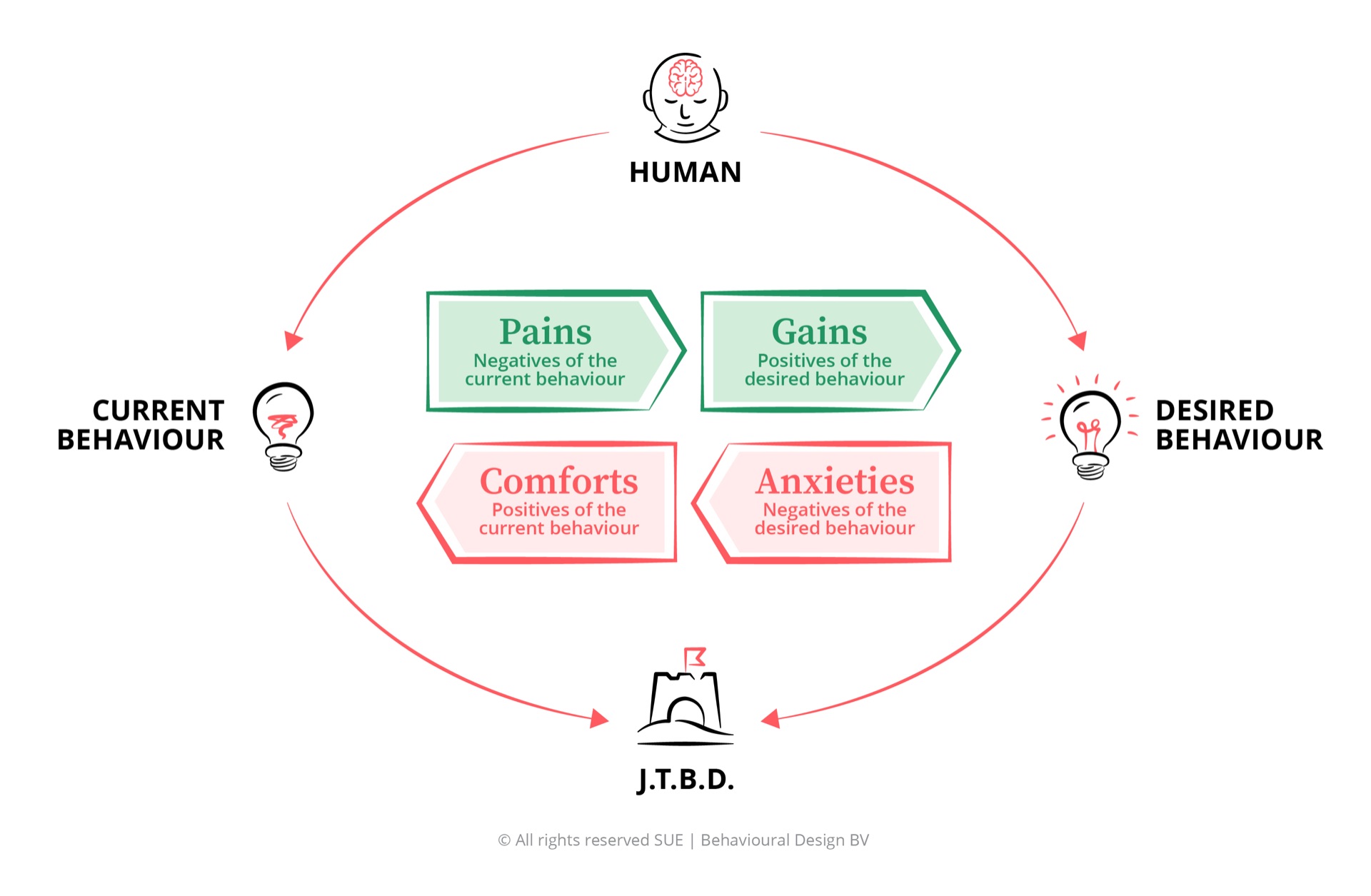
The decoy effect is therefore one of the purest examples of choice architecture as behavioural design: you change the environment, not the person. You do not need to persuade anyone. You do not need to inform anyone. You design the context in which the choice is made.
Five interventions for the workplace
1. Always design three-option architectures for preference decisions. If you want to guide people toward a specific choice, never present that choice alone. Build a choice set of three. Make sure your preferred option sits in the middle and that the third option scores slightly worse on the dimensions that matter most. This applies to pricing pages, proposals, budget scenarios, and internal recommendations.
2. Use decoys ethically in proposals. A decoy is ethical when all three options are honestly described and the preferred choice genuinely is the best one for the decision-maker. A decoy is not ethical when it is designed to lead people toward an option that is worse for them but better for you. The test: could you explain the architecture to the decision-maker without feeling embarrassed?
3. Structure the choice set to make the preferred option shine through contrast. The decoy must be inferior to the preferred option on the dimensions the decision-maker weights most heavily. If price is the key factor, the decoy should cost almost as much but offer less value. If quality matters more, the decoy should be almost as good but clearly more expensive.
4. Test your option sets before presenting them. Ask a colleague who does not know the content to evaluate the choice set. Which option would they choose? Why? If their reasoning follows exactly the pattern you expected, your architecture is working. If they hesitate or choose an unexpected option, revise the proportions.
5. Know the ethical limits. The decoy effect is one of the most powerful nudges available. Precisely for that reason, the ethical limits are sharp. Nudging becomes manipulation when the choice architecture leads people toward options that are good for you but not for them. In Behavioural Design we distinguish autonomy-preserving nudges (which make choices easier) from manipulative nudges (which control choices). The decoy effect sits at the boundary. Use it with responsibility.
Related biases
The decoy effect does not operate in isolation. It reinforces and is reinforced by other cognitive patterns in the workplace.
Anchoring bias is the closest relative: the first number or option you see serves as a reference point for all subsequent judgements. The decoy effect adds a dimension to this by using a specific third option as a relative reference point rather than an absolute anchor.
The framing effect describes how the way you present information influences judgement, independent of the content. The decoy effect is a specific form of framing: you frame the preferred option as the winner by placing it next to an inferior competitor.
The scarcity principle works well alongside the decoy effect in choice architecture: if the preferred option is also scarce or limited in availability, that amplifies the urgency to choose before the opportunity is lost.
Loss aversion is the underlying force that makes the decoy effect especially powerful: the inferior third option represents what you miss out on if you do not take the preferred choice. You can see the loss concretely, which increases the pull of the preferred option.
Frequently asked questions
What is a concrete example of the decoy effect at work?
A classic workplace example is the three-tier SaaS pricing model. Companies deliberately place an expensive third option next to the middle tier to position that middle option as the sensible choice. The same principle applies to internal budget proposals: present three scenarios and decision-makers almost always choose the middle one. Not because it is objectively the best, but because in comparison it seems the most reasonable.
How does the decoy effect differ from anchoring?
Anchoring is about the first number you encounter: that anchor influences all subsequent judgements. The decoy effect is about the structure of a choice set: an inferior third option changes the relative attractiveness of the other two. Anchoring works through a starting point; the decoy effect works through contrast within a comparison.
Is the decoy effect manipulation?
That depends on intent and the honesty of the options. If you use a decoy to guide people toward an option that genuinely is better for them, it is a legitimate design tool. If you use a decoy to lead people toward an option that is worse for them but better for you, it is manipulation. The line lies in whether all options are honestly described and whether the preferred choice actually delivers value.
Can you recognise the decoy effect in your own decisions?
Yes, but it is difficult. Ask yourself with any choice set: would I have the same preference if I could only see the original two options? If the presence of a third option has changed your choice, it is worth investigating whether that third option exists solely to colour your comparison.
Does the decoy effect work in internal decision-making?
Yes, and this is where it is most powerful. When leadership needs to approve a budget proposal, the structure of your options largely determines which one they choose. Present three budget scenarios with your recommendation in the middle, and the chances are high that they choose that middle option - not because they have weighed all trade-offs, but because in comparison it appears the most reasonable.
Conclusion
The decoy effect is one of the most direct lessons from behavioural science for anyone who designs or influences decisions. Whether you are building a pricing page, writing a proposal, or structuring an offer: the options you place next to your preferred choice largely determine how that choice is experienced.
Want to learn how to apply this systematically in your work? In the Behavioural Design Fundamentals Course you learn to apply the Influence Framework and the SWAC Tool to analyse and design choice environments. Rated 9.7 out of 10 by over 10,000 alumni from 45 countries.
PS
At SUE, our mission is to deploy the superpower of behavioural psychology to help people make positive choices. The decoy effect shows that freedom of choice is not only about offering options. It is about how those options stand next to each other. Understanding this means you design decisions. Not understanding it means you are instructed by them without knowing it. The knowledge is not in the technique. It is in the realisation that every choice set is a design, whether intentional or not.