Engaging employees in change does not work through workshops and participation sessions. Genuine engagement is behavioural: it arises when people carry concrete ownership over a piece of the outcome, not when they have been invited to share their opinion on a decision that has already been made. The behavioural science approach focuses on designing ownership: early co-diagnosis, visible contributions, and direct responsibility for results.
The agenda for the meeting was clear: management would present the new organisational structure, employees would have the opportunity to ask questions, and then working groups would be set up to shape the implementation. By the end of the morning, the facilitators gauged the mood. Positive, broad understanding of the necessity, willingness to cooperate.
Six months later, the working groups had gone silent. Implementation deadlines had been pushed back. And in the corridors, you heard the stories you always hear: "This was just imposed on us", "We were allowed to participate but not really contribute", "It had already been decided."
This is not an exception. This is the pattern. And it has everything to do with the difference between two things we consistently conflate: engagement and ownership.
People who have co-built a solution execute that solution differently from people who were presented with it. That is not a motivation difference. That is behavioural psychology.
Engagement is not the same as ownership
Engagement is passive. You have been informed. You have been allowed to give input. You were present at the presentation. Ownership is active: you are responsible for a piece of the outcome. Not for executing a step-by-step plan devised by others, but for achieving a concrete result where you determine the approach yourself.
Most change initiatives produce engagement. They simulate participation. They organise sessions, listen to feedback, adjust a few things here and there. But the core of the decision is fixed. The direction is fixed. The solution is fixed. People are asked to think along about the implementation of something that has already been decided.
People see through this. Almost always. The result is not resistance per se, but a subtle withdrawal. They participate. They deliver. But they do not carry the change. They execute it.
That difference is everything. A change that is executed by people collapses the moment external pressure disappears. A change that is carried by people endures, even when the project manager has moved on to the next initiative.
The IKEA effect: why co-creation works
Behavioural economists Michael Norton, Daniel Mochon, and Dan Ariely conducted a simple experiment. They asked two groups of people to evaluate the same IKEA furniture: one group had assembled it themselves, the other group received it ready-made. The self-assemblers valued the furniture significantly higher, even though it was objectively identical to the ready-made version.[1]
They call this the IKEA effect. The principle: people value outcomes more the more they have personally contributed to them. And this applies not only to furniture. It applies to strategic plans, new work processes, and organisational structures.
A team that has co-built the analysis of the problem, that has identified the three key moments where behaviour needs to change, that has co-designed the interventions: that team executes the change fundamentally differently from a team that was presented with the same change in a PowerPoint.
The change has not become better. The engagement has.
Five behavioural principles for genuine engagement
How do you design ownership instead of compliance? Five principles that behavioural science confirms time and again.
1. Involve people in diagnosing the problem, not in approving the solution
The moment at which you involve people determines the type of engagement you get. Most organisations involve employees when the solution is already finished. This produces engagement with the form, not the substance. The sense of ownership is minimal.
Involve people in the diagnostic phase. Do not ask them "what do you think of this new approach?" but "in which three situations in your daily work does things currently go wrong?" That input is more concrete, more honest, and it gives people the feeling that they co-defined the problem. Whoever has defined the problem feels co-responsible for the solution.
2. Give people a concrete role in execution, not an advisory role in preparation
Working groups and sounding boards rarely produce ownership. They produce recommendations. Recommendations that may or may not be adopted. If they are not adopted, the effect on engagement is negative: people have invested time and their contribution does not count.
Ownership works differently. Give small teams concrete responsibility for a measurable part of the change. Not "think along about the communication strategy" but "you are responsible for adoption in your own department in the first three months, with concrete target X." That is not an advisory role. That is execution responsibility. And that creates entirely different behavioural dynamics.
3. Make contributions visible and traceable
One of the most powerful behavioural principles is that people attach more value to their own contribution when that contribution is visible and traceable. An idea that is raised in a working group and then disappears into a report does not create ownership. An idea that is implemented and where it is visibly clear that it came from your team works entirely differently.
This sounds simple. It requires deliberate design. Track which input from which team was adopted. Communicate this concretely. Not in general terms about "valuable input", but specifically: the decision to start the onboarding process with a peer introduction instead of a management briefing was a proposal from the customer service team. That kind of visibility builds ownership.
4. Use psychological safety as infrastructure
Google’s Project Aristotle studied one hundred teams to understand what distinguishes high-performing teams from others.[2] The outcome was surprising: the determining factor was not talent, not diversity, not team size. It was psychological safety: the shared belief that you can flag mistakes, ask questions, and express dissenting opinions without social consequences.
Psychological safety is not only relevant for innovation. It is also the infrastructure for genuine engagement in change. In environments without psychological safety, people say in participation sessions what they think is expected. They do not raise genuine objections. They do not flag genuine risks. You get agreement without ownership.
Building psychological safety takes time and consistent leadership. But it is the only environment where genuine co-creation can take place.
5. Link the new behaviour to something that already exists
Behaviour change sticks best when new behaviour is linked to existing routines. James Clear calls this habit stacking.[3] For employee engagement, this means: link the new responsibility to an existing moment in the working week. Not "whenever you have time, log your findings in the system" but "at the start of the Thursday stand-up, you discuss one finding from the new system."
That new behaviour then has a fixed trigger: the existing routine. It requires less conscious choice. It is easier to sustain. And it becomes embedded in the social context of the team, which pushes the social norm in the desired direction.
The Anxieties that block engagement
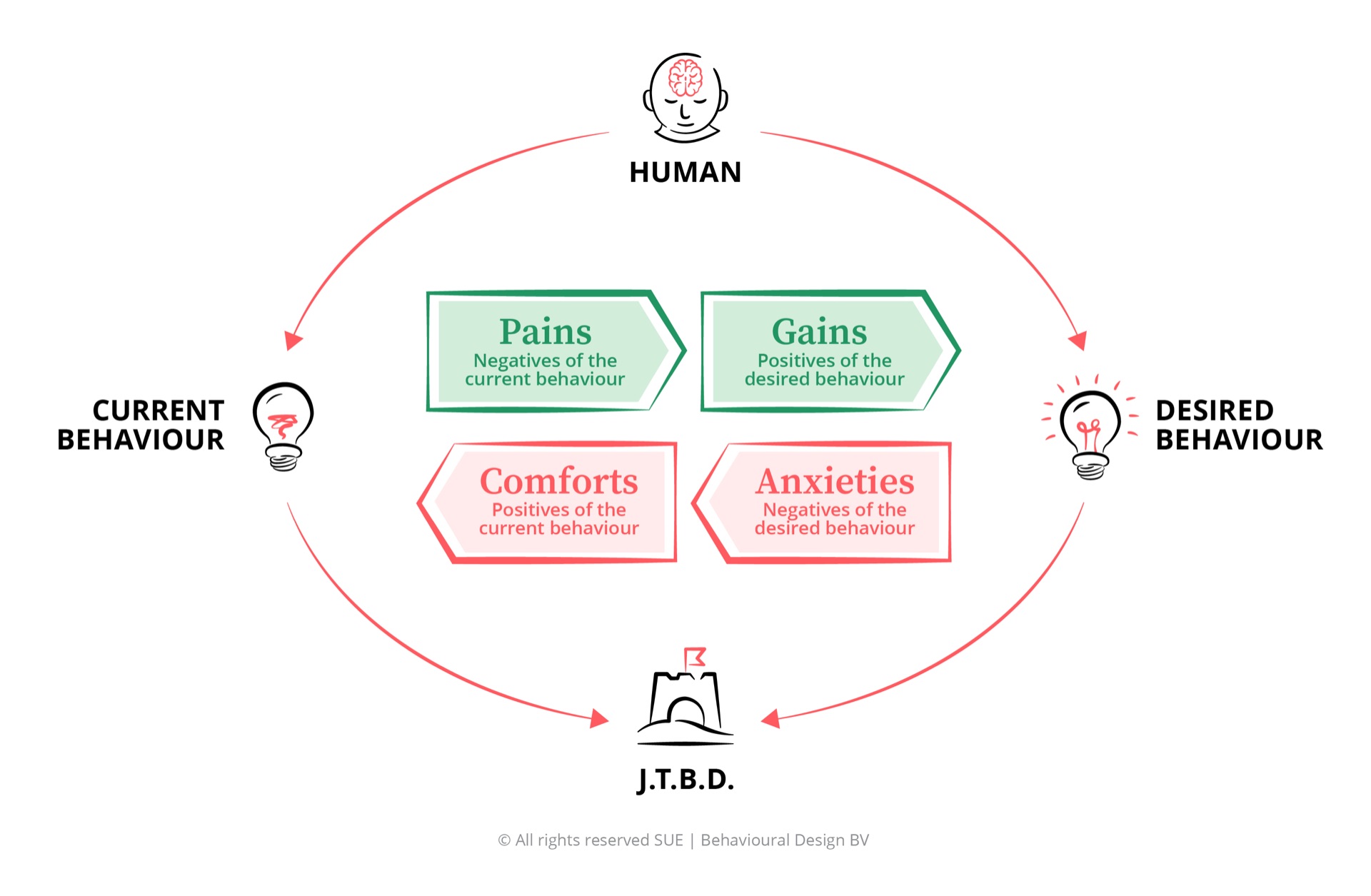
Engaging employees in change often fails not through lack of will, but through specific fears that make ownership feel threatening. The SUE Influence Framework© calls these Anxieties: the blocking forces that prevent people from adopting the new behaviour, even when they understand its benefits.
Three Anxieties are most dominant in engagement. Fear of failure: if I accept responsibility for this result and it goes wrong, what are the consequences? Status anxiety: taking ownership means becoming visible, and becoming visible in change also means visibly failing if things go wrong. And time anxiety: engagement costs time that I do not have alongside my regular work, and that time is not explicitly given to me.
All three are environmental problems, not attitude problems. Fear of failure is addressed by building the psychological safety that normalises learning from failure. Status anxiety is addressed by placing ownership at the team level, not the individual level. Time anxiety is addressed by explicitly scheduling engagement as a work activity, not as an afterthought alongside the real work.
Where to start tomorrow
Take the change initiative you currently have in front of you. Step back one level from the implementation approach and ask three questions. At what point in the process are employees first involved, and has the direction already been set by then? Have the people involved been given an advisory or an executive role? And is their contribution visible and traceable in the outcomes?
If the answer to all three is unfavourable, you do not have a communication problem. You have a design problem. And that is good news, because design can be changed.
More on the structural causes of why change initiatives miss the behavioural layer can be found in the article why change initiatives fail. The analysis of resistance to change goes deeper into the psychological mechanisms behind relapse.
Frequently asked questions
How do you engage employees in change?
Engaging employees in change does not work through a participation session or a workshop. It works by designing ownership at three levels: involve people early in diagnosing the problem, give them a concrete role in executing the change, and make their contribution visible in the results. Ownership is a behavioural phenomenon, not an attitude.
Why do employees not feel engaged in change?
Employees do not feel engaged because most change initiatives simulate participation rather than genuinely enabling it. The decision has already been made. The solution has already been worked out. The sessions are intended to build understanding and reduce resistance, not to influence the direction. People see through this. The result is compliance, not ownership.
What is the IKEA effect in change initiatives?
The IKEA effect is the behavioural psychology phenomenon whereby people value outcomes more the more they have personally contributed to them. Norton, Mochon, and Ariely demonstrated that people valued self-assembled furniture significantly higher than identical ready-made versions. In change initiatives: teams that have co-built the solution execute that solution significantly more actively than teams that were presented with the ready-made solution.
How do you prevent engagement in change from remaining superficial?
Superficial engagement arises when participation takes place regarding the form of the change while the substance has already been decided. Genuine engagement arises when people have influence over what changes, not only over how it is implemented. Involve employees in identifying the key moments in their work process where the new behaviour will encounter the most resistance, and let them co-redesign those moments.
What is the difference between engagement and ownership in change?
Engagement is passive: you have been informed, you may ask questions, you have given input. Ownership is active: you are responsible for a piece of the outcome. In practice, ownership means that individual employees or small teams carry concrete, measurable responsibility for an aspect of the change - not for executing a step-by-step plan, but for achieving a result.
PS
The word "engagement" is one of the most used and least understood terms in change management. Everyone wants it. Few know how to design it. At SUE, we believe that engagement is not something you ask of employees. It is something you build into the structure of the initiative itself: in the moment of first involvement, in the nature of the role, in the visibility of the contribution. That is not a soft skill. That is Behavioural Design.