Imagine two managers presenting the same quarterly results to the board. The first says: “We achieved 73% of our target.” The second says: “We missed 27% of our target.” Same data. Same reality. But the emotional response in the boardroom is completely different. The first manager gets nods. The second gets questions, frowns, worried glances.
This is the framing effect at work. And it is one of the most powerful - and most underestimated - psychological mechanisms that determine how people respond to your messages, proposals and decisions.
The framing effect is the tendency of people to evaluate the same information differently and make different decisions based on how that information is presented. A gain frame highlights what you win; a loss frame highlights what you lose. Same data, completely different behaviour. In the SUE Influence Framework, framing is the lever that determines whether you activate your audience’s Gains or their Pains.
What is the framing effect?
In 1981, Amos Tversky and Daniel Kahneman published one of the most cited experiments in behavioural science: the Asian Disease Problem.[1] Participants were given a scenario: an epidemic threatens to kill 600 people. They had to choose between two programmes.
Group A was given the choice framed as follows: Programme A will certainly save 200 people. Programme B offers a one-third chance that all 600 people will be saved and a two-thirds chance that nobody will be saved. The majority chose the certain Programme A.
Group B was given exactly the same programmes, but framed differently: Programme A: 400 people will certainly die. Programme B: a one-third chance that nobody dies, a two-thirds chance that all 600 people die. The majority now chose the risky Programme B.
The outcomes were mathematically identical. But the first frame activated gain-thinking, the second loss-thinking. And that changed everything.
This is the framing effect: a System 1 process that operates entirely outside your conscious awareness. Your brain does not respond to the facts themselves, but to the emotional charge of the frame within which those facts are presented. Tversky and Kahneman identified three types of framing that are most relevant in the workplace.
Gain framing emphasises positive outcomes: what you win, achieve or obtain. “This system increases your productivity by 20%.”
Loss framing emphasises negative outcomes: what you lose, miss or risk through inaction. “Without this system you miss out on 20% productivity.”
Attribute framing concerns how you describe the characteristics of a product, situation or person. “95% fat-free” versus “5% fat”. The same yoghurt, but the evaluation differs significantly.
Facts don’t exist. Only frames. And the frame you choose determines the behaviour you get.
Three scenarios where framing changes everything
Scenario 1: The hot-desking announcement that lost half the organisation
A large consultancy decides to switch to flexible working. No more fixed desks - shared spaces that you book daily. The change manager is asked to communicate this internally. She writes two drafts.
Draft A reads: “With our new workplace concept, you get the freedom to choose where you work. In our office, at home, or on the go. Your working day becomes more flexible and you always have access to modern, inspiring workspaces.”
Draft B reads: “As of 1 April, your fixed desk will no longer be available. You will book a desk each day via our app.”
Both drafts describe exactly the same new reality. But Draft A activates the Gains: freedom, flexibility, modernity. Draft B activates the Pains: loss of familiarity, extra actions, uncertainty. The employees who received Draft B responded with resistance. Not because the change was worse. But because the frame made them focus on what they were losing: their fixed spot, their familiar routine, the feeling of ownership over a piece of the office.
This is change management in essence. The content of the change is rarely the problem. The frame in which you announce it determines whether people feel threatened or liberated.
Scenario 2: 95% fat-free and what it teaches you about internal reporting
In 1988, Irwin Levin and Gary Gaeth showed that the same product is evaluated significantly differently depending on how it is described.[2] Hamburgers described as “75% lean” scored better than hamburgers described as “25% fat”. Identical meat. Completely different evaluation.
You recognise this immediately in marketing. Apple never presents its products in terms of what they cannot do. A keynote is about what becomes possible, not about what disappears. Flixbus does not sell “cheap buses without luxury” but “travel smarter for less”. The frame determines the perception of value.
But the lesson reaches further than marketing. Look at how your organisation reports internally. A quarterly report that opens with “We were 12% below target” triggers immediate defensive behaviour. That same report opening with “We delivered 88% of our target, placing us in the top tier of our sector” - and only then addressing the shortfall - creates a completely different conversational space.
This is not spin. It is a deliberate choice about which emotional context you create for the facts you want to share. The facts do not change. The reception does.
Scenario 3: The same risk data, two completely different budget decisions
An IT director needs to convince the board to invest in cybersecurity. She can frame this in two ways.
Frame A: “With this investment of 400,000 euros we build a robust security infrastructure that enables us to launch new services safely and structurally strengthen customer trust.”
Frame B: “Without this investment we face an estimated risk of 2.4 million euros in damage from a data breach, on top of reputational damage and fines under GDPR legislation.”
Both frames describe the same reality. But Frame A activates opportunity-thinking: growth, trust, new possibilities. Frame B activates loss aversion: damage, reputational loss, legal consequences. In most boards, Frame B leads to a faster and larger budget decision. Not because it is more honest, but because loss weighs more heavily than gain.
This is the core of what behavioural economists call loss aversion: people are willing to do more to prevent something than to achieve something. Kahneman and Tversky estimated that losses weigh psychologically roughly twice as heavily as equivalent gains. If you want a board to quickly approve a large budget, do not give them a growth story. Give them a loss scenario.
Why framing activates both Gains and Pains
Within the SUE Influence Framework, Gains and Pains are the two primary drivers of human behaviour. Gains pull people towards new behaviour: the benefits, the improvements, the exciting possibilities. Pains push people away from their current situation: the problems, the frustrations, the costs of staying still.
Framing is the lever that determines which of these two forces you activate. And that is what makes it so powerful, because you are working with exactly the same factual material. You add nothing and take nothing away. You only choose which lens you give your audience.
But the Influence Framework makes something else visible too: framing works best when you know what is already alive in your audience. If your employees are primarily experiencing Anxieties about the change - fear of losing status, routines, familiarity - then a purely gain frame does not help. It feels hollow or even unconvincing. You first need to acknowledge the Pains, address the Anxieties, and then introduce the Gains. Framing is not a trick you paste onto a message. It is a strategic choice that flows from a deep understanding of what is happening for your audience.
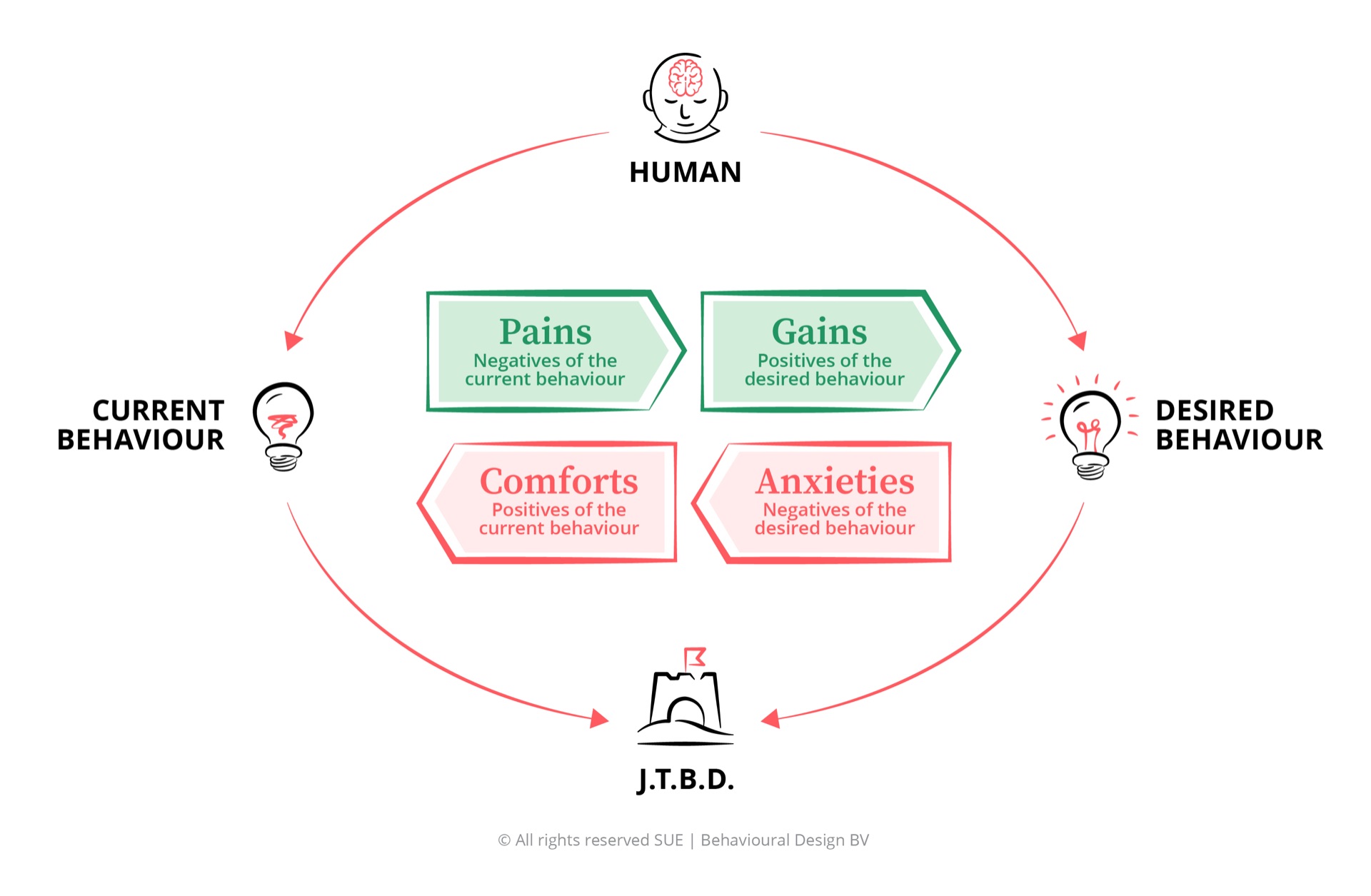
Loss framing works strongest for urgency: when you want to move people who are comfortably standing still. Gain framing works strongest for motivation: when you want to accelerate and enthuse people who are already moving. The combination is most powerful: first acknowledge the loss that inaction brings, then introduce the gain that change delivers.
Five interventions to use framing deliberately
1. Always present both frames, but choose your opening deliberately. When you make a proposal, know which frame you are activating. Write two versions of your key message consciously: one in gain framing, one in loss framing. Then choose deliberately based on what your audience needs. Comfortably standing still? Start with the loss. Already motivated? Start with the gain.
2. Reframe resistance as information about the frame, not the content. When people show resistance to a proposal that is substantively sound, the first question is: which frame have I activated? Resistance is almost always a signal that the frame does not connect with what is alive in your audience - not that the content is wrong. Adjust the frame before you defend the content.
3. Test your message frames internally. Before you send a major communication out into the world, test two versions on a small group. Not on content, but on emotional response. Which frame generates the desired reaction? A/B testing is not only for marketing emails. It is for every important internal or external communication moment.
4. Use loss framing for urgency, gain framing for motivation. This is the rule of thumb you can apply almost everywhere. Do you want to move people who are standing still? “Every month we wait costs us X.” Do you want to enthuse and accelerate people who are already moving? “At this pace we reach Y ahead of schedule.” The audience determines the frame, not your preference.
5. Establish framing guidelines for internal communication. Most organisations have style guides for visual communication but no deliberate policy on language frames. Decide as a team which frames are consistent with your culture and values. Does your organisation communicate from trust and growth, or from fear and loss? And check whether your internal communication actually uses that frame.
Related biases
The framing effect rarely operates in isolation. In the workplace, it reinforces and interweaves with other cognitive biases that influence your decision-making.
Loss aversion is the psychological engine behind loss framing: the reason a loss frame is so powerful is that people weigh losses disproportionately heavily. Loss framing works because loss aversion works.
Anchoring bias determines the reference point of your frame. If you start with a high number, everything that follows seems relatively low. Framing and anchoring work together in negotiations, pricing and salary discussions.
Confirmation bias amplifies the effect of framing: once in a frame, people interpret new information through the lens of that frame. A gain frame makes people more sensitive to positive signals; a loss frame makes them more sensitive to risks and threats.
The decoy effect is framing at the level of choice: by adding a third, inferior option, you frame the two main options relative to each other. The context of the choice determines which option appears attractive.
Frequently asked questions
What is a concrete example of the framing effect at work?
A classic: a manager announces that a new system “eliminates 95% of errors”. Another manager announces the same system as “a 5% error rate remains”. Identical reality, but the second frame triggers unease and resistance. You see this at work in every change initiative, every risk report and every salary negotiation.
What is the difference between gain framing and loss framing?
Gain framing highlights what you gain from a particular choice: more flexibility, higher returns, new possibilities. Loss framing highlights what you lose from inaction or a different choice: missed revenue, lost certainty, increased risk. Both are equally factual, but loss framing typically has a stronger behavioural impact due to loss aversion: people weigh losses more heavily than equivalent gains.
How do you deliberately use the framing effect in communication?
Start by asking what you want to achieve. Do you want to create urgency? Use loss framing: what is at stake if nothing changes? Do you want to motivate and generate energy? Use gain framing: what becomes possible if people embrace this? Always test both versions - A/B-test your messages internally and externally. And establish framing guidelines for consistent communication across your organisation.
Is the framing effect manipulation?
Framing is unavoidable: every message has a frame, even if you do not choose it consciously. The question is not whether you frame, but whether you do so honestly and in the interests of your audience. Using framing deliberately to help people make better decisions - like a doctor who presents a treatment as “90% survival rate” rather than “10% mortality rate” - is responsible behavioural science.
How does the framing effect relate to loss aversion?
Loss aversion is the underlying psychological driver: people experience losses as roughly twice as painful as equivalent gains are pleasurable. The framing effect is the mechanism through which loss aversion exerts its influence: by presenting information in a loss frame, you activate the emotional response to loss, even if nothing is objectively being lost.
Conclusion
The framing effect teaches you something fundamental about communication: you cannot not frame. Every message you send has a frame - consciously or unconsciously. The only question is whether you choose that frame strategically based on what your audience needs, or whether you leave it to chance.
Want to learn how to use the framing effect and other behavioural insights deliberately in your communication, strategy and leadership? In the Behavioural Design Fundamentals Course you learn to apply the SUE Influence Framework to understand the drivers of your audience and design messages that genuinely land. Rated 9.7 by 5,000+ alumni from 45 countries.
PS
At SUE our mission is to harness the superpower of behavioural psychology to help people make positive choices. The framing effect shows that reality does not consist of facts, but of perspectives on facts. That is not a cynical insight. It is an invitation to take responsibility: once you know that every frame is a choice, you can no longer choose unconsciously. The only remaining question is: which frame serves your audience best?