In 2017, the US state of Oregon decided to tackle a problem that information campaigns had never solved: thousands of eligible residents were not accessing the benefits they were entitled to, not because they did not want them, but because the application process was so complex that most people gave up before completing it. The unemployment benefit application required 47 pages of forms. The food stamps application required proof of income from up to three sources, a home visit, and documentation that most people do not keep readily available.
Oregon did not run more awareness campaigns. It did not increase the benefit amounts. It redesigned the forms, pre-filled data from existing government records, consolidated applications across programmes, and removed requirements that were legally optional but had been in place for decades. Completion rates rose dramatically. Tens of thousands of people started receiving benefits they had been entitled to for years.
The forms had been functioning as friction. Reducing them changed behaviour more than any communication campaign had.
Friction in behavioural design refers to the effort, steps or complexity required to complete an action. Every extra step between intention and action is a moment at which people fall away. Reducing friction makes desired behaviour more likely; adding friction to undesired behaviour makes it less likely. When friction is added by organisations to prevent people from accessing legitimate benefits or exercising rights, it becomes sludge -- the dark side of friction design. Understanding which friction to add, which to remove, and which is sludge, is one of the most practically important skills in behavioural design.
What is friction in behavioural design?
The term friction comes from physics, where it describes the resistance that one surface encounters when moving against another. In behavioural design, it describes the resistance between intention and action: the form fields, the clicks, the waiting times, the decisions, the searches, the verifications, and the steps that stand between wanting to do something and actually doing it.
The insight is straightforward but its implications are enormous. Every extra step in a process reduces the probability that people complete it. Not because people are lazy -- though cognitive efficiency is a real feature of human psychology -- but because every additional step is an opportunity for interruption, distraction, second thoughts, changed circumstances, or simple loss of momentum. The relationship between friction and follow-through is not linear; it can be asymptotic. A process that takes ten minutes to complete may have a 60% completion rate. The same process taking fifteen minutes may have a 20% completion rate. Five extra minutes, two thirds fewer completions.
Friction does not just slow people down. It changes who arrives at the destination at all.
This matters in every domain of behavioural design. In public health, the friction of scheduling a vaccination appointment, travelling to a clinic and waiting determines uptake more than most awareness of the vaccine’s benefits. In financial services, the friction of pension enrolment determines retirement savings more than financial literacy education. In product design, the friction of onboarding determines retention more than the features delivered after it.
Reducing friction for desired behaviour
The first application of friction in behavioural design is the one most people recognise: removing barriers to make desired behaviour easier. This is the core of what has come to be called “making it easy” in the nudge literature, and it is consistently one of the most cost-effective interventions available.
Amazon One-Click and the purchase funnel
Amazon patented the one-click purchase mechanism in 1999. The patent expired in 2017, by which point it had already reshaped the expectations of an entire industry. The insight was simple: every step between the decision to buy and the confirmed purchase is a step at which the customer might change their mind, find a competing product, or simply get distracted. Reducing the confirmation process from a multi-step checkout flow to a single click removed all of those opportunities for defection. It dramatically increased impulse purchases and repeat buying across Amazon’s entire catalogue.
The same logic drives every major friction reduction in consumer technology. Spotify’s freemium model removed the payment friction from music discovery. Uber removed the friction of hailing a taxi, finding cash, and negotiating a route. Airbnb removed the friction of booking accommodation from an unknown host by building a review system that made trust a low-friction commodity. These are not simply better products. They are products that removed friction from journeys that previously lost people at every step.
Government services and pre-filled forms
The government services analogy runs throughout behavioural design literature because it is where friction has the most clearly documented humanitarian consequences. When people do not access benefits they are entitled to, they experience real material harm. And the evidence consistently shows that complexity -- friction -- is the primary driver of non-take-up, not lack of awareness or lack of desire.
Denmark’s approach to public services is instructive. The Danish government pre-fills tax returns with data from employers, banks and other government agencies. Citizens receive a pre-completed return and need only confirm it is accurate, or correct errors. The system works because it removes friction from a process that most people find anxiety-inducing. Compliance rates are high, errors are low, and the administrative burden falls on the government rather than the citizen.
The UK’s Behavioural Insights Team documented the same pattern in benefit applications, court fine payments, and NHS appointment attendance. In every case, reducing the number of steps, pre-filling available information, and simplifying instructions produced significant improvements in completion rates, often at minimal cost.
Public health: vaccination uptake and harm reduction
Friction analysis transformed vaccination policy during the COVID-19 pandemic. Early vaccination programmes required people to book appointments online, travel to specific centres, and navigate verification processes that excluded populations with lower digital literacy or less reliable transport. Uptake was stratified by exactly the populations most burdened by these friction costs.
Walk-in vaccination centres removed the booking friction. Mobile units brought vaccines to where people already were, removing transport friction. On-site vaccination at workplaces removed the time friction of taking time off. Each friction removal produced measurable uptake increases in the populations it reached.
In harm reduction, needle exchange programmes that originally required identification documents found that this single friction point -- having to prove who you are to access a service you may be embarrassed to need -- dramatically reduced uptake among the populations with the highest need. Removing the identification requirement, making access unconditional, was more effective than any awareness campaign.
Adding friction to undesired behaviour
The second application is less intuitive but equally well-evidenced: deliberately adding friction to undesired behaviour to make it harder and less automatic.
Cooling-off periods
Many jurisdictions require cooling-off periods for major consumer purchases: a specified period after signing a contract during which the buyer can withdraw without penalty. The design insight is that many purchasing decisions are made in conditions of elevated emotion, social pressure or momentary enthusiasm that do not reflect considered preferences. The cooling-off period introduces friction -- a delay -- between the automatic impulse to commit and the opportunity to reconsider.
Consumer protection law across the EU and UK typically mandates a 14-day cooling-off period for distance selling. The provision is not primarily about giving people information they lacked at the point of purchase. It is about introducing deliberation time into a process that may otherwise have been driven by automatic processing. The friction is the point.
Speed bumps in digital design
The speed bump metaphor is useful precisely because a physical speed bump does not stop traffic. It slows it down enough to prompt a small amount of deliberation: am I going the right speed for this environment? In digital design, speed bumps serve the same function.
When Twitter (now X) prompts users to read an article before retweeting it, the prompt is a speed bump: a small friction insertion that interrupts the automatic retweet impulse and creates space for a moment of reflection. Studies found this reduced the sharing of articles that users had not read by a significant margin -- without preventing sharing of articles users had genuinely engaged with.
Confirmation dialogues for irreversible actions -- “Are you sure you want to delete this? This cannot be undone” -- are designed speed bumps. They do not prevent deletion. They slow down deletion enough to filter out accidental or impulsive actions. The small friction serves the user’s genuine interests: they get to keep things they did not mean to delete.
Friction on unhealthy choices
Physical environment design applies friction to unhealthy choices in ways that have been extensively studied in cafeteria and retail settings. Placing unhealthy food at the back of the cafeteria, below knee height, or behind a counter adds physical friction -- the effort of walking further, bending down, or waiting for service -- to options that a well-designed choice environment might want to make less automatic.
In Amsterdam, a supermarket chain experimented with placing unhealthy snack products in less prominent locations and healthy alternatives at checkout. Impulse purchases of unhealthy snacks fell; healthy alternatives sold more. The products were not removed. The friction increased.
Sludge: when friction becomes harmful
Cass Sunstein and Shlomo Benartzi coined the term “sludge” to describe friction that is used against people’s interests: bureaucratic obstacles, unnecessary paperwork, complex processes and deliberate barriers that prevent people from accessing benefits, exercising rights, or changing unwanted arrangements.
The word is deliberately unflattering. Sludge is friction that has no legitimate purpose other than to deter people from doing something that is in their interest to do. It is the 47-page benefits application that Oregon removed. It is the gym membership cancellation that requires certified mail. It is the insurance company that processes claims slowly, hoping policyholders will give up before receiving what they are owed. It is the bank account that is easy to open and requires branch visits to close.
Sludge is structurally identical to dark patterns in digital design. Both use friction as a tool against users rather than for them. The test is the same: whose interests does this friction serve? If the friction protects the person experiencing it -- the cooling-off period, the deletion confirmation, the speed bump -- it is good friction. If it prevents the person from accessing something they are legitimately entitled to, it is sludge.
The regulatory and policy response to sludge is accelerating. The FTC’s “click to cancel” rule, proposed in 2023, requires that cancelling a subscription be as easy as subscribing to it. The symmetry requirement is a direct anti-sludge measure: it makes it illegal to make the exit as hard as the entrance has always been made easy. The EU’s Digital Services Act contains similar provisions. The era of sludge as a defensible business strategy is ending.
Friction and the SUE Influence Framework
Within the SUE Influence Framework, friction sits primarily in the Comforts and Anxieties quadrants. Friction on the desired behaviour functions as an invisible Anxiety: not a fear or a worry, but a practical barrier that makes the new behaviour feel harder than staying put. Removing that friction reduces the Anxiety cost of changing.
Friction on the undesired behaviour increases its Comfort cost: staying put suddenly requires effort, deliberation, or a journey to the back of the cafeteria. The behaviour that was automatic is no longer quite so automatic.
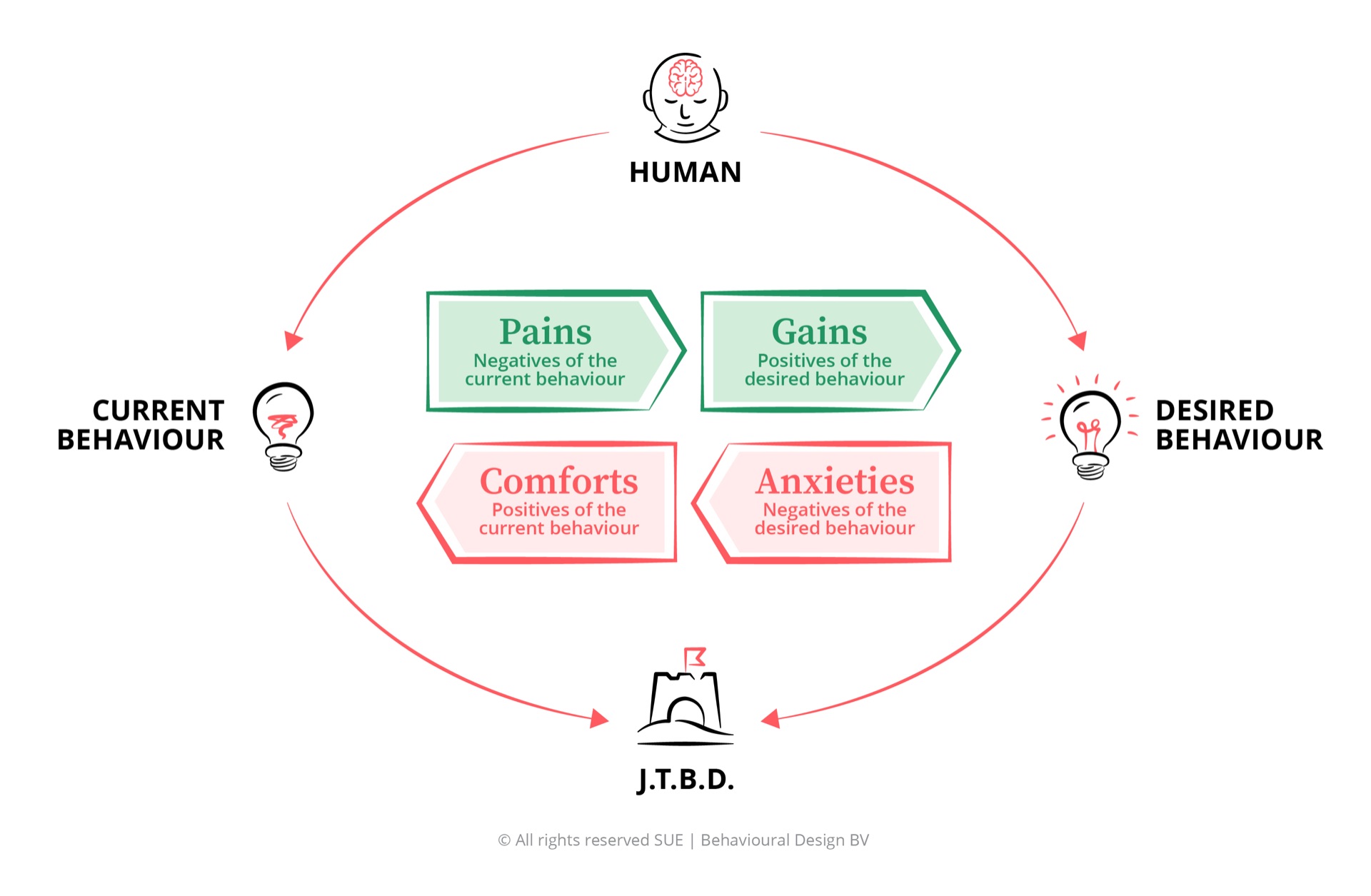
The important insight from the Influence Framework is that friction alone rarely addresses Pains and Gains -- the deeper motivational forces. A person who faces significant friction in accessing a pension scheme but also does not trust that the money will ever be accessible is not primarily held back by friction. They are held back by an Anxiety that no amount of form simplification will address. In those cases, reducing friction is necessary but not sufficient. You also need to address the underlying fear.
Common misconceptions about friction in behavioural design
Misconception 1: “Less friction is always better”
This is the most common mistake. Friction is not inherently bad. Good friction serves the person experiencing it by creating space for reflection, preventing irreversible mistakes, and slowing down automatic choices that do not reflect considered preferences. The cooling-off period is friction. The confirmation dialogue is friction. The speed bump is friction. All of them are good. The question is not how much friction, but what it is for.
Misconception 2: “Friction only affects weak-willed people”
Friction affects everyone. The cognitive mechanisms that friction exploits -- limited attention, cognitive load, the preference for paths of least resistance -- are universal features of human psychology, not symptoms of weakness. Highly motivated, highly intelligent people abandon complex processes at roughly the same rates as everyone else when the friction is high enough. The Oregon benefit application was not abandoned only by unmotivated people. It was abandoned by people whose lives were too full and whose cognitive bandwidth was too limited to navigate 47 pages of forms on top of everything else.
Misconception 3: “Reducing friction always increases conversion, which is the goal”
This conflates short-term conversion with genuine value creation. Reducing friction on a purchase flow increases conversions. It also increases returns, regret purchases, and customer service costs if the friction reduction bypassed genuinely important decision points. Amazon’s one-click system drove revenue growth and also drove return rates. Not all friction is waste. Some friction filters out choices that the person would later regret, and removing it produces conversions that do not produce satisfaction.
Practical applications: designing with friction
- Map friction in your user journey. Identify every step, form field, decision point and waiting period between intention and action in your product or service. Count them. Then ask: does each one serve the person navigating it? The ones that do not are your intervention targets.
- Remove friction on the desired path first. Before adding any friction to undesired behaviours, make the desired behaviour as effortless as possible. Reduce form fields to the minimum required. Pre-fill available information. Eliminate redundant steps. One step removed is worth more than ten awareness messages sent.
- Add friction where reflection serves the user. Before irreversible actions, before large purchases, before commitments with long-term consequences: add a deliberate pause. The confirmation dialogue, the cooling-off period, the “are you sure?” moment. These are friction points that serve the person experiencing them.
- Audit your exit and cancellation flows for sludge. If cancelling or opting out requires more steps than joining or opting in, you have sludge. Fix it. Not only because regulation increasingly requires symmetry, but because sludge produces customers who feel trapped -- and customers who feel trapped are liabilities, not assets.
- Use friction asymmetrically in the environment. Make healthy options physically closer, easier to reach and more prominent. Make unhealthy options further away, smaller-portioned and less visible. The food does not disappear. The friction changes who accesses it automatically and who makes a deliberate choice to do so.
Frequently asked questions about friction in behavioural design
What is friction in behavioural design?
Friction refers to the effort, steps or complexity required to complete an action. Every extra step between intention and action reduces the probability that people follow through. Reducing friction makes desired behaviour more likely. Adding friction to undesired behaviour makes it less automatic. It is one of the core mechanisms through which choice architects shape behaviour without restricting options.
What is the difference between good friction and bad friction?
Good friction serves the person experiencing it: a cooling-off period before a large purchase, a confirmation step before permanent deletion, a speed bump that prompts reflection before an irreversible action. Bad friction serves the organisation at the person’s expense: a labyrinthine cancellation flow, a benefits application with dozens of unnecessary pages, a cookie banner where rejection requires seven clicks. The test is whose interests the friction serves.
What is sludge?
Sludge is friction used against people’s interests -- making beneficial, legitimate or desired actions needlessly hard. The term was introduced by Cass Sunstein to describe the dark side of friction: bureaucratic obstacles, unnecessary paperwork and complex processes that prevent people from accessing benefits, exercising rights or changing unwanted arrangements. Sludge is to friction what dark patterns are to nudging.
How does friction affect behaviour?
Friction affects behaviour by determining the path of least resistance. Every extra step, form field, decision point or waiting period reduces the probability that people follow through on an intention. Conversely, every step removed increases follow-through. Research consistently shows that friction reduction is one of the most effective interventions in behavioural design -- often more effective than information or incentives alone.
What are examples of friction reduction in real products?
Amazon’s one-click purchase removed payment friction and increased impulse purchases dramatically. Spotify’s frictionless sign-up drove early growth. Government pre-filled tax returns in Denmark increase compliance. Mobile vaccination units removed transport friction during COVID-19 and increased uptake in underserved populations. In every case, the intervention was not providing new information or new incentives -- it was removing the effort barriers that had been preventing people from doing what they already wanted to do.
Conclusion
Friction is everywhere. The application form that takes 47 pages. The cancellation flow that takes 25 minutes. The vaccination appointment that requires a working internet connection, a personal email address and a reliable way to get to a clinic. All of these are friction points, and all of them are shaping behaviour -- not by informing or incentivising, but by determining who follows through and who falls away.
The behavioural designer’s job is to examine friction deliberately: to remove it where it is preventing people from doing what they genuinely want to do, and to add it where automatic behaviour produces harm that a moment of reflection could prevent. That is a more powerful lever than most organisations realise. And it is available without a budget increase, a communications campaign, or a new product feature.
Want to develop the skills to diagnose and redesign friction in your own work? The Behavioural Design Fundamentals Course gives you the frameworks and methods to do exactly that. Rated 9.7 out of 10 by more than 10,000 professionals from 45 countries.
PS
At SUE, our mission is to use the superpower of behavioural science to help people make better choices -- for themselves and for society. The Oregon benefit application is one of the most important case studies I know in this space, not because it is dramatic, but because it is honest about what friction does to people in vulnerable situations. People were entitled to help. They wanted help. And forms -- just forms -- were the thing preventing them from getting it. Removing the sludge was not a sophisticated behavioural intervention. It was an act of basic respect for how human beings actually work.