In 2015, ING Netherlands was profitable. Market position: strong. No scandal, no collapsing revenue, no competitor eating their lunch yet. By every conventional measure, there was no reason to tear the organisation apart and rebuild it from scratch.
Most large transformations happen under pressure. A burning platform, a crisis, a quarter so bad the board finally agrees something has to give. ING had none of that. They chose to change because they could see what was coming, not because they were already on fire. That makes this case unusual. And worth studying carefully.
This is not an agile manifesto piece. I am not going to tell you that self-organising teams are the future of work or that hierarchy is dead. What I want to look at is what ING actually did, through the lens of behavioural design, and understand why it worked when so many similar programmes fail. The answer, as it usually is, has less to do with the structure they built and more to do with how they changed what people did automatically every day.
The behavioural patterns that were failing
Before understanding the transformation, you need to understand what ING was actually dealing with. Not as a process failure, but as a set of behavioural patterns that had become deeply ingrained.
Decision-making was hierarchical in the most literal sense. Every significant decision needed layers of approval, which meant weeks of delay. By the time something was signed off, the context had often shifted. People had learned not to push for speed because the system would slow them down regardless. Patience became the rational response.
The departments worked in silos. Marketing, IT, operations and product teams each operated in their own world, then tried to coordinate at the end of a project. This coordination was expensive and often produced compromises that served no one well. People in each department had optimised for their own team's metrics, because that was what they were measured on.
Planning ran on annual cycles. ING was launching five or six major initiatives per year. By the time something launched, the customer needs it was designed for had often moved. The planning structure made it structurally impossible to respond quickly, even when everyone could see the gap opening up between what was being built and what was needed.
And risk avoidance had become so embedded that it operated through complexity. Governance processes grew elaborate enough to ensure that very little went catastrophically wrong. They also ensured that very little happened fast. The system had found an equilibrium that prioritised the absence of mistakes over the presence of progress.
None of this was anyone's fault individually. People were behaving rationally within the structure they had. That is exactly the point.
The insight that changed everything
ING's leadership could have responded by launching an agile training programme. They could have introduced new project management tools, hired agile coaches, and spent two years explaining the Spotify model to middle managers. Many companies have done exactly that. Most of them still have the same behavioural patterns they started with, just now with different vocabulary.
The insight that distinguished ING's approach was recognising that the challenge was not primarily technical. It was behavioural. And more specifically, it was structural: the organisation itself was training people, every single day, to behave in ways that no longer served customers or the business.
Hierarchy did not just slow decisions down. It made deference automatic. When every significant choice required approval from above, the rational response was to wait for signals before acting. After years of this, waiting became the default. It was not a mindset problem. It was a trained behaviour.
Silos did not just create communication gaps. They made territorial thinking the path of least resistance. When your performance was measured within your department and your career progressed within your function, cross-functional collaboration required active effort. It was friction, not flow.
Annual cycles did not just create slow launches. They made short-term responsiveness structurally impossible. You could not ship a quick fix to a customer problem in March if the next planning window was October. The system had made certain behaviours literally unavailable.
"You couldn't change behaviour within this structure. The structure was the problem. It was training people every day to behave in ways that no longer served customers or the business."
They aimed at people's beliefs, knowledge or motivation. ING aimed at the structure that determined what was easy, what was rewarded, and what was even possible.
The SUE Influence Framework analysis
Before looking at the specific interventions ING deployed, it helps to map what was actually happening using the SUE Influence Framework. The framework maps four forces. Two push people toward change (Pains and Gains). Two hold them in place (Anxieties and Comforts). Most change programmes only work on the first two.
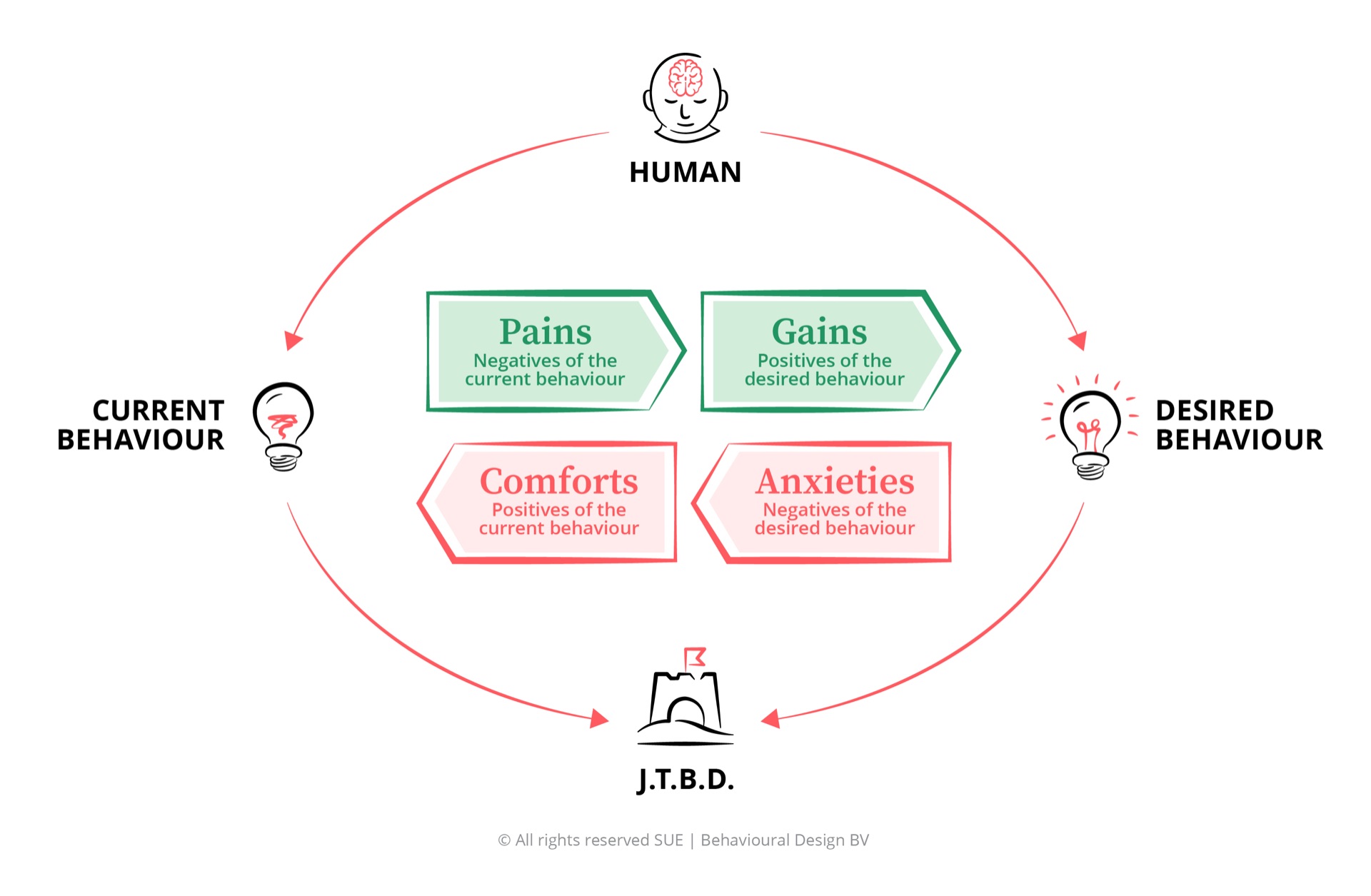
Pains (the driving forces)
Talented people were leaving for faster companies. Not in large numbers yet, but enough to notice. The frustration with slow decision-making was real and widely shared. Engineers who had come from startups found the approval layers demoralising. Product people watched competitors shipping features ING had been discussing in planning meetings for months. The pain was present. It just had not yet become urgent enough to overcome the inertia of the existing system.
Gains (the driving forces)
The alternative that ING was pointing toward carried genuine appeal. Freedom to decide without waiting for approval. The opportunity to work on things with real, visible customer impact. Faster feedback loops, so you could see within days whether your work actually mattered rather than waiting months for a launch to reveal whether the product had missed the mark. For people who had joined ING because they cared about building things, these gains were not abstract. They were what had motivated them in the first place.
Anxieties (the restraining forces)
Hierarchy offers protection. When you are in a structure with clear lines of approval, you are also in a structure where responsibility is distributed. Someone above you carries part of the accountability. Remove the hierarchy and you also remove that protection. That is not irrational. That is a realistic assessment of what changes.
Career paths were deeply unclear in the proposed new world. How do you progress when there are no management layers to climb? What does advancement look like when you are a permanent member of an autonomous squad? Nobody had good answers to these questions in 2015, and people were right to worry about them.
And in a regulated industry like banking, accountability without a clear chain of command is genuinely confusing. When something goes wrong in a flat structure, who is responsible? Not an abstract concern. A real operational question with real consequences.
Comforts (the restraining forces)
The existing structure provided real psychological value that was easy to underestimate from the outside. Role definitions were clear. Career progression was predictable. You knew what you were doing, you knew where you were going, and you knew who was above and below you. That clarity is genuinely comfortable. It reduces cognitive load. It lets you focus on the work rather than constantly negotiating your position.
The ability to defer difficult decisions upward is also a comfort that people rarely acknowledge out loud. When a hard call needs to be made, having a manager to escalate to is not just bureaucracy. It is relief. Self-organising teams require every team member to hold more uncertainty, which takes real energy.
And status. Management titles carried identity. "I manage a team of twenty" is a meaningful statement about who you are professionally. Removing that and replacing it with something more ambiguous asks people to rebuild a piece of their professional self-image. That is not nothing.
The Influence Framework makes something visible that most change programmes ignore entirely. People were not resisting because they were stubborn or change-averse. They were holding on because the old structure offered real psychological value. Any transformation that does not take those anxieties and comforts seriously will produce exactly what most agile transformations produce: the vocabulary of agility layered over unchanged behaviour.
The four interventions
ING's transformation worked because it addressed all four forces, not just the driving ones. Each of the main interventions mapped directly to what was actually needed behaviourally.
1. Making the transition feel safe (addressing anxieties)
The most immediately visible anxiety was about career development. In a flat, squad-based structure, who is invested in your growth? ING's answer was the "chapter lead" role. Chapter leads were not managers in the traditional sense. They did not direct day-to-day work. But they were explicitly responsible for the professional development of their chapter members. They held career conversations, identified skill gaps, and advocated for people across squad boundaries.
This was not a trivial structural addition. It was a direct response to a legitimate anxiety. You can still grow here. Someone is still paying attention to your development. The hierarchy of decision-making was gone, but the human infrastructure of professional support remained.
Competency frameworks became explicit and visible. Career paths were redesigned around expertise and impact rather than management hierarchy. You could advance by becoming a better engineer, a more skilled product thinker, a more effective designer, not only by accumulating reports.
Coaching was provided extensively, well beyond the typical training rollout. ING understood that asking people to operate differently in a new structure was a psychological shift, not just a process change. Coaches worked with teams for months. Early sprints were run with explicit failure tolerance, so people could learn what self-organisation actually meant in practice before being held fully accountable for outcomes.
2. Replacing the old sources of status (addressing comforts)
Most organisations never attempt this, because it requires acknowledging something uncomfortable: the status system embedded in the old structure was real, and people valued it. You cannot simply announce that status now comes from something different. You have to build the new status system with the same care you put into the structural design.
ING created new markers of professional standing. Owning a customer outcome, being the person whose squad moved a metric that mattered, becoming a recognised expert whose opinion other squads sought out. These became the new signals of professional success.
Autonomy was reframed not as abandonment but as freedom. Teams could make decisions without approval. That shift was genuinely liberating for people who had been waiting for sign-offs for years. The experience of making a call and seeing it executed within days was its own form of status confirmation: you are trusted to decide.
Clear accountability replaced diffuse responsibility. In the old structure, accountability was shared across layers in ways that made it hard to feel genuine ownership. In the squad model, the team owned the outcome. That created real accountability, but it also created real ownership. For people who cared about their work, ownership was preferable to the comfortable ambiguity of shared responsibility.

3. Making the problem visible (amplifying pains)
ING did something that sounds simple and is actually very hard to execute: they made the pains undeniable.
All employees, including senior executives, spent their first week in the call centre. Not observing, not shadowing. Actually handling customer calls and hearing customer problems directly. This was not a symbolic gesture. It was a carefully designed intervention in how people understood the gap between what ING was delivering and what customers needed. You cannot argue with a customer on the line telling you their problem could not be resolved because no one in the bank had the authority to make the relevant decision.

Competitive analysis became visible and concrete. Specific features that competitors had shipped were mapped against ING's own planning timeline, showing exactly how many months or years behind ING was on things customers were already using elsewhere. Making the cost of the current structure tangible shifted the felt urgency in a way that strategic presentations could not.
The real cost of delay was documented, not just as a concept but in specific cases. This removed the comfortable vagueness that allows people to know something is a problem in the abstract while not feeling it urgently enough to change.
4. Connecting to a new purpose (activating gains)
The new measure of success was customer impact. Not activity tracking. Not compliance with process. Not the number of meetings attended or approvals secured. Whether customers were better served because of what your squad did this sprint.
Two-week release cycles meant the feedback loop became almost immediate. You could see within days whether what you built mattered. That is a fundamentally different experience of work. In the old model, you might spend months on something and only find out whether it worked after a big launch event. The sprint cadence changed the relationship between effort and feedback entirely.
Individual autonomy was connected explicitly to team outcomes. You are free to decide, and your decisions show up in metrics within two weeks. That connection between freedom and visible impact is what made the autonomy feel meaningful rather than merely structural.
The choice architecture changes reinforced all of this. Defaults shifted from "seek approval" to "decide and inform." Meetings were restructured around sprint rhythms rather than hierarchical reporting lines. Physical space was redesigned: no corner offices, collaborative spaces as the default environment for work. The environment itself encoded the new behaviours, so that acting in the old ways required deliberate effort rather than the new ways.
The results
The behavioural shifts were visible before the business metrics moved.
Within months, you could observe patterns that had been rare before. Employees described a sense of ownership that was qualitatively different from their previous experience. Not because they had been told to feel it. Because the structure made ownership the natural response to the situation they were in. Decisions happened at team level without escalation. Cross-functional collaboration became the norm rather than a special arrangement requiring senior sponsorship.
The business results followed. Time to market dropped from months to two or three weeks. Releases went from five or six per year to continuous delivery. ING became the number one mobile banking app in the Netherlands, which is a meaningful signal in a market where every major bank was investing in digital. Employee engagement increased despite, or perhaps because of, the disruption. The people who stayed were more energised than they had been in the old structure.
The biggest change was not structural. It was psychological. People went from asking permission to taking ownership. The structure just made ownership the easier choice. That is the whole point of choice architecture. You do not change what people want. You change what is automatic.
What this means for anyone leading change
Most change programmes aim at System 2. New processes, training courses, communication campaigns, change management workshops. All addressed to the conscious, deliberate part of the brain. ING aimed at System 1 instead, at the environment that made certain behaviours automatic. They changed what was easy, what was rewarded, and what was possible before they worried about what people believed.
If your structure makes old behaviours the default, that is what you will get, regardless of how many training sessions you run. The right diagnostic question is not "why are people resisting?" It is "what does our current structure train people to do automatically?" Answer that honestly and you will know exactly what needs to change. Most leaders skip this question entirely. They address the symptoms and leave the architecture untouched.
There is something else worth noting about ING's approach that tends to get overlooked. They did not just change what people did. They changed how people saw themselves professionally. "I manage a team of twenty" became "I own this customer outcome." That shift, from identity based on hierarchy to identity based on impact, is stickier than any behavioural change programme, because it creates internal motivation rather than relying on external enforcement. People do not need to be reminded to act consistently with who they believe they are.
And they transformed all 3,500 employees at once. Not a pilot in one department while the rest of the organisation stayed traditional. Not a lighthouse team operating under different rules while their colleagues watched from the old structure. The full transition, all at once. When your colleagues, your manager, your space and your metrics have all changed at once, there is no old normal to slip back into.
The ING case is the clearest example I know of why we spend so much time in Behavioural Design talking about choice architecture. The transformation succeeded because leadership understood that you cannot train people into agility while keeping the hierarchical structure that makes deference automatic. You have to design the environment first. Then the behaviour follows.
Sources: McKinsey Quarterly, Harvard Business School Case Study, ING Agile Transformation Documentation.