No matter how objective you try to be, and no matter how good your intentions are: nobody is immune to the temptation of using a bonus to boost motivation. Myself included. It feels logical. You want people to perform, so you reward performance. And yet, behavioural science has been clear on this point for fifty years. Extrinsic rewards work. But not in the way you expect. And sometimes they work in exactly the opposite direction.
This article is not about abolishing bonuses. It is about something most organisations skip: asking what was already there, before you introduced the incentive. Almost always, there was already motivation. The question is what you built afterwards, and whether that helped or undermined what was already present.
Intrinsic motivation at work is the willingness to do good work because the work itself is rewarding. It rests on three psychological needs: autonomy, competence and relatedness (Deci & Ryan, 2000). External rewards can undermine this motivation through the overjustification effect (Lepper, Greene & Nisbett, 1973). Behavioural Design says: first look at what is blocking the intrinsic drive that is already there, using the SUE | Influence Framework, before adding another incentive.
What is intrinsic motivation?
Intrinsic motivation is the willingness to do something because it is inherently satisfying. Not because of the reward that follows. Not because of the performance review. But because the work itself engages you: curiosity, pride, the feeling of getting better at something, or the awareness that what you do matters to others.
The psychologists Edward Deci and Richard Ryan have investigated this most rigorously in their Self-Determination Theory (SDT). Their central finding: intrinsic motivation is not a personality trait that some people have and others do not. It is a state that arises when three universal psychological needs are met.[1]
The first is autonomy: the sense that you decide how you do things, that your choices matter, that you are not merely a cog in a machine someone else designed. The second is competence: the sense that you are growing, that you are becoming better at something, that the challenge is just difficult enough to engage you without being so overwhelming that it paralyses you. The third is relatedness: the sense that your work contributes to something that touches others, and that you are connected to the people around you.
When those three conditions are present, you do not need to motivate people. They are already motivated. The question any manager or HR professional should be asking is not: how do I motivate my team? The question is: what in our workplace is blocking the motivation that is already there?
How bonuses destroy the motivation they are designed to create
In 1973, Mark Lepper, David Greene and Richard Nisbett conducted an experiment that turned the world of motivational psychology upside down. They observed children who already loved drawing. Picture it: children who draw in their free time, purely for the pleasure of it. No encouragement needed.[2]
The researchers divided the children into three groups. The first group knew beforehand that they would receive a reward for their drawings. The second group drew without any promise, but received a surprise reward afterwards. The third group drew with no reward at all. Two weeks later, the children were given free time to do whatever they liked. The children who had known in advance that they would be rewarded drew significantly less than the other two groups. The children who had never received a reward drew just as enthusiastically as before.
This is the overjustification effect: when you attach an external reward to behaviour that people already find intrinsically motivating, their internal explanation for that behaviour shifts. From "I do this because I enjoy it" to "I do this for the reward." When the reward is withdrawn, the motivation goes with it. The external incentive has crowded out the internal reason.
This is not a phenomenon confined to laboratory settings. You see it everywhere in working life. A consultant who was genuinely curious about the profession becomes trapped in a bonus structure that counts only targets. A teacher who chose education because of the children becomes submerged in a system of scores and assessments that reduces every conversation to a data point. A software developer who loves building is placed in an organisation that measures every sprint on velocity and leaves no room for craft.
Before you add another incentive, ask what is blocking the intrinsic drive that is already there.
I am not saying this to condemn bonuses as a principle. Extrinsic rewards work perfectly well for routine tasks that offer little intrinsic satisfaction. The problem arises when you deploy them for work that people find naturally compelling, or when they become so dominant that they are the only thing people focus on. At that point, organisations miss precisely the energy they were trying to generate.
Three places where intrinsic motivation erodes
The performance management system that made everything measurable
Imagine a team of consultants who have worked with real dedication for years. The atmosphere is good, the quality is high, and there is a culture of taking problems seriously. Then the organisation introduces a new performance management system. Every project gets KPIs. Every quarter, a review. Every conversation, a form.
In the first quarter, little changes. In the second, someone notices that the KPIs have started to drive how projects are structured, not the quality of the work. Tasks that are hard to measure quietly move to the background. Tasks that score well receive more attention, even when they have less impact. People begin managing to the metric, not to the work. That is not cynicism. It is rational behaviour inside a system that measures what it measures.
What happened: autonomy declined (the system dictates what matters), the experience of competence shifted (success is now defined by the score, not the quality of the work), and relatedness suffered (the measurement pulls attention towards individual scores and away from collective results). All three needs were eroded. Not through bad intentions, but through a system that was not designed with motivation in mind.
The onboarding process that killed curiosity
Almost every onboarding programme I have encountered is built the same way. Day one: a welcome presentation from HR. Day two: a tour and introductory conversations. Week two: mandatory e-learning modules. Week three: the first real tasks, but strictly supervised, with precisely prescribed procedures for every scenario.
The problem is not that this is badly intentioned. The problem is that it immediately places new employees in a passive role. Everything is pre-programmed. There is no space for their own questions, their own approach, the sense that they have something to contribute. They are an empty vessel being filled, not a person with experience and curiosity who is invited to add something.
New employees often arrive full of energy. They want to show what they can do. They are curious about the organisation. They have ideas. An onboarding process that systematically suppresses this by over-prescribing and leaving too little space kills exactly the energy that is so valuable in the first months. Autonomy is minimal, competence is not used but merely filled in, and relatedness must grow through presentations rather than through real conversations and real contributions.
More autonomy in onboarding is not the same as less guidance. It is about space to make one's own choices within a framework: these are our values, this is what we are here for, now tell us how you think you can contribute best. That conversation is the foundation of intrinsic motivation. Without it, you are fitting people into a system rather than connecting them to a mission.
The culture change programme that told people what to value instead of removing what blocked them
One of the most frustrating patterns I encounter in organisations trying to change their culture: they begin by formulating values. Collaboration. Innovation. Customer focus. Those values are printed on posters, included in presentations, named in performance conversations. And then the organisation waits for people to start living them.
That wait tends to be a long one. Because the problem was never that people did not share the values. Most employees are genuinely fine with collaboration. They want to be customer-focused. They are curious enough to innovate, if the conditions allow it. But the conditions did not. The structure of the working day, the way meetings are set up, the systems people use, the way budgets are distributed: all of these made it harder to act on the desired values in practice, not easier.
This is what Behavioural Design makes so clear: you do not change behaviour by telling people what they should want. You change behaviour by changing the context so that the desired behaviour becomes easier. The will was already there. The path was not. And a culture change programme that focuses on selling values rather than removing the obstacles that prevent people from living them is, as I would say, a design for disappointment.
Why motivation fails: an Influence Framework analysis
When you analyse a motivation problem using the SUE | Influence Framework, you quickly see why conventional interventions so often go wrong. The framework examines four forces that determine whether someone engages in the desired behaviour: pains, gains, comforts and anxieties.
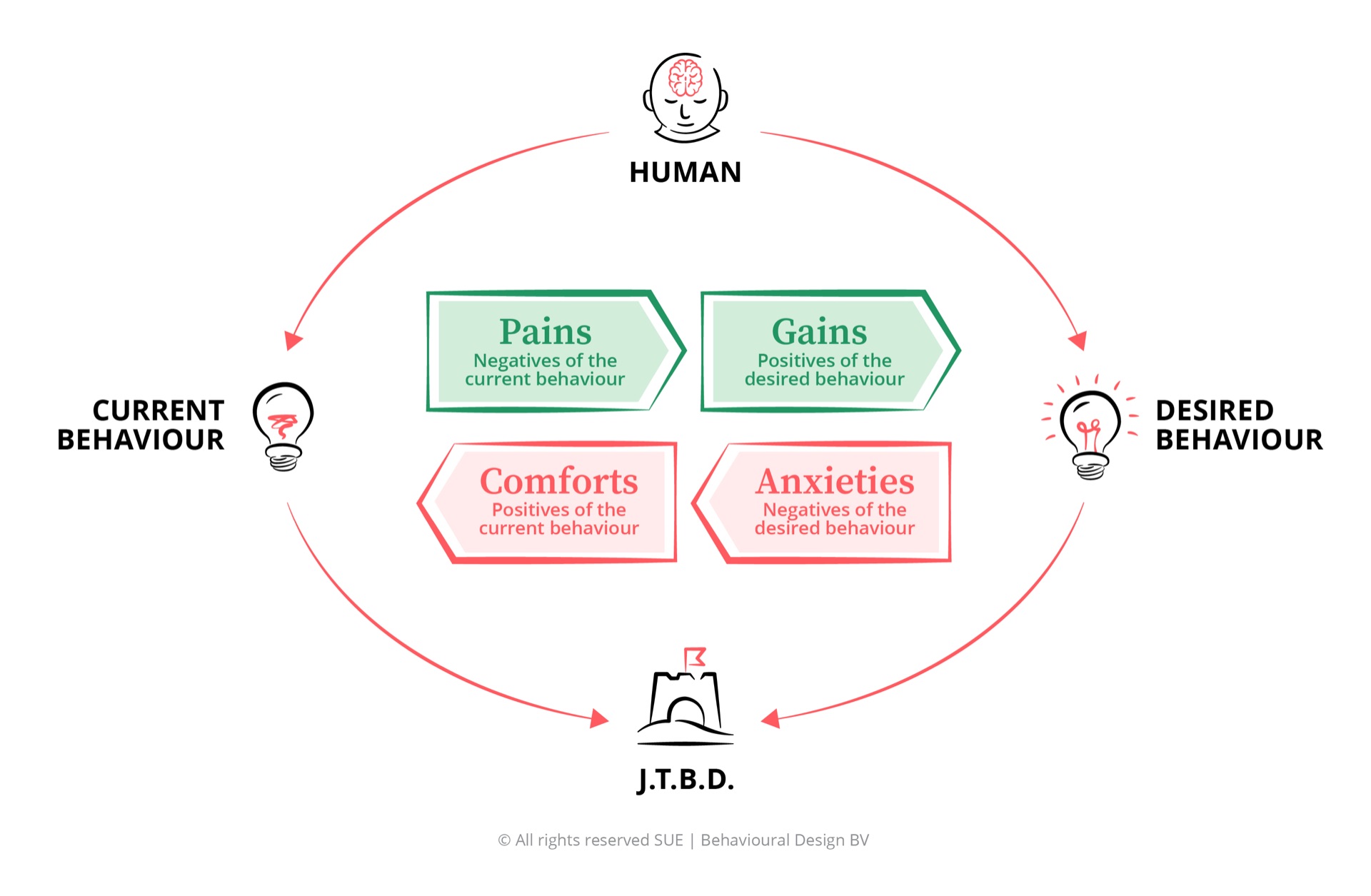
The pains of someone losing motivation are concrete: the sense of having no influence over how work is done, tasks that are never challenging, contributions that remain invisible. These are real frustrations. Left long enough, they become the norm.
The gains of engaged, intrinsically motivated work are equally clear: growing in your profession, making a contribution that counts, working alongside people you respect. But those gains are not automatically visible or felt. They need to be designed. And that is exactly where most organisations fall short.
Then there are the comforts: the routines and habits that hold people in passive behaviour. It is easier to do what you always did than to take initiative in an organisation that does not actively invite that initiative. The meeting structure that leaves no room for individual input, the system that requires approval for any small deviation from procedure, the culture where standing out is more likely to be punished than rewarded. These are comforts that hold people not in good behaviour, but in passive behaviour.
And finally the anxieties: the brake on initiative and growth. The fear of failure in an organisation that penalises mistakes rather than learning from them. The fear of standing out. The uncertainty about whether your ideas are welcome. These anxieties are sometimes explicit but more often implicit: people adapt to what they observe being rewarded and what being punished. The organisation gave that signal, perhaps without knowing it.
What makes the IF analysis so valuable: it shows that motivation problems are almost never a shortage of willpower or ambition. They are almost always a deficit in autonomy, an excess of anxiety, or an absence of visible relatedness. The solution is not a new incentive. The solution is removing what blocks. As Tom always says: influence is more judo than karate. You do not fight the resistance. You remove what feeds it.
What works: three design principles for intrinsic motivation
Behavioural science is not pessimistic about motivation. It is simply honest about what works and what does not. What works has three characteristics.
Design for autonomy, not compliance. Autonomy does not mean people can decide everything. It means they feel that their choices matter within a clear framework. Give people influence over how they do their work, even when the what is fixed. Let teams decide their own ways of working, let people choose which approach they use, give them room to experiment. The sense of choice is already sufficient to feed the autonomy need, even when the actual margin is limited.
Build growth in, not just evaluation. The experience of competence grows when people can see themselves becoming better at something. That requires three things: a challenge that sits just outside the comfort zone, feedback that arrives quickly enough to course-correct, and an environment where mistakes are allowed as learning moments. Most performance systems deliver only the last element: the assessment. And assessments that only measure what someone achieved, not how they grew, do not feed competence. They measure it.
Make meaning visible, not just results. Relatedness grows when people can see how their work makes the lives of others better. That sounds abstract but it is concrete to design. Make the end-user of the work visible. Tell the stories of people who have been helped. Let teams know what changed because of their contribution. Workplace wellbeing does not grow from satisfaction alone. It grows from the awareness that what you do matters to someone else.
And a fourth principle, perhaps the simplest: involve people in the changes you expect of them. Not to give them the feeling of having a say, but to build the genuine relatedness that is required before people become intrinsically motivated to do something. People who help build the solution are more motivated to live it than people who have it imposed on them. That is not a soft HR principle. That is behavioural science. And if you want to understand how to reduce the resistance that so often accompanies top-down change, start with removing the friction that blocks people from acting on what they already value.
Frequently asked questions
What is intrinsic motivation at work?
Intrinsic motivation at work is the willingness to do good work because the work itself is rewarding, not because of a bonus, performance review, or other external incentive. People are intrinsically motivated when they experience three things: autonomy (I decide how I do this), competence (I am getting better at this), and relatedness (this work matters to the people around me). According to Self-Determination Theory by Deci and Ryan, these are the three universal psychological needs that sustain intrinsic motivation.
Why do bonuses sometimes undermine motivation?
This is called the overjustification effect, first documented by Lepper, Greene and Nisbett in 1973. When you reward people for something they already enjoy doing, their internal explanation for the behaviour shifts: from "I do this because I enjoy it" to "I do this for the reward." When the reward is withdrawn, the motivation goes with it. The external incentive has crowded out the internal reason. This risk is highest for tasks that are already intrinsically motivating.
What are the three conditions for intrinsic motivation?
According to Self-Determination Theory, the three universal psychological needs are: autonomy (the sense that you choose how you act), competence (the sense that you are growing and becoming better at something), and relatedness (the sense that your work matters and that you are connected to the people around you). If any one of these is absent, intrinsic motivation declines. Most motivational problems in organisations are, at their core, a deficit in one of these three dimensions.
How do I use the Influence Framework to analyse motivation problems?
The SUE | Influence Framework analyses behaviour through four forces: Pains, Gains, Comforts and Anxieties. With motivation problems, the root cause is almost always found in the Comforts and Anxieties: routines that leave little room for autonomy, fear of failure that blocks growth, or an environment that undermines relatedness. The answer is not adding more incentives. It is removing those blocks.
How is intrinsic motivation different from extrinsic motivation?
Extrinsic motivation comes from outside: a bonus, praise, a KPI, a performance reward. Intrinsic motivation comes from within: you do something because the work itself gives you satisfaction, because you are growing, because it contributes to something you find meaningful. Both can coexist, but relying too heavily on extrinsic incentives can erode intrinsic motivation, especially for work that is inherently challenging and meaningful.
Conclusion
Most people do not arrive at work without motivation. They arrive full of it. They want to contribute, they want to grow, they want to matter. What then goes wrong is almost always the same: an organisation that tries to steer that motivation through external incentives and performance reviews, rather than designing the context that allows intrinsic motivation to flourish.
Autonomy, competence and relatedness are not nice-to-haves. They are the needs that determine whether people are just as committed in ten years as they were on day one. Design for those needs. Not by promising more, but by removing what blocks.
Want to learn how to analyse motivation problems using the Influence Framework and design behavioural interventions that actually work? The Behavioural Design Fundamentals Course teaches you exactly that: from diagnosis to design, combined with the power of AI. Rated 9.7/10 by over 10,000 professionals from 45 countries.
PS
At SUE, we believe most motivation problems are actually context problems. Not people who do not want to. But people inside systems that make wanting progressively harder. Behavioural science gives you the tools to see that. And once you see it, you can change it. That is precisely why we do what we do.