Here is a scenario I guarantee you have lived. Your organisation rolls out a new system. Everyone has been trained. The benefits have been clearly demonstrated. The tool is objectively faster, more efficient and cheaper than what you are currently using. And yet, three months later, half the team barely touches it. People open the old spreadsheet. They send the familiar email. They track down the colleague who “still knows how the old system works.”
You have already deployed every rational argument available. You have explained why the change is better. You have shown the data. Nothing sticks. And the frustrating part is this: the people who resist most are not your least capable employees. They are often the most experienced, most invested, most senior people in the room.
This is loss aversion at work. Not resistance to something new. Resistance to giving up something familiar.
Loss aversion is the psychological tendency to weight losses more heavily than equivalent gains. Kahneman and Tversky demonstrated in 1979 that a loss feels roughly twice as painful as an equivalent gain feels pleasurable. In the workplace, this explains why people cling to the old way even when the new way is objectively better: the feeling of loss dominates the pull of the gain. In the SUE Influence Framework, loss aversion shows up as an Anxiety, the dominant blocking force in any behaviour change challenge.[1]
What is loss aversion?
In 1979, Daniel Kahneman and Amos Tversky published their Prospect Theory, one of the most influential papers in the history of economic psychology. The core finding: people do not evaluate outcomes in absolute terms. They evaluate them as gains or losses relative to a reference point. And that evaluation is not symmetric. Losing 100 euros feels more painful than gaining 100 euros feels pleasurable. The ratio is roughly 2 to 1.[2]
This is not a rational calculation. It is System 1: the fast, automatic, unconscious thinking process that Kahneman later described in Thinking, Fast and Slow. The brain developed this mechanism over thousands of years of evolution. Avoiding loss was more critical to survival than chasing gain. Ignoring a threat could be fatal. Missing a reward rarely was.
On the modern workplace, the same mechanism runs on different inputs. It is not predators we are protecting against. It is the loss of status, expertise, routine and autonomy. Three dimensions matter most.
Loss of identity. The skill that makes you valuable in your team, the expertise you have built over years: when a new tool or method makes that expertise less relevant, you lose a piece of who you are in the organisation. That is not a metaphor. That is how the brain experiences it.
Loss of control. People have a deep need for autonomy. When a new process is more prescribed, more transparent about who does what, or more monitored, you lose degrees of freedom. That feels like loss, even when the new system works better.
Loss of status. Every team has a hierarchy of expertise. The person who knows how the old system really works has power. When everyone starts learning from scratch, that power position temporarily or permanently disappears. That is a real loss, and the brain registers it accordingly.
People don't resist change. They resist the loss of what they already have.
Three scenarios where it causes the most damage
AI adoption: the loss of expertise
Take a marketing team at a mid-sized company that decides to integrate ChatGPT and other AI tools into its workflow. The productivity gains are obvious: content creation runs twice as fast, briefs get sharper, research takes a fraction of the time. The business case is airtight.
And yet adoption stalls. Not among the juniors who have always googled their way through problems and love experimenting. Among the senior copywriters and strategists with twenty years of craft knowledge. The people who know precisely how to write a brief, how to find an insight, how to build a campaign that works. Exactly the people the organisation relies on most.
What is happening? Not reluctance. Loss aversion. If the AI matches content quality, what makes my twenty years of experience uniquely valuable? If a junior with the right prompt reaches the same output I would after an hour of thinking, what is my worth? These are the implied questions nobody voices out loud but everyone feels underneath the surface. And the answer is too threatening to look at directly.
The pain of losing expertise and status outweighs the gain of efficiency. So the brain avoids the situation that would make that loss visible. The system stays closed. The excuses accumulate. The change stalls.
Office redesign: the loss of territory
An organisation moves to activity-based working. No more assigned desks. Each day you pick a spot based on what you are doing. The logic is sound: the building was never fully occupied anyway, collaboration improves when people sit next to different colleagues, and the new layout is demonstrably nicer.
The reaction is furious and completely disproportionate to the actual disruption. People who rarely raise issues suddenly find their voice. Petitions circulate. HR directors get cornered in corridors. Someone takes their desk cactus home as an act of symbolic resistance.
This is loss aversion in its purest form. It has nothing to do with the quality of the workspace. It is about the loss of “my” spot. The photos on the desk, the favourite mug in the drawer, the chair adjusted exactly right: these are anchor points for identity and territory. The brain registers their loss as a real threat, even when the rational damage is zero.
And because the loss is concrete and immediate, while the benefit (better collaboration, nicer spaces) is abstract and future, the loss wins. Every time.
Salary restructuring: the loss hiding inside the gain
This is perhaps the most underestimated loss aversion scenario. An organisation redesigns its compensation structure. Everyone comes out ahead in total pay, but the ratio between fixed salary and variable bonus changes. The fixed component goes down, the bonus potential goes up substantially.
Objectively, this is a better deal for most employees, especially strong performers. But the response is surprisingly negative. Even people who rationally understand they are better off push back. Why?
Because they experience the lower fixed salary as a loss. The bonus potential is future, uncertain, conditional. The lower fixed salary is now, certain, permanent. The brain weights the definite loss more heavily than the uncertain gain, even when the probability of the bonus is high and the expected value is clearly positive. This is exactly what Kahneman and Tversky described: people are loss-averse and risk-averse when it comes to certain outcomes. You are offering them a lottery when they already felt like they had won. They experience it as a loss.
The result: trusted employees leave or disengage, not because the deal is bad, but because the framing makes it feel like one.
Why anxieties always beat gains
When you analyse loss aversion at work through the SUE Influence Framework, you see a pattern I observe consistently in our Behavioural Design Sprints: the blocking forces are structurally stronger than the driving forces.
Pains (what pushes people away from current behaviour): the current system is slow, error-prone, inefficient. These frustrations are real, but they are chronic, and people adapt to chronic pain. They do not feel urgent enough to trigger action.
Gains (what pulls people toward new behaviour): productivity gains, better collaboration, higher quality. Real and measurable. But abstract, future-dependent and contingent on a successful transition that has not happened yet.
Comforts (what keeps people in current behaviour): the familiar system works, maybe not perfectly but predictably. Routine requires no mental energy. You know what you know. This comfort is a genuine force, not to be underestimated.
Anxieties (what stops people from changing): and here loss aversion becomes visible. The fear of losing expertise. The fear of losing control. The fear of ending up worse off, even when that is rationally unlikely. The fear that the new system makes you more vulnerable than the old one.
Anxieties are the dominant force in any behaviour change challenge. They are concrete and immediate, while gains are abstract and future. And loss aversion doubles their weight: the pain of a potential loss feels twice as strong as the pleasure of an equivalent gain.[3]
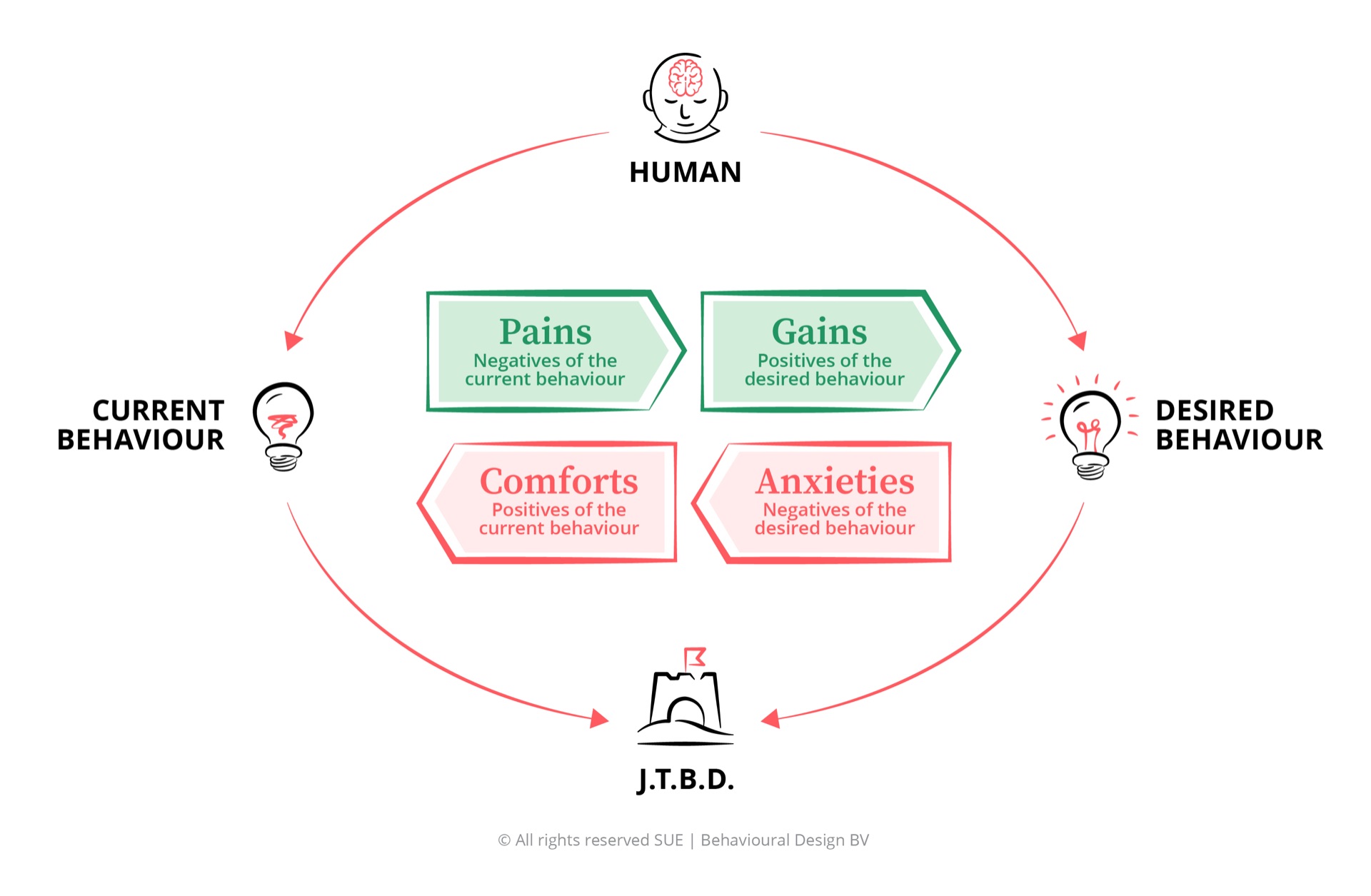
This is precisely why classic change communication fails. You communicate gains. You try to amplify the pains of the current system. But as long as you do not address the anxieties, and as long as you do not replace current comforts with new ones, you are fighting the wrong battle. The business case reaches System 2. But loss aversion lives in System 1.
Five interventions that actually work
The solution is not to persuade people. The solution is to design the environment so that the new behaviour feels less like loss. Here are five concrete, environment-level interventions.
1. The reversible trial period. Loss aversion is strongest when change feels permanent. A trial period removes that permanence: you lose nothing as long as you can go back. When Microsoft introduced new Outlook features, “try it for 30 days” produced three times higher adoption rates than a direct rollout. The feature was identical. The framing differed. The threshold was lower because no permanent loss was at stake.
2. The default intervention. When the new behaviour becomes the standard and the old behaviour becomes the exception, the loss aversion mechanism flips. Now the old way is something you have to actively choose, which means giving up what you already have (the new default). Organisations that have embedded AI tools as defaults in their workflows see significantly higher adoption than those that present them as opt-in additions.
3. Reframe loss as avoiding something worse. Instead of saying “this system will save you two hours a week,” say: “people who do not use this system risk falling two hours a week behind colleagues who do.” This activates loss aversion in the service of change rather than against it. It is a subtle but critical shift in framing, and it works.
4. Gradual transition that carries identity forward. When you give people the chance to bring their expertise into the new situation rather than having it replaced by the new situation, most of the identity threat disappears. A senior copywriter who learns to use AI to amplify their own creative voice loses nothing. A senior copywriter who hears that AI is replacing them loses everything. The change is the same. The narrative is different.
5. Social proof from early adopters. Loss aversion is also social: you do not want to be the person who misses out on what others have already gained. When early adopters visibly and credibly share their success, not as evangelists but as colleagues, the reference point shifts for everyone else. The new system is no longer something they have to adopt. It is something they are missing if they do not.
How loss aversion connects to other biases
Loss aversion rarely operates alone. In the workplace it combines with other biases in ways that make change management especially hard to diagnose.
Status quo bias is the direct partner: the preference for the current situation is partly rooted in loss aversion. Any departure from the status quo feels like a potential loss, even when the alternative is objectively better.
The endowment effect compounds it: people value what they already own, their current method, their current tool, their current position, more highly than an equivalent alternative, simply because they already have it. It is a specific expression of loss aversion applied to possession.
The sunk cost fallacy makes it worse: when people have already invested heavily in the old system, switching feels doubly like a loss, the loss of the future they had planned and the loss of the investment they have already made.
And the framing effect is both the explanation and the solution: whether people experience something as a loss or a gain depends largely on how it is presented. The same change can be framed as either. And that framing makes all the difference.
Frequently asked questions
What is loss aversion at work?
Loss aversion at work is the tendency of employees to block or avoid changes because giving up the familiar feels like a loss, even when the new situation is objectively better. It is not stubbornness or incompetence. The brain automatically weights potential losses more heavily than equivalent gains, which means even clear improvements trigger resistance.
How does loss aversion explain resistance to AI adoption?
AI adoption triggers multiple forms of loss aversion simultaneously. People fear losing expertise: the skills that made them valuable may count for less. They fear losing status: the junior who learns the tool fastest suddenly becomes the expert, displacing the experienced colleague. And they fear losing autonomy: an algorithm takes over decisions they used to make themselves. These three fears combined outweigh any rational business case.
Why doesn't emphasising the benefits of change work?
Because loss aversion is a System 1 process: fast, automatic and immune to rational argument. The business case reaches System 2, but the emotional resistance lives in System 1. As long as you only communicate what people stand to gain, you ignore the fear of what they stand to lose. And that fear is structurally about twice as strong as the pull of the gain.
What is the difference between loss aversion and status quo bias?
Status quo bias is the broad preference for the current situation over any change. Loss aversion is the underlying mechanism that partly explains it: you want to preserve the status quo because change feels like losing what you already have. They reinforce each other, but loss aversion is more specific: it describes the asymmetry between the pain of losing and the pleasure of gaining.
How do you overcome loss aversion in a change programme?
Five interventions work reliably: offer a reversible trial period so no permanent loss is at stake, change the default so the new behaviour is the standard, reframe the loss as avoiding something worse, make the transition gradual so people can carry their identity forward, and use social proof from early adopters who have successfully made the switch.
Conclusion
Loss aversion is not a sign that your employees are difficult or that they do not understand change. It is a fundamental mechanism of the human brain that Kahneman and Tversky described decades ago and that has been confirmed across hundreds of contexts since. In the workplace it shows up in AI adoption, office transitions, salary restructuring, and any programme where people have to let go of something familiar.
The mistake organisations make repeatedly: they try to convince people of the benefits of change. But loss aversion is immune to logic. You have to design the environment, change the default, adjust the framing, make the transition gradual. Not because you are manipulating people, but because you are working with how the brain actually works.
Want to learn how to drive behaviour change in your organisation systematically? In the Behavioural Design Fundamentals Course, you learn to apply the Influence Framework and the SWAC Tool to diagnose and overcome loss aversion and other biases. Rated 9.7 out of 10 by 5,000+ alumni from 45 countries.
PS
At SUE our mission is to use the power of behavioural psychology to help people make better choices. Loss aversion may be the most underestimated force in change management, precisely because it is invisible to those who are not looking for it. You see resistance. You do not see the fear of loss underneath it. The moment you make that fear visible and take it seriously, your interventions change. And then your results change.