Think back to your last performance review. Perhaps you received nine positive points and one area for improvement. Which point is still stuck in your head? Exactly. That one point. You drive home and the nine compliments have evaporated. That one critical remark is all you remember. And maybe all you carry with you for the next few weeks.
Or think of the time you gave a presentation to thirty people. Twenty-nine were enthusiastic. One person asked a critical question. Guess what you were still thinking about that evening.
This is negativity bias at work. And it is one of the most underestimated cognitive biases in organisations, precisely because everyone thinks it is simply about being sensitive. It is not. It is a fundamental property of how your brain processes information. And it has far-reaching consequences for how your team performs, how you assess talent and whether there is room for innovation.
Negativity bias is the brain’s tendency to weigh negative experiences, information and emotions more heavily than positive ones. At work, one negative feedback point overshadows ten positive results, causing performance reviews, innovation and talent assessments to become structurally distorted. The solution is not “thinking more positively” but redesigning feedback, decision-making and assessment processes using the SUE Influence Framework.
What is negativity bias?
Negativity bias is what happens when your brain applies an ancient survival mechanism to a modern work environment. Instead of weighing positive and negative information equally, the brain automatically gives negative signals priority. More attention. More emotional charge. More memory storage. It is a System 1 process: fast, automatic and entirely beyond your conscious control.[1]
Psychologists Paul Rozin and Edward Royzman described four dimensions of negativity bias in 2001. Negative stimuli are more potent (they trigger stronger reactions), they dominate in mixed situations (a positive and negative experience together feel net negative), they are more complex (we think longer and deeper about negative events) and they are contagious (a little bit of negative can spoil an entire positive experience).[2]
Think of a restaurant with a hundred five-star reviews and three one-star reviews. You read those three negative reviews. Or think of the colleague who has delivered good work for months, but missed one deadline. What do you remember about that colleague?
Roy Baumeister and colleagues summarised it in 2001 in one of the most cited papers in social psychology: “Bad is stronger than good.” Negative events have an impact roughly five times as strong as comparable positive events.[3]
Evolutionarily, this made sense. The ancestor who ignored the snake in the grass lived a shorter life than the one who panicked at it. But in the workplace in 2026 there is no snake. There is an improvement point in your performance review. And your brain reacts as if it is the same thing.
Your brain is not designed to make you happy. It is designed to keep you alive. And staying alive means: always giving negative signals priority.
Three situations where it causes the most damage
The performance review that demotivates instead of motivates
At SUE we regularly speak with organisations struggling with their review cycle. The complaint is always the same: employees leave performance conversations demotivated, even when the review is predominantly positive. Managers cannot understand why. They gave positive feedback, didn’t they?
Yes. But they also gave one improvement point. And that one point is all the brain held on to.
This is not an exaggeration. It is precisely how negativity bias works. Baumeister’s research shows that the emotional impact of one negative remark requires roughly five positive remarks to be neutralised. Not compensated. Neutralised. To get back to zero. To actually send someone out of the conversation feeling motivated, you need even more.
Marcial Losada and Emily Heaphy studied the communication patterns of business teams in 2004. High-performing teams had a ratio of approximately 3:1 to 6:1 positive-to-negative interactions. Low-performing teams sat below 1:1. The highest-performing teams did not have an absence of criticism. They had an abundance of positive reinforcement within which criticism could land productively.[4]
Most review systems are not built for this. They are built on the assumption that “honest feedback” means naming areas for improvement. That is correct. But if the structure of the conversation does not compensate for negativity bias, you are building a demotivation system and calling it performance management.
The team that stops experimenting
Last year I was involved in a project for a large financial services firm. They had launched an innovation programme. Employees were encouraged to come up with new ideas. There was budget. There was a dedicated team. There was a CEO who stood on stage and said that failure was allowed.
Six months later, almost nobody had submitted a proposal.
Not because motivation was lacking. But because the organisational culture punished more heavily than it rewarded. The first team that had tried an experiment and failed was given a hard time in a quarterly review. Not publicly. Subtly. A remark here. A question there. A tone in the meeting that everyone understood.
That was all it took. One negative experience for one team. And the rest of the organisation learned in silence: failure is not really allowed. The CEO could say ten more times that experimentation was encouraged. Employees’ brains had already learned what the actual consequences were.
This is negativity bias at organisational level. Google discovered through Project Aristotle that psychological safety is the most important characteristic of high-performing teams. But psychological safety is fragile. One moment of public punishment can undo months of trust-building, precisely because negative experiences are stored so much more powerfully than positive ones. Amy Edmondson at Harvard calls this the “asymmetric effect” of negative versus positive signals on psychological safety.
The most innovative organisations understand this. They design structures in which the consequences of failure are explicitly limited. Amazon’s “two-pizza teams” limit the blast radius of failed experiments. Pixar’s Braintrust sessions decouple criticism from the person. These are not culture programmes. They are environmental interventions that compensate for what the brain does automatically.
The candidate who gets rejected for the wrong reason
A colleague of mine recently described a hiring process in which four interviewers shared their impressions. Three were predominantly positive about a candidate. One had a negative observation: the candidate seemed nervous and had given a weak answer to one question.
Guess which observation dominated the conversation.
The three positive assessments were summarised in a few sentences. The negative observation was discussed for minutes. What exactly did she mean? How nervous was he? What did that say about his ability to perform under pressure? The team ultimately decided not to hire the candidate.
Perhaps that was the right decision. But the point is that the decision-making process was structurally distorted. Negative information received disproportionate weight, not because that information was objectively more important, but because negativity bias ensures that negative data points automatically receive more attention, more discussion and more emotional charge.
This has a measurable effect on diversity in hiring. Research shows that interviewers react more quickly and more strongly to signals that do not match their expectation pattern. For candidates who deviate from the “prototype” of the ideal employee, small negative signals are magnified. The mismatch feels like a red flag, when it is actually unfamiliarity. Negativity bias thereby amplifies the confirmation bias already present in the process.
Why “positive thinking” is never the answer
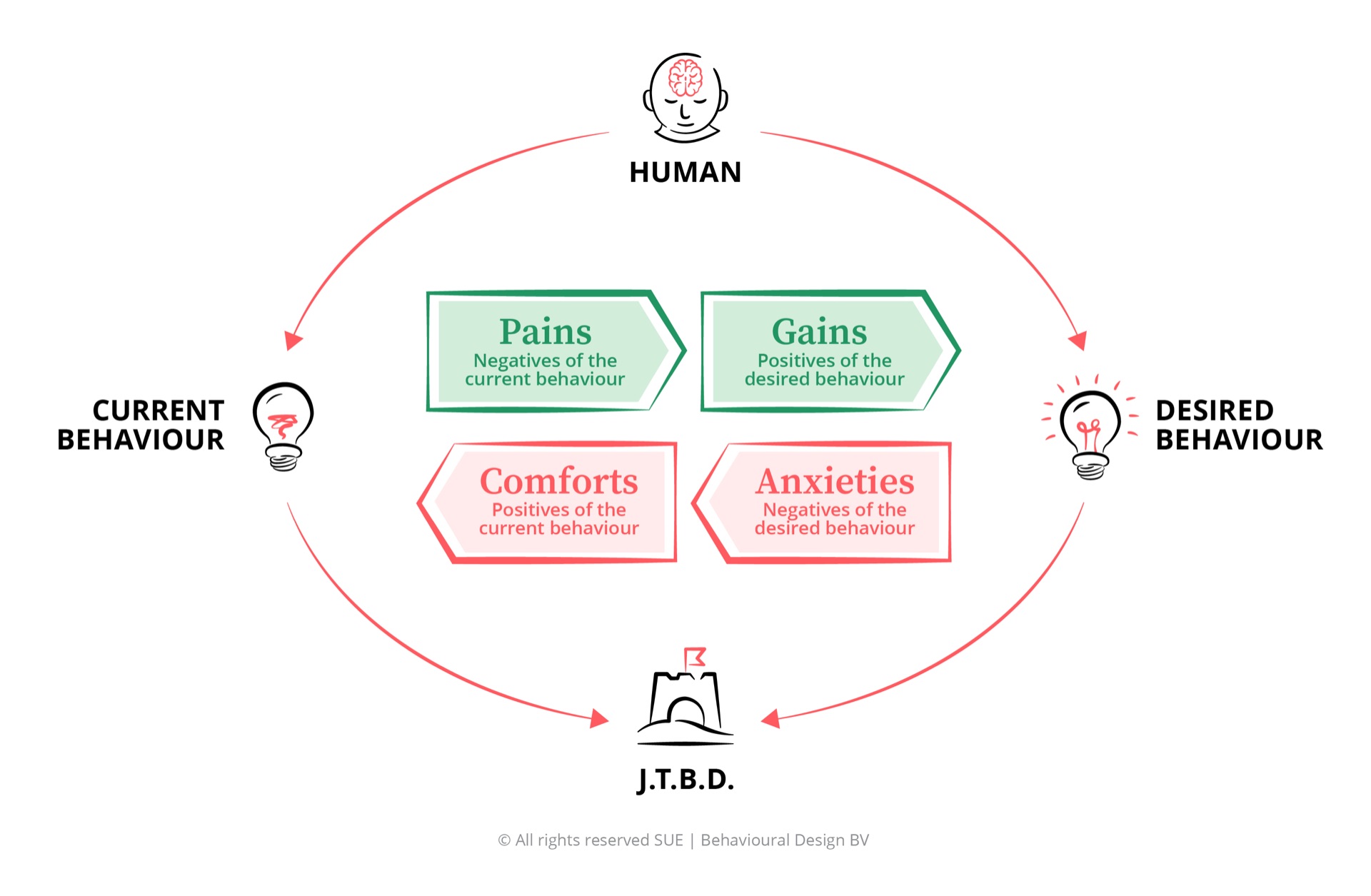
You hear it often in organisations: “We need to communicate more positively.” Or: “People need to learn not to take feedback personally.” It sounds reasonable. But it does not work. And the Influence Framework shows why.
When you analyse negativity bias at work using the Influence Framework, you notice that the blocking forces are deeply anchored in how the brain functions.
Pains (what pushes you away from current behaviour): teams become risk-averse, talent leaves after demotivating reviews, innovation dries up. These are real costs. But they are diffuse and delayed. You do not see the connection directly. Nobody writes on their exit form: “I am leaving because of negativity bias.”
Gains (what attracts you towards new behaviour): a feedback culture in which people grow, teams that dare to experiment, better hiring decisions. Valuable, but abstract and in the future.
Comforts (what keeps you in current behaviour): and here is the core of the problem. Negativity bias feels productive. Focusing on what went wrong feels like thoroughness. It feels like quality control. If you only say positive things in a performance review, that feels like weak feedback. If you only name risks in a meeting, that feels like responsible leadership. The bias disguises itself as professionalism.
Anxieties (what holds you back from changing): if you start communicating structurally more positively, are you not being naive? Will you not be seen as soft? Will you lose your critical edge? The fear of not being taken seriously keeps people trapped in a pattern where the negative automatically gets priority.
The comfort of “being critical feels professional” and the anxiety of “being seen as soft” are together powerful enough to override any rational argument about better feedback. You cannot think your way out of it. The bias operates beneath conscious thinking.[5]
Five interventions that change the environment, not the person
The solution to negativity bias is not awareness. It is redesigning the processes and structures within which decisions are made. Change the environment, not the person.
1. Build feedback protocols with a mandatory ratio. Structure performance conversations so that positive observations are named explicitly and first, in a ratio of at least 3:1. This is not a trick. It compensates for the asymmetric processing of positive and negative information. Microsoft redesigned its review system around “growth mindset” principles: feedback begins with what is going well and why, before improvement points are discussed. It did not change the message. It changed the sequence and the structure.
2. Design “pre-mortems for success” alongside risk analyses. Most decision-making processes ask: “What could go wrong?” That is valuable. But if you only ask that, you feed the negativity bias. Add a mandatory block: “Imagine this project becomes a major success. What made it possible?” This forces the team to think through positive scenarios as systematically as negative ones.
3. Make successes structurally visible, not just failures. Most organisations have incident reports, complaint logs and post-mortems for failures. How many have a structured process for analysing and sharing successes? Spotify’s “Win Wall” makes success stories physically visible. It is not a feel-good poster. It is an environmental intervention that compensates for the fact that the brain forgets successes faster than failures.
4. Use blind assessments in hiring and talent decisions. When interviewers read each other’s feedback before the group discussion, the most negative observation gains disproportionate influence. Have interviewers record their assessment individually against pre-defined criteria before they see each other’s input. This prevents one negative data point from hijacking the entire group decision.
5. Design safe space for failure with explicit boundaries. Psychological safety requires more than a CEO saying failure is allowed. It requires structures that explicitly and predictably limit the consequences of failure. Define in advance: how much budget can an experiment cost before it needs approval? What is the maximum duration? What concretely happens if the experiment fails? When people know the boundaries of the playing field, they dare to play in it.
How negativity bias interacts with other biases
Negativity bias rarely operates alone. In the workplace it amplifies other biases in a way that multiplies the damage.
Loss aversion is the closest relative. Kahneman and Tversky showed that losing something you have weighs roughly twice as heavily as gaining something equivalent. Negativity bias is the broader tendency: all negative information weighs more heavily, even when no personal loss is at stake. Together they create a double amplification. A team that risks losing a project (loss aversion) and is focused on everything that went wrong (negativity bias) becomes paralysed.
Confirmation bias makes it worse. Once your brain is oriented towards the negative, you start selectively seeking information that confirms that negative impression. The employee who missed one deadline is unconsciously judged more harshly on every subsequent task. You look for signs that confirm your negative picture and ignore evidence that contradicts it.
The halo effect works in reverse here. Where the halo effect lets one positive trait colour everything, the negative variant (the “horn effect”) does the same with one negative trait. Negativity bias ensures the horn effect is structurally stronger than the halo effect.
And the availability heuristic adds another layer: because negative experiences are stored with more emotional charge, they are also easier to recall from memory. When someone asks you how the project is going, the problems surface faster than the successes. Not because there are more problems. But because they are more readily available in your memory.
Frequently asked questions
What is negativity bias at work?
Negativity bias is the brain’s tendency to weigh negative experiences and information more heavily than positive ones. At work, this means one critical point in a performance review, one failed project or one negative customer review has more impact on decisions than dozens of positive signals. It is a System 1 process that operates automatically and below conscious awareness.
What is the difference between negativity bias and loss aversion?
Loss aversion specifically concerns the fear of losing something you already have. The loss weighs roughly twice as heavily as an equivalent gain. Negativity bias is broader: the brain gives all negative information more weight, even when no personal loss is at stake. You can think of negativity bias as the overarching tendency, and loss aversion as a specific manifestation of it.
How much positive feedback do you need to offset one negative?
Research by Baumeister et al. (2001) suggests that negative experiences weigh roughly five times as heavily as positive ones. In a team context, Losada and Heaphy (2004) found that high-performing teams had a ratio of approximately 3:1 to 6:1 positive-to-negative in their daily interactions. The exact ratio varies by context, but the direction is clear: you structurally need more positive than negative.
Can you unlearn negativity bias?
No. Negativity bias is a System 1 mechanism that is deeply rooted in evolution. It helped our ancestors survive by detecting danger faster than opportunity. You cannot switch it off by thinking about it. The solution is designing work environments that structurally compensate: feedback processes with mandatory positive components, decision-making protocols that weigh both risks and opportunities, and assessment systems with pre-defined criteria.
How does negativity bias affect company culture?
Negativity bias creates a culture of risk avoidance. When mistakes weigh five times more heavily than successes, employees learn to avoid risks rather than seize opportunities. Teams stop experimenting. Innovation dries up. The irony is that this happens invisibly. Nobody consciously decides to be less innovative. It is the automatic consequence of an environment in which the negative receives more attention than the positive.
Conclusion
Want to learn how to structurally improve feedback and decision-making in your organisation? In the Behavioural Design Fundamentals Course you learn to apply the Influence Framework and the SWAC Tool to diagnose cognitive biases and design environments that work better. Rated 9.7 by 10,000+ professionals from 45+ countries.
PS
At SUE our mission is to use the superpower of behavioural psychology to help people make positive choices. Negativity bias reminds me time and again how deep the gap is between what we rationally know and what our brain automatically does. We know the performance review was predominantly positive. We only feel the negative point. We know the team is performing well. We only remember the time it went wrong. The first step is accepting that your brain works this way. The second step is to stop trying to repair the brain, and to start repairing the environment.