A staircase painted as a piano keyboard. Floor stickers pointing toward a bin. An app that gives you a badge when you have exercised three days in a row. A canteen card where vegetables are the automatic default and meat requires an active choice. These are all attempts to influence behaviour. But they work in fundamentally different ways.
Two approaches dominate the conversation when it comes to behaviour change without coercion: nudging and gamification. Both are popular. Both are regularly misused or deployed in the wrong context. And the question of which to choose depends on something most designers and policymakers never state explicitly: what kind of behaviour are you actually trying to change?
Nudging adjusts the choice environment so that the desired behaviour becomes the easiest option, without restricting the person's freedom. It works through System 1: automatic, below conscious awareness.[1] Gamification adds game elements, such as points, badges and leaderboards, to make behaviour more attractive through motivation and reward. It works through engagement. When nudging fails: when behaviour requires deep motivation over a long period. When gamification fails: when novelty wears off and the overjustification effect undermines intrinsic motivation. The strongest approach combines both: gamification for initial engagement, nudging for sustained behaviour.[2]
| Dimension | Nudging | Gamification |
|---|---|---|
| Focus | Make the desired choice the easiest option | Make the desired behaviour more engaging |
| Scientific basis | Behavioural economics (Thaler & Sunstein) | Motivation psychology, game design theory |
| Primary method | Defaults, choice architecture, framing | Points, badges, leaderboards, progress bars |
| Example | Healthy food at eye level in a canteen | Fitness app rewarding streaks with badges |
| When to use | Routine or low-involvement choices | New habits that need initial motivation |
| Blind spot | Fails when deep motivation is required | Overjustification effect undermines intrinsic motivation |
What nudging is and how it works
Nudging is a concept Richard Thaler and Cass Sunstein introduced in their 2008 book of the same name. The core idea: you can steer behaviour by changing the architecture of choices, without imposing bans or financial incentives. You change the environment, not the person.
A school canteen that places fruit at eye level and fizzy drinks at the back of the refrigerator changes nothing about the availability of those products. Students can still reach for the fizzy drink. But the default, the path of least resistance, is now the fruit. And because most behavioural choices are made through System 1 thinking, automatic and largely unreflective, that architecture has a large influence on what people actually choose.
Nudges work best for:
One-time or infrequent choices where the choice environment is decisive. Think pension enrolment, organ donation, default settings for privacy preferences. When the right choice is the default, the majority choose it, simply because switching requires cognitive effort.
Routine behaviour where automaticity dominates. The position of healthy food in a canteen, the order of options in a form, the layout of an office that encourages collaboration or does not. These are all environmental factors that steer behaviour without people noticing.
Low-involvement behaviour. When people are not thinking much about a choice, the architecture of that choice has disproportionately large influence.
The most powerful nudge is one that works without people realising they are being steered. But that is also the ethical boundary that must be carefully watched.
What gamification is and how it works
Gamification is the application of game principles to non-game contexts to stimulate engagement, motivation and behaviour change. The concept gained prominence around 2011, with a classic definition from Deterding and colleagues as its starting point: the use of game design elements in non-game contexts.[2]
The best-known elements: points for desired behaviour, badges as milestones, leaderboards that activate social comparison, progress bars that trigger a desire for completion, challenges and quests that provide direction. All of these work through motivation psychology: they make the desired behaviour more attractive by adding reward, status and a sense of progression.
Gamification works best for:
Behaviour with intrinsic resistance. Exercise, learning, disliked tasks. When behaviour creates resistance, gamification adds a motivational layer that lowers the threshold.
Building new habits. In the early phase of behaviour change, when the new behaviour still costs effort and reward seems far away, gamification can provide immediate positive feedback that encourages persistence.
Social behaviours. Leaderboards and team challenges activate social comparison and the desire to contribute. In workplace contexts this can be powerful for team goals.
When nudging fails and when gamification fails
This is the part that is missing from most articles on nudging and gamification: both approaches have structural limits that are often overlooked.
The limits of nudging
Nudging works through the choice environment. But if the environment is not the determining factor in the behaviour, a nudge helps little. When someone is actively resisting a change, a default adjustment does not work. When behaviour requires deep motivation over a long period, such as quitting smoking, exercising consistently or developing a complex new skill, the architecture of choices provides insufficient support.
There is also the risk of habituation. People learn to recognise nudges and consciously circumvent them. A fruit bowl at eye level works well in the first few months. If canteen visitors suspect they are being steered and experience it as paternalistic, it can trigger a reactance response: people deliberately make the opposite choice to assert their autonomy.
The limits of gamification: the overjustification effect
Gamification has a far more fundamental structural weakness: the overjustification effect. This psychological phenomenon, documented from the 1970s onward, describes what happens when you add extrinsic rewards to behaviour that people already find intrinsically motivating.
Someone who exercises because they enjoy it begins exercising for points in an app. What then happens: intrinsic motivation weakens. The exercise is no longer an end in itself but a means to earn points. And once the app disappears, the badges stop coming or the novelty of the system wears off, the behaviour disappears with it. Sometimes to below the level before the intervention.
This is one reason why so many gamification projects collapse after an initial success. The engagement was real but artificially driven. Once the external trigger falls away, it becomes clear the habit was never truly formed.
Which approach to choose when: the Influence Framework as a compass
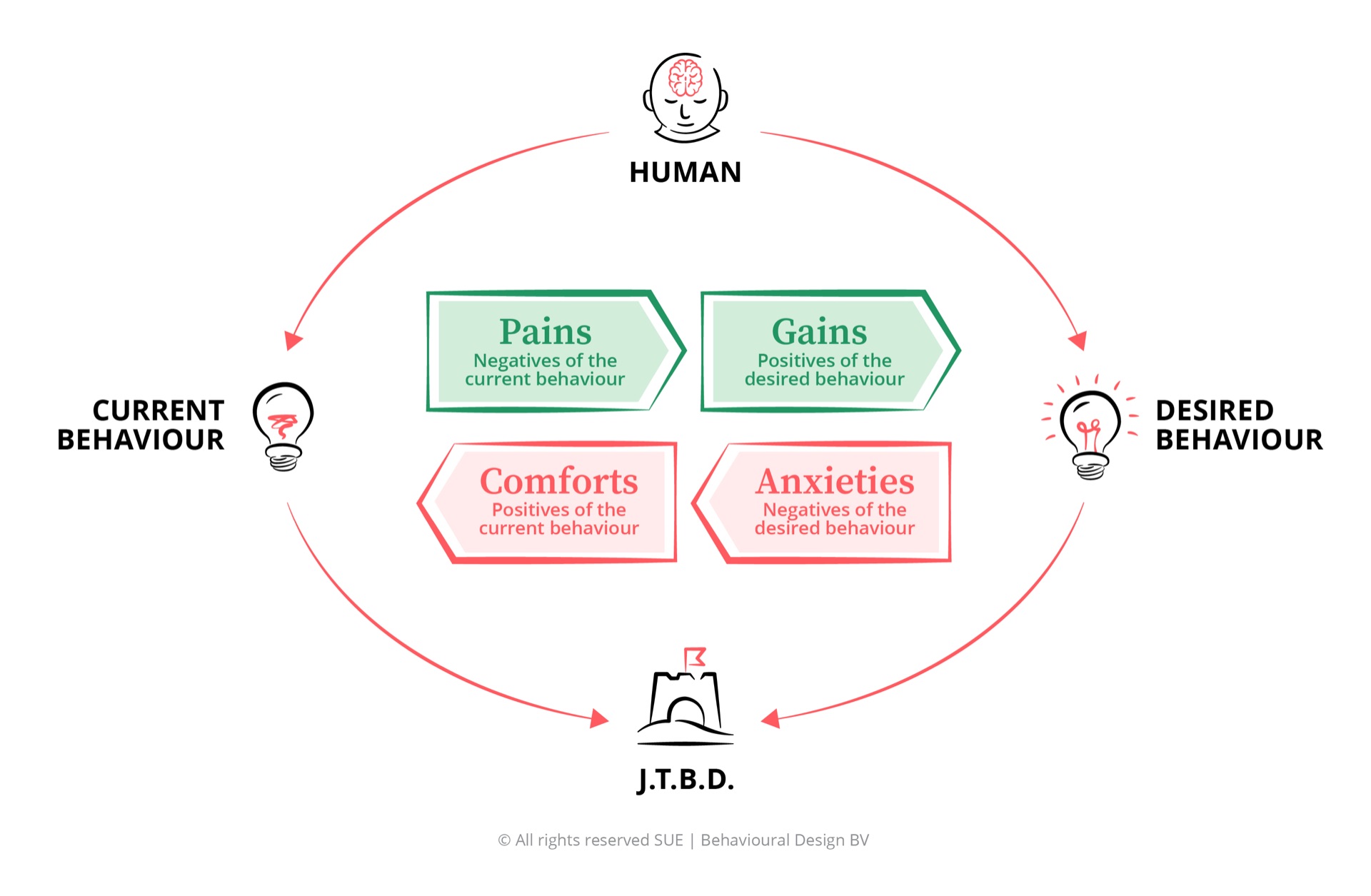
The question “nudging or gamification?” is actually the wrong question. The right question is: what keeps people in their current behaviour and what prevents them from adopting the desired behaviour? Only when you know that can you choose the right intervention.
With the Influence Framework you analyse four forces:
If the Comforts of current behaviour lie primarily in ease, habit and automaticity, then a nudge is the appropriate intervention. Make the desired behaviour as easy as or easier than the current behaviour.
If the Anxieties around new behaviour lie primarily in demotivation, boredom or a lack of immediate reward, then gamification is the appropriate intervention. Add motivational stimuli that bridge the initiation period.
If both forces are at play, combine them. That is almost always the most effective approach.
The power of combining: gamification for initiation, nudging for duration
The most robust behaviour change uses both approaches strategically. Here is the logic:
In the initiation phase, the main problem is that people do not start. The behaviour is new, the routine does not yet exist, immediate reward is absent. Here gamification works: instant feedback, badges for early milestones, social comparison that strengthens motivation. Duolingo does this masterfully. The first weeks of a language course are gamified to the core, and that works to keep people on board.
In the sustaining phase, the main problem is that people revert to old behaviour once novelty fades. Here nudging works: making the desired behaviour the default, designing the environment so the new behaviour costs less cognitive energy than the old one, making social norms visible that confirm the new behaviour. At this point the environment takes over from motivation.
A concrete example: a city wants more residents to cycle. Gamification: an app that rewards cycling kilometres, with neighbourhood leaderboards and badges for cycling in the rain. Nudging: better cycling infrastructure, free bike hire at the railway station, car parking moved to the edge of the city centre. The app motivates people to start. The infrastructure ensures cycling remains the easiest option.
Frequently asked questions
What is the difference between nudging and gamification?
Nudging adjusts the choice environment so that the desired behaviour becomes the easiest option, without restricting the person's freedom. It works through System 1: automatically, below conscious awareness. Gamification adds game elements such as points, badges and leaderboards to make behaviour more attractive through motivation and reward. It works through engagement and making the right choice more enjoyable.
When does nudging not work?
Nudging works best for one-time or routine behaviours where the choice environment is the determining factor. It works less well when behaviour requires deep motivation over a longer period, when people actively resist, or when the barriers to the desired behaviour are structural and cannot be resolved through the choice environment.
What is the overjustification effect in gamification?
The overjustification effect occurs when external rewards such as points or badges undermine the intrinsic motivation for an activity. People who originally did something because they enjoyed it stop when the external reward disappears. In gamification this means that once the badges and leaderboards are removed, the behaviour disappears with them. This is a structural weakness of gamification for activities with high intrinsic value.
How do you combine nudging and gamification effectively?
The strongest approach combines both. Use gamification in the initiation phase to get people started and engaged. Use nudging for the sustaining phase: once people begin, the right choice environment ensures the desired behaviour remains the easiest route. Gamification for the start function, nudging for the sustainability function.
Is nudging manipulation?
This depends on the transparency and intention behind the nudge. Thaler and Sunstein introduced the concept as libertarian paternalism: the choice environment is designed in the person's interest, without restricting the freedom to choose differently. A nudge is ethically sound when you can make it public without it ceasing to work. If you would not want to disclose a nudge publicly, that is a signal you are moving toward manipulation.
Conclusion
Nudging and gamification are not competitors but complements. Nudging works through the architecture of choices and is most effective for behaviour where automaticity and ease are the determining factors. Gamification works through motivation and is most effective for bridging the initiation phase. Want to learn how to apply these insights to your own behavioural challenge? In the Behavioural Design Fundamentals Course you learn to apply the Influence Framework to choose the right intervention for your specific context, rated 9.7 out of 10 by 5,000+ alumni from 45 countries.
PS
The most useful question to ask before choosing nudging or gamification is: what actually keeps people in their current behaviour? If the answer is “ease”, nudge. If the answer is “lack of motivation”, gamify. If the answer is more complex, which it almost always is, use the Influence Framework to work it out systematically before designing an intervention. The toolkit is only useful when you know which problem you are solving.