The word “ownership” appears on virtually every organisational agenda. Leaders want it. HR managers want it. Consultants promise it. And yet fostering employee ownership remains a frustrating endeavour in most organisations. Not because employees don’t want it, but because the context that should enable initiative is rarely well designed.
The standard response to a lack of ownership is a communication campaign, a mindset training programme or a mention in the annual performance review. None of the three works structurally. And behavioural science explains precisely why.
Ownership is not a character trait. It is behaviour. And behaviour is always the outcome of a context. Design the context well, and ownership emerges naturally. Design the context poorly, and no appeal for “more proactivity” will move you a single step forward.
The ownership paradox: demanded but not designed
In most organisations, ownership is demanded but not designed. That is the core of the paradox. Leaders talk in town halls about “entrepreneurship from within.” HR builds a competency profile with “ownership” as a core value. And on the wall hangs a poster with the words: We take ownership.
Meanwhile, the systems and structures of the organisation are built on control and compliance. Decisions are made centrally. Initiative without permission is punished. And the reward system - pay rises, bonuses, promotions - primarily rewards those who quietly do what is asked of them.
This is what I call the ownership design gap. Between what organisations say they want and how they have structured their context, there is a fundamental divide. And information never bridges that divide.
Most organisations design for control and then wonder why ownership never appears.
Behavioural science is clear on this: information does not change behaviour. If people already know that ownership is desired - and they do, because you have been saying it for years - then a lack of information is not the problem. The problem runs deeper: in the forces that hold people in a waiting posture, and in the forces that block ownership before it can even emerge.
What blocks ownership: a behavioural analysis
If you want to build employee ownership, you first need to understand why it is absent. For this I use the SUE Influence Framework™: an analytical model that makes visible the unconscious forces that drive behaviour.
From the perspective of the employee, it looks like this.
Comforts - why waiting feels so comfortable:
- Waiting for instructions is safer than acting on your own initiative
- The reward system rewards compliance, not initiative
- “That’s not my job” is a legitimate answer when ownership boundaries are unclear
- The habit of passing responsibility up the chain is deeply ingrained in hierarchical organisations
Anxieties - what blocks ownership:
- The risk of failure is personally visible - and can have career consequences
- An unclear mandate: how much can I actually decide on my own?
- No psychological safety: earlier initiative was ignored, corrected or even punished
- The fear of micromanagement if you act outside expected boundaries
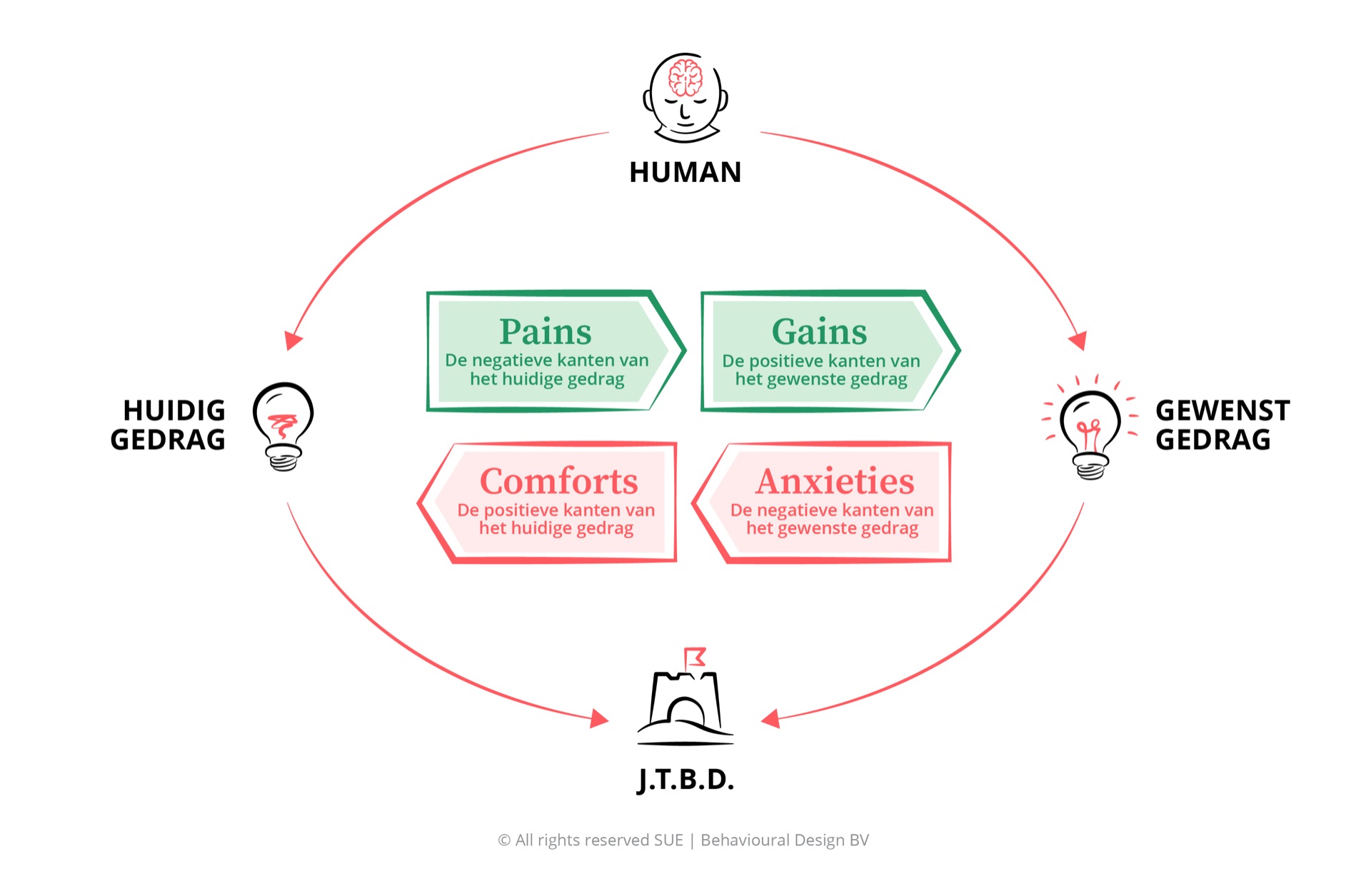
What would move people toward ownership are the Pains - frustrations with the status quo that they want to solve themselves - and the Gains: the feeling of impact, meaningful work, recognition and professional growth. But as long as the Comforts of waiting outweigh the Gains of initiative, and as long as the Anxieties around failure remain unaddressed, ownership will not appear.
This brings us to one of the most powerful insights from behavioural science: the fundamental attribution error.[2] When employees fail to show ownership, managers’ default response is: “They’re not motivated enough” or “They lack an entrepreneurial spirit.” But almost always the problem is the context, not the character. Good people, bad circumstances.
The autonomy–commitment connection
There is a behavioural principle that every leader who wants to foster ownership must understand: psychological reactance. When people feel their autonomy is being restricted - when they are told what to do - they naturally resist. Not out of stubbornness, but as a basic mechanism of the human brain.
The antidote is equally powerful and intuitive: restore the sense of autonomy. And the most powerful way to do this is by letting people reach their own conclusions through questions, rather than giving them answers.
Case: the Sherpa Prep method
One of my favourite illustrations of this comes from an unexpected corner: GMAT preparation for MBA candidates. In the Sherpa Prep approach, the instructor never began a session with a schedule or a study plan. Instead, he asked his students a series of questions:
- “Why do you actually want to go to graduate school?”
- “Which school is your first choice?”
- “What GMAT score do you need for that?”
Students answered themselves: “720” or “760.” They named their own target. The instructor then asked: “What is your current average?” Say: 580. Then came the simple question: “How many more points do you need?” And finally: “Would you like to know how many hours of study that requires?”
Students asked for it themselves. And when they got the answer - “Count on around 300 hours” - they accepted it. No resistance. No negotiation. They had reached the conclusion themselves. They had become the owner of the goal, and with it, the owner of the path to get there.
Ask questions → restore autonomy → commitment → behaviour. That is the ownership formula.
Translated to the organisation: if you want employees to take ownership of a problem or a change, don’t start with the solution. Start with the diagnosis. Let people name the pain themselves, formulate the goal themselves, see the gap themselves. The initiative that follows is not your initiative - it is theirs.
Designing ownership: the SWAC approach
The SWAC model - Can, Want, Spark, Again - is a practical framework for designing behaviour. Applied to fostering employee ownership, it looks like this.
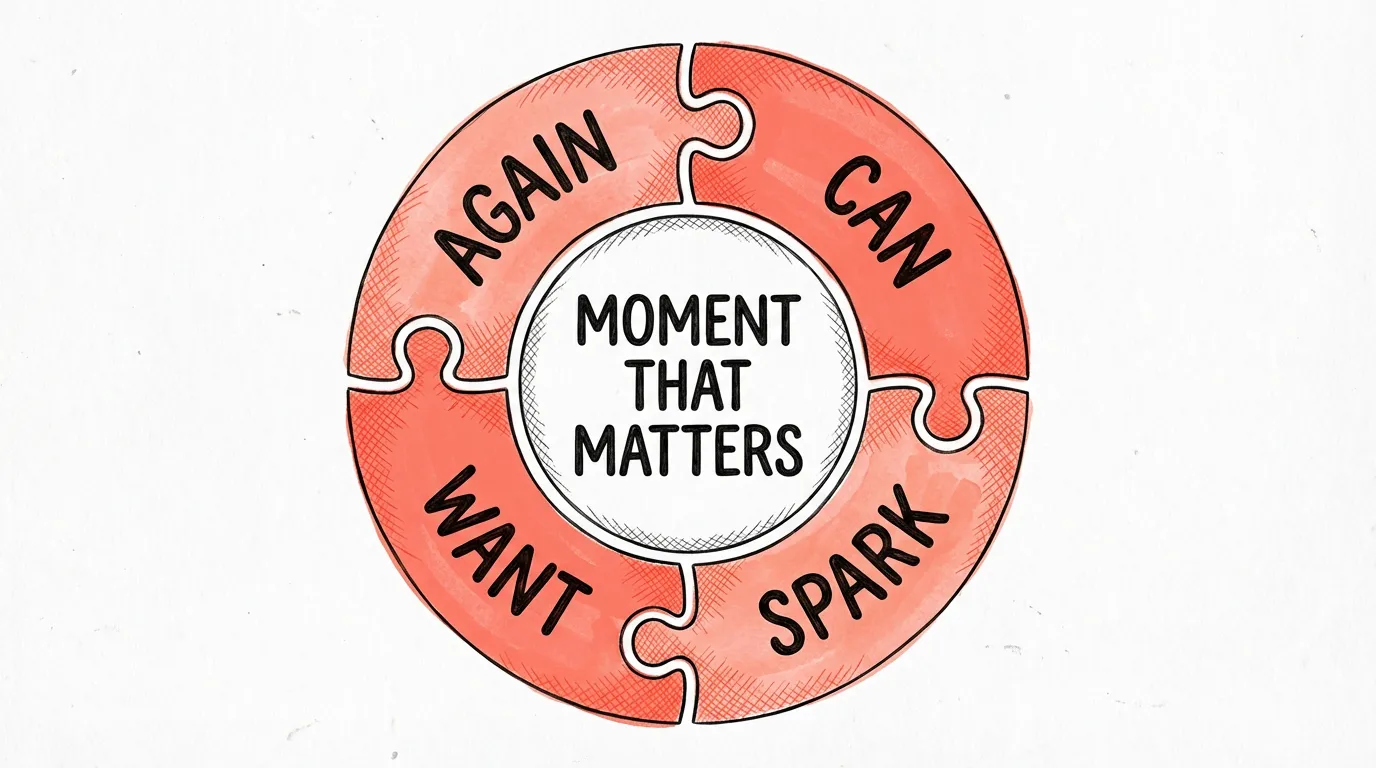
CAN - Make ownership possible
The first question is not “does someone want to take ownership?” but “can someone take ownership?” In many organisations the answer is: no, because the mandate is unclear.
- Clear mandate: Define explicitly what someone may decide independently, without asking for permission. Vague boundaries lead to a waiting posture.
- Simplified escalation: If escalating is unnecessarily complex, nobody does it. Make the route upward simple enough that people know when they can act autonomously and when they cannot.
- Psychological safety: As long as making mistakes has personal consequences, waiting is rational. Create an environment where experimenting and failing is informative, not punishable.[1]
WANT - Make ownership attractive
Ownership must be rewarding - not only in abstract terms like “personal growth,” but concretely and visibly.
- Recognition for initiative: Name explicitly and publicly when someone shows ownership. Visible rewarding of behaviour is one of the most powerful behavioural interventions that exists.
- Autonomy over meaningful work: Ownership over a task that nobody finds meaningful is not motivating. Connect independence to work that matters.
- Purpose connection: Show people how their initiative contributes to something larger. Making impact visible increases the intrinsic motivation to take ownership again.
SPARK - Trigger ownership
Even when people can and want to take ownership, there needs to be a trigger that sets the behaviour in motion.
- Involve people in problem diagnosis: Ask employees what they see as the problem before you present the solution. This activates ownership over both the problem and the solution.
- Regular “what would you do?” conversations: Make it a habit to ask people for their own analysis and ideas. Every time someone formulates an answer, they take a little ownership of the issue.[3]
- Start small: Ownership over a large, complex issue feels overwhelming. Start with small, clearly delineated domains where initiative has an immediately visible effect.
AGAIN - Make ownership a habit
One-off ownership is not a culture change. The goal is to repeat ownership until it becomes the norm.
- Team rituals: Build regular moments into which ownership is demonstrated and rewarded - a weekly opening where someone shares their own initiative, a retrospective where ownership takes centre stage.
- Consistent positive feedback: Every time ownership behaviour is rewarded, you increase the likelihood it will be repeated. This is not soft management - this is behavioural science.
- Activating social norms: People look at what the norm is in their team. When ownership is visibly the norm, others conform to that norm.
What managers need to do differently
Most managers are trained to solve problems, not to leave them to others. That is their strength as an individual contributor - and their blind spot as a leader who wants to foster ownership.
The core shift is from giving answers to asking questions. This sounds simple but is fundamentally different in practice. Every time a manager solves a problem that an employee brings to them, they reinforce the habit of passing responsibility upward. Every time they instead ask “what do you think we should do?”, they are designing ownership.
The second shift is from ownership over outcomes to ownership over the context. Managers are used to being responsible for results. But when it comes to fostering ownership, their primary responsibility is designing the environment: the mandate, the safety, the recognition systems. Not controlling every decision made within that environment.
The manager as ownership architect designs the garden. The employee decides what grows in it.
Want to read more about why change programmes fail? Or about how to involve employees in change? Those insights connect directly to this article.
The role of leadership
Ownership starts at the top. Not because leaders should claim ownership over everything, but because the psychological safety that makes ownership possible is created by leadership. Or not.
A leader who corrects employees when they make a decision that did not have their approval teaches the organisation one thing: always wait for permission. A leader who says “I might have done it differently, but I can see why you chose this - let’s see what we can learn from it” - that leader designs a safe space for ownership.
Leaders who want to see ownership must model it themselves. That means: publicly naming your own doubts, acknowledging your own mistakes, asking questions instead of giving answers in meetings. Leading by example is not a communication strategy - it is the most powerful behavioural design that exists.
The decision fatigue that pervades many organisations is also a direct obstacle to ownership. When employees feel that every decision costs energy and carries risk, they automatically make fewer decisions. Simplify the decision landscape, and ownership increases.
Finally: ownership also requires intrinsic motivation. That motivation does not arise from control or extrinsic incentives, but from autonomy, mastery and meaning. Leaders who design the context so that employees experience those three elements no longer need to ask for ownership - it emerges on its own.
Conclusion
Building employee ownership is one of the most cited organisational goals - and at the same time one of the least effectively designed. The reason is simple: organisations treat ownership as a trait you can enforce through communication or training, when in reality it is a behaviour you can design by creating the right context.
Behavioural science shows us the way. Remove the Comforts that make waiting attractive. Take away the Anxieties that block initiative. Restore autonomy by asking questions instead of giving answers. Design a context in which ownership is not only desired, but also the logical, safe choice.
No poster. No mindset training. Design.
Frequently asked questions
How do you build a sense of ownership in employees?
Building ownership is not done by communicating it or training for it, but by redesigning the context. Give a clear mandate (what can someone decide independently?), create psychological safety, visibly reward initiative, and involve people in diagnosing the problem before solutions are conceived. Asking questions instead of giving answers is the most powerful lever a leader has.
Why don't employees take ownership?
In most cases, a lack of ownership is not a character issue but a context problem - the fundamental attribution error. Employees don’t take initiative because it’s riskier than waiting, because the mandate is unclear, because earlier initiatives were ignored or punished, or because the reward system rewards compliance instead of initiative. The context makes non-ownership the rational choice.
What is the role of leadership in ownership?
Leaders who want to see ownership must model it themselves and design the context that makes ownership possible. That means: asking questions instead of giving answers, treating mistakes as learning moments rather than failures, and creating psychological safety by showing vulnerability themselves. The leader as ownership architect designs the environment, not the outcome.