Picture this: a three-day company offsite. Day one is good. Day two is genuinely great, anchored by a keynote speaker who leaves everyone electric. Day three ends in chaos. The transfer to the airport goes wrong, the flight has a two-hour delay, people are standing in the rain next to their luggage on a car park tarmac.
Six months later, ask anyone how the offsite was. They remember two things: that keynote, and the airport disaster. Three days compressed into two moments. Everything in between, the decent meals, the good conversations, the comfortable hotel rooms, has more or less dissolved.
This is the peak-end rule at work. And it changes, fundamentally, how you should think about designing experiences for customers, employees and everyone who comes into contact with your organisation.
The peak-end rule is the psychological principle that people judge experiences primarily by their most intense moment (the peak, positive or negative) and their ending, not by the average or total duration. Identified by Daniel Kahneman based on research by Barbara Fredrickson. In the SUE Influence Framework, this sits under Gains: you can engineer memorable experiences by deliberately designing precisely these two moments.
What is the peak-end rule?
In 1993, Daniel Kahneman and Barbara Fredrickson published research that permanently changed the psychology of memory. They asked participants to submerge their hand in cold water, in two separate conditions. In the first, the hand was held in 14-degree water for 60 seconds, after which the experiment stopped. In the second, those same 60 seconds were followed by a further 30 seconds as the water temperature slowly rose to 15 degrees, a barely perceptible difference.[1]
Participants were then offered a choice: which version would they repeat if they had to do it again? The majority chose the second. The longer, objectively more painful session. Not because they enjoy discomfort, but because that second session ended with something that felt fractionally less bad. The ending coloured the memory of the entire experience.
This is what Kahneman called the distinction between the experiencing self and the remembering self. The experiencing self lives in the moment: pain is pain, pleasure is pleasure. But the remembering self constructs a summary afterwards, and that summary follows two rules. Rule one: the peak counts. Rule two: the ending counts. Everything in between is largely ignored.[2]
Kahneman called this duration neglect: the length of an experience has almost no influence on how we evaluate it. A pleasant concert of ninety minutes that ends abruptly due to a technical failure is remembered worse than one that closes warmly and with ceremony. Length does not count. The ending does.
It is a System 1 process: fast, automatic, entirely outside conscious control. Your brain constructs this summary without you having any say in the matter. What you afterwards believe you experienced is a construction, not a faithful record.
You don’t experience what happened. You experience what you remember.
The implications for the workplace are significant. If people evaluate experiences not on the average but on two specific moments, that is a design principle. You can create those moments deliberately.
Three scenarios where it changes everything
Scenario 1: The onboarding you forget and the onboarding that stays with you
A new employee starts on Monday. The first week is well organised: laptop ready, a tour of the office, a welcome lunch with the team, a clear induction plan. Then the real period begins: three months of figuring things out alone, little feedback, no clear milestones, a manager who is perpetually busy.
Ask that employee six months later how onboarding went. They will remember the three months of ambiguity and silence, not the solid first week. Because the first week was the beginning, not the peak, and certainly not the ending.
Compare this with an organisation that approaches onboarding differently. The first week is fine but unremarkable, except for one moment: on Friday afternoon, the organisation’s director invites everyone for a thirty-minute conversation. Not to discuss the job, but to ask: what do you want to achieve here? What do you want to learn? That conversation is the peak. The moment where the new employee feels: I am welcome here. My growth matters. And three months later, the formal induction period closes with a lunch where the new colleague shares what they have learned and what they want to contribute.
Two onboardings. The first objectively better in week one. The second better remembered, better rated, and likely leading to stronger engagement. Not because everything else was superior, but because a peak and a deliberate ending were designed into the experience.
Scenario 2: The hotel that puts a chocolate on your pillow at checkout
There is a well-documented phenomenon in hospitality: a hotel with consistently average service scores worse in reviews than one with comparable or even slightly inferior service overall, but with a strong close. Why? Because reviews reflect the remembering self, not an objective tally of service quality across every touchpoint.
Ritz-Carlton understands this. Their training programmes are explicitly designed to create unexpected, personal moments at checkout. A remark that shows staff paid attention. A small gesture that communicates genuine care. That ending colours the entire stay.
IKEA understands it too, though it sounds more prosaic: the cheap hot dog at the exit is not an afterthought. It is a deliberately engineered close to the shopping experience. You have spent ninety minutes navigating a labyrinth, your trolley is full of flat-pack boxes, and then the experience ends with something unexpectedly pleasant. Positive ending. Positive memory of the total experience.
Disney goes further still. The park days at Disneyland and Walt Disney World end with fireworks. Not because fireworks are cheap, but because the peak and the ending converge in a single spectacular moment. Parents who queued for hours, children who were exhausted and fractious, overpriced lunches: all of that recedes behind the fireworks display. The memory is magical, even if the day was not entirely so.
These are not accidental choices. This is peak-end design, applied deliberately to customer journeys.
Scenario 3: The meeting that drifts versus the meeting that lands
You know this type of meeting. Ninety minutes. The agenda was full, the discussion went well, there were interesting insights. But at the end things unravel: someone surfaces a new point at the last minute, time runs out, people are already closing their laptops while others are still talking, the close is vague. “OK, let’s pick this up.” Nobody quite knows what was decided. Nobody knows exactly what they are now supposed to do.
Six months later, if someone asks how that meeting was: inefficient. Chaotic. A waste of time. Even though the content was not actually bad.
Compare this with a meeting of the same length, but with a deliberate ending. The final five minutes are reserved for three things: what did we decide, who is doing what before when, and what is the single most valuable insight everyone takes away. Those five minutes cost you nothing. They give you a meeting that is remembered as effective, even if the discussion beforehand was messy.
Leaders who understand how the peak-end rule works design their meetings differently. They engineer a peak, a moment of genuine sharpness or a decisive insight, somewhere in the middle. And they protect the ending as though it is the only thing that counts. For the remembering self, it is.
The peak-end rule and the Influence Framework: this is a Gains story
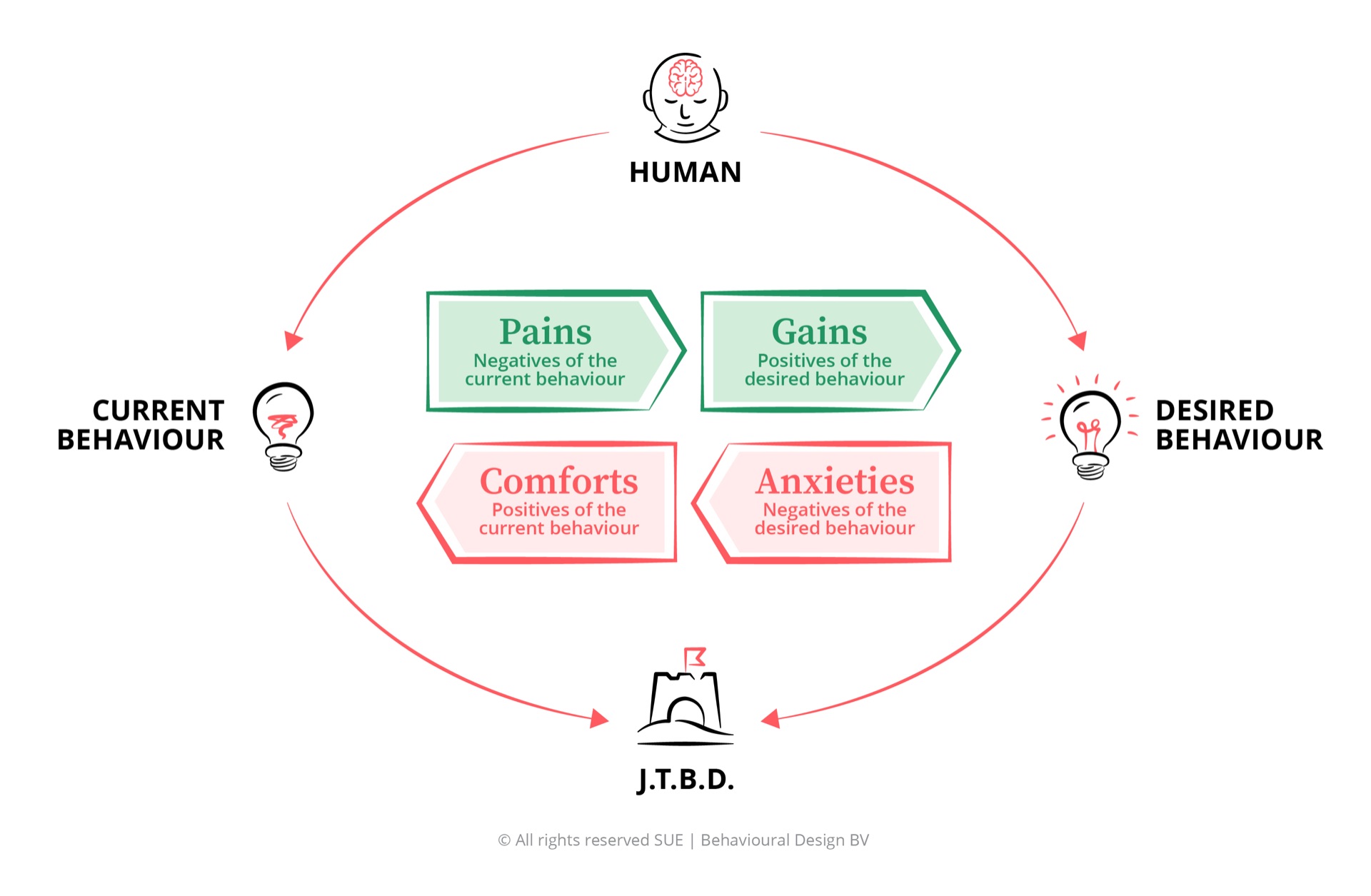
Within the SUE Influence Framework, we analyse behaviour through four forces: Pains, Gains, Comforts and Anxieties. The peak-end rule sits primarily under Gains, but it is a particular kind of Gain.
Ordinary Gains are the benefits people consciously pursue: a better role, higher revenue, greater satisfaction. The Gain of the peak-end rule is subtler and more powerful at the same time: it is the Gain of a lasting memory. People do not consciously seek out peaks and strong endings. But they evaluate everything on those two moments.
This makes the peak-end rule not just a psychological insight but a design principle. You do not need to make the entire experience perfect. That is impossible and unaffordable. You need to design two moments: the moment at which intensity is highest, and the moment at which the experience closes.
The Comforts are relevant here too: the tendency to design experiences as smooth progressions, step by step, everything equally polished, means no genuine peak ever emerges. Everything is average. And average is forgotten. The Anxiety: deliberately engineering a peak means other moments receive less attention. That feels like neglect. In reality it is smart prioritisation.
The intervention is always the same: stop trying to make everything uniformly good. Start with the question: what is the peak we want to deliberately create, and how does this experience end?
Five concrete interventions
1. Design the ending deliberately
For every experience you design, whether a customer journey, an employee programme, an event or a meeting, the question starts at the ending. How does this close? What is the last thing people experience? Is it a strong moment, or a slow fade? If the last thing customers do after a purchase is wait for a confirmation email that never arrives, that is the ending of their experience. Design that ending with the same care as everything else.
2. Create intentional peak moments
Identify, in every customer or employee journey, the moment with the highest potential for intensity. Not the most logistically complex moment, but the one where emotional impact can be greatest. Invest disproportionate attention and budget there. Let the rest be average if necessary. But that one moment needs to be exceptional.
3. Engineer the peak into onboarding
Onboarding needs a clear structure, but that structure must contain a climax. It might be a personal conversation with the organisation’s leader. An early win where the new employee contributes something real in week two and is recognised for it. Or a ritual in which the team welcomes the new colleague in a way that genuinely feels like belonging. That peak becomes the onboarding. Everything else is context.
4. Introduce closing rituals for meetings
Reserve the final five minutes of every meeting for three questions: what did we decide, who is doing what, and what is the most valuable insight from today? This is not an agenda item. It is a ritual that gives every meeting’s ending a clear shape. After a few weeks you will find that meetings are remembered as sharper and more effective, even if the discussion itself has not substantially changed.
5. Engineer the endpoints of your customer journey
Map where your customer journey actually ends. Not where you think it ends, but where the customer stops actively thinking about the experience. Is it at product receipt? At first use? At the first contact with customer service? Design that endpoint as a deliberate moment. A personal message, an unexpected extra, a handwritten note. Something that marks the ending and colours it.
How the peak-end rule connects to other biases
The peak-end rule rarely operates in isolation. In the workplace it interacts with and amplifies other cognitive phenomena that shape how we remember and evaluate experiences.
The framing effect determines how people interpret information at the moment they receive it. If the peak of an experience is framed negatively, such as bad news delivered clumsily, that colours not only the peak itself but the memory of the entire experience. Framing and the peak-end rule work together to determine how experiences are encoded in memory.
The availability heuristic means people make judgements based on how easily an example or memory comes to mind. The moments that the peak-end rule stamps as the peak and ending of an experience are precisely the moments most available in memory. They surface first when someone asks: “How was it?”
Social proof amplifies the effect: when people share their assessments in reviews, on LinkedIn or in conversation, they share what stayed with them. And what stays with them is determined by the peak-end rule. The reviews others read and trust are the output of the remembering self, not the actual experience. Well-designed peaks and endings generate better word of mouth.
The anchoring bias plays a role in how expectations are set. When a customer or employee has already experienced a strong peak, that anchors as a reference point for future interactions. A first impression that creates a peak sets the benchmark for every interaction that follows.
Frequently asked questions
What is the peak-end rule?
The peak-end rule is the principle that people judge experiences not based on their average or total duration, but on two moments: the most intense moment (the peak, positive or negative) and the ending. The phenomenon was described by Daniel Kahneman and Barbara Fredrickson based on research into pain and memory.
How does the peak-end rule work in customer experience?
In customer experience, the peak and the ending of a customer journey determine how customers rate the overall experience and whether they return. A hotel that makes checkout pleasant with an unexpected gesture scores better in reviews than a hotel with consistently average service. IKEA deliberately ends the shopping experience with a cheap hot dog. Disney ends park days with fireworks.
How do you apply the peak-end rule in employee experience?
Design onboarding with a strong peak moment in the first weeks, such as a meaningful conversation, a welcome ritual or an early win. Ensure offboarding and farewell moments are warm and respectful. End team meetings with a positive, clear moment rather than trailing off into uncertainty or the most urgent action items.
What is duration neglect?
Duration neglect is the finding that the length of an experience contributes almost nothing to how we remember and judge it. A painful medical procedure that is short but ends at its worst moment is rated more negatively than a longer procedure that ends with diminished discomfort. Length matters far less than the ending.
Why do deliberate endings matter so much in meetings?
The ending of a meeting determines how participants remember and evaluate it. A meeting that drifts into ambiguity or overruns while people are already packing up will be remembered as chaotic, even if the content was strong. A meeting that ends with a clear decision and concrete next steps will be remembered as effective.
Conclusion
The peak-end rule is not a pleasant psychological curiosity. It is a fundamental principle of how human memory works. And it has direct implications for everyone who designs experiences, whether those are customer journeys, employee programmes, events or meetings.
You do not need to make everything perfect. That is impossible. But you can design two moments: the peak and the ending. Those two moments become the experience in the memory of the people who were there. Everything in between gets averaged, forgotten and rendered irrelevant to the judgement they make afterwards.
Want to learn how to apply this in your own organisation? In the Behavioural Design Fundamentals Course you will learn to apply the Influence Framework and the SWAC Tool to analyse and design experiences that stay with people. Rated 9.7 out of 10 by 5,000+ alumni from 45 countries.
PS
At SUE, our mission is to use the superpower of behavioural psychology to help people make better choices. The peak-end rule may be the most democratic insight in that toolkit: you do not need an unlimited budget to create memorable experiences. You only need the willingness to design two moments deliberately. The peak that makes people say, “I won’t forget that.” And the ending that leaves them feeling: that was right.