Picture the scenario: you have a brilliant idea. You’ve developed it thoroughly, gathered the data, built a compelling presentation. And yet, nothing. Your colleagues nod politely, your manager says “interesting”, and then everything continues exactly as before. You can try as hard as you like to persuade and influence through facts and logic, it simply doesn’t work. Not because your idea is weak. But because you’re using the wrong entry point.
Behavioural science is unambiguous on this: people don’t make decisions through rational deliberation. They make them through fast, automatic processes that largely operate outside conscious awareness. Anyone who wants to persuade and influence must understand how those processes work, and how to engage them systematically.
This guide covers everything you need to know about influence: the definition, the psychology behind it, six proven techniques, the SUE Influence Framework, and how to start applying it tomorrow.
What is influence?
Influence is the act of changing someone else’s thoughts, feelings or behaviour. That sounds simple enough, but the term immediately raises a question: when does influencing become persuasion, and when does it become manipulation?
The answer lies not in the technique you use, but in your intention.
- Ethical influence: you help someone make a decision that is in their interest. You are transparent about what you are doing. The other person can always choose differently.
- Manipulation: you influence someone in your interest, at their expense. You operate outside their awareness. There is no genuine opt-out.
The line therefore does not lie in the technique itself: framing, social proof and loss aversion can all be used ethically or manipulatively. The line lies in whose interest you serve.
Influence is not a trick: it is understanding. You help people make a decision that is in their own interest, but which they would not have made without your help.
This distinction is not only morally relevant; it is also strategically sound. Influence that serves the other person’s interest builds trust. Manipulation, once discovered, destroys it. And in a world where people are increasingly adept at recognising dark patterns, ethical influence is also the smartest long-term strategy.
How influence really works: System 1
To influence effectively, you must first accept what science has known for decades but what most communication professionals still apply too rarely: people are not rational decision-makers.
Nobel laureate Daniel Kahneman described in Thinking, Fast and Slow (2011) two systems in our brain:
- System 1, fast, automatic, unconscious, emotional. Responsible for approximately 96% of our decisions.
- System 2, slow, conscious, rational, analytical. Costs significant mental energy and is used sparingly.
This has a fundamental implication for influence: most attempts to persuade people target System 2. They provide more facts, better arguments, more thorough substantiation. But the decision has already been made, by System 1, before System 2 even enters the picture.
This is where the attitude-behaviour gap comes from: the well-known phenomenon in which people say they will do something (System 2 rational intention) but then don’t follow through (System 1 wins in the end). Influence limited to rational arguments works against the current.
The most effective influence works like judo: you work with the forces already in play, not against them. You make the desired behaviour the path of least resistance, you connect to existing emotions and social norms, and you design the context so that the right choice is the easiest choice.
Six proven principles of influence
Behavioural science has identified six principles that prove effective time and again, across countless situations. Here they are, with concrete real-world examples.
1. Social proof
People copy the behaviour of others, especially when they are uncertain about what to do. “10,000 professionals have already done this” is more persuasive than a list of benefits, because it gives System 1 a mental shortcut: if so many others do this, it must be the right thing.
A hotel that places cards in rooms saying “75% of guests in this room reuse their towels” instead of a generic environmental appeal significantly increases reuse. Not through better arguments, but by making a social norm visible. Read more about how this works in practice in our article on social proof at work.
2. Framing
How you present something determines how it is experienced, even when the objective content is identical. “90% fat-free” sounds more appealing than “10% fat”. A treatment with a “90% survival rate” is judged differently from one with a “10% mortality rate”. Framing is not lying; it is choosing the lens through which you let something be seen.
For communication and marketing professionals, framing is one of the most powerful tools available. Which perspective do you activate? What reference point do you establish? What feeling does the phrasing evoke? All these choices determine how a message lands. Read more about the framing effect and how it works.
3. Loss aversion
People are roughly twice as motivated to avoid a loss as to achieve a comparable gain. This is one of the most robust findings from behavioural economics. “You will miss out on €500 if you don’t apply” is more powerful than “You will earn €500 if you apply”.
Loss aversion also explains why the status quo is so sticky: giving up what you have feels like a loss, even if the new situation is objectively better. Anyone seeking to encourage change would do well to explicitly name the pain of the current situation, rather than simply promising the benefits of the new one.
4. Anchoring
The first number or reference point you name becomes the anchor against which all subsequent assessments are made. In negotiations, the opening bid is the anchor. On a pricing page, the most expensive option is the anchor that makes the middle option look attractive.
Anchoring works beyond pricing too: “Most teams run three sessions per quarter” sets a norm that makes your proposal of two sessions seem modest. Deliberately applying anchoring starts with asking: what reference point do I want to plant in my audience’s mind?
5. The decoy effect
By adding a third, asymmetrically dominated option, one of the other two becomes more attractive, without anything having changed about those options. The classic example: a subscription at €59 for print only, €125 for digital only, and €125 for print and digital combined. The third option is the decoy: it exists solely to make the combined option look like a bargain.
How to deploy this effectively, and how to recognise it when it is being used on you, is explained in our article on the decoy effect at work.
6. Reciprocity
When someone gives you something, an automatic and deeply rooted urge arises to give something back. This is one of the most universal social norms in existence, present in virtually all human cultures. Marketers who give value first, a free report, a helpful piece of advice, an unexpected gift, activate reciprocity before making any ask.
Crucially, reciprocity works most powerfully when the act of giving feels genuine and unexpected. A calculated “free gift with your order” activates System 2 (and suspicion). A sincere contribution with no immediate strings attached activates System 1.
The SUE Influence Framework: systematic influence
The six principles above are powerful, but applying them ad hoc leads to inconsistent results. You add a framing here, some social proof there, and hope something sticks. That is not influence; it is guesswork.
Systematic influence begins with a proper diagnosis. At SUE, we use the SUE Influence Framework for this: a model that makes the unconscious forces driving behaviour visible. The framework identifies four forces:
- Pains: frustrations with the current situation that create willingness to change
- Gains: benefits of the desired behaviour that motivate people
- Comforts: habits and conveniences that keep people in their current behaviour
- Anxieties: fears and doubts that block new behaviour
Pains and Anxieties are typically the most powerful forces: because loss aversion is stronger than gain seeking. That means the most effective influence does not begin by promising benefits, but by recognising and relieving pain and anxiety.
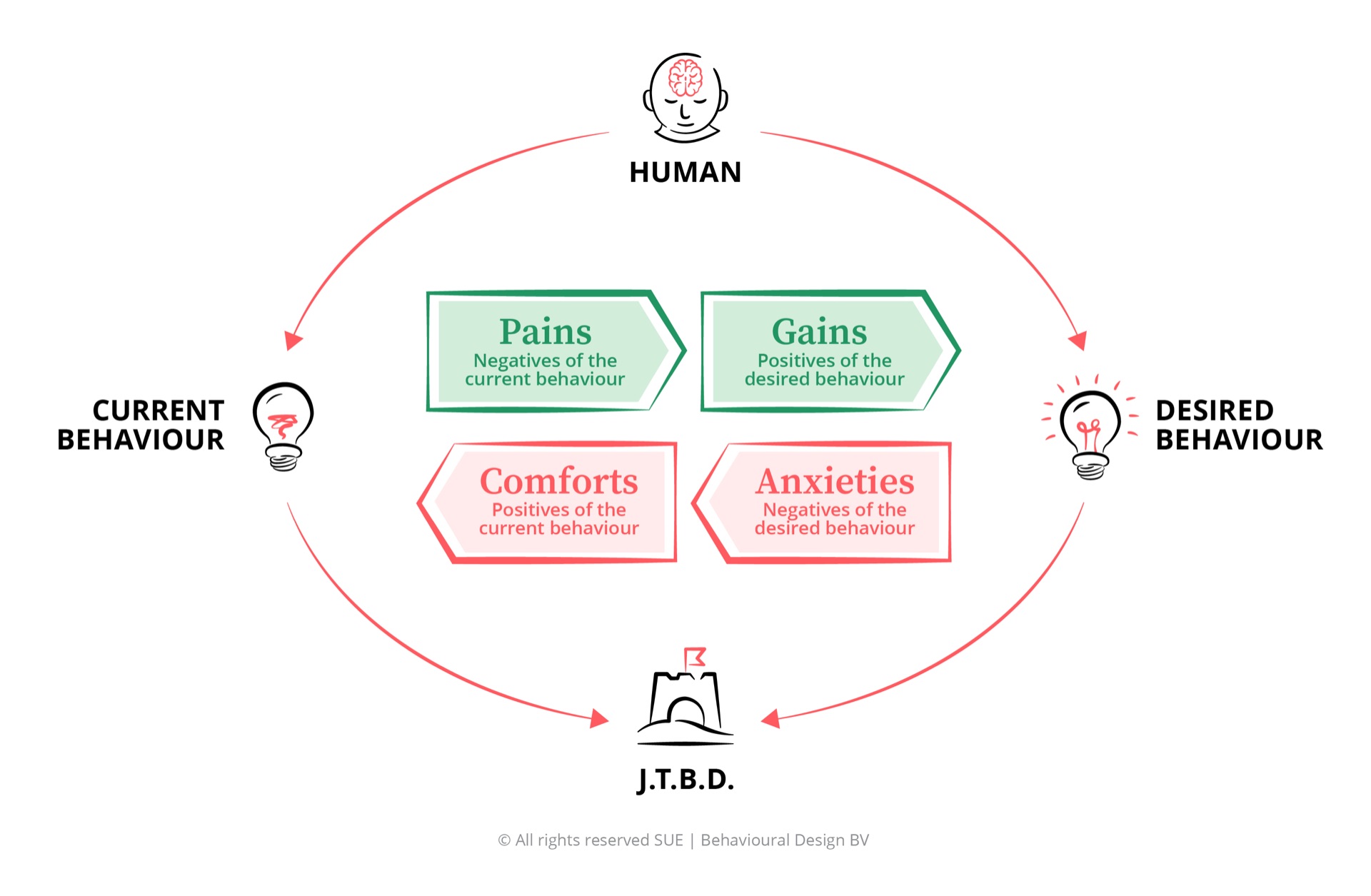
Use the Influence Framework as a diagnostic tool before choosing a technique. Ask the questions: What Pains does my audience have in their current situation? What Anxieties are holding them back from taking the next step? What Comforts make the status quo so appealing? And what Gains are realistic and credible enough to motivate action?
Only then, based on that diagnosis, do you choose the technique. Is the dominant force an Anxiety? Then social proof (others have done this and it went well) works better than loss aversion. Is it a Comfort that needs breaking? Then a commitment device is more effective than framing. The framework transforms influence from art to science.
Ethical influence: when does persuasion become manipulation?
We have touched on this already, but the question deserves a fuller answer: where exactly is the line?
The negative example is dark patterns: designs that deliberately mislead users in the interest of the provider. Fake urgency (“Only 2 left!” when there are 200 in stock), hidden unsubscribe buttons, forced continuity (automatically rolling free trial periods into paid subscriptions without clear warning). These are all forms of manipulation: they influence in the interest of the provider, not the user.
At SUE we apply a clear test: can this influence withstand daylight? Can you explain to your audience what you are doing and why, without damaging trust? If the answer is yes: it is ethical influence. If the answer is no, if you would rather people not know what you are doing, it is manipulation.
Ethical influence can withstand daylight. You can explain what you are doing and why, and it strengthens trust rather than damaging it.
For communication professionals who want to influence ethically, our page for communication professionals offers more tools and training options.
Influence in practice: how to start tomorrow
Theory is valuable, but influence is learned by doing. Here are three steps you can take as of tomorrow.
Step 1: Diagnose first
Before you craft a message, design an intervention, or choose a technique: do the diagnosis. Use the Influence Framework as your lens. What are your audience’s Pains in their current situation? Which Anxieties are holding them back? Which Comforts make the status quo so attractive? And which Gains are credible enough to motivate?
Most influence attempts fail because they skip straight to the technique without doing the diagnosis. They choose social proof because it once worked, or loss aversion because it sounds powerful, without knowing whether that force is dominant in this specific situation.
Step 2: Choose the technique that matches the dominant force
Based on your diagnosis, select the technique that connects to the dominant force. Here are the most effective pairings:
- Anxiety dominates → social proof (others went before you and it worked out) or guarantees that remove uncertainty
- Pain dominates → loss aversion or framing the pain of the current situation versus the relief of the new one
- Comfort dominates → remove friction from the transition, or use a commitment device to make the first step easy
- Gain dominates → anchoring and framing of value, decoy effect to make the desired option more attractive
For marketing and communication professionals who want to apply influence systematically: Behavioural Design for marketing.
Step 3: Apply the transparency test
Before you launch your intervention, apply the transparency test. Ask yourself: would I be willing to explain this to my audience? Would their trust in me be strengthened if they knew what I was doing? If the answer is yes, proceed. If you would prefer to keep it hidden: redesign.
Conclusion: persuasion is science, not innate talent
Influence feels to many people like something intangible, something charismatic people naturally possess and others do not. But behavioural science demonstrates that this is not the case. Persuasion and influence are skills that can be learned, applied systematically, and used ethically.
The key does not lie in better arguments or more data. It lies in understanding: understanding how people actually make decisions, what forces drive their behaviour, and how you can engage those forces in a way that serves their interests.
The SUE Influence Framework gives you that understanding systematically. The six principles give you the tools. And the transparency test ensures you always stay on the right side of the line.
Want to learn to apply influence professionally? In the Behavioural Design Fundamentals, you learn step by step how to use the SUE Influence Framework to analyse behaviour, select the right influence technique, and design effective interventions that are both ethical and measurably effective.