You know you should work on the strategic plan. Instead, you answer three more emails. They feel productive. They feel urgent. They are not. The strategic plan that determines the next two years sits untouched while you optimise your inbox.
That feeling is familiar. Those emails give you an immediate sense of completion. The strategic plan will only give you that feeling weeks from now, if you even make it through. And so without thinking, you choose the emails, day after day, meeting after meeting, quarter after quarter.
This is present bias at work. And it is more dangerous than most people realise, precisely because it feels so natural.
Present bias is the disproportionate preference for rewards that are closer to the present moment over future rewards of equal or greater value. At work, it leads to procrastination on important tasks, technical debt, and the sacrifice of long-term capability for short-term results. The solution lies not in discipline but in precommitment and making future consequences concrete now - using the SUE Influence Framework.
What is present bias?
Present bias is what economists Ted O’Donoghue and Matthew Rabin formally described in 1999: people have a systematically exaggerated preference for rewards that are close to the present moment, and an equally systematic undervaluation of rewards further in the future.[1]
The mechanism behind present bias is called hyperbolic discounting. Standard economic thinking assumes people discount future rewards at a consistent rate per unit of time: the same percentage no matter how far away the reward lies. What people actually do is far messier. The drop in perceived value is steep near the present and quickly flattens out. A reward in one week feels disproportionately less valuable than a reward right now. But a reward in 53 weeks barely feels different from a reward in 52 weeks. The closeness of the present is what drives the distortion, not the absolute time span.[2]
This is a classic System 1 process. The brain does not evaluate future rewards through rational cost-benefit analysis. It uses a fast heuristic: how concrete, how tangible, how near does this feel? Walter Mischel’s marshmallow experiment demonstrated in the 1970s how early this mechanism operates. Children who could receive two marshmallows by waiting systematically chose one marshmallow now. Even when they knew waiting would yield more.
At work, the exact same mechanism plays out. It manifests across three dimensions:
Immediate gratification. Tasks that complete quickly and deliver immediate reward (emails, brief meetings, putting out fires) always beat tasks that only pay off over time (writing strategy, developing people, improving processes).
Procrastination on important work. The more important a task, the more effort it demands, the greater the temptation to defer it. Present bias ensures that the pain of now (tackling the task) outweighs the reward of later (the result) in the brain’s valuation. Tomorrow always feels like a better moment than today.
Short-termism in strategy. Organisations sacrifice long-term investments for short-term results. Training budgets are the first to be cut. Technical debt accumulates. Quarterly numbers dominate decisions over customer relationships that span years.
The problem is not that you do not know what you should be doing. The problem is that “later” always loses to “now”.
Three scenarios where it does the most damage
The training budget that disappears when pressure mounts
The scenario plays out in almost identical fashion in every organisation I know. The quarter is going badly. The CFO asks for cost savings. The list of options circulates around the table. Learning and development budget is the first to go.
The reasoning feels logically airtight. The saving is immediate and concrete: this quarter there is fifty thousand pounds less in training costs. The damage is abstract and distant: employees who are less capable, less adaptive and more likely to leave two years from now. That damage is real but invisible, precisely because it only becomes material later.
This is present bias in its purest organisational form. The immediate reward of a better quarterly balance sheet overwhelms the future cost of a less capable organisation. And nobody at the table feels irresponsible, because the reasoning holds on a short time horizon. Present bias makes the long term literally harder to see.
What makes this systemic? The people making this decision are acting rationally given their time horizon. When success is measured in quarters, cutting long-term investments is the logical call. The bias is not only in the individual but in the structure of how organisations measure, reward and hold people accountable.
The quick fix that ends up costing ten times as much
A software team has found a bug. There are two options. Option A: fix it the right way, address the underlying architecture, three days of work. Option B: implement a workaround that masks the bug, three hours of work, but leaves the root cause in place.
In theory everyone knows Option A is better. In practice, teams under pressure consistently choose Option B. The sprint deadline is Friday. The client expects the release. The immediate reward of “done” beats the future benefit of “done properly”. Technical debt accumulates.
Six months later the codebase has become a network of workarounds. Every new feature takes three times as long to build. Bugs reproduce across systems that were supposed to prevent them. The team that chose the quick fix now feels its consequences every day, but nobody traces the cause back to the decision made six months ago. Present bias does not only obscure the future. It obscures the past as well.
This pattern repeats itself in almost every production environment. It is not a lack of technical understanding. It is a structural problem with how immediate pressure consistently distorts the perception of future cost.
The easy task that replaces the difficult one
An employee has two tasks on her list. Task A: finishing a presentation for the management team on a topic where she still has room to grow. Uncomfortable, demanding, time-consuming, but precisely the work that advances her career. Task B: processing a stack of routine requests already sitting in her inbox. Comfortable, quick, satisfying.
Present bias predicts what happens. Task B gets handled with increasing thoroughness. The inbox empties out. The feeling of productivity is real. Task A gets pushed to tomorrow, then the day after, then next week. When the presentation finally arrives it is rushed, below her best, and has not given her the visibility it could have provided.
This is how people become structurally trapped in work that does not move them forward. They are not lazy. They are not incompetent. They are responding in exactly the same way that every human brain responds when confronted with an immediate reward against a delayed one. The easy work wins. Day after day, year after year.
What is striking is that people often see this themselves. They know they are procrastinating. They know they should be growing. But that awareness does not change the behaviour. Awareness alone is never enough. And that is exactly what the Influence Framework makes visible.
Why Comforts always beat future Gains
When you analyse present bias using the SUE Influence Framework, something fundamental becomes visible: the forces that keep people in their current behaviour are not weak. They are overwhelming.[3]
Pains (what pushes you away from current behaviour): the real costs of present bias are genuine. A stagnating career, accumulating technical debt, organisations slowly becoming less competitive. But these pains are abstract and future-facing. The brain barely registers them when they are not concrete and nearby.
Gains (what pulls you towards different behaviour): the benefits of long-term thinking are also real and sometimes enormous. A stronger organisation in two years, a significant career step, a codebase that operates an order of magnitude faster. But gains far in the future are abstract. They feel theoretical. And abstract rewards always lose to concrete ones.
Comforts (what keeps you in current behaviour): and this is the heart of present bias. The present is concrete. The past has already happened. The future is a story. Immediate rewards feel real and tangible: the email you answer gives you a tick-off moment, the bug you fix quickly gives instant relief, the easy task you clear gives the feeling of productivity. These Comforts are not irrational. They are the normal way the human brain operates.
Anxieties (what stops you from changing): long-term investments come with uncertainty. What if the strategic investment does not work? What if the sustainable solution turns out to be the wrong one? What if I invest time in growth and it yields nothing? The future is uncertain. The present is certain. Anxieties about the uncertainty of the future strengthen the pull of the now.
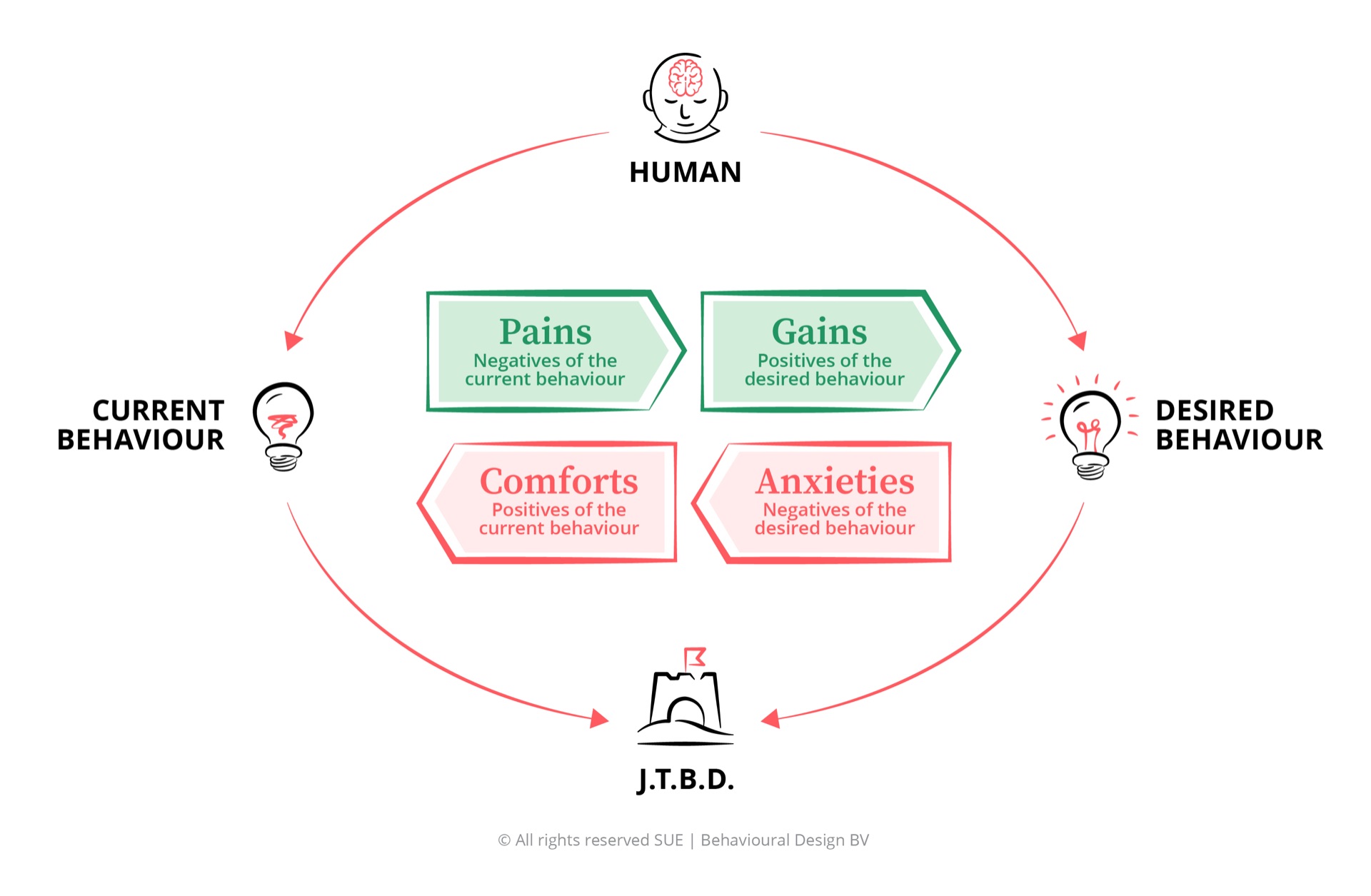
The conclusion is hard but clear: the present does not dominate because people are weak or lack discipline. It dominates because human psychology is built that way. Comforts are direct and tangible. Future Gains are abstract and uncertain. As long as the structure of work and rewards reinforces this, present bias will win.
Five interventions that work
The most effective interventions do not work by convincing people to exercise more discipline. They work by designing environments in which long-term behaviour becomes the easiest option.
1. Precommitment. Lock in future behaviour before the temptation of the present takes hold. Ulysses ordered his sailors to tie him to the mast before he heard the sirens, precisely because he knew his future self would make a bad decision. At work this looks like: block fixed time in your calendar for strategic work before the day fills with meetings. Lock quarterly planning into a format you cannot deviate from without an explicit decision. Set automatic pension contribution percentages that require active effort to change. The goal is not to hope for future behaviour but to secure it now.
2. Organisational-level precommitment. Have teams decide in advance what percentage of sprint capacity goes to technical debt, what budget is ring-fenced for development, which strategic projects are protected from quarterly pressure. Decisions made in advance during a calm moment are far less susceptible to present bias than decisions made under the pressure of the moment.
3. Make future consequences concrete right now. Present bias is a valuation error relative to abstract future outcomes. The intervention: make those future outcomes concrete and vivid. Have the team calculate the technical debt accumulated last year in engineering hours this quarter. Visualise what the organisation looks like in five years if training budgets are cut now. Work out what the quick fix will cost when it needs to be addressed again two iterations later. The moment future costs become concrete, the trade-off changes.
4. Implementation intentions. One of the most robustly supported interventions in behavioural science is the implementation intention: linking a specific situation to a specific desired behaviour in an “If X, then Y” format. “When I arrive on Monday morning, I open the strategic document before I check my inbox.” This moves the decision from the unconscious to the planned. Present bias operates primarily at the moment of choice. Implementation intentions eliminate that moment of choice.
5. Reward restructuring. When an organisation’s reward structure almost exclusively rewards immediate performance (quarterly results, short-term KPIs, visible output), that structure actively amplifies present bias. Add smaller, immediate rewards for long-term-oriented behaviour: recognition for completing a development plan, visibility for consistently reducing technical debt, concrete milestones for strategic projects that pay out over a longer period. The brain responds to nearby rewards. Design reward structures that create that proximity for long-term behaviour.
Related biases
Present bias rarely operates alone. At work it combines with and amplifies other biases in ways that make it particularly hard to diagnose and address.
Decision fatigue reinforces present bias: as the day progresses and decision-making energy depletes, the pull of the easiest option grows stronger. It is no coincidence that strategic decisions made early in the day are on average better than the same decisions made at the end of a long day of meetings.
Status quo bias works in the same direction: the tendency to stick with the familiar reinforces the preference for the immediate. Change requires investment now for gain later. Present bias makes that trade-off systematically unattractive.
Optimism bias makes it worse: people consistently overestimate how quickly and easily they will be able to complete future tasks. That makes procrastination easier to justify. “I can do it in an hour tomorrow” - which is never true, but feels that way.
The sunk cost fallacy interacts with present bias in an interesting way: once invested in a quick solution, the sunk cost fallacy makes it harder to switch to the better long-term solution, even when the cost-benefit case is now clearly in favour of switching.
Frequently asked questions
What is present bias at work?
Present bias is the tendency to weight immediate rewards more heavily than future rewards, even when those future rewards are objectively larger. At work it manifests as procrastination on important tasks, choosing quick fixes over durable solutions, and sacrificing long-term investments for short-term results.
What is the difference between present bias and procrastination?
Procrastination is the behaviour: delaying action. Present bias is the underlying mechanism that causes the behaviour. Present bias explains why people consistently postpone tasks they know they should do. The pain of now (tackling the task) outweighs the reward of later (the result) in the brain’s valuation. Procrastination is the symptom; present bias is the cause.
How does hyperbolic discounting work?
Hyperbolic discounting describes how people discount future rewards not at a constant rate but steeply near the present and shallowly further out. A reward in one year feels far less valuable than the same reward now. But when both rewards are far enough in the future, people choose rationally. The irrationality kicks in the moment one of the options becomes “now”.
Can you overcome present bias?
Not through willpower or awareness. Present bias is a System 1 mechanism deeply embedded in how the brain evaluates future rewards. The most effective interventions work not against the bias but with human psychology: precommitment strategies that lock in future choices, implementation intentions that automate behaviour, and making future consequences concrete and vivid right now.
What is an example of present bias in an organisation?
A common example is the training budget. Under short-term performance pressure, organisations cut learning and development spending first. The saving is immediate and concrete; the damage (a less capable workforce two years from now) is abstract and distant. Present bias makes the future costs invisible and the immediate saving feel overwhelming.
Conclusion
Present bias is not a lack of discipline, not unwillingness, not a failure of insight. It is the normal functioning of a human brain built to survive in a world where the future was uncertain and the present was concrete. That functioning does not fit well in a world where the most valuable investments only pay off over time.
The question is therefore never: how do I make people stronger than their own brain? The question is: how do I design environments and structures that make long-term behaviour the easiest choice? Want to learn how to do that systematically in your own organisation? In the Behavioural Design Fundamentals Course you learn to apply the Influence Framework and the SWAC Tool to diagnose behavioural patterns and design behavioural environments. Rated 9.7 by 5,000+ alumni from 45 countries.
PS
At SUE our mission is to use the superpower of behavioural psychology to help people make positive choices. Present bias may be the most universal enemy of that mission, precisely because it is so invisible. You do not see that you are choosing the present. You experience it as logical, as priority, as productivity. The first step is recognising the pattern in your own calendar. The second step is to stop judging yourself and start designing the environment that protects you from the tyranny of the moment.