Picture this. A colleague helps you push back a deadline. She handles it internally, takes on an extra meeting and gives you the space to finish your work properly. Two weeks later, she asks you for a favour. Something that doesn’t actually suit you. And yet you say yes. Not because you have no choice, not because she demands it, but because you feel you owe her.
You didn’t even consciously think about it. It was just there.
This is the reciprocity principle at work. And it is one of the most powerful behavioural levers we know, precisely because it is so deeply rooted that it feels like common sense. Not manipulation. Not pressure. Social logic.
The reciprocity principle is the deeply wired obligation to return what you receive. Robert Cialdini identified it as one of six universal principles of influence. It operates through System 1: automatic, fast and below conscious awareness. In the SUE Influence Framework it sits firmly in the Gains quadrant: whoever gives first creates a sense of obligation that shapes behaviour in sales, leadership and negotiation.
What is the reciprocity principle?
In 1984, Robert Cialdini published Influence: The Psychology of Persuasion. He described six principles through which people influence other people. Reciprocity topped the list, not because it is the most spectacular principle, but because it is the most universal.[1]
Cialdini made clear that reciprocity is not a choice. It is a norm. Sociologist Alvin Gouldner described it in 1960 as “the norm of reciprocity”: the universal social rule that you must give back what others give you. Gouldner argued this norm exists in every society on earth, regardless of culture, religion or political system. It is so fundamental that it is experienced as a moral obligation, not a rational calculation.[2]
One of the most striking early experiments is Dennis Regan’s from 1971. His participants worked alongside a confederate who, midway through the experiment, spontaneously handed them a bottle of Coca-Cola with no explanation and no strings attached. At the end of the experiment the confederate asked participants to buy raffle tickets. The group that had received the Coca-Cola bought significantly more tickets than the control group. Not because they liked the confederate more, but because they felt they needed to give something back. The value of the gift barely mattered. The sense of obligation did.
Reciprocity operates through three mechanisms, each with its own dynamic in the workplace.
Material reciprocity is the most obvious form: a gift, a free product, a service that has real value. You give something tangible, the other person feels obligated to give something back.
Concession reciprocity is subtler and especially powerful in negotiations: when you step back, the other person feels obligated to step back too. This is the engine behind the door-in-the-face technique, which we will come to shortly.
Emotional reciprocity is the most powerful and most underestimated form: trust invites trust, vulnerability invites openness, respect invites loyalty. Whoever gives something of genuine value first sets a reciprocal movement in motion.
Reciprocity is not a transaction. It is the oldest social code we know.
Three scenarios where it determines the dynamic
Sales: the free sample that creates a purchase obligation
The Hare Krishna movement was among the first to discover this on a large scale, in the 1970s. Members would approach travellers at airports and hand them a flower, a book or a small gift, asking for nothing in return. Only then would they ask for a donation. The tactic worked so effectively that airports eventually introduced regulations to stop it. Not because anyone was coerced. But because people felt so strongly obligated that refusing felt almost impossible.
Costco has built the same principle into one of the most successful retail strategies in the world. Free samples on the shop floor do not only increase sales of the sampled product. They raise the overall revenue of the entire department. People who receive a piece of cheese or a bite of pizza do not feel comfortable simply walking away without buying anything. The obligation is unconscious but real.
In professional sales the same mechanism applies. A free audit, a complimentary consulting session, a white paper that delivers genuine insight. Each of these instruments provides value before the relationship becomes commercial. And each time you do it, you activate the reciprocity response in the potential client. Not consciously. Not as a ledger. But as background noise that says: these people have already done something for me. They deserve my serious attention.
The key is that what you give must have genuine value. A useless freebie does not activate reciprocity; it triggers irritation. But a free session that produces a real insight, or a report that diagnoses a problem the client had not clearly seen, sets the tone for a relationship built on trust and felt obligation.
Leadership: give trust first, get commitment back
I see it repeatedly in the organisations I work with. A manager who micro-manages their team, who controls every decision, who communicates distrust through every email and every meeting, gets a very specific type of employee back. Someone who does what is asked. Nothing more. Someone who works nine to five and closes their laptop at five o’clock precisely. Compliance, not commitment.
That too is reciprocity. Just in the wrong direction.
The manager who deliberately gives trust first, who offers autonomy before results are visible, who shows vulnerability in a meeting, who publicly credits a team member for work the manager could have claimed, activates an entirely different dynamic. Their team does not give because it has to. It gives because it feels that something was given that is worth giving back.
Adam Grant explored this mechanism in depth in Give and Take. Organisations that cultivate a culture of giving consistently outperform organisations that run on transactions and control over the long term. Not as a moral claim, but as an empirical finding. Reciprocity scales. When a leader gives, their team gives. When a team gives, the organisation gives. And organisations that give attract people who want to give.
This is also why onboarding matters so much. A new employee who is welcomed warmly, equipped properly, given genuine attention from their manager and made to feel genuinely wanted, experiences reciprocity in their very first week. The felt sense of “this company has invested in me” operates as an anchor that motivates the employee months and years later. A five-minute tour and a stack of forms communicates something very different.
Negotiation: the door-in-the-face technique
This is the most tactical application of reciprocity, and also the most abused. The logic is simple. You open a negotiation with a request so large that the other party will almost certainly refuse. A budget far beyond what is reasonable. A timeline nobody can meet. A set of demands that are impossible to accept.
The other person says no.
Then you step back. You ask for less. Something that is actually quite reasonable. And at that moment something fascinating happens. The other person registers that you have made a concession. You have moved from your original position. And through concession reciprocity, they feel obligated to concede something too. Compliance with your second request is significantly higher than if you had made that same second request directly, without the build-up.
Cialdini documented this in his research and showed that the door-in-the-face technique can nearly double compliance in certain contexts. Not because the other person is misled about what is being asked. But because the sense of reciprocity is powerful enough to colour their judgement.
The tactical lesson for negotiators: never open with your real offer. Make sure you have room to make a concession the other person experiences as meaningful. And give that concession deliberately, visibly and graciously, so the reciprocity response is as strong as possible.
Gains dominate: reciprocity as a deliberate tool
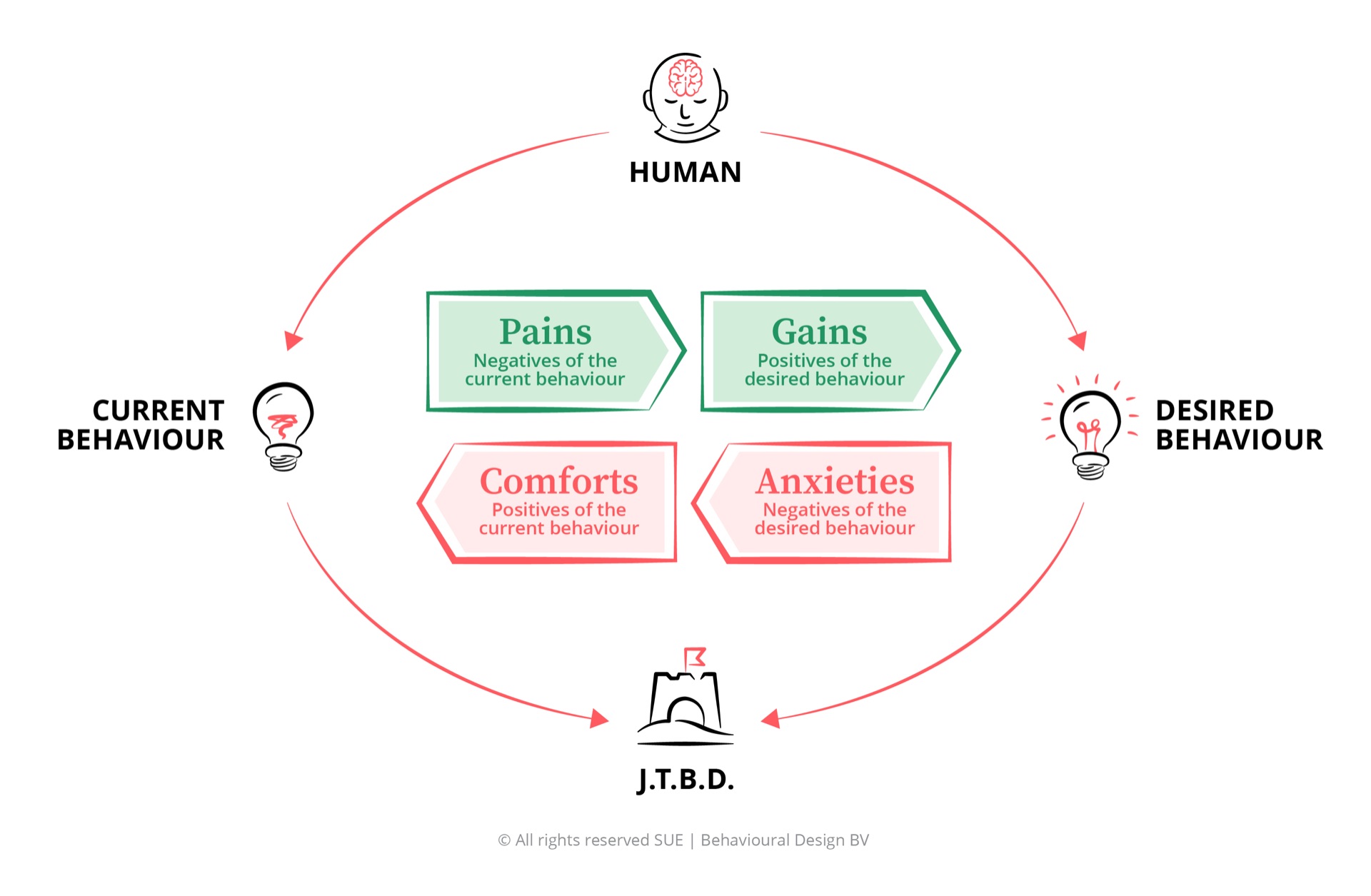
When you analyse the reciprocity principle through the SUE Influence Framework, something striking emerges. This is one of the few behavioural principles where the Gains are so strong that they dominate all other forces.
Pains (what pushes you away from current behaviour): the cost of not giving. Organisations that never give anything without an immediate return find that relationships stay shallow, trust builds slowly and clients switch to cheaper competitors the moment one appears. The pain of transactional behaviour is real but arrives late.
Gains (what pulls you toward new behaviour): and here the reciprocity principle is unique. The gains are immediate, concrete and measurable. Whoever gives first immediately creates a sense of obligation. Not months from now. Now. This is why reciprocity is so effective as a behavioural tool: it delivers results in real time.
Comforts (what keeps you in current behaviour): many organisations are accustomed to a transactional model. Sign the contract, then deliver the value. That feels familiar and safe. It takes courage to step away from that model and begin giving without the guarantee of return.
Anxieties (what stops you from changing): the fear of being taken advantage of. That people will take the free sample and never buy. That the complimentary consulting session will generate no contract. This is a genuine concern, but research consistently shows that the conversion rates produced by reciprocity-based strategies more than compensate for the fear of misuse.
The reciprocity principle is a TOOL. Not an accident, not a social vulnerability to defend against, but an instrument you can deploy deliberately and strategically. The question is not whether reciprocity works. It does, always. The question is whether you are willing to give first.
Five interventions to use reciprocity strategically
1. Give before you ask, always. This is the foundational rule. In sales: deliver insight before you send a proposal. In leadership: acknowledge a performance before you ask for extra effort. In negotiation: make a concession before you state your real need. The sequence changes everything.
2. Create value before you request commitment. The most powerful lead magnets are not the cheapest ones, but the most valuable. A free audit that diagnoses three concrete problems is more powerful than a white paper nobody reads. Give something that genuinely helps the other person, and the reciprocity response is proportionately stronger.
3. Build reciprocity into your onboarding. The first days of a new employee’s tenure are the moment when the reciprocity dynamic is strongest and most sensitive. Invest disproportionately in that first week: attention, warmth, resources. Give more than expected. The sense of “this company has genuinely invested in me” operates as an anchor that motivates the employee months and years later.
4. Master the concession strategy. In every negotiation: open above your target, make concessions deliberately and visibly, and thank the other person for their flexibility when they concede too. Each of these steps reinforces the reciprocity dynamic. The other person registers that you have given. They want to give in return. Both parties leave the table feeling the outcome was fair.
5. Distinguish authentic from manipulative reciprocity. This is the ethical line every professional needs to know. Authentic reciprocity gives value because the other person benefits, and accepts that they may not give back. Manipulative reciprocity gives value as an instrument to create a sense of obligation the other person would not consciously accept. The test is simple: would the other person want the gift if they knew what you expected in return? If the answer is no, you have already crossed the line.
Reciprocity in combination with other behavioural principles
Reciprocity rarely operates in isolation. In the workplace it reinforces other behavioural principles in ways that amplify the total influence effect.
Social proof and reciprocity reinforce each other in sales. When a potential client sees that others have accepted your free offer and speak positively about it, the threshold for accepting it themselves drops. And once accepted, the reciprocity response activates.
The scarcity principle amplifies the perceived value of what you give. When the free offer has limited availability, it is experienced as more valuable, and the reciprocity response on acceptance is stronger. An “exclusive invitation for the first ten clients” combines scarcity and reciprocity in a single move.
Anchoring is the silent force behind the door-in-the-face technique. The extreme opening request works as an anchor that shifts the other person’s reference frame. Within that frame, the concession toward the reasonable request feels all the larger, which strengthens the reciprocity response.
The framing effect determines how the gift is experienced. The same free consulting session, framed as “a quick introductory call” or as “a complimentary strategy session worth £500”, produces a very different reciprocity response. Framing determines perceived value, and perceived value determines the strength of the felt obligation.
Frequently asked questions
What is the reciprocity principle?
The reciprocity principle is the deeply wired social norm to return what you have received. Robert Cialdini identified it as one of six universal principles of influence. It operates through System 1: automatic, fast and below conscious awareness. When someone gives, they create a sense of obligation in the recipient, whether that was the intention or not.
How does reciprocity work in sales?
In sales, reciprocity works by delivering value before asking for anything in return. Think free samples, no-cost audits, complimentary strategy sessions or genuinely useful content. The recipient unconsciously feels obligated to give something back, which significantly lowers the barrier to a purchasing decision. Costco built an entire business model on this.
What is the door-in-the-face technique?
The door-in-the-face technique is a negotiation strategy based on concession reciprocity. You open with an extreme request that will almost certainly be refused. When the other person says no, you step back to a reasonable request. That step back feels like a concession, and the other person feels obligated to concede something too. Cialdini’s research showed this nearly doubles compliance.
When does reciprocity become manipulative?
Reciprocity becomes manipulative when you give something with the explicit intention of creating a sense of obligation the other person would not accept if they understood it. The ethical test: would the other person want the gift if they knew what you expected in return? Authentic reciprocity gives value because the other person benefits. Manipulative reciprocity gives value as an instrument.
How do you use reciprocity as a leader?
Leaders who give trust before they ask for trust activate reciprocity at team level. Give autonomy, recognise performance proactively, offer development opportunities without conditions. Micro-managing backfires: it communicates distrust, which triggers distrust in return. Compliance, not commitment.
Conclusion
The reciprocity principle may be the most useful behavioural insight in existence. Not because it lets you manipulate others, but because it forces you to place giving before asking. And whoever does that consistently builds something no contract can enforce: trust, loyalty and a genuine desire to give back. Want to learn how to apply this and other behavioural principles strategically? In the Behavioural Design Fundamentals Course you learn to apply the Influence Framework to analyse behaviour and design influence strategies that actually work. Rated 9.7/10 by 5,000+ alumni from 45 countries.
PS
At SUE our mission is to use the superpower of behavioural psychology to help people make positive choices. Reciprocity fits that mission perfectly, because it shows that the most powerful influence starts with giving, not asking. The Hare Krishnas knew it. Cialdini proved it. And every leader, sales professional and negotiator who applies it seriously experiences it. Whoever gives first, wins. Always.