Imagine starting a new job. Your contract says the working hours are nine to five. But in your first week you notice that everyone is still at their desk at six in the evening. Nobody told you this. Nobody made it a requirement. And yet within a week you know exactly what is expected of you.
This is social norms at work. Unwritten rules that are stronger than written rules, precisely because they are enforced by something far more powerful than management: the social environment itself.
Social norms are unwritten rules about how people are expected to behave in particular situations. They come in two forms: descriptive norms (what people actually do) and injunctive norms (what people ought to do). Both drive behaviour, but through different mechanisms. The SUE Influence Framework helps you identify which type of norm dominates your behavioural challenge - and how to address it effectively.
What are social norms?
The definition I find most useful in practice comes from Robert Cialdini: social norms are the information people use to determine the correct course of action in a given situation. They function as a cognitive shortcut. Instead of analysing every behavioural dilemma from scratch, people look around: what are others doing? What is expected here?[1]
That sounds simple, but the implications are far-reaching. It means behaviour is not determined solely by individual preferences, knowledge or values. It is largely determined by the social context. And that social context can be designed.
Cialdini distinguishes two types of norms that work fundamentally differently:
Descriptive norms describe what people actually do. “Most guests in this hotel reuse their towels.” “Eighty per cent of taxpayers in your area pay on time.” The implicit message: this is what normal looks like. And because people want to behave normally, these norms drive behaviour without any explicit appeal to values or rules.
Injunctive norms describe what people ought to do. “Do not litter.” “Be on time.” “Pay your taxes.” They are about approval and disapproval: what is viewed positively by the social environment, what is viewed negatively. They appeal to moral intuitions, not to descriptive reality.
Social norms are stronger than rules, precisely because they are enforced by something more powerful than management: the social environment itself.
The towel experiment that changed everything
In 2008, Goldstein, Cialdini and Griskevicius published a study that permanently changed the basic logic of norm messaging.[2] They tested which message in hotel rooms most prompted guests to reuse their towel. The standard message was an environmental appeal: reuse your towel because it is good for the planet. Effective, but not remarkable.
The social norm message was different: “Most guests in this hotel reuse their towels during their stay.” That message activated a descriptive norm and led to significantly more reuse. But the most interesting finding was this: the message “Most guests in this room reuse their towel” worked even better. The closer the reference group was to the chooser, the stronger the norm effect.
This is a crucial lesson for anyone trying to change behaviour. The norm does not work in the abstract. It works through relevance. “People” is too vague. “People like you” is what counts.
Opower and the boomerang effect: the trap of being too honest
The energy company Opower sent millions of people a report comparing their energy use to their neighbours’. “You use 15 per cent more energy than comparable households in your area.” The result for people above the norm: they reduced their energy use. Social norm in action.
But Opower discovered an unexpected problem. For people who were already more energy-efficient than their neighbours - the early adopters, the sustainability leaders - the message backfired. “You use 20 per cent less energy than your neighbours.” And what did those people do? They increased their energy use. They adjusted their behaviour toward the norm, in the wrong direction. This is the boomerang effect: a norm intervention that discourages the very people you wanted to reward.
Opower’s solution was elegant: for people who were already performing above the norm, they added a small approving smiley face to the message. A modest injunctive norm - this is good, you are approved - combined with the descriptive. The boomerang effect disappeared almost entirely. The lesson: when you use descriptive norms, you must account for those who sit above the norm. For them, you need an injunctive addition.
Three examples of social norms at work
Meeting culture: the invisible time rule
In most organisations the social norm around meetings is stronger than any formal policy. If the unwritten rule is that meetings always overrun, meetings always overrun - regardless of what the meeting protocol says. If the norm is that everyone must attend every meeting, even when their contribution is marginal, everyone sits there.
The way to change this norm is not to introduce a new rule. It is to make the new behaviour visibly the norm. When a leader consistently starts on time, consistently ends on time and consistently allows people to be absent when they add no value, the descriptive norm changes. The newly visible norm - punctuality is normal, absence is acceptable - becomes the new standard.
Email response time: the expectation nobody ever stated
In many organisations the unwritten norm is that emails must be answered within a few hours, including outside working hours. Nobody decided this. Nobody wrote it into policy. But when a manager sends emails at ten in the evening and expects a reply, the norm is installed.
Descriptive norm: “Here people reply to emails outside working hours.” Injunctive norm: “If you do not, you are not committed.” Both norms operate simultaneously, neither was ever spoken aloud, and together they create a culture of constant availability that nobody consciously chose.
Overtime as norm: the trap of visible hard work
One of the most persistent social norms in many organisations is the norm around overworking. When the people with the highest status - partners, senior managers, the most respected colleagues - are the last to leave the office, that installs a descriptive norm: successful people work long hours. And an injunctive norm: if you leave early, you are less serious.
Research consistently shows that overworking beyond a certain point reduces rather than increases productivity. But that is irrelevant when the social norm says otherwise. The only way to break this norm is through the people whose behaviour defines it: when senior people consistently and visibly leave on time, the descriptive norm changes. Not as an occasional exception, but as a structural pattern.
The Influence Framework and social norms
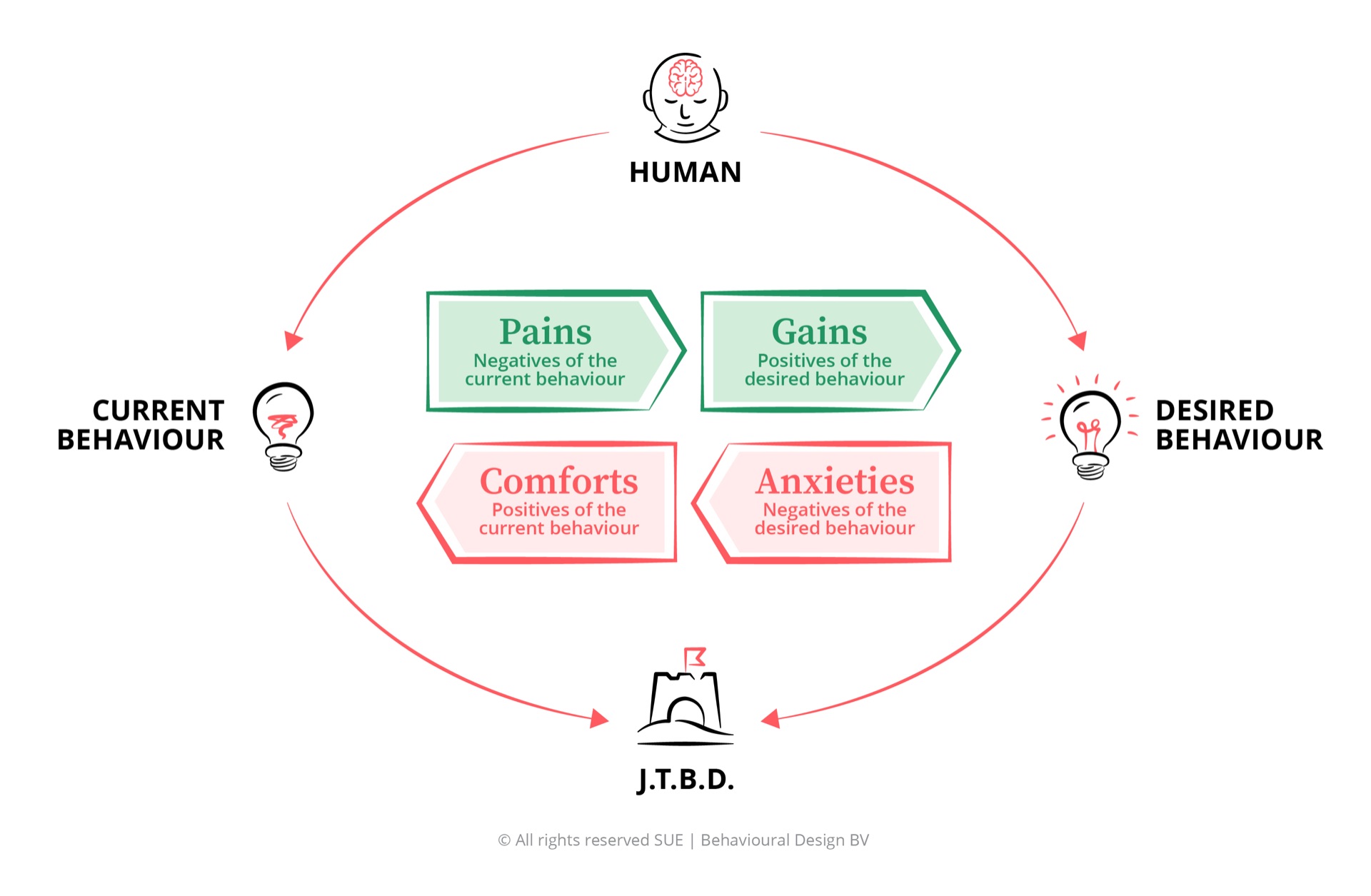
When you analyse social norms through the SUE Influence Framework, you immediately see where their power comes from - and where the pitfalls lie.
Pains: the pain of norm violation is social and immediate. Whoever breaks the norm feels it straight away: exclusion, implicit disapproval, the sense of not belonging. That pain is more powerful than abstract fines or distant health risks.
Gains: norm conformity delivers social acceptance, approval and the feeling of belonging to the group. These are immediate, concrete rewards. They compete successfully with the long-term benefits of different behaviour.
Comforts: norm-conforming behaviour is cognitively cheap. You do not have to think about what the right choice is; the norm thinks for you. This is precisely why norms are so persistent: they reduce cognitive load.
Anxieties: breaking the norm is risky. You do not know exactly what the consequences will be. Will your colleague look at you oddly? Will your manager take you less seriously? That uncertainty keeps people locked in norm-conforming behaviour, even when they would personally prefer to do things differently.
This means the most effective norm interventions do not work through information or argument, but through changing the social reality that people perceive. If you want people to eat more healthily, make healthy eating visibly the norm in your environment. If you want people to go home on time, make sure senior people visibly do that first.
Frequently asked questions
What is the difference between descriptive and injunctive norms?
Descriptive norms describe what people actually do: “most colleagues eat lunch at their desk”. Injunctive norms describe what people ought to do: “you should take a proper lunch break”. Cialdini found that both types drive behaviour but do not always point in the same direction and can even work against each other.
What is the boomerang effect in social norm interventions?
The boomerang effect occurs when you inform people that their behaviour is already better than the norm, and they subsequently adjust their behaviour toward the norm rather than maintaining or improving it. Opower resolved this by adding an approving signal to messages for people who were already frugal, combining the descriptive norm with an injunctive endorsement.
How do social norms operate in the workplace?
In the workplace, social norms determine what counts as normal: when you reply to emails, whether you work overtime, how long meetings run, whether you voice feedback or swallow it. These norms are often invisible until you violate one. New employees learn them rapidly through observation, not through the employee handbook.
Can you deliberately change social norms?
Yes, but only if you understand which type of norm you are targeting. You change descriptive norms by making visible what people actually do. You change injunctive norms by showing what is valued and rewarded. Effective norm interventions combine both: show the desired behaviour as frequent and as approved.
What is Cialdini's towel experiment?
Goldstein, Cialdini and Griskevicius tested in 2008 which message most prompted hotel guests to reuse their towels. “Most guests in this hotel reuse their towel” (descriptive norm) outperformed the standard environmental message. “Most guests in this room” worked even better, because the reference group was closer to the chooser.
Conclusion
Social norms explain more human behaviour than we find comfortable to admit. Most of our choices are not choices: they are norm conformities that we experience as choices. That is not a weakness - it is an efficient adaptation to a social world. But it has direct implications for anyone who wants to change behaviour. You cannot only address the individual chooser. You must address the social environment. Want to learn how? The Behavioural Design Fundamentals Course gives you the toolkit. Rated 9.7 out of 10 by more than 10,000 professionals.
PS
The most underappreciated implication of social norm research is the responsibility it places on leaders. If you are the person whose behaviour defines the norm in your team or organisation, you are already a choice architect, whether you want to be or not. The question is only whether you are doing it deliberately. Every email you send in the evening, every hour you stay at the office when others leave, every moment you hold back feedback rather than give it - all of them install norms. Conscious leadership begins with understanding that normative power of your own behaviour.